
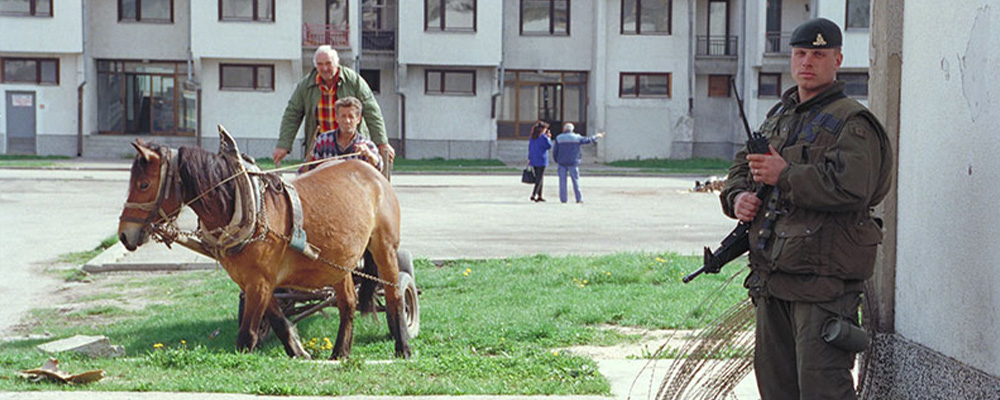
Order of events
1991
Violence erupts as communist government of Yugoslavia collapses
September 1991
Canadian Armed Forces (CAF) peacekeepers join European Community Monitoring Mission in the Balkans
Early 1992
United Nations Protection Force begin operations in the Balkans
15-16 September 1993
CAF members see heavy action in the Medak Pocket of Croatia
December 1995
North Atlantic Treaty Organization (NATO) launches its Implementation Force in Bosnia-Herzegovina
December 1996
NATO launches its Stabilization Force peace support efforts in Bosnia-Herzegovina
1999
Canadian pilots fly combat missions over Kosovo. Kosovo Force begins its mission there
2004
Last large CAF contingent leaves the Balkans but Canadian peacekeepers remain
Balkans
1991 – present

A war-torn land
(June 1991 – July 1992)
After the breakup of Yugoslavia, the international community began peace support missions in the war-torn Balkans. Canada played a major role.
Yugoslavia
The nation of Yugoslavia emerged after the First World War which collapsed the Austro-Hungarian Empire. Some of the Slavic states in the Balkan Peninsula merged to form the new country of Yugoslavia. Its diverse population had various ethnic and religious groups with a long history of tense relationships. Yugoslavia faced hardships during the Second World War and battled occupation for years. After the Axis forces were finally forced out, Yugoslavia was reborn as a communist state.
Weakening of communism
In the 1980s, Yugoslavia's communist rule began to weaken. President-for-Life Josip Broz (better known as Tito) died in 1980. This was a serious blow to the country's unity. As economic conditions worsened, the strength of communism around the world weakened. Meanwhile, old rivalries between the different peoples of Yugoslavia were growing.
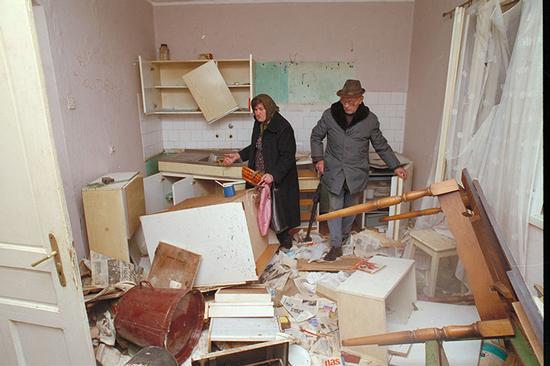
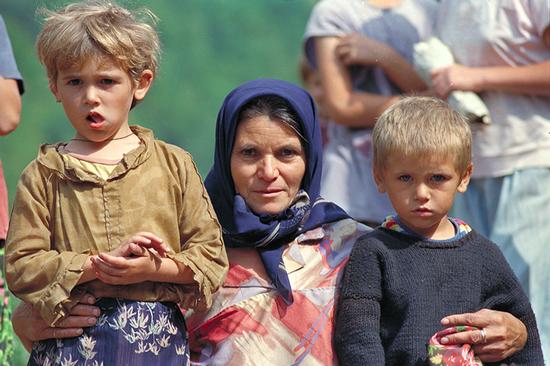
An elderly Serbian refugee couple search for a few personal effects in their destroyed home. Photo: Department of National Defence
Breakup of Yugoslavia
Yugoslavia's central government lost its ability to keep the country together. The states that made up Yugoslavia pushed to become their own countries. Tensions between ethnic and religious groups began to escalate. Slovenia and Croatia declared their independence in June 1991. Civil war soon spread across the Balkans.
The world responds
The outbreak of fighting brought an international reaction. Slovenia and military forces in the rest of Yugoslavia fought a brief war in the summer of 1991. To help enforce a ceasefire, the European Community Monitoring Mission was set up. CAF officers joined this multinational peace support effort in September 1991.
The United Nations Protection Force
Fighting erupted in Croatia and Bosnia-Herzegovina. In early 1992, the United Nations Protection Force (UNPROFOR) formed. It protected the civilians within three special “UN Protected Areas” in Croatia and kept other military forces out. By the time the original mandate of UNPROFOR came to an end in 1995, its mission had extended into the wider region. Peacekeepers from dozens of countries, including Canada, served in this effort.
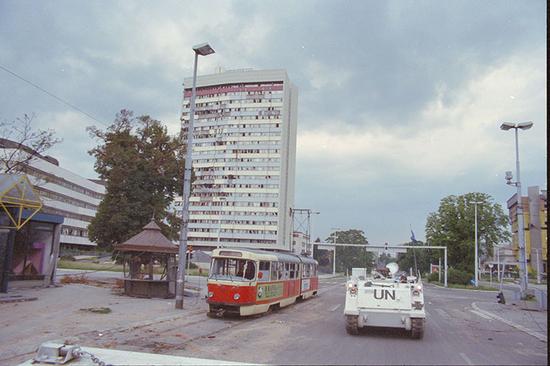
Sarajevo. A Canadian Armored Personnel Carrier drives through the well known "Sniper Alley." Photo: Department of National Defence
Canada's role
Canada played an important role in UNPROFOR efforts. Canadian soldiers went to the Balkans as a peacekeeping force. But they soon found out that there was often very little “peace” to “keep”. Many CAF members came under fire during the UN efforts there.
Intense duties in Sarajevo
In the spring of 1992, fighting escalated in Bosnia-Herzegovina. UNPROFOR moved troops into that area. Their goal was to help the civilians trapped by the fighting and deliver humanitarian aid. A major part of the operation was to open the airport in Sarajevo so supplies could be flown in. In July 1992, as Canadian peacekeepers protected the airport and escorted relief convoys, they often came under fire.
Canada's Major-General Lewis MacKenzie commanded the United Nations (UN) forces in the Sarajevo Sector. He often made international news as he did his best to let the world know the harsh reality there. In the end, our peacekeeping efforts helped keep the vital flow of outside help coming in.

The Medak Pocket
(15 – 16 September 1993)
Tasked with protecting civilians in Croatia, Canadian Armed Forces members came under heavy fire.
A fragile peace
Despite the efforts of UNPROFOR, peace remained elusive in the Balkans in the early years of the mission. Croatia and neighbouring Bosnia-Herzegovina saw particularly bitter violence. They sniped, fired shells and carried out small-scale attacks against one another. In the summer of 1993, much of the shelling by Serb forces against the Croatian Army originated from high ground near Medak, Croatia.
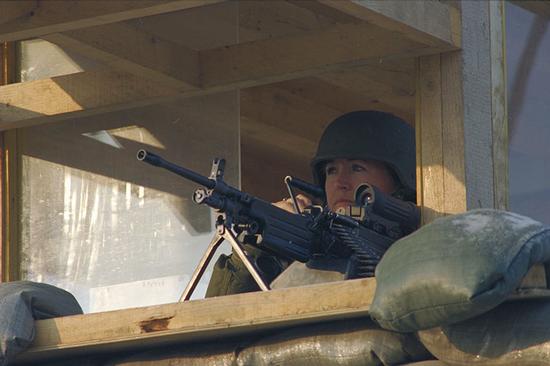
UN Duty in Bosnia. Photo: Department of National Defence
Arranging a ceasefire
On 9 September 1993, Croatian forces began an offensive to take that position. After several days of intense fighting, a ceasefire agreement was arranged. It required all warring forces to pull out of the so-called Medak Pocket the Croatian Army had taken during its offensive.
On 15 September 1993, UNPROFOR sent hundreds of soldiers from the 2nd Battalion Princess Patricia’s Canadian Light Infantry, supported by troops from France, to oversee the withdrawal. The Croatian forces had other plans and the Canadians came under heavy machine gun and artillery fire.
Standing up for peace
The Canadians didn’t back down. They built a fortified position to withstand the shelling, return fire, and beat back night assaults by the Croatian infantry. The next day an impromptu news conference by Canadian commander, Lieutenant-Colonel James Calvin, pressured Croatians to relent and the Canadians finally advanced into the Medak Pocket.
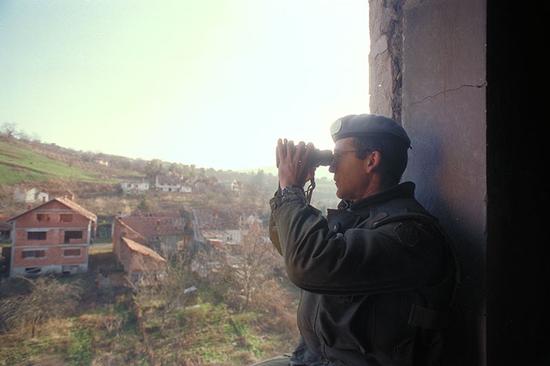
Members of PPCLI keep watch for any dangerous movement in the area. Photo: Department of National Defence
Aftermath
Four Canadian soldiers were wounded in the fighting. Sadly the UN found evidence of ethnic cleansing of Serbian residents by Croatian forces in the Medak Pocket, but their arrival had stopped additional killing.
The Battle of Medak Pocket is considered by many to be the toughest action faced by our soldiers in the period between the conflicts in Korea and Afghanistan. In recognition of this, then-Governor General Adrienne Clarkson bestowed the Commander-in-Chief Unit Commendation on the 2nd Battalion Princess Patricia’s Canadian Light Infantry in 2002.
Further UNPROFOR contributions in the Balkans
Thousands of Canadian Armed Forces members would take part in UNPROFOR efforts. Almost every Canadian infantry battalion and armoured regiment spent time in the Balkans. CAF members played many other important roles during their time with the UNPROFOR. Our service members supplied military engineering, mine clearance, logistical support, electronic warfare and air control capabilities. Canadian warships patrolled the Adriatic Sea to help the UN block arms shipments to the region. Canadian aircraft enforced the UN's no-fly zones and prevented the warring sides from buying weapons.
Through it all, Canadian peacekeepers helped the local people a lot in a variety of ways. For example, they protected humanitarian aid convoys and hospital patients. They also volunteered time and money to donate school supplies and fix damaged buildings.

NATO efforts in the Balkans
March 1999 – April 2004
Canadian Armed Forces warplanes took part in NATO air strikes in Kosovo. They saw some of their heaviest action since the Korean War.
North Atlantic Treaty Organization takes over
The original mandate for UNPROFOR ended in the spring of 1995. Three different multinational forces took over its roles in the Balkans. Two were in Macedonia and Croatia. A restructured UNPROFOR continued in Bosnia and Herzegovina. By December, the North Atlantic Treaty Organization (NATO) had taken over most of the peace support duties in the region. CAF members continued to serve in the Balkans, but now it would be as part of a new NATO mission.
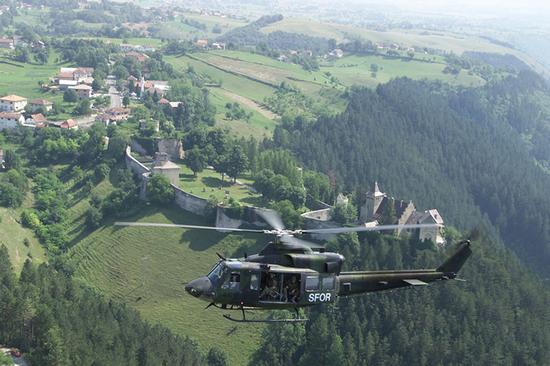
A CH-146 Griffon Helicopter from 408 Tactical Helicopter Squadron, CFB Edmonton, flies a mission carrying the Quick Reaction Force past the ruins of an old castle near Velika Kladusa, Bosnia and Herzegovina. Photo: Department of National Defence
NATO Implementation Force
The Dayton Peace Accord of December 1995 laid out the terms to end the fighting in Bosnia and Herzegovina. A multinational peace Implementation Force patrolled the ceasefire lines and other borders. It helped keep citizens safe, assist local police forces and monitor elections. The Implementation Force also helped refugees return and rebuild the economy.
More than 1,000 CAF members served with the Implementation Force in many roles. This included a headquarters group, a reconnaissance squadron, a mechanized infantry company, an engineer squadron, and command and support elements.
NATO Stabilization Force
The Stabilization Force was the next phase of NATO peace support efforts in Bosnia-Herzegovina. Formed in December 1996, it saw multinational peace support troops patrol the country. It helped establish lasting peace in the war-torn land. Its goal was to help set up a democratic nation that would sustain the peace process without help from multinational peace support forces. Some 1,200 CAF members would serve with the Stabilization Force.
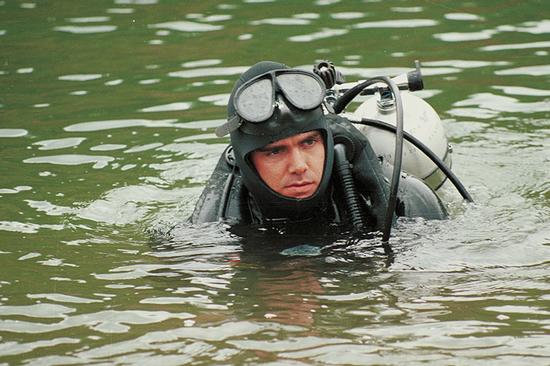
Canadian Armed Forces diver in Zgon, Bosnia and Herzegovina. Photo: Department of National Defence
Unrest in Kosovo
In 1998, the Serbian military and the local Albanians began fighting in Kosovo. Despite attempts by NATO to enforce peace, the violence continued. The Serbian military repeatedly attacked civilian Albanian residents in Kosovo. NATO threatened military action against the Serbians if a lasting ceasefire was not signed. When negotiations failed, NATO forces began an air campaign.
Operation Allied Force
Operation Allied Force was the code name given to the NATO bombing campaign in Kosovo. Its goal was to drive the Serbian military out of Kosovo. In March 1999, Canada committed six CF-18 jets—a number that grew to 18 by the end of the mission. Canadian warplanes made up 10% of the missions flown in Kosovo.
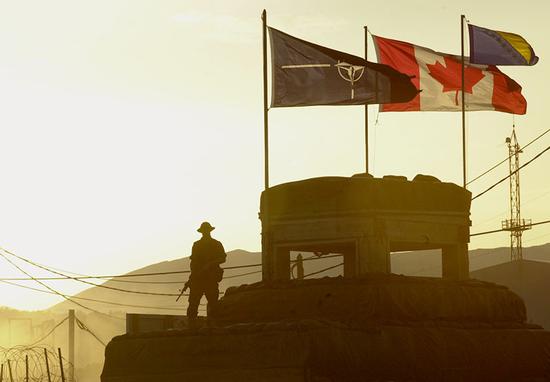
Standing atop the Camp Normandy main entrance in Tomislavgrad, Bosnia and Herzegovina, Private Anthony Gruppuso of the Toronto Scottish Regiment takes the sunset watch. Photo: Department of National Defence
Ceasefire
The NATO bombing campaign did a lot of damage and took a toll on the Serbian forces in Kosovo. With its plans to end the bombing, NATO deployed ground forces to Kosovo and nearby Macedonia. In June, Serbian forces accepted a ceasefire agreement and NATO's Kosovo Force rolled in.
Canada's role in the Kosovo Force
Canada initially dedicated roughly 800 peace support troops to the Kosovo Force, and soon added 500. Canadians helped maintain the fragile peace, protected civilians and provided reconnaissance support. The CAF deployed an armoured reconnaissance squadron, a tactical helicopter squadron, a field engineer squadron, an infantry battle group, and command and logistical supports elements.
They led patrols and monitored activities. Our soldiers also carried out many humanitarian aid projects in Kosovo. They rebuilt damaged schools and medical facilities. They installed small bridges and put up playgrounds for local children.
In December 1999, the first Canadians to serve in the Kosovo Force rotated out. By June 2000, most of the Canadian military personnel had left.
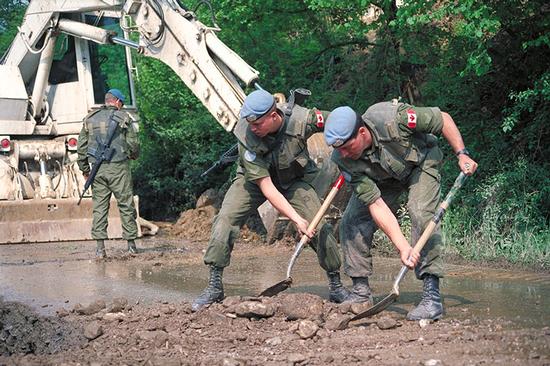
Corporals Rob Serjeant (left) and Rob Majore (right) clear debris from the road near Kiseljak, Bosnia and Herzegovina. Sergeant Pat Gear in the background supervises some work of the Drott excavator. Photo: Department of National Defence
On the road to peace
By December 2003, the situation in Bosnia had improved. NATO reduced the size of the Kosovo Force and the Canadian contingent dropped to about 650 people by April 2004. The European Union Force led the multinational peace support troops in late 2004. As the mission evolved into this new form, the number of CAF members in the country reduced to less than 85.
A Liaison and Observation Team led Canada's role with the European Union Force. These troops kept in close contact with local authorities, police departments, community leaders and army units. They helped develop a peaceful society, collect illegal weapons and prevent smuggling. As a lasting peace took root, the CAF withdrew its last troops from Bosnia and Herzegovina in 2007.
A handful of CAF members are still serving in the Balkans today. The region has recovered since the devastating civil wars that swept through the former country of Yugoslavia in the early 1990s. Almost 40,000 Canadian peacekeepers served there over the years. They played a major role in helping achieve this hard-won security and stability.
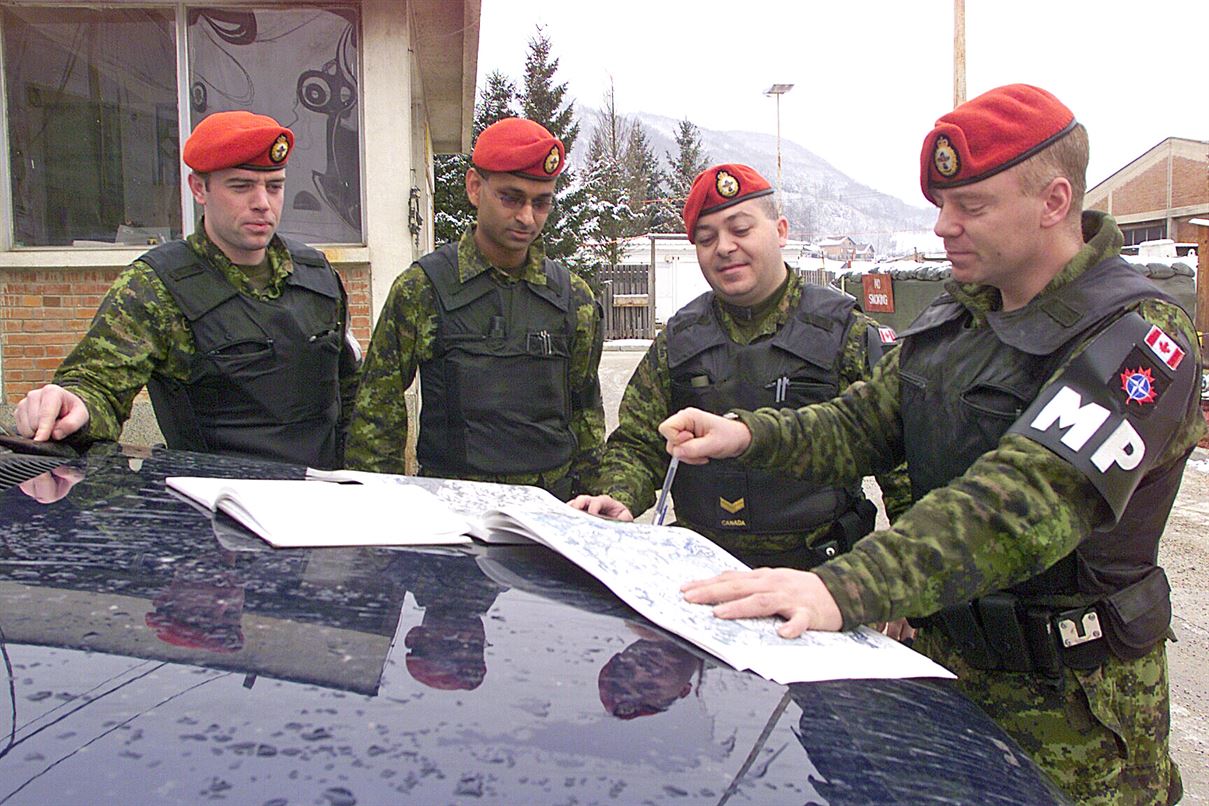
Canadian Armed Forces military policemen preparing for patrols in Zgon, Bosnia-Herzegovina. (Photo: Master Corporal Bernie Tessier. Department of National Defence ZN2004-003-003)
Sacrifice
Canadians can be proud of our country's reputation around the world as a force for peace, but this comes at a price. About 130 Canadians have died in the course of international peace support operations. In the Balkans, 23 of our service members died and many more were injured.
The wounds of peacekeeping are not always caused by hostile fire, land mines or accidents. Sometimes the scars of service are psychological. Canada's military efforts in the Balkans were particularly difficult for our soldiers. The war crimes and atrocities committed against the civilian population there were horrific. Witnessing such human brutality often has a deep impact on those who see it.
Photo Gallery

Petty Officer 2nd Class Spike Bullen inspects some refueling hoses aboard HMCS Protecteur. October 10, 1990. Photo: Department of National Defence ISC91-4083
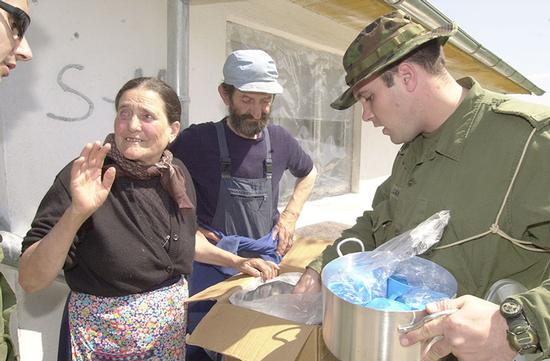
Master Corporal Logan, with the help of a translator, is delivering humanitarian goods such as flour and some pots to cook with to some elderly returnees to the Glamoc area. Photo: Department of National Defence
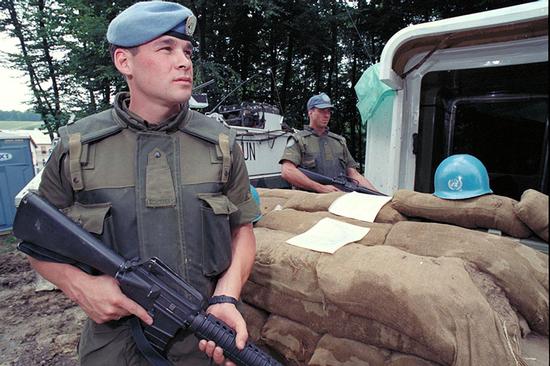
Les Caporaux Darrell Houle et Daniel Proulx, signaleurs canadiens, montant la garde devant la porte principale du Camp Polom en Croatie. Photo : Ministère de la Défense nationale
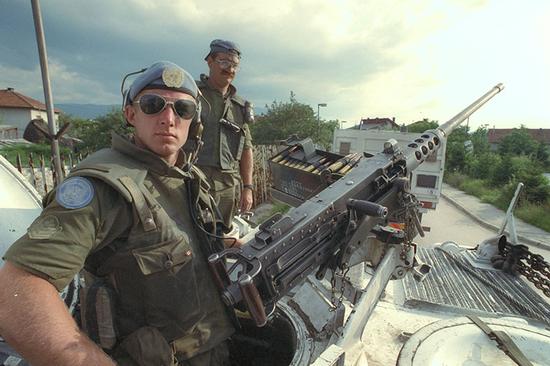
Operation Harmony, Sarajevo. Humanitarian aid convoy. Photo: Department of National Defence
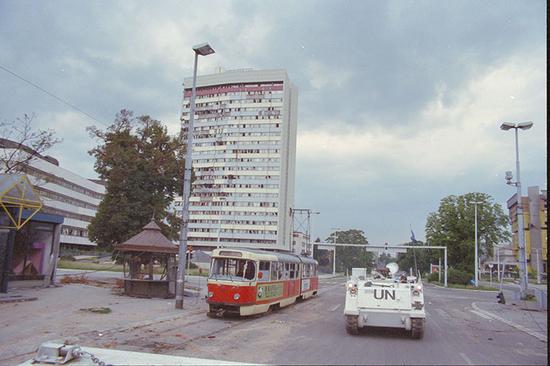
Sarajevo. A Canadian Armored Personnel Carrier drives through the well known
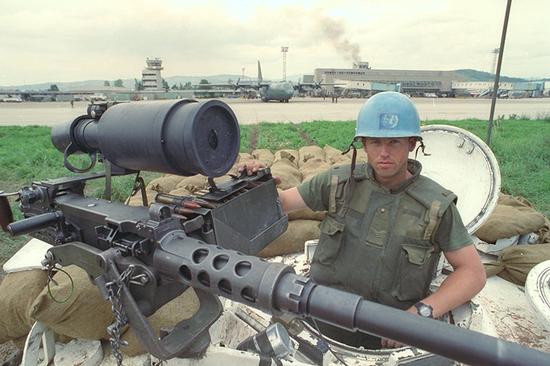
Operation Harmony, Sarajevo. Private Pierre Lévesque at the airport in Sarajevo. Photo: Department of National Defence
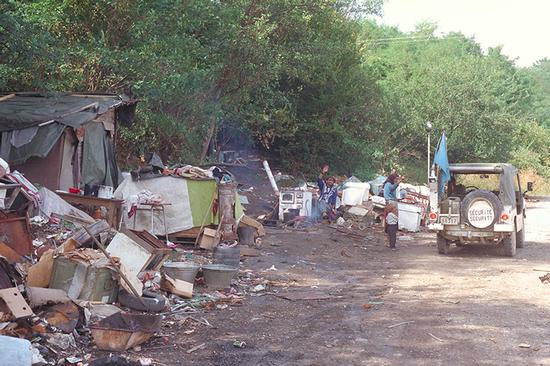
A jeep driven by Sergeant Robert Huard of the 1st Battalion of the Royal 22e Régiment arrives at the dump where the families of Daruvar, Croatia live. Photo: Department of National Defence
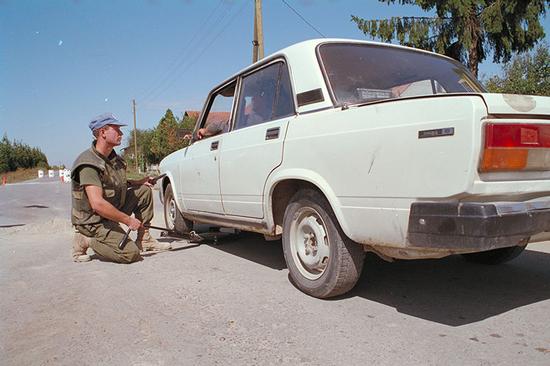
With the aid of a mirror, Sergeant Eric Bernier of 1st Battalion, Royal 22e Régiment checks under the vehicle at the check point just outside Lipik, Croatia. Photo: Department of National Defence
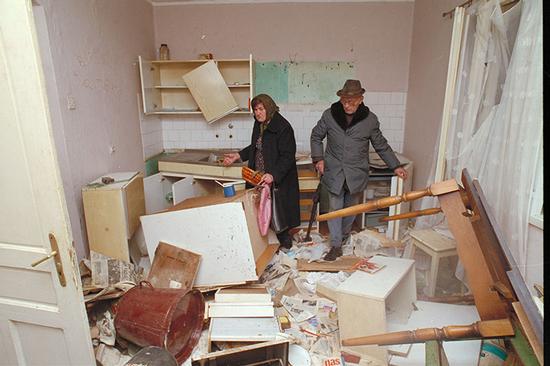
An elderly Serbian refugee couple search for a few personal effects in their destroyed home. Photo: Department of National Defence
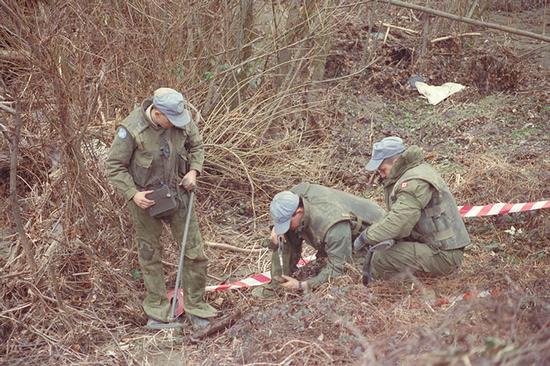
Canadian Armed Forces members in the Balkans. Photo: Department of National Defence
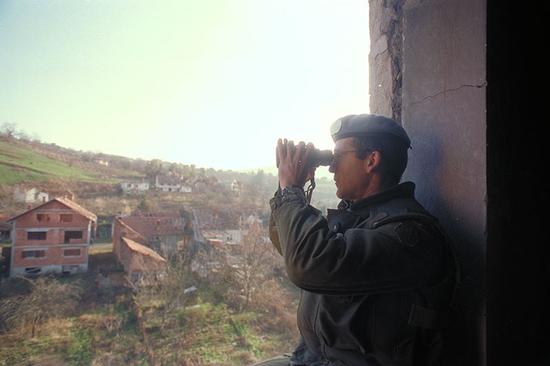
Members of PPCLI keep watch for any dangerous movement in the area. Photo: Department of National Defence
Srebrenica - Thousands of refugees have tried to find accommodations inside a town that normally houses less than one-third of that amount. Photo: Department of National Defence
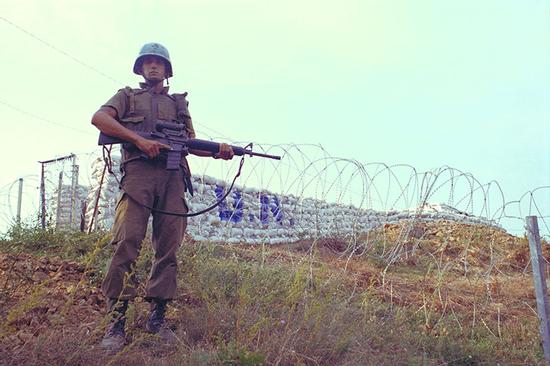
Corporal Richard Néron provides security at an observation post in Srebrenica. Photo: Department of National Defence
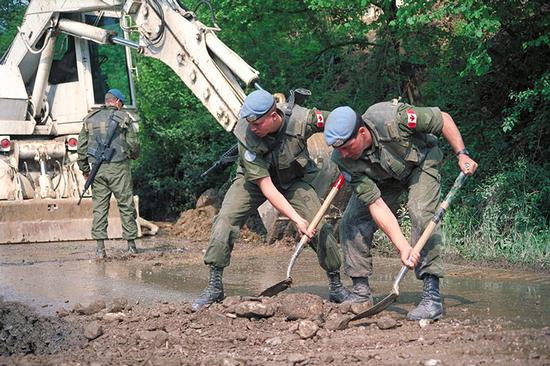
Corporals Rob Serjeant (left) and Rob Majore (right) clear debris from the road near Kiseljak, Bosnia and Herzegovina. Sergeant Pat Gear in the background supervises some work of the Drott excavator. Photo: Department of National Defence
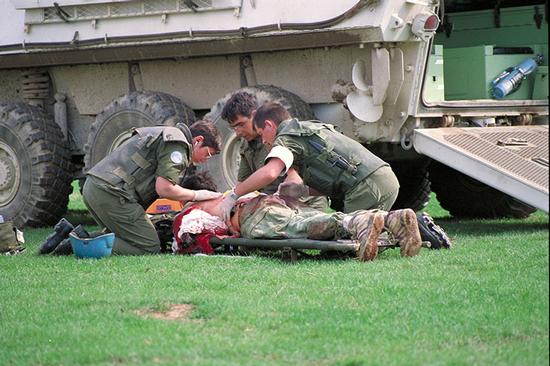
Major Hillary Jaeger, Sergeant Danny Noyes and Corporal Phil Fewer of Second Canadian Battalion Field Surgical Team treat a mortar casualty prior to transport to Camp Visoko Hospital. Photo: Department of National Defence
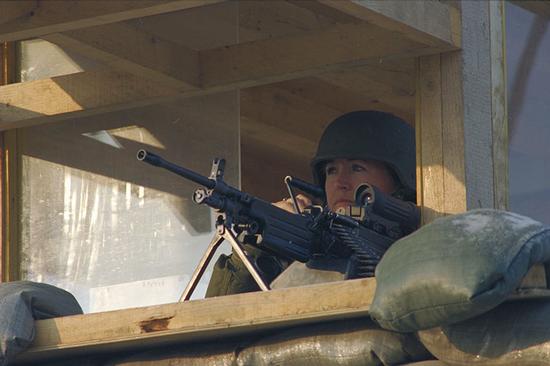
UN Duty in Bosnia. Photo: Department of National Defence
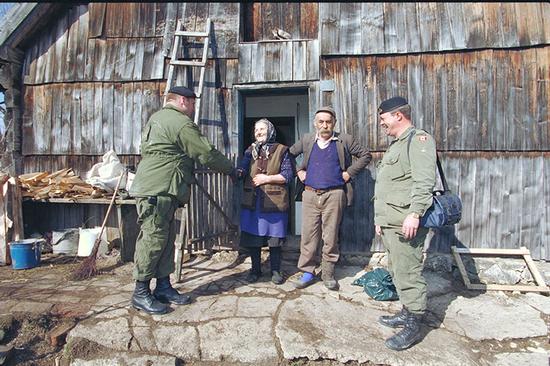
Donation to family at their house. Photo: Department of National Defence

SFOR Patrol in downtown Drvar, Bosnia. Photo: Department of National Defence
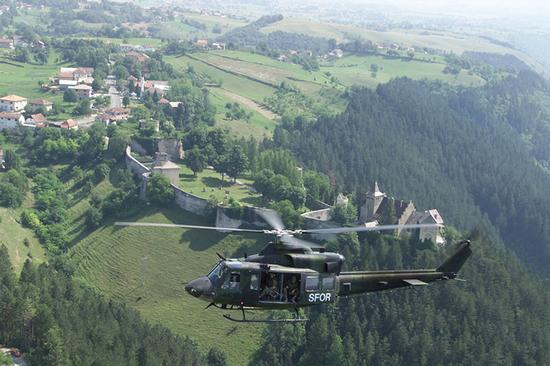
A CH-146 Griffon Helicopter from 408 Tactical Helicopter Squadron, CFB Edmonton, flies a mission carrying the Quick Reaction Force past the ruins of an old castle near Velika Kladusa, Bosnia and Herzegovina. Photo: Department of National Defence
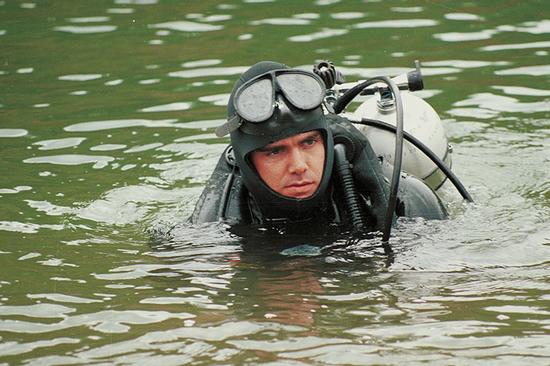
Canadian Armed Forces diver in Zgon, Bosnia and Herzegovina. Photo: Department of National Defence
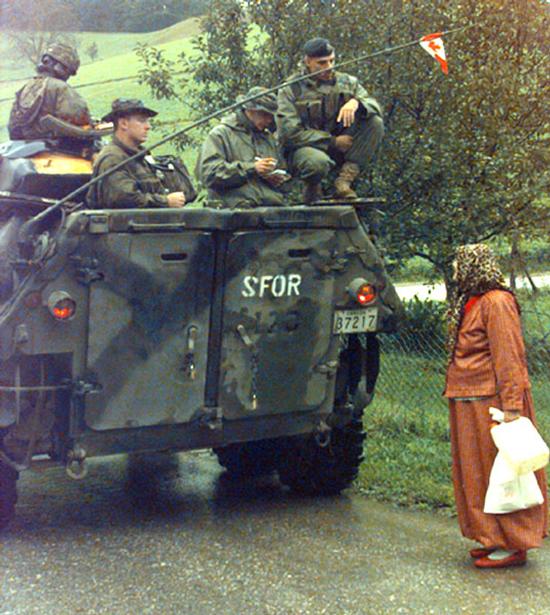
Canadian soldiers on an armoured vehicle talking with a local woman during the NATO mission in Bosnia in the 1990s. Photo: Department of National Defence
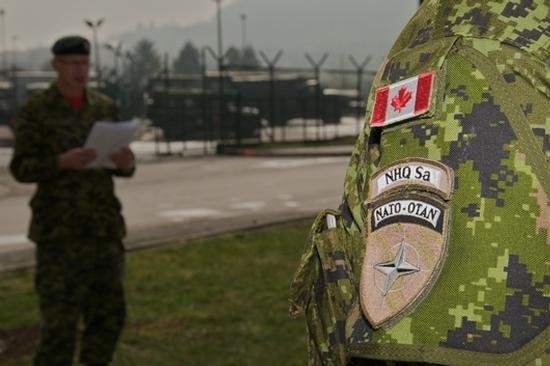
A Canadian soldier’s arm displaying his NATO patch during a ceremony in Bosnia-Herzegovina in March 2010. Photo: Department of National Defence IS2010-2000-03