
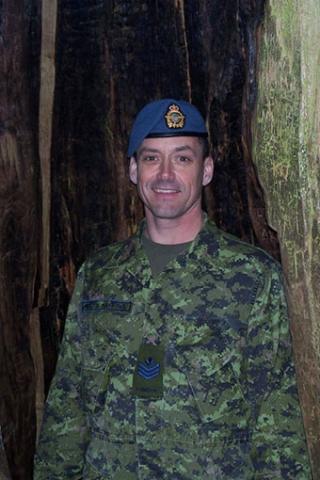

Joined
1981

Postings
- Shilo, MB
- North Bay, ON
- Moose Jaw, SK
- Greenwood, NS
- Borden, ON
- Toronto, ON
- Barrie, ON

Deployments
- Cyprus, 1982
- Africa, 1999
*Warning: this content involves graphic subject matter that some may find disturbing. Reader discretion is advised.
If you are a Veteran, family member or caregiver in need of mental health support, the VAC Assistance Service is available to you 24/7, 365 days a year at no cost. Call 1-800-268-7708 to speak to a mental health professional right now.
It was a crisp, Canadian morning at minus 40 Celsius when Sergeant (retired) Al McFarlane boarded a plane in Winnipeg, Manitoba for his first deployment to Cyprus.
It was 1982—Eye of the Tiger was topping the music charts, Pierre Elliott Trudeau was Prime Minister and phones were attached to walls with cords.
At his Sergeant Major’s request, eighteen-year-old McFarlane wrote his mother a letter from high above the Atlantic Ocean.
It had taken his mom three months to work up the nerve to sign his military papers after he spied a “Join the military, see the world,” recruitment poster on a downtown Calgary bus. At that time, neither one of them could pick Cyprus out on a map.
“My mother was terrified, she was like ‘Where's my boy going? What's this place called? I didn't even know. I was just this young kid that was going on this huge adventure.”
When the airplane doors opened on the Cyprus tarmac, a wall of 40-degree heat hit his face.
“What an eye-opener,” he remembers.
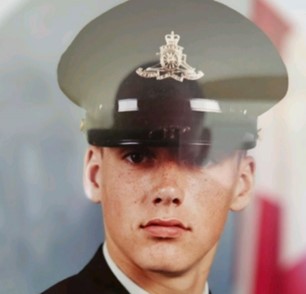
A young Al McFarlane in military uniform
The 80-degree temperature change was the beginning of a 35-year military career in which he says he was forced, like most military members, over and over to adapt. He served with the Canadian Army and the air defence artillery with the Royal Regiment of Canadian Artillery. He then became an aviation technician and later moved into investigative work. McFarlane finished his career as a recruiter before he was medically released in 2016.
In Cyprus, the United Nations was tasked with keeping the peace after the war between Greeks and Turks.
“You just did whatever you had to do,” he said.
Proud to be Canadian
Part of the mandate of his first deployment was to build relationships with the locals. The locals’ reaction to Canadian peacekeepers is what instilled his national pride at a young age.
“We had to wear our uniforms out so the local population knew right away; they would see the flag: ‘Oh, Canadian!’ They loved the Canadians. They treated us like gold,” he said, adding many soldiers were invited into locals’ homes for meals.
Teaching civilians in unstable countries what a healthy democracy looks like made the young soldiers realize how lucky they were to be Canadian. He says he remembers celebrating Canada Day that year (the first year it was renamed Canada Day instead of Dominion Day) with a Calgary Stampede-themed party.
“The locals brought donkeys in. We had a bunch of cowboy hats shipped in from Canada and Canadian flag t-shirts. We just tried to make it as much like home as possible,” he said.
He reflects on that mission with pride.
“Did we prevent any more loss of life? Did we bring something to their community that would show them that, number one, we have hearts, we’re not just warriors? Number two, our views and beliefs in this part of the world, we can try and bring some of that to an un-stabilized part of the world.”
Darker memories
But those somewhat happy memories of peacekeeping were often overshadowed by the darker parts of McFarlane’s military service. For six years during the war in Afghanistan, he worked as a crash investigator and a casualty case examiner with Defence Research and Development Canada.
“We would take all of the gear that the casualties wore; combat clothing, combat boots, tactical vests, fragment vests, ballistic eyewear, helmets and take it back to our labs and try and figure out how can we make the gear better for the soldiers to survive,” he said.
“It was kind of macabre, we would actually go to the morgue and get all the stuff.”
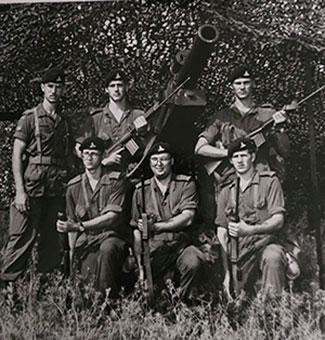
McFarlane (middle top row) stands with a group of soldiers at CFB Gagetown during a training exercise in the summer of 1981.
In 1998, he deployed to Bangui, capital of the Central African Republic, to help restore peace and uphold peace agreements after a political-military crisis in the country.
“I have nightmares to this day over Bangui. It was a war-torn area. There was political conflict going on. Those rules of engagement were pretty much wide open, and the stuff that I saw there …” he said, his voice trailing off.
Witnessing local children in distress was extra difficult knowing he had left his two young sons at home.
“I had to be almost a robotic guy to not melt because I'm thinking about my kids, but I'm on tour, so I’ve got to be positive and professional. It was a hard balancing act.”
In 2007, he worked as an Air Force crash investigator on a Snowbird crash in Montana that killed a Canadian pilot. This was a turning point for McFarlane.
“That’s where a lot of my problems started to surface,” he said. “I had a lot of problems buried that I didn't realize. There was a point where I just couldn't do it anymore.”
He left the military, rejoined as a reservist and spent the last six years of his career with the less traumatizing position of a Canadia Amed Forces recruiter in Barrie, Ontario.
Medical release
After his 2016 medical release and Post Traumatic Stress Disorder (PTSD) diagnosis. he says he struggled with alcoholism, the breakdown of his marriage, and suicide attempts.
“I’m an alcoholic. I’ve been dry now since March 18, 2014. I tried to commit suicide that day,” he said.
He’s been committed to recovery since then, but it hasn’t been an easy road. After his suicide attempt, he spent eight weeks at Homewood Health Centre, a mental health institute in Guelph.
“I just basically crawled into a bottle and didn't come out,” he explained. “I was going down a hole, a really dark hole, and I saw no way of getting out of it.”
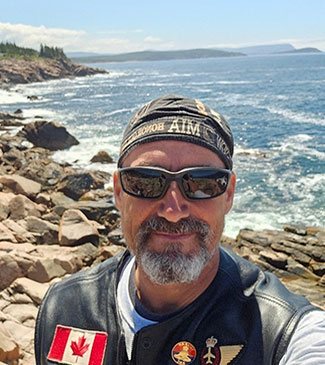
Al McFarlane on the Cabot Trail, Cape Breton, Nova Scotia.
He now reflects on coming home from deployments as especially hard when his sons noticed their Dad had changed and asked him ‘Why? What did you do?’
“There is a lot of lot of stuff going on in the back of your mind. As soon as you see your family, as soon as my boys would come running. Bam! You’d forget about what you just have been through and just hang on for dear life. Just hold on, hold on, and hold on,” he said.
He says he understood the trepidation his family felt during those reunions too, not knowing how the tough experiences had changed him.
“I was thinking ‘how am I going to react to their sadness, the possibility of their horror if they asked me and was I ready to respond to that?’”
Support for recovery
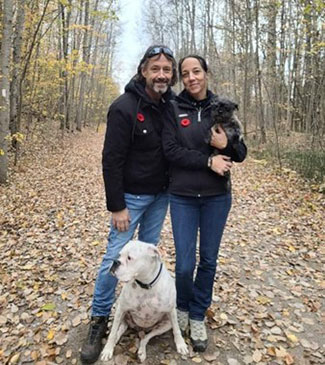
Al McFarlane with his partner, Patrizia, his service dog, a boxer named Charlie and her dog Pickle.
He credits his psychologist, his girlfriend Patrizia, his Veterans Affairs Case Worker and Charlie, his service dog, for his survival.
McFarlane’s membership in “The Asshole Club” (AHC) a group of 13 Army Vets who plan annual reunions, parades for fallen friends and celebrations of lifelong bonds formed in service, has also been essential to his survival. He says the consistent and reliable support and understanding of the brotherhood of the AHC has illuminated his darkest hours.
“These are friendships the civilian world can’t really understand,” he said.
McFarlane has made some big, positive steps forward since his release. He competed in archery in the 2017 Invictus Games in Toronto.
In 2020, he moved north to a village called Victoria Harbour on the shores of Georgian Bay. And he recently received the Education and Training Benefit from Veterans Affairs which allowed him to invest in the equipment and training to start an exciting new career as a drone pilot and photographer.
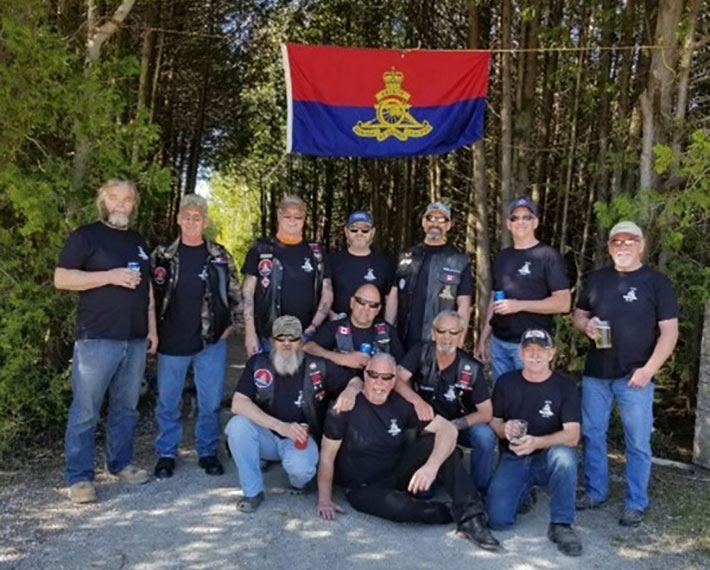
Members of “The Asshole Club” a group of Army Veteran friends who plan annual reunions, honour the fallen and help pull each other up when one falls.
He says he wants to keep spreading the word for other Veterans who are struggling—“help is out there. Don’t give up.”
He wishes he could talk to his mom Donna, who died in 1987, five years after she signed those fateful military papers. He says he would tell her all about his incredible life so far.
“She was my sounding board. I wish I could grab her and hug her and say, ‘It’s OK, Ma! This is what I did. This is what I saw.’”
With courage, integrity and loyalty, Al MacFarlane is leaving his mark. He is a Canadian Armed Forces Veterans. Discover more stories.
The well-being of Veterans is at the heart of everything we do. As part of this, we recognize, honour and commemorate the service of all Veterans. Learn more about the services and benefits that are available to Veterans and their families.