
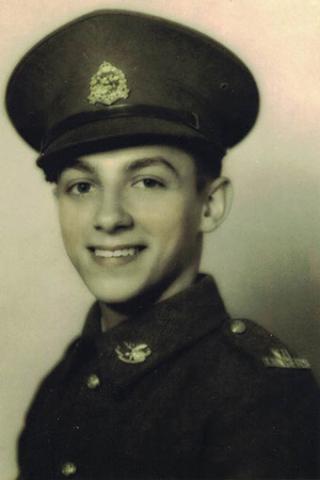

Joined
1939

Postings
- Newfoundland
- Hong Kong
- Korea
- Germany (Soest)

Deployments
- Second World War
- Korean War
Introduction
On the 80th anniversary of Victory over Japan Day (V-J Day), Canadians are called to reflect on the sacrifice and endurance of those who lived through one of the lesser-known chapters of the Second World War. While many recall battles in Europe or the atomic bombings that ended the war, it is the Defence of Hong Kong that shaped Alfred Babin into a soldier who survived impossible circumstances.
Resilience forged in captivity
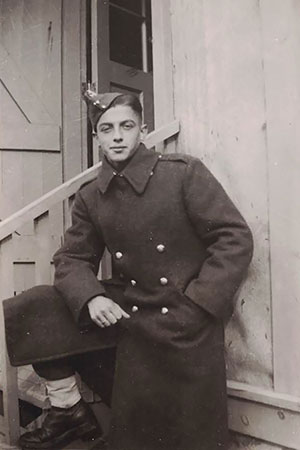
Alfred Babin in Canada, 1941.
In the fall of 1941, Rifleman Alfred Babin was sent to defend the British colony of Hong Kong. Within only a few weeks, he was captured by Japanese soldiers. Though he was a prisoner of war (POW) for nearly four years, he rarely spoke of the dark moments he endured.
Babin passed away in 2014, but his legacy lives on through his son Michael who is dedicated to preserving the memory of Canada’s first ground battle of the Second World War.
“It wasn't because he wanted to be a hero, it was because he needed a job.”
Canada enters the Second World War
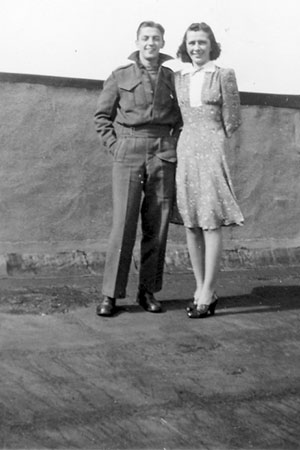
Alfred Babin and Christina Crowell before his deployment to Hong Kong.
Born in 1921 in Moncton, New Brunswick, and later living in Sydney, Nova Scotia, Babin enlisted in the army in 1939, just one day before Britain declared war on Germany. “It wasn't because he wanted to be a hero,” says Michael. “It was because he needed a job.”
In 1940, Babin met Christina Crowell, a fellow Canadian Armed Forces member from Windsor, Nova Scotia. No sooner had they started dating than Babin was deployed. Boarding a train in Valcartier, Quebec, he didn’t know where he was heading. As it rolled west, he realized they weren’t going to Europe. After arriving in Vancouver, the troops set sail for Hong Kong, to join the British garrison to defend the colony.
The unfamiliar landscape, climate, and culture were striking to a young man from a French-speaking Maritime household. Within weeks, he went from training in the mountainous countryside, to war.
The Defence of Hong Kong
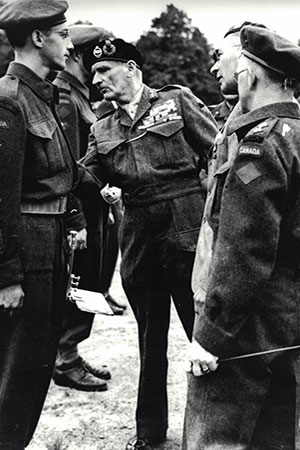
Alfred Babin (left) on inspection with British Field Marshal Bernard Law Montgomery.
On 8 December 1941, hours after the attack on Pearl Harbor, Japan struck Hong Kong. Babin, a trained musician in the Royal Rifles, was assigned ambulance duty. “My father had never driven,” Michael explains. “But they were short an ambulance driver … He very quickly taught himself how to drive.”
Babin faced danger on the front lines, retrieving the wounded from the battlefields and transporting them to St. Stephen’s College, which had been converted into a hospital.
On 25 December, Japanese forces broke through the hospital, and a massacre unfolded. Inside a locked room with others, Babin heard the screams of his comrades. When released, he was ordered to help burn the bodies of those killed.
“He tended to see things on the positive side, which I think is what got him through the war.”
Three years, eight months
Of the 1,975 Canadian soldiers in the Battle of Hong Kong, including two nursing sisters and many Indigenous soldiers, 1,685 became POWs. Babin spent the next 44 months in captivity – first in Hong Kong, then in Japan. Day after day, POWs were woken up early, sometimes to the banging of drums, and marshalled out to the work sites. Babin endured starvation, hard labour, and brutality. He shoveled coal, wasted away on rice and tea, and once ate a discarded orange peel – his only fruit in years.
“He was not a complainer,” Michael reflects. “He tended to see things on the positive side, which I think is what got him through the war.” Also keeping him going was the notion that somebody was waiting for him. Babin wrote letters to Crowell, not knowing whether they’d ever reach her. “That was a powerful incentive for him to stay alive,” says Michael.
Japanese civilians would try and slip food to the prisoners, “under pain of being beaten or killed themselves.”
Babin rarely spoke of the beatings or the starvation at the hands of the Japanese military, but he did recall moments of compassion. “Some Japanese civilians actually displayed kindness,” says Michael. “They would try and slip food to them under the fence, under pain of being beaten or killed themselves.”
“He knew the war was ending, and maybe he needed to unburden himself.”
In July 1945, a well-to-do Japanese man invited Babin and other POWs into his home. “He just wanted to speak with them,” Michael says, still unsure of who the individual was. “He knew the war was ending, and maybe he needed to unburden himself.” A few weeks later, on 15 August, the POWs awoke to silence.
No drumming and no marshalling to the labour camp; the guards had vanished and the gate stood open. Though they had heard rumors after the atomic bombs had been dropped, Michael recalls his father saying that they didn’t believe it at first. They thought it was a trap. But it was real – Japan had surrendered. The war was over.
A soldier returns home
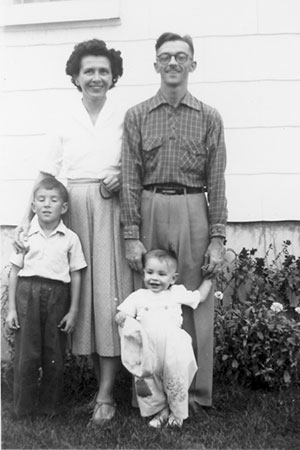
Alfred Babin with his wife, Christina, and their children, Michael (left) and Paul (right).
Back home in Nova Scotia, Crowell had indeed waited for him. Though his letters never arrived, a telegram had informed her and Babin’s parents of his capture. Tragically, his parents passed away before his return. He and Crowell married soon after and had two sons, Michael and Paul.
He remained in the army, later serving in the Korean War. He retired in 1971 after over 30 years of service. Though he wasn’t demonstrative about his time at war, he always stood in quiet reflection each year on November 11.
His son Michael, now 76, carries that legacy forward. After a career in technology, he joined the Hong Kong Veterans Commemorative Association, later becoming its president. The organization works to educate Canadians about the Battle of Hong Kong and its survivors through educational materials, a searchable database, and projects recognizing Indigenous soldiers.
Commemorating 80 years of freedom
For Michael, the anniversary of V-J Day is more than a commemoration. It’s a chance to preserve memories and reconnect families with untold stories. In 2025, the anniversary holds particular meaning: 80 years since the war ended; prisoners of war were liberated; and reunions with families began.
Veterans who survived hardships, like those faced by Babin, often never talked about it. Some of their children and grandchildren are only now discovering what really happened. This is a chance to connect those stories.
Babin lived to be 92 and passed away on 12 July 2014, one month after Christina. With courage, integrity and loyalty, Alfred Babin left his mark. Discover more stories.
The well-being of Canadian Veterans is at the heart of everything we do. As part of this, we recognize, honour and commemorate the service of all Canadian Veterans. Learn more about the services and benefits that we offer.