


Joined
1971

Postings
- Canada
Signing on
Warrant Officer (Retired) Brian Prairie is a proud Métis Veteran with both Red River and Ontario heritage. He is committed to preserving and honouring his people’s cultureand history.
Prairie’s military journey began in the early seventies with the Army reserves in Thunder Bay, Ontario.
“It was a time when there was a lot of peace and love and marijuana and experimentation and I just didn’t fit,” he recalled.
He had a few friends who had joined the Army reserves already. They told him about all the amazing things they were doing working for the Canadian Armed Forces (CAF).
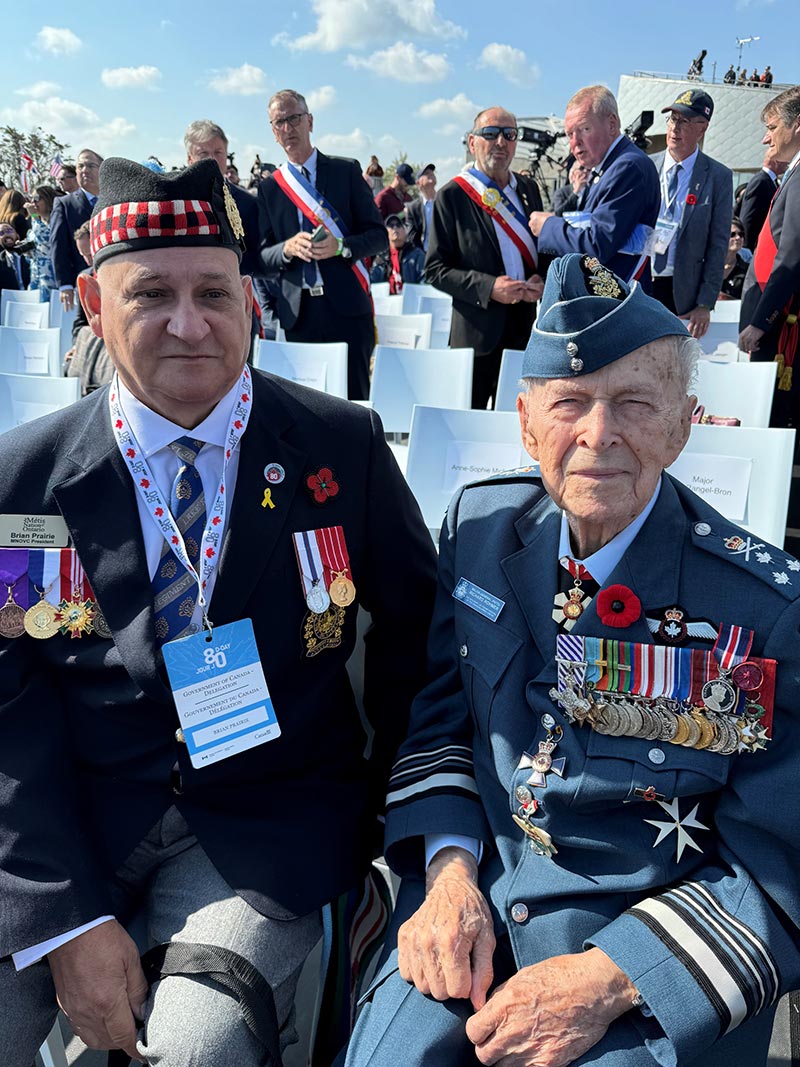
Brian sits in a white chair next to Honorary Lieutenant-General Richard Rohmer during a commemorative event at Juno Beach.
“That sounds like something I want to do,” he thought.
The problem was that he wasn’t 18 yet, so he couldn’t sign up for the CAF without his parents’ consent. But he didn’t let that stop him. He went and got the papers from his local recruiter.
“I went to my mother [...] and I just stuck a piece of paper in front of her and said, ‘Sign this, Mom.’”
She signed.
However, after placing a second piece of paper down in front of her, his mother became suspicious and asked what it was for. He told her it was a form for quitting school. She then asked what the first paper was for.
“I backed up and said: ‘I just joined the army.’”
Reconciliation, recognition, and belonging
Prairie enlisted in May of 1971, working in the infantry. He took every opportunity he could to train and build his leadership skills. Throughout his career, he had many incredible experiences doing the things his friends told him about—the things he’d always dreamed of. One experience he will never forget was riding an assault boat all the way down the Bow River from Jasper to Calgary in one week.
“That was an adventure of a lifetime.”
While his time in the Army was certainly adventurous, Prairie admits that he didn’t feel he had an opportunity to express his culture at work. People who served with him knew he was Métis, but he says that his identity was never really “broadcasted.” Métis soldiers like Prairie didn’t have the option to identify themselves until the Constitution Act passed in 1982. They were soldiers first.
“It was one of those things where we were there, but we weren’t there,” he said,
Since leaving the Army, Prairie has become the President of the Métis Nation of Ontario Veterans’ Council, and a member of the National Council of Veteran Associations of Canada. He has worked with various organizations to promote the presence and recognition of Métis Veterans.
“We want the Métis footprint that’s been silent for so many years to be seen and heard, and people to be aware that we’re here, and we’ve always been here.”
In recent years, Prairie says he’s seen bigger steps made toward recognizing Métis Veterans and soldiers, and honouring their stories. He’s proud of traditions like Indigenous Veterans Day and extremely proud of the Indigenous Veterans Monument in Ottawa.
“If you ever get a chance to go there, look at it, but don’t just stand in front of it. Do the four sides, because every side tells another story.”
His feelings on National Indigenous Veterans Day, however, are complicated.
"National Indigenous Veterans Day is a very important day for us, but […] as far as I’m concerned, it shouldn’t exist.”
Prairie explained that National Indigenous Veterans Day was created to recognize Indigenous Veterans at a time when traditional Remembrance Day celebrations excluded them. He's glad that there is finally recognition for Indigenous Veterans, but he wishes that there was never a need for a separate day in the first place.
“We’ve always been here, we’ve always served, and we belong.”
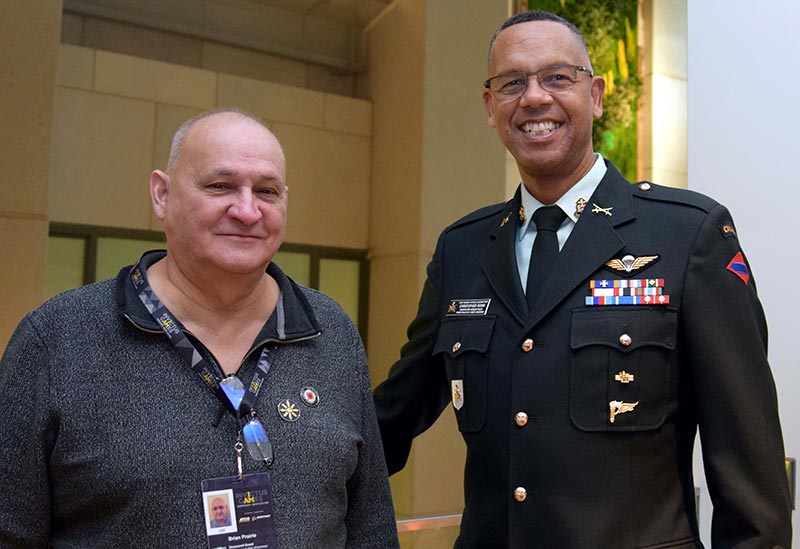
Brian Prairie (left) smiles for a photo with Canadian Army Sergeant Major, Chief Warrant Officer Christopher Robin.
Stewards of the land and people
In February 2025, Prairie was part of a Veterans Affairs Canada delegation of Indigenous Veterans and youth at the 2025 Invictus Games. The delegation included Indigenous Veterans from across Canada. Together with the Líl̓wat7úl [Líl̓wat], xʷməθkʷəy̓əm [Musqueam], Sḵwx̱wú7mesh [Squamish], and səlilwətaɬ [Tsleil-Waututh] Nations, the delegates honoured the sacrifices of all Indigenous Veterans who served in the CAF. They also engaged with Indigenous Veterans of other participating nations. Of all the delegations he has participated in, Brian said this was his favourite.
“The people that we [were] engaging with, the Indigenous communities, and just the love and the camaraderie, the mixing, it’s incredible.”
As the stories of Métis Veterans become more visible, Prairie encourages all of those who are thinking of joining the military to do so, and to use their service as an opportunity to share their culture.
“Follow the traditions of your ancestors and serve your country. But don’t be shy to say who you are and be identified, because that’s what we want.”
While there are still challenges for Métis people to overcome, especially Métis Veterans, Prairie is happy with how far things have progressed—that includes the services he has accessed through Veterans Affairs Canada. Prairie has submitted applications to the Department, but admits that he was not fully aware of all the programs and services available to him.
“I mean, really, like I had no clue about how deaf I was until I got hearing aids.”
He says that there are still a lot of people who are not aware of what’s available to them, and there is much to be done to ensure that they can get access to the programs, benefits, and supports they need.
“We earned it, but a lot of people don’t know about it, so again, we’re pushing to get that education out there.”
He continues to work hard to promote the contributions of Métis Veterans and to ensure their sacrifices are never forgotten. He also advocates for access to support that he hopes will ensure that all Indigenous people have a place where they feel they belong.
“We’re stewards. We have to be here to take care of the land and to take care of our people, and to make sure that our cultures never go away.”
With courage, integrity and loyalty, Brian Prairie has left his mark. He is one of our Canadian Veterans. Discover more stories.
The well-being of Canadian Veterans is at the heart of everything we do. As part of this, we recognize, honour and commemorate the service of all Canadian Veterans. Learn more about the services and benefits that we offer.
If you are a Veteran, family member or caregiver, the support of a mental health professional is available anytime at no cost to you. Call 1-800-268-7708.