
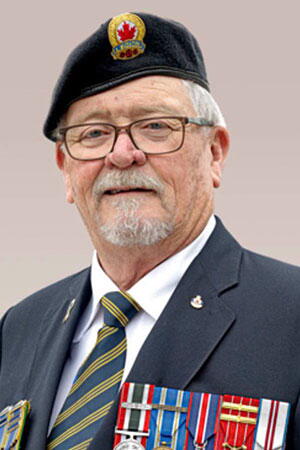

Postings
- Shearwater, Nova Scotia, CFB Greenwood, NS, 404 Squadron training school

Deployments
- Baden-Söllingen, Germany, NATO HMCS Iroquois

Medals/Awards
- CD, Special Service with NATO bar, Non-article 5, Queen’s Jubilee, King’s Coronation
The glory days of Canadian military aircraft
Almost every aircraft Master Warrant Officer (Retired) Jack MacIsaac worked on during his 33-year career – the Tracker, Starfighter, T-33, Sea King, Challenger -- has been retired.
Only the CP-140 Aurora remains in service, but even its days are numbered.
For MacIsaac, change has been constant throughout a lifetime of service.
The former Royal Canadian Air Force Master Warrant Officer has spent more than three decades adapting to new aircraft, new technologies and new challenges. The constant evolution was one of the things he loved most about military life, and retirement has never held much appeal.
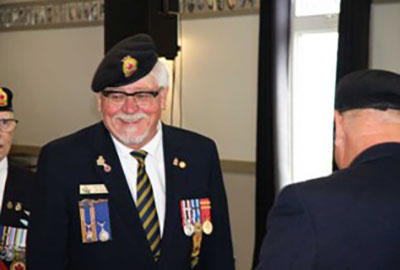
Today, as Dominion First Vice-President of the Royal Canadian Legion, he is helping the Canadian institution embrace change.
As the Legion marks its 100th anniversary, it is looking to a new generation of Veterans to help shape its next century.
“For many years, the Legion was thought of as just a place for the old guys to hang out, and that’s not true anymore,” MacIsaac said.
“This is a rejuvenation year, we hope.”
A life of service
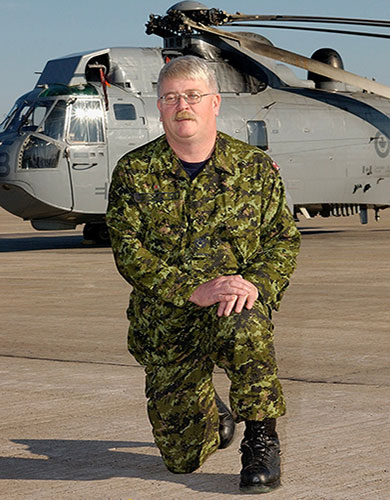
Jack MacIsaac posing for his “hero shot” at 12 Wing Shearwater in Nova Scotia.
MacIsaac was 21 and living just outside Charlottetown, Prince Edward Island, when he joined the Regular Force after spending time in the reserves.
He did his basic training at CFB Cornwallis in 1977, then became an aircraft technician with the Air Force. His career took him from Shearwater, Nova Scotia, to Baden-Söllingen, Germany, and back to Canada.
He spent five years teaching his trade at the Canadian Forces School of Aerospace Technology and Engineering in Borden, Ontario, before being posted to 14 Wing Greenwood in 1990.
He worked on the CP-140 Aurora and served with 434 Squadron before moving to 404 Squadron, where he oversaw about 30 instructors.
In 2003, MacIsaac returned to Shearwater and served as an air department chief aboard Royal Canadian Navy ships. In 2005, he deployed with NATO aboard HMCS Iroquois and retired in 2010, as a Master Warrant Officer.
From serving to supporting
MacIsaac joined the Legion in Kingston, Nova Scotia, in 1991, while posted at Greenwood.
Back then, it was mostly a social opportunity.
That changed after he moved to Prince Edward Island in 2014, and began taking on leadership roles, eventually becoming president of the Legion’s P.E.I. Command and moving into national leadership.
But there is a deeper reason he stays involved.
“Personally, I do like to help other Veterans,” he said. “Being a Vet myself, I know some of the issues.”
He has watched friends struggle with health problems and has seen Veterans come to the Legion during some of the hardest periods of their lives.
“The organization takes the Veterans’ needs to heart,” he said.
A Legion in transition
The Legion MacIsaac joined more than 30 years ago has changed.
Membership declined for years as the number of Second World War and Korean War Veterans dwindled. At the same time, younger Veterans of Afghanistan, Bosnia and other operations haven’t always seen their local Legion branch as a place for them.
MacIsaac wants that to change.
“You can’t drive change from the outside,” he said. “You need to drive change from the inside. I love to see them get involved.”
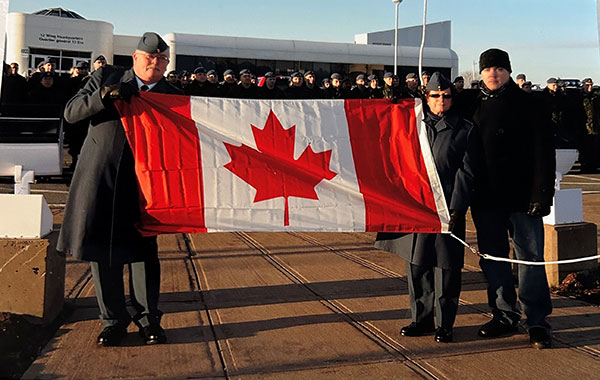
Jack MacIsaac (left) is assisted by his wife, Master Warrant Officer (retired) Pat MacIsaac and their son, Curtis at the flag raising ceremony for his retirement in December 2010.
The Legion is looking for more Veterans in their 30s, 40s and 50s to join.
Its centennial year has offered some encouragement.
The Legion offered free membership to new members in 2026, and gained about 100,000 in the first six months, pushing national membership above 300,000.
“We thought that was impossible,” MacIsaac said.
About 15 per cent of new members are 40 and under, while 28 per cent are 50 and under.
The challenge now is keeping them — and giving them a meaningful role in the Legion’s future.
That includes better reflecting the diversity of today’s Canadian Armed Forces.
“Could we be more diverse? I think so,” MacIsaac said. “The military is more diverse. So hopefully our Veterans will join the Legion, and that makes us more diverse.”
The mission remains
While the Legion evolves, MacIsaac says its fundamental purpose hasn’t changed.
Poppy funds help Veterans with immediate needs such as groceries, gas and emergency accommodation. They also support bursaries, Veteran programs and Legion service officers who help Veterans and their families navigate benefits and services.
“We see them come in here with mental health problems that just scare you,” he said.
Today’s Veterans may face operational stress injuries, difficult transitions to civilian life, homelessness, financial pressures or challenges accessing benefits.
The issues may have changed since the Legion was founded in 1926, but MacIsaac sees the mission as the same: Veterans helping Veterans.
“The Legion always keeps honouring Veterans at the forefront of everything they do,” he said.
And as another Poppy Campaign approaches, MacIsaac encourages Canadians to give.
“When you see the Legionnaires out there, buy your poppy. Donate,” he said. “If you have some time, donate some time.
“They served their country. So now it’s time to help them.”
This year, the Poppy Campaign kicks off October 24 and runs until November 11.
The well-being of Veterans is at the heart of everything we do. As part of this, we recognize, honour and commemorate the service of all Canadian Veterans. Learn more about the services and benefits that we offer.
If you are a Veteran, family member or caregiver, the support of a mental health professional is available anytime at no cost to you. Call 1-800-268-7708.