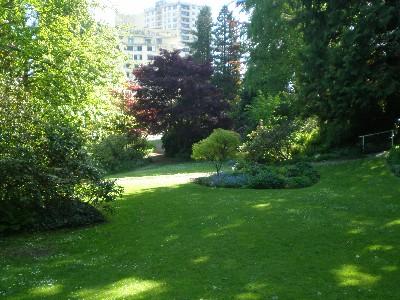
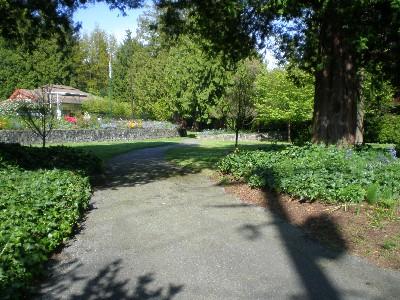
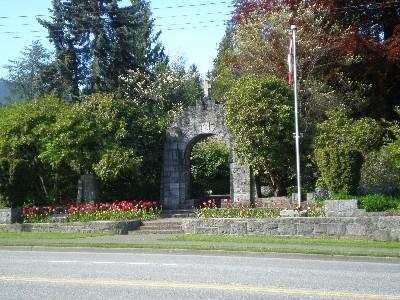
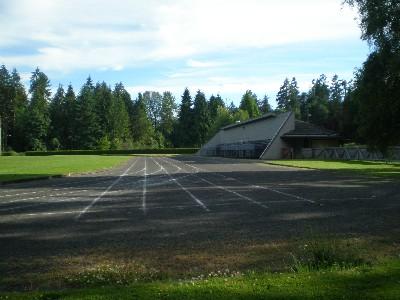
In 1921, Bylaw #151 was passed by the municipal council and the district accepted the donation of the land to be utilized as a public park and to be known as Memorial Park. This small park, opposite the Memorial Library (59034-022) is a peaceful sanctuary next to the bustling Ambleside Business District. The park is home to a formal memorial garden (59034-026), memorial arch (59034-012), and memorial benches (59034-027, 59034-028, 59034-029, 59034-030).
Parks
Memorial Park
no inscription/aucun inscription
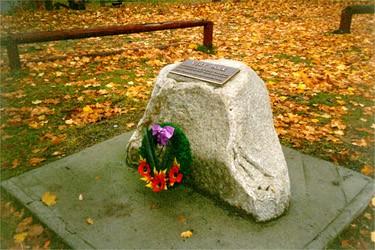
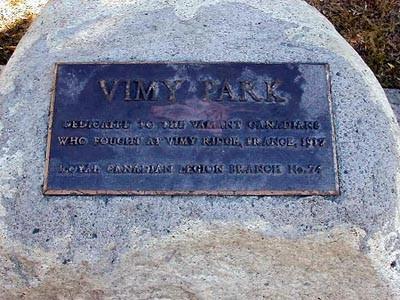
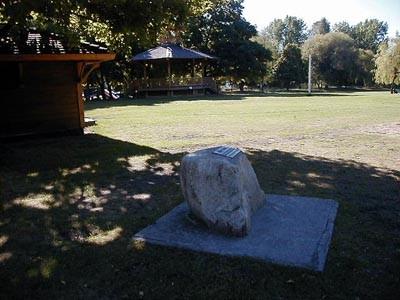
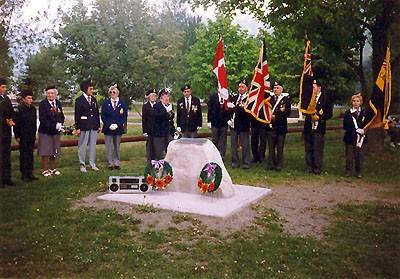
Vimy Park
[plaque/plaque]
VIMY PARK
This memorial was erected by Royal Canadian Legion Branch No. 74. It was constructed in 1992 in honour of veterans of Vimy Ridge.
Burnaby South Memorial Park
(needs further research/recherche incomplète)
This 1.5 acre park was named Burnaby South Memorial Park on November 3, 1993, by the Burnaby Parks, Recreation and Culture Commission's Parks, Names and Signs Committee, at the request of the Burnaby Heritage Advisory Committee (now the Community Heritage Commission.) The land was previously the site of the Burnaby South High School, but obtained by the city in 1989.
Within the park there are Memorial Tennis Courts and a Cenotaph that were dedicated in 1948 to the memory of 51 former students of the older school who died in the Second World War.
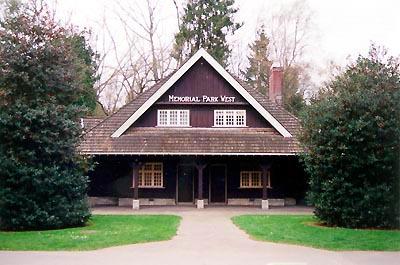
Memorial West Park
(needs further research/recherche incomplète)
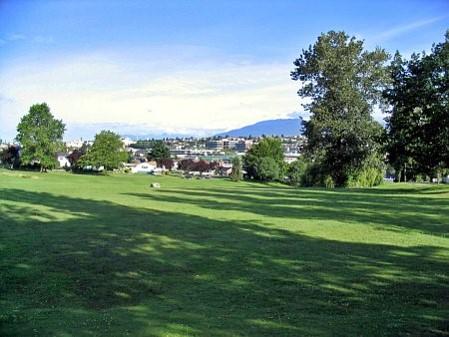
Established in 1958 through a local improvement by-law initiative whereby residents in the area agreed to directly fund original building costs, this busy centre is located on Memorial Park West (7.5 hectares), a verdant greensward bounded by large shade trees and comprising playfields, playgrounds and a bank of six tennis courts. The park's original name was Dunbar Park but this was changed following the First World War to Memorial Park. The "West" was added onto the park's name following the amalgamation of West Point Grey and South Vancouver Municipalities with the City of Vancouver where a park with the same name already existed. Vancouver Parks Board - About the Park - Memorial West Park's lively playing fields and courts attract many people from the surrounding neighbourhood. A charming interplay of restrained, forested areas and manicured, active spaces, most people will find something wonderful waiting at this park. It is easy to get lost in thought wandering the trails that link the active sports areas with the peaceful woodland. History - Originally known as Dunbar Park and part of the Point Grey Municipality, sometime after 1921 the site was renamed Memorial Park to commemorate the soldiers who died in the First World War. Following amalgamation of the Point Grey and South Vancouver Districts with the City of Vancouver, the "West" was added to the name to distinguish it from South Vancouver's Memorial Park South. In 1937, to commemorate the coronation of King George VI, Mrs. A. Atkinson, one of the first Presidents of the Point Grey Women's Institute, planted an oak from Britain's Windsor Great Park while reading verses of her own composition in honour of the occasion.
Falaise Park
[sign/enseigne]
Falaise Park
Built in 1948, Grandview Heights in northeast Vancouver was developed as a sub-division to provide housing for Veterans after the Second World War. Falaise Park was named on July 16, 1956, by the City of Vancouver. The park is named in memory of those who fought at the Battle of the Falaise Pocket.
Falaise is a small French town, 35 km south of Caen, known for the battle of the “Falaise Pocket” during the Allied re-conquest of France (OPERATION OVERLORD) from August 12-21, 1944, in which two German armies were encircled and destroyed by the Allied armies. Some 10,000 German troops were killed and 50,000 taken prisoner. Much of the Falaise was destroyed before the town was taken by a combined force of Canadian and Polish troops. Falaise was largely restored after the war.
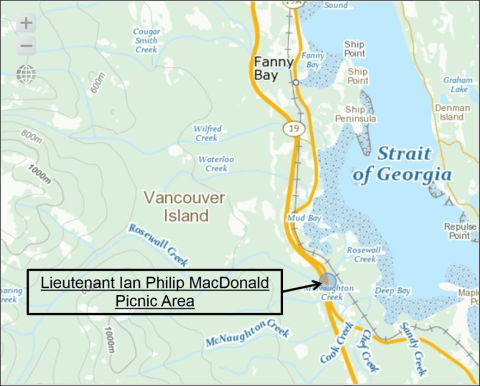
Lieutenant Ian Philip MacDonald Picnic Area
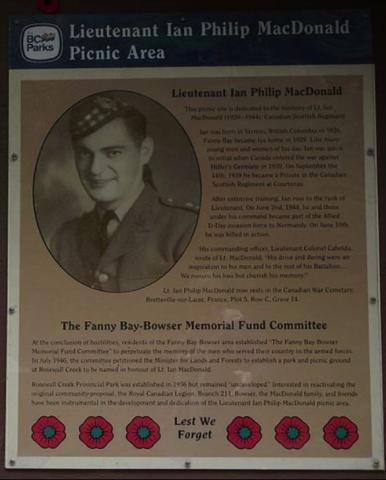
[plaque/plaque]
Lieutenant Ian Philip MacDonald
This picnic area is dedicated to the memory of Lt. Ian MacDonald (1920 – 1944) Canadian-Scottish Regiment.
Ian was born in Vernon, British Columbia in 1920. Like many young men and women of his day, Ian was quick to enlist when Canada entered the war against Hitler’s Germany in 1939. On September the 14th 1939, he became a Private in the Canadian Scottish Regiment at Courtenay.
After extensive training, Ian rose to the rank of Lieutenant. On June 2nd 1944, he and those under his command became part of the Allied D-Day invasion force to Normandy. On June 10th, he was killed in action.
His Commanding Officer, Lieutenant-Colonel Cabledu, wrote of Lt. MacDonald, “His drive and daring were an inspiration to his men and to the rest of his Battalion… We mourn his loss but cherish his memory”.
Lt. Ian Philip MacDonald now rests in the Canadian War Cemetery Bretteville-sur-Laize, France, Plot 5, Row C, Grave 14.
The Fanny Bay-Bowser Memorial Fund Committee
At the conclusion of hostilities, residents of the Fanny Bay-Bowser area established the “The Fanny Bay-Bowser Memorial Fund Committee” to perpetuate the memory of the men who served their country in the armed forces. In July 1946, the committee petitioned the Minister of Lands and Forests to establish a park and picnic ground in honour of Lt. Ian MacDonald.
Rosewall Creek Provincial Park was established in 1956 but remained “undeveloped”. Interested in reactivating the original community proposal, the Royal Canadian Legion Branch 211 Bowser, the MacDonald family and friends have been instrumental in the development and dedication of the Lieutenant Ian Philip MacDonald Picnic Area.

The Lieutenant Ian Philip MacDonald Picnic Area is named in honour of Lt. Ian MacDonald, Canadian-Scottish Regiment. It is on the grounds of Rosewall Creek Provincial Park, and was named on September 9, 1995 by British Columbia Parks.
Ian Philip MacDonald was born in March 1920 in Vernon, British Columbia, but moved to Fanny Bay on Vancouver Island at the age of 9. He enlisted in Courtenay on September 14, 1939 and was assigned to the Canadian Scottish Regiment. He sailed for England with the 1st Battalion, Canadian-Scottish Regiment in August 1941. On D-Day, June 6, 1944, this Regiment landed in Normandy, France as part of the 7th Infantry Brigade, 3rd Canadian Infantry Division. By then, Ian MacDonald had been commissioned a Lieutenant. On June 10, 1944, Lieutenant Ian Philip MacDonald was killed in action while leading his platoon during a battle near the Putot-En-Bessin Bridge between Bayeux and Caen. He is buried at the Bretteville-sur-Laize Canadian War Cemetery.
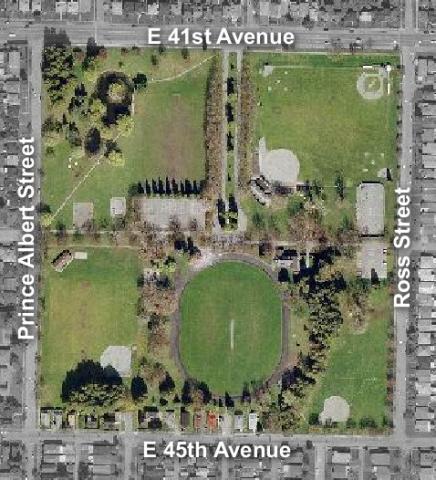
Memorial South Park
This park was designed by Municipal Engineer E. Dundas Todd as a memorial to soldiers who perished in the First World War.
Vancouver Board of Parks and Recreation - Memorial South Park - About the Park - This large park is enjoyed by sports teams and neighbours alike. The formal tree-lined entry leads to the war memorial that gives the park its name; the track and beyond is a popular place to exercise and socialize. The pond is a quiet place to watch dragonflies and ducks.
History - Originally known as Wilson Park (West 41st Avenue was known as Wilson Road at the time) this site was acquired by tax sales and was part of the South Vancouver Municipality before the City was amalgamated in 1929. Municipal Engineer E. Dundas Todd designed the park as a memorial to soldiers who perished in the First World War. Vancouver's first Cenotaph, located at South Vancouver Municipal Hall was relocated to the park later on November 11, 1939. The new park was officially opened on May 22, 1926. For many years the park played host to whippet racing but the most exciting event had to be an emergency plane landing on the football field during the Second World War. It seems the trainer plane from the No. 18 Elementary Air Training School at Boundary Bay had gotten off course, was low on fuel and had to make a forced landing. (Refer to memorial number 59027-001)
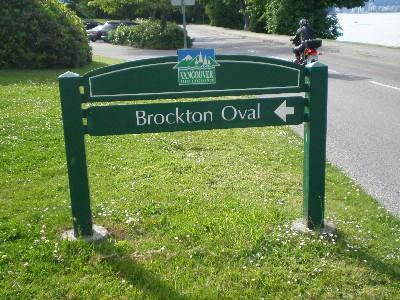
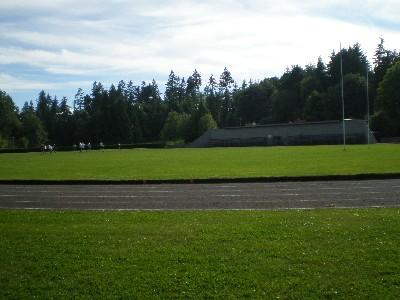
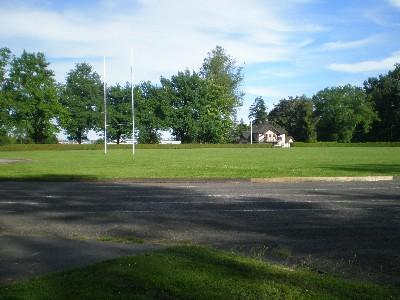
Brockton Oval
(needs further research/recherche incomplète)
This area was named in honour of Francis Brockton, Chief Engineer aboard the HM surveying vessel Plumper.
Brockton Point
(needs further research/recherche incomplète)
This area was named in 1859 by Captain Richards of HM surveying vessel Plumper after Francis Brockton, Chief Engineer.