Parks

City/Municipality
Kemptville
Memorial Number
35041-055
Type
Address
Highway 416 and Rideau River Road
Location
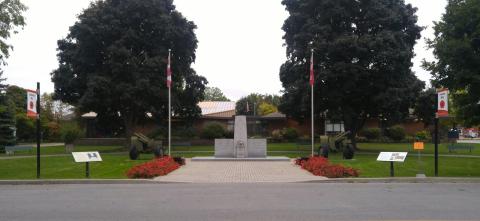
Veterans Commemorative Park
in Canada
Yes
GPS Coordinates
45.0825219, -75.6308102
Inscription

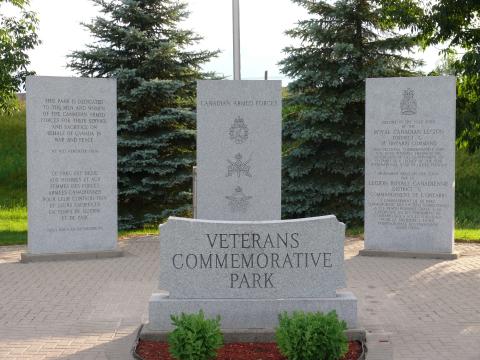
[slab/dalle]
VETERANS
COMMEMORATIVE
PARK

[left stele/stèle de gauche]
THIS PARK IS DEDICATED
TO THE MEN AND WOMEN
OF THE CANADIAN ARMED
FORCES FOR THEIR SERVICE
AND SACRIFICE ON
BEHALF OF CANADA IN
WAR AND PEACE.

WE WILL REMEMBER THEM

CE PARC EST DEDIE
AUX HOMMES ET AUX
FEMMES DES FORCES
ARMEES CANADIENNES
POUR LEUR CONTRIBUTION
ET LEURS SACRIFICES
EN TEMPS DE GUERRE
ET DE PAIX.

NOUS NOUS EN SOUVIENDRONS

[middle stele/panneau du centre]
CANADIAN ARMED FORCES

(three crests: Royal Canadian Navy, Canadian Armed Forces, and Royal Canadian Air Force/trois écussons suivent : ceux de la Marine royale du Canada, des Forces armées canadiennes et de l’Aviation royale du Canada)

[right stele/stèle de droite]
ERECTED IN THE YEAR 2000
BY THE
ROYAL CANADIAN LEGION
DISTRICT G
OF ONTARIO COMMAND

THIS VETERANS COMMEMORATIVE PARK
WAS MADE POSSIBLE THROUGH THE
GENEROSITY OF THE GOVERNMENT OF
ONTARIO AS A LEGACY OF THE 1999
INTERNATIONAL YEAR OF OLDER PERSONS

MONUMENT ERIGE EN L'AN 2000
PAR LA
LEGION ROYALE CANADIENNE
DISTRICT G
COMMANDEMENT DE L'ONTARIO

L'ETABLISSEMENT DE CE PARC
COMMEMORATIF DES ANCIENS COMBATTANTS
A ETE RENDU POSSIBLE GRACE A LA
GENEROSITE DU GOUVERNEMENT DE
L'ONTARIO QUI A VOULU SOULIGNER
POUR LA POSTERITE L'ANNEE
INTERNATIONALE DES PERSONNES
AGEES (1999)

Image
Caption
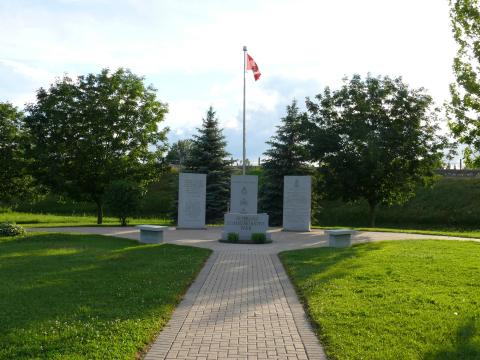
Veterans Commemorative Park
1 of 2 images
Image
Caption
inscription
1 of 2 images
Province
!4v1712141672802!6m8!1m7!1szgvBn85bE_fI0JQS_b5vUA!2m2!1d45.08255051894033!2d-75.63085955171182!3f220.8422096871339!4f-1.1654014122920273!5f3.325193203789971
Body Content

Veterans Commemorative Park is dedicated to the men and women of the Canadian Armed Forces. The park was the collective efforts of the Ontario Seniors' Secretariat, Ontario Ministry of Transportation and the Royal Canadian Legion Ontario Command District G. Officially opened in 2000, the Veterans’ Commemorative Park features monuments and gardens to be used for Remembrance Day commemorations as well as other Legion activities.

City
Kemptville
Country
Type Description
Park, stelia - grey granite
Photo Credit
Tim Laye, Ontario War Memorials
Memorial CF Legacy ID
5417
City/Municipality
Brockville
Memorial Number
35041-033
Type
Address
Block House Island Road & Water Street West
Location
Armagh Sifton Price Park
in Canada
Yes
GPS Coordinates
44.5895355, -75.6822362
Inscription

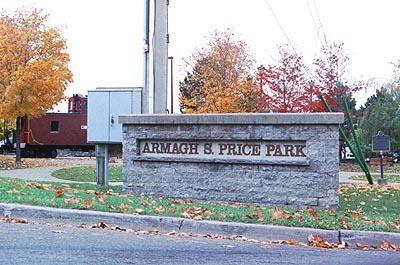
ARMAGH S. PRICE PARK

Image
Photo Credit
Cpl Sean Hunter
Caption
front view
Province
!4v1623347796190!6m8!1m7!1sTHEbSMNuU3eJDmEQ0JFKZw!2m2!1d44.58953550291439!2d-75.68223615714987!3f113.15721113332464!4f-8.551345556283763!5f2.8164952223074233"
Body Content

Needs further research

City
Brockville
Country
Type Description
Park
Memorial CF Legacy ID
5026
City/Municipality
Ottawa (Kanata)
Memorial Number
35040-052
Type
Address
Edenvale Drive and Colchester Square
in Canada
Yes
GPS Coordinates
45.3216149, -75.8905979
Inscription

[park sign/signe du parc]

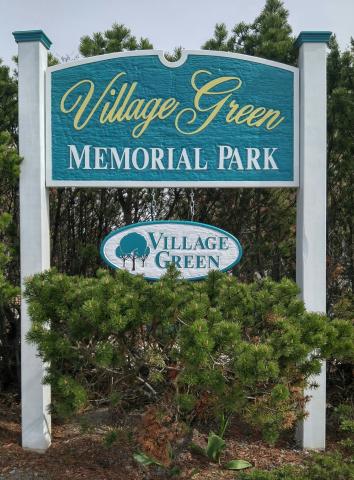
Village Green
MEMORIAL PARK

[plaque 1/plaque 1]

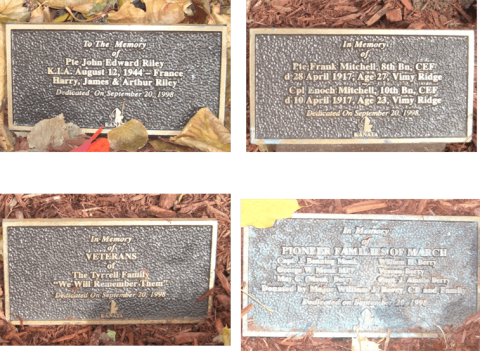
To the memory of Pte John Edward Riley. KIA August 12, 1944, France. Harry, James and Arthur Riley. Dedicated 20 September 1998.

[plaque 2/plaque 2]

In memory of Pte Frank Mitchell, 8th Bn CEF, d 28 April 1917, age 27, Vimy Ridge. Cpl Enoch Mitchell, 10th Bn CEF, d 10 April 1917, age 23, Vimy Ridge. Dedicated on 20 September 1998.

[plaque 3/plaque 3]

In memory of the veterans of the Tyrell family. “We will remember them”. Dedicated on 20 September 1998.

[plaque 4/plaque 4]

In memory of pioneer families of March. Capt J Benning Monk, William H Berry, George W Monk MMP, Vernon Berry, May G (monk) Berry, Capt J Ainslie Berry. Donated by Major William J Berry CD and family. Dedicated on 20 September 1998.

[plaque 5/plaque 5]

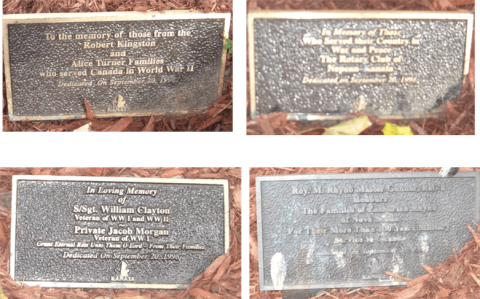
To the memory of those from the Robert Kingston and Alice Turner families who served Canada in World War II. Dedicated on 20 September 1998.

[plaque 6/plaque 6]

In memory of those who served their country in War and Peace, The Rotary Club of Nepean-Kanata. Dedicated on 20 September 1998.

[plaque 7/plaque 7]

In loving memory of S/Sgt William Clayton, veteran of WW I and WW II. Private Jacob Morgan, veteran of WW I. Grant eternal rest onto them, O Lord. From their families. Dedicated on 20 September 1998.

[plaque 8/plaque 8]

Roy M Rhyno, Master Gunner Ret’d, honours the families of Zachariah Rhyno of Nova Scotia for their more than 100 years military service to Canada. Dedicated on 20 September 1998.

[plaque 9/plaque 9]

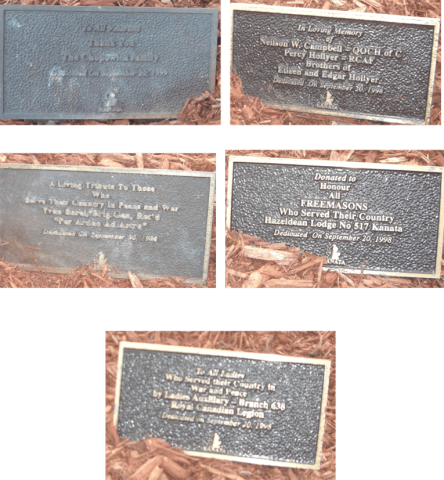
To all veterans, thank you. The Chopowich family. Dedicated on 20 September 1998.

[plaque 10/plaque 10]

In loving memory of Neilson W Campbell- QOCH of C, Percy Hollyer, RCAF. Brothers of Eilleen and Edgar Hollyer, Dedicated on 20 September 1998.

[plaque 11/plaque 11]

A living tribute to those who served their country in Peace and War. Yvon Sorel, Brig Gen Ret’d. “Per Ardua Ad Astra”. Dedicated on 20 September 1998.

[plaque 12/plaque 12]

Donated to honour all Freemasons who served their country. Hazeldean Lodge No. 517 Kanata. Dedicated on 20 September 1998.

[plaque 13/plaque 13]

To all ladies who served their country in War and Peace. By the Ladies Auxiliary Branch 638 Royal Canadian Legion. Dedicated on 20 September 1998.

Image
Photo Credit
Richard Turcotte
Caption
Village Green Memorial Park- memorial trees and plaques 1 to 4
1 of 4 images
Image
Caption
Village Green Memorial Park- memorial trees and plaques 5 to 8
1 of 4 images
Image
Caption
Village Green Memorial Park- memorial trees and plaques 9 to 13
1 of 4 images
Image
Photo Credit
Louise Bellec
Caption
Village Green Memorial Park sign
1 of 4 images
War or Conflict Term
Province
!4v1626720183948!6m8!1m7!1sz0ybX6mzWcwy2qOkw7Dqxw!2m2!1d45.32161482695101!2d-75.89059771894048!3f172.71796736285287!4f0.7833954020575931!5f0.7820865974627469
Body Content

In November 1996, Kanata Legion Branch 638 President Harry Riley asked Mr. John Gooch to assume the responsibility as Cenotaph Chairman. After numerous meetings with city officials and Urbandale Developments, a site was chosen and named "Village Green Memorial Park". The Legion donated a flagpole and kicked-off a fundraising program that would eventually result in twenty trees being planted around the park, each with a commemorative plaque, and a park bench in August 1997.

Several Legion members donated trees and the "tree program" was made available to the general public and other service clubs. By July 1998, 20 trees were planted, and the grass and garden were meticulously and expertly laid out. Each of the 20 trees has a dedication plaque. Of the 20 trees, 13 are dedicated to the military, or members of the military.

The Canadian flag was raised for the first time in the park on September 19, 1998. The dedication committee included: Cde. John Gooch (Chairman), Cde. George Gordon, Cde. Harry Riley and Cde. Ray Ponto.

The Kanata Cenotaph is also located here.

City
Ottawa (Kanata)
Country
Type Description
Park, trees
Memorial CF Legacy ID
8963
City/Municipality
Carleton Place
Memorial Number
35040-029
Type
Address
Lake Avenue West and Boundary Road
Location
Roy Brown Park
in Canada
Yes
GPS Coordinates
45.1293503, -76.1537625
Inscription

Roy Brown Park

Province
!4v1716985510753!6m8!1m7!1s31fuLNCVCTefCg1p2y7Z8g!2m2!1d45.12935031400968!2d-76.15376252645669!3f159.42715558135677!4f-6.181507104365593!5f1.8039686873395269
Body Content

Captain Arthur Roy Brown was the Great War flying ace credited for bringing down German Baron Manfred von Richthofen, the legendary Red Baron. Although controversy will always follow the cause of the Baron's demise, generally sources give credit to Captain Brown for firing the fatal shot.

Brown was born on December 23, 1893, in Carleton Place, Ontario. In the summer of 1915, he applied to Britain’s Royal Naval Air Service but was told he first needed a private pilot’s license. The nearest Canadian flying school was full, so he attended the Wright School of Aviation in Dayton, Ohio and obtained his pilot’s license on November 13, 1915. He enrolled in the Royal Naval Air Service and was sent to Royal Naval Air Service Station Chingford in northeast London to learn the fundamentals of military flying and dropping bombs.

He was injured on May 2, 1916, when he crashed a training airplane and was hospitalized for two months. In March 1917, Brown was posted to No. 9 Naval Squadron, was injured again and did not recover until May. On November 2, Brown was awarded the Distinguished Service Cross for his aerial victories and for aiding a fellow pilot under attack by four German aircraft, even though his own machine guns had jammed. By April 1918, he had shot down nine enemy aircraft.

On the morning of April 21, 1918, Brown and other pilots in 209 Squadron became involved in a dogfight with a German squadron including top ace Manfred von Richthofen and his cousin, novice pilot Wolfram von Richthofen. The Red Baron broke off to pursue Canadian pilot “Wop” May, who was on the tail of his cousin. Brown saw that his friend was in trouble and disengaged to attack Richthofen. He fired a long burst from behind and pulled out of a steep dive to avoid a collision. Richthofen continued over Allied territory and was fired at by British and Australian soldiers until he crashed into a field.

Four days later, Brown was grounded and hospitalized with severe food poisoning and extreme exhaustion, then sent to England to recover. Soon afterwards, he was recommended to receive the Distinguished Service Cross with Bar. Released from hospital on June 6, Brown reported for duty as an instructor with No. 2 School of Aerial Fighting and Gunnery in Yorkshire. On July 15 just after takeoff, his engine failed, the aircraft stalled and crashed. Seriously injured again, Roy spent eight months in hospital before being sent back to Canada on March 8, 1919 and was released from the Royal Air Force in April 1920 with the rank of Captain. Captain Brown tried to join the Royal Canadian Air Force when the Second World War began, but was rejected.

City
Carleton Place
Country
Type Description
Park
Memorial CF Legacy ID
12506
City/Municipality
Carleton Place
Memorial Number
35040-025
Type
Address
36 Franklin Street
in Canada
Yes
GPS Coordinates
45.1401842, -76.1441535
Inscription

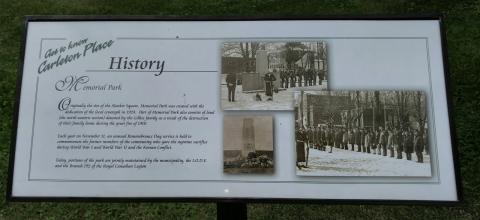
[storyboard/scénarimage]

Get to know
Carleton Place

History

Memorial Park

Originally the site of the Market Square, Memorial Park was created with the
dedication of the local cenotaph in 1924. Part of Memorial Park also consists of land
(the north-eastern section) donated by the Gillies family as a result of destruction
of their family home during the great fire of 1910.

Each year on November 11, an annual Remembrance Day service is held to
commemorate the former members of the community who gave the supreme sacrifice
during World War I and World War II and the Korean Conflict.

Today, portions of the park are jointly maintained by the municipality, the I.O.D.E.
and the Branch 192 of the Royal Canadian Legion.

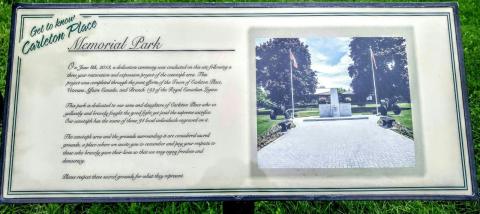
[storyboard/scénarimage]

Get to know
Carleton Place

Memorial Park

On June 8th, 2013, a dedication ceremony was conducted on this site following a
three year restoration and expansion project of the cenotaph area. This
project was completed through the joint efforts of the Town of Carleton Place,
Veterans Affairs Canada, and Branch 192 of the Royal Canadian Legion.

This park is dedicated to our sons and daughters of Carleton Place who so
gallantly and bravely fought the good fight yet paid the supreme sacrifice.
Out cenotaph has the name of those 94 individuals engraved on it.

The cenotaph area and the grounds surrounding it are considered sacred
grounds, a place where we invite you to remember and pay your respects to
those who bravely gave their lives so that we may enjoy freedom and
democracy.

Please respect these sacred grounds for what they represent.

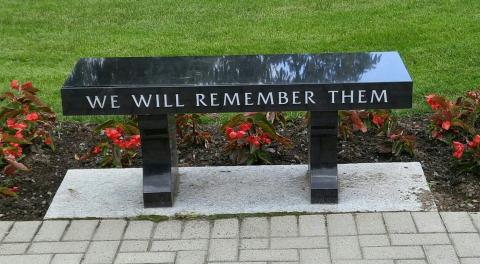
[bench/banc]

WE WILL REMEMBER THEM

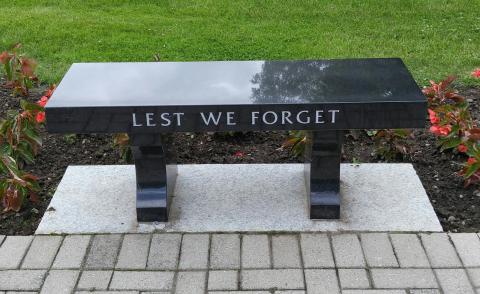
[bench/banc]

LEST WE FORGET

Image
Caption
Memorial Park storyboard
1 of 6 images
Image
Caption
Memorial Park storyboard
1 of 6 images
Image
Caption
park bench
1 of 6 images
Image
Caption
park bench
1 of 6 images
Image
Caption
Memorial Park
1 of 6 images
Image
Caption
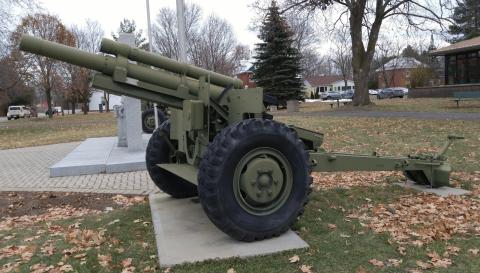
105mm Howitzer
1 of 6 images
Province
!4v1709666282381!6m8!1m7!1szY5RP1UDRvO8aldP2a1KaA!2m2!1d45.14018419406428!2d-76.14415346681035!3f181.9506403937219!4f-2.2884262280924617!5f0.7820865974627469
Body Content

Memorial Park was created with the dedication of the local cenotaph in 1924. The park originally honoured those who died during the First World War. On June 8, 2013, the park was re-dedicated to all who died during their military service.

City
Carleton Place
Country
Type Description
Park
Photo Credit
Louise Bellec
Memorial CF Legacy ID
12319
City/Municipality
Ottawa (Kanata)
Memorial Number
35040-018
Type
Address
147 Robert Gray Crescent
in Canada
Yes
GPS Coordinates
45.316353, -75.8974337
Inscription

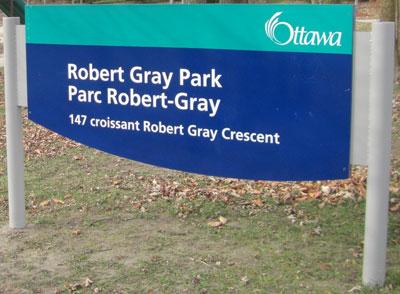
[park sign/signe du parc]

Robert Gray Park
Parc Robert-Gray
147 Croissant Robert Gray Crescent

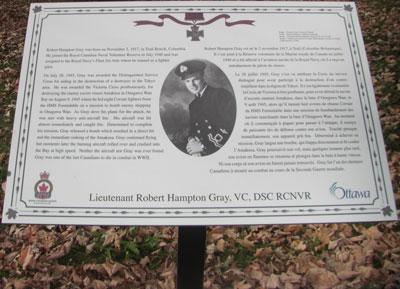
[plaque/plaque]

Lieutenant Robert Hampton Gray, VC, DSC, RCNVR

Robert Hampton Gray was born on November 2, 1917 in Trail, British Columbia. He joined the Royal Canadian Naval Volunteer Reserve in July 1940 and was assigned to the Royal Navy’s Fleet Air Arm where he trained as a fighter pilot.

On July 28, 1945, Gray was awarded the Distinguished Service Cross for aiding in the destruction of a destroyer in the Tokyo area. He was awarded the Victoria Cross posthumously for destroying the enemy escort vessel Amakusa in Onagawa Wan Bay on August 9, 1945 where he led eight Corsair fighters from the HMS Formidable on a mission to bomb enemy shipping in Onagawa Wan. As Gray dove his plane for the attack, he was met with heavy anti-aircraft fire. His aircraft was hit almost immediately and caught fire. Determined to complete his mission, Gray released a bomb which resulted in a direct hit and the immediate sinking of the Amakusa. Gray continued flying but moments later the burning aircraft rolled over and crashed into the bay at high speed. Neither the aircraft nor Gray was ever found. Gray was one of the last Canadians to die in combat in WW II.

Robert Hamotin Gray est né le 2 novembre 1917 à Trail (Columbie-Britannique). Il s’est joint à la Réserve Volontaire de la Marine royale du Canada en juillet 1940 et a été affecté à l’aviation navale de la Royal Navy, où il a reçu un entraînement de pilote de chasse.

Le 28 juillet 1945, Gray s’est vu attribuer la Croix de service distingué pour avoir participé à la destruction d’un contre-torpilleur dans la région de Tokyo. Il s’est également vu remettre la Croix de Victoria à titre posthume pour avoir détruit le navire d’escorte ennemi Amakusa, dans la baie d’Onagawa Wan le 9 août 1945, alors qu’il menait huit avions de chasse Corsair de HMS Formidable dans une mission de bombardement des navires marchands dans la baie d’Onagawa Wan. Au moment où il commençait à piquer pour passer à l’attaque, il essuya de puissants tir de défense contre son avion. Touché presque immédiatement, son appareil prit feu. Déterminé à achever sa mission, Gray largua une bombe qui frappa directement et fit couler l’Amakusa. Gray poursuivit son vol, mais quelques instants plus tard, son avion en flammes se retourna et plongea dans la baie à haute vitesse. Ni son corps no son avion ne furent jamais retrouvés. Gray fut l’un des derniers Canadiens à mourir au combat au cours de la Seconde Guerre mondiale.

Image
Photo Credit
Richard Turcotte
Caption
park sign
1 of 2 images
Image
Photo Credit
Richard Turcotte
Caption
plaque
1 of 2 images
War or Conflict Term
Province
!4v1626719188803!6m8!1m7!1s0HphyESiIPNQAu8U4wAylQ!2m2!1d45.31635032689004!2d-75.89743160798271!3f183.53544685162134!4f2.176339407840203!5f1.2282570959648893
Body Content

Robert Gray Park was named in memorial to Lieutenant Robert Hampton Gray, VC, DSC, RCNVR. The park features a biographical plaque on Lt. Gray, and was erected by the City of Ottawa and Royal Canadian Legion Branch 638.

City
Ottawa (Kanata)
Country
Type Description
Park, sign, plaque
Memorial CF Legacy ID
9217
City/Municipality
Kanata
Memorial Number
35040-017
Type
Address
100, Bellrock Drive
Location
Alexander Dunn Park
in Canada
Yes
GPS Coordinates
45.3172782, -75.896367
Inscription

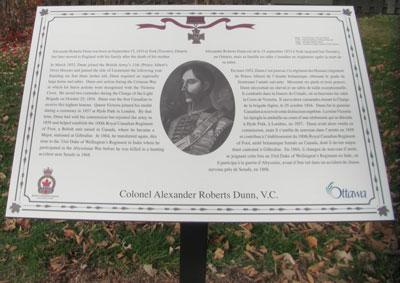
[plaque/plaque]

[text on left/texte à gauche]

Alexander Dunn was born on September 15, 1833 in York (Toronto) Ontario
but later moved to England with his family after the death of his mother.

In March 1852, Dunn joined the British Army's 11th (Prince Albert's
Own) Hussars and gained the title of Lieutenant the following year.
Standing six feet three inches tall, Dunn required an especially
large horse and sabre. Dunn saw action during the Crimean War
in which his brave actions were recognized with the Victoria
Cross. He saved two comrades during the Charge of the Light
Brigade on October 25, 1854. Dunn was the first Canadian to
receive this highest honour. Queen Victoria pinned his medal
during a ceremony in 1857 at Hyde Park in London. By that
time, Dunn had sold his commission but rejoined the army in
1858 and helped establish the lOath Royal Canadian Regiment
of Foot, a British unit raised in Canada, where he became a
major, stationed in Gibraltar. In 1864, he transferred again, this
time to the 33'" Duke of Wellington's Regiment in India where he
participated in the Abyssinian War before he was killed in a hunting
accident near Senafe in 1868.

[text on right/texte à droite]

Alexander Dunn est ne le 15 septembre 1833 à York (aujourd'hui Toronto),
en Ontario, mais sa famille est allée s'installer en Angleterre après la mort de
sa mère.

En mars 1852, Dunn s'est joint au 11e Régiment des Hussars (Régiment
du Prince Albert) de I' Armée britannique, obtenant le garde de
lieutenant l`année suivante. Mesurant six pieds et trois pouces,
Dunn nécessitait un cheval et un sabre de taille exceptionnelle. II combattit dans la Guerre de Crimée, ou sa bravoure lui valut
la Croix de Victoria. II sauva deux camarades durant la Charge
de la Brigade légère, le 25 octobre 1854. Dunn fut le premier
Canadien à recevoir cette distinction suprême. La reine Victoria
lui épingla la médaille au cours d'une cérémonie qui se déroula
à Hyde Park, à Londres, en 1857. Dunn avait alors vendu sa
commission mais il s'enrôla de nouveau dans I' armée en 1858
et contribua à I' établissement du l00th Royal Canadian Regiment
of Foot, unité britannique formée au Canada, dont il devint major,
étant cantonné à Gibraltar. En 1864, il changea de nouveau d'unité,
se joignant cette fois au 33rd Duke of Wellington's Regiment en Inde, ou
il participa à la Guerre d'Abyssinie, avant d'être tué dans un accident de chasse
survenu près de Senafe, en 1868.

[at bottom/en bas]

[left corner/coin gauche]

(crest of the Royal Canadian Legion/insigne de la Légion Royale Canadienne)

[at centre/au centre]

Colonel Alexander Roberts Dunn, V.C.

Ottawa

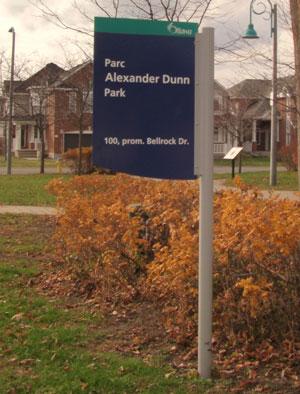
[park sign/pancarte de parc]
[front/devant]

Ottawa

Parc Alexander Dunn
Park

100, prom. Bellrock Dr.

Image
Photo Credit
Richard Turcotte
Caption
park sign
1 of 2 images
Image
Photo Credit
Richard Turcotte
Caption
plaque
1 of 2 images
Province
!4v1626190044884!6m8!1m7!1sdlJqVxW1Iep4bdRVfen5Tg!2m2!1d45.31727816361595!2d-75.89636702160699!3f279.08588659827626!4f0.7249259805132056!5f1.7846642393976593"
Body Content

This memorial was erected by the city of Ottawa assisted by the Royal Canadian Legion Branch 638 (Kanata), and is dedicated to Colonel Alexander Roberts Dunn,V.C..

City
Kanata
Country
Type Description
Park, sign and plaque
Memorial CF Legacy ID
8503
City/Municipality
Ottawa (Kanata)
Memorial Number
35040-012
Type
Address
42 Bishops Mills Way
in Canada
Yes
GPS Coordinates
45.3188653, -75.8917313
Inscription

[plaque/plaque]

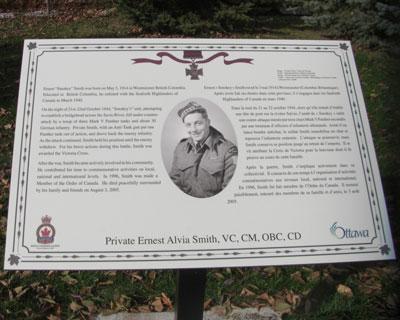
Private Ernest Alvia Smith, VC, CM, OBC, CD

Ernest “Smokey” Smith was born on May 3, 1914 in Westminster, British Columbia. Educated in British Columbia, he enlisted with the Seaforth Highlanders of Canada in March 1940.

On the night of 21st – 22nd October 1944, “Smokey’s” unit, attempting to establish a bridgehead across the Savio River, fell under counter-attack by a troop of three Mark V Panther tanks and about 30 German infantry. Private Smith, with an anti-tank gun put one Panther tank out of action and drove back the enemy infantry. As the attack continued, Smith held his position until the enemy withdrew. For his brave actions during battle, Smith was awarded the Victoria Cross.

After the war, Smith became actively involved in his community. He contributed his time to commemorative activities on local, national and international levels. In 1996, Smith was made a member of the Order of Canada. He died peacefully surrounded by his family and friends on August 3, 2005.

Ernest « Smokey » Smith est né le 3 mai, 1914 à Westminster (Colombie-Britannique). Après avoir fait ses études dans cette province, il s’engagea dans le Seaforth Highlanders of Canada en mars 1940.

Dans la nuit du 21 au 22 octobre 1944, alors qu’elle tentait d’établir une tête de pont sur la rivière Savio, l’unité de « Smokey » subit une contre-attaque menée par trois chars Mark V Panther secondés par une trentaine d’officiers d’infanterie ennemie. L’attaque se poursuivit mais Smith conserva sa position jusqu’au retrait de l’ennemi. Il se vit attribuer le Crois de Victoria pour sa bravoure dont il fit preuve au cours de cette bataille.

Après la guerre, Smith s’impliqua activement dans sa collectivité. Il consacra de son temps à l’organisation d’activités commémoratives aux niveaux local, national et international. En 1996, Smith fut fait membre de l’Ordre du Canada. Il mourut paisiblement, entouré des membres de sa famille et d’amis, le 3 août 2005.

Image
Photo Credit
Richard Turcotte
Caption
park sign
1 of 3 images
Image
Photo Credit
Richard Turcotte
Caption
surroundings
1 of 3 images
Image
Photo Credit
Richard Turcotte
Caption
plaque
1 of 3 images
War or Conflict Term
Province
!4v1626718980466!6m8!1m7!1svIND9FMbsmTJXCc6JRm-5w!2m2!1d45.31886525867776!2d-75.8917313457829!3f51.109754885001976!4f-1.6934011344898891!5f1.2526150787865675
Body Content

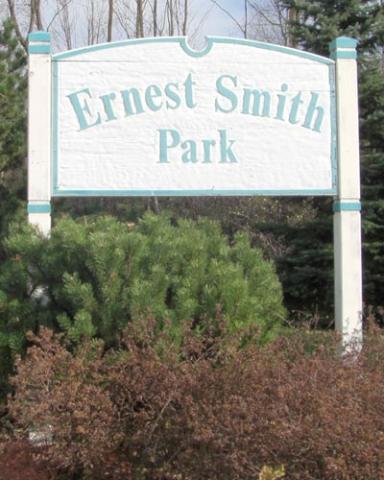
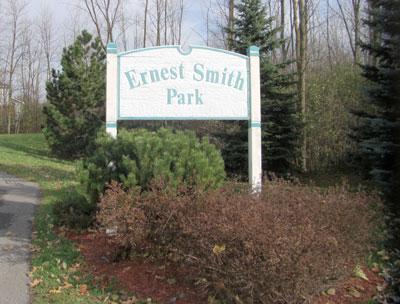
Ernest Smith Park was named in memorial to Private Ernest Alvia Smith. The park features a biographical plaque on Private Smith, and was erected by the City of Ottawa and Royal Canadian Legion Branch 638.

City
Ottawa (Kanata)
Country
Type Description
Park, sign and plaque
Memorial CF Legacy ID
9216
City/Municipality
Ottawa (Kanata)
Memorial Number
35040-011
Type
Address
55 Bellrock Drive
in Canada
Yes
GPS Coordinates
45.3180634, -75.8949725
Inscription

[plaque/plaque]

[top centre/en haut au centre]

(imagee of the Military Cross/Image de la Croix militaire

[top right/en haut a droite]

Image: Military Cross/Croix militaire
Credit: National Defence/Defense Nationale
Image: Ed Hollyer
Credit: Ed Hollyer Collection

[text on left/texte à gauche]

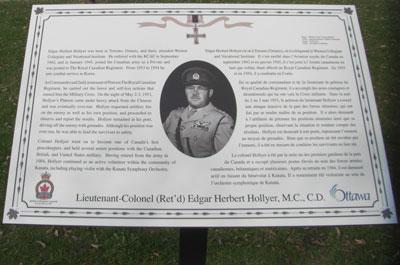
Edgar Herbert Hollyer was born in Toronto, Ontario, and there, attended Weston
Collegiate and Vocational Institute. He enlisted with the RCAF in September
1942, and in January 1945, joined the Canadian army as a Private and
was posted to The Royal Canadian Regiment. From 1953 to 1954 he
saw combat service in Korea

As Commander and 2nd Lieutenant of platoon The Royal Canadian
Regiment, he carried out the brave and self-less actions that
earned him the Military Cross. On the night of May 2-3, 1953,
Hollyer`s platoon came under heavy attack from the Chinese
and was eventually over-run. Hollyer requested artillery fire
on the enemy as well as his own position, and proceeded to
observe and report the results. Hollyer remained at his post,
drivinig off the enemy with grenades. Although his position was
over-run, he was able to lead the survivors to safety

Colonel Hollyer went on to become one of Canada`s first
peacekeepers, and held several senior positions with the Canadian,
British, and United States military. Having retired from the army in
1984, Hollyer continued as an active volunteer within the community of
Kanata, including playing violin with the Kanata Symphony Orchestra.

[text on right/texte à droite]

Edgar Hervert Hollyer est né à Toronto (Ontario), où il a fréquenté le Weston Collegiate
and Vocational Institute. Il s`est enrôlé dans l`Aviation royale du Canada en
septembre 1942 et en janvier 1945, il s`est joint à l`Armée canadienne en
tant que soldat, étant affecté au Royal Canadian Regiment. En 1953
et en 1954, il a combattu en Corée.

En sa qualité de commandant et de 2e lieutenant de peloton du
Royal Canadian Regiment, il a accompli des actes courageux et
désintéressés qui lui ont valu la Croix militaire. Dans la nuit
du 2 au 3 mai 1953, le peloton du lieutenant Hollyer a essuyé
une attaque massive de la part des forces chinoises, qui ont fini par se rendre maître de sa position. Il a alors demandé
à l`artillerie de pilonner les positions ennemies ainsi que sa propre position, observant la situation et rendant compte des
résultats. Hollyer est demeuré à son poste, repoussant l`ennemi
au moyen de grenades. Bien que sa position ait été envahie par
l`ennemi, il a été en mesure de conduire les survivants en lieu sûr.

Le colonel Hollyer a été par la suite un des premiers gardiens de la paix
du Canada et a occupé plusieurs postes élevés au sein des forces armées
canadiennes, britanniques et américaines. Après sa retraite en 1984, il est demeuré
actif en faisant du bénévolat à Kanata. Il a notamment été violoniste au sein de l`orchestre symphonique de Kanata

[at bottom/en bas]

[left corner/coin gauche]

(crest of the Royal Canadian Legion/insigne de la Légion Royale Canadienne)
ROYAL CANADIAN LEGION
Kanata Branch 638
[at centre/au centre]

Lieutenant-Colonel (Ret`d) Edgar Hervert Hollyer, M.C., C.D.

[right corner/coin droit]

Ottawa

[park sign/pancarte de parc]
[front/devant]

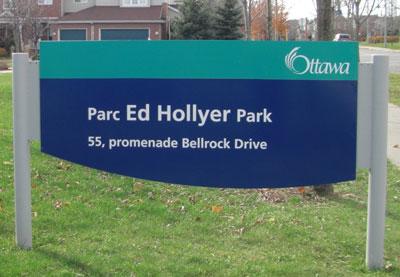
Parc Ed Hollyer Park

55, promenade Bellrock Drive

Image
Photo Credit
Richard Turcotte
Caption
park sign
1 of 2 images
Image
Caption
plaque
1 of 2 images
War or Conflict Term
Province
!4v1626718541288!6m8!1m7!1sPiYzw-LnyfgClZBbQntRZA!2m2!1d45.31806344417486!2d-75.89497247785569!3f96.1391831931915!4f0.37200238272806984!5f1.5051878233171778
Body Content

This memorial park was erected by the city of Ottawa assisted by the Royal Canadian Legion Branch 638 (Kanata), and is dedicated to Lieutenant-Colonel Edgar Herbert Hollyer, M.C., C.D..

City
Ottawa (Kanata)
Country
Type Description
Park, sign and plaque
Memorial CF Legacy ID
8515
City/Municipality
Ottawa (Kanata)
Memorial Number
35040-005
Type
Address
1 Bishops Mills Way
in Canada
Yes
GPS Coordinates
45.3205206, -75.8930321
Inscription

[plaque/plaque]

[text on left/texte à gauche]

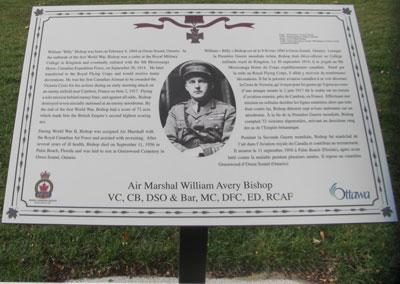
William "Billy" Bishop was born on February 8, 1894 in Owen Sound, Ontario. At
the outbreak of the first World War, Bishop was a cadet at the Royal Military
College in Kingston and eventually enlisted with the 9th Mississauga
Horse, Canadian Expedition Force, on September 30, 1914. He later
transferred to the Royal Flying Corps and would receive many
decorations. He was the first Canadian Airman to be awarded the
Victoria Cross for his actions during an early morning attack on
an enemy airfield near Cambrai, France on June 2, 1917. Flying
a solo mission behind enemy lines, and against all odds, Bishop
destroyed seven aircrafts stationed at an enemy aerodrome. By
the end of the first World War, Bishop had a score of 72 aces
which made him the British Empire's second highest scoring ace.

During World War II, Bishop was assigned Air marshall with
the Royal Canadian Air Force and assisted with recruiting. After
several years of ill health, Bishop died on September 11, 1956 in
Palm Beach, Florida and was laid to rest at Greenwood Cemetery in
Owen Sound, Ontario.

[text on right/texte à droite]

William « Bishop » est né le 8 février 1894 à Owen Sound, Ontario. Lorsque
la Première Guerre mondiale éclata, Bishop était élève-officier au Collège
militaire royal de kingston. Le 30 septembre 1914, il se joignit au 9th
Mississauga Horse du Corps expéditionnaire canadien, passé par
la suite au Royal Flying Corps, il allait y recevoir de nombreuses
décorations. Il fut le premier aviateur canadien à se voir décerner
la Croix de Victoria, qu`il reçut pour les gestes qu`il posa au cours
d`une attawue menée le 2 juin 1917 tôt le matin sur un terrain
d`aviation ennemi, près de Cambrai, en France. Effectuant une
mission en solitaire derrière les lignes ennemies alors que tout
était contre lui, Bishop détruisit sept avions stationnés sur un
aérodrome. À la fin de la Première Guerre mondiale, Bishop
comptait 72 victoires répertoriées, arrivant au deuxième rang
des as de l`Empire britannique.

Pendant la Seconde Guerre mondiale, Bishop fut maréchal de
l`air dans l`Aviation royale du Canada et contribua au recrutement.
Il mourut le 11 septembre 1956 à palm Beach (Floride), après avoir
lutté contre la maladie pendant plusieurs années. Il repose au cimetière
Greenwood d`Owen Sound (Ontario)


[bottom left corner/en bas coin gauche]

(crest of the Royal Canadian Legion/insigne de la Légion Royale Canadienne)
ROYAL CANADIAN LEGION
Kanata Branch 638

[centre/au centre]

Air Marshal William Avery Bishop
VC, CB, DSO & Bar, MC, DFC, ED, RCAF

[right corner/coin droit]

Ottawa

[park sign/pancarte de parc]

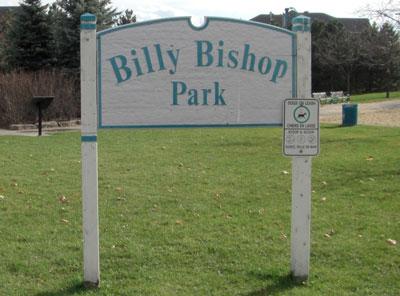
Billy Bishop
Park

Image
Photo Credit
Richard Turcotte
Caption
park sign
1 of 2 images
Image
Photo Credit
Richard Turcotte
Caption
plaque
1 of 2 images
Province
!4v1626718354785!6m8!1m7!1sHNeD3QQUuVLQJ4HYTeTnyA!2m2!1d45.32052062033792!2d-75.89303207741943!3f135.0089050383167!4f3.8888177879816936!5f0.8095570188466561
Body Content

This memorial park was erected by the city of Ottawa assisted by the Royal Canadian Legion Branch 638 (Kanata), and is dedicated to Air Marshal William Avery Bishop, V.C., C.B., D.S.O. & Bar, M.C., D.F.C., E.D., R.C.A.F.

City
Ottawa (Kanata)
Country
Type Description
Park, sign and plaque
Memorial CF Legacy ID
8514