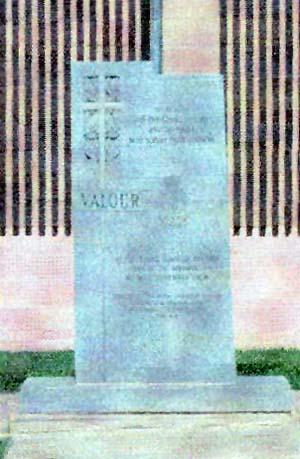
This street commemorates those who fought at the Battle of Vimy Ridge in the First World War.
Vimy Avenue
needs further research/recherche incomplète
My VAC Account
My VAC Accountneeds further research/recherche incomplète
This street commemorates those who fought at the Battle of Vimy Ridge in the First World War.
needs further research/recherche incomplète
This street commemorates those who served in the Korean War.
needs further research/recherche incomplète
This street commemorates those who fought at the Gothic Line in the Second World War.
In the last week of August 1944, the entire Canadian Corps began its attack on the Gothic Line with the objective of capturing Rimini. On August 25, the Canadians crossed the Metauro River, the first of six rivers lying across the path of the advance. They moved on to the Foglia River to find that the Germans had concentrated their forces here. It required days of bitter fighting and softening of the line by Allied air forces to reach it.
On August 30, two Canadian brigades crossed the Foglia River and fought their way through the Gothic Line. On September 2, General Burns reported that; "the Gothic Line is completely broken in the Adriatic Sector and the 1st Canadian Corps is advancing to the River Conca." The announcement was premature for the enemy recovered quickly, reinforced the Adriatic defence by moving divisions from other lines and thus, slowed the advance to Rimini to bitter, step-by-step progress. Five kilometres south of the Conca, the forward troops came under fire from the German 1st Parachute Division, while heavy fighting was developing on the Coriano Ridge to the west. By hard fighting, the Canadians captured the ridge and it appeared that the Gothic Line was finally about to collapse. The Canadians battled for three more weeks, however, to take the hill position of San Fortunato which blocked the approach to the Po Valley.
needs further research/recherche incomplète
This street commemorates those who fought at Apeldoorn in the Second World War.
An assault on Arnhem began on April 12, 1945 and, after two days of intense house-to-house fighting, the town was liberated. The 5th Canadian Armoured Division then dashed northward to the Ljsselmeer River, some 50 kilometres away, to cut off the enemy forces in Apeldoorn facing the 1st Canadian Division. The Canadians liberated Apeldoorn on April 17.
needs further research/recherche incomplète
This street commemorates those who fought at the Battle of the Rhineland in the Second World War.
Mons Avenue
On 11 November 1918, the last day of the First World War, Canadian forces captured the Belgian town of Mons — liberating a place that had been under German occupation since 1914. This street commemorates those who fought at Mons.
needs further research/recherche incomplète
This street commemorates those who fought at Mount Sorrel in the First World War.
The Honour “Mount Sorrel” was awarded for the successful defence against a German attack on the high ground east of Ypres and the counter-attack that successfully regained all positions. The newly formed 3rd Canadian Division (Major-General M.S. Mercer) was placed in the line with four battalions forward. Early on 2 June 1916 Mercer had gone forward with the commander of the 8th Brigade (Brigadier-General V.A.S. Williams) to inspect the brigade's forward defences. The two senior officers were in the trenches of the 4th Canadian Mounted Rifles when, at 0600 hours, the Germans unleashed an enormous barrage on the Canadian positions in the area of Hills 60 and 62 east of Ypres.
The German attack was fiercest in the area between 8th and 7th Brigades (Brigadier-General A.C. Macdonell), almost wiping out the 4th Canadian Mounted Rifles. Under intense bombardment, and in the face of well-planned infantry assaults, Canadian units fiercely defended their positions in all areas of the front. Reinforcements were moved in throughout the day and stopped the German advance. Lieutenant-General Byng, the Canadian Corps Commander, ordered a counter-attack for the night of 2/3 June. Delayed until the morning, the attack did close a gap in the Canadian line, but did not accomplish its objective due to the attacking units having made an uncoordinated start.
The Germans now had a commanding position overlooking the Canadian lines. They consolidated their gains by digging in and setting up machine gun positions and barbed wire to defend their new positions. While the Canadian Corps planned a counter attack, the Germans struck near Hooge detonating two large mines but the 6th Brigade holding that area continued to resist despite suffering heavy losses.
Carried out mainly by the 1st Canadian Division (Major-General A.W. Currie), the counter-attack placed a heavy emphasis on the use of artillery. A large number of guns from other British formations were placed at the disposal of the Canadian Corps. The artillery was used to prevent enemy consolidation in front and support lines and to destroy German batteries. Four large barrages fell on the Germans to deceive them as to the beginning of the assault.
The Canadian assault was launched at 1:30 am on 13 June. Covered by a heavy barrage of artillery, behind a smoke screen and under intense rain, the Canadians achieved surprise. In about an hour all of the ground lost since 2 June had been retaken. The Germans did attempt two counter-attacks on the morning of the 14th but these were broken up by artillery fire. The line was re-established almost exactly where it had been before the attack on the 2nd of June 1916, the Canadian Corps having suffered approximately 8,000 casualties.
needs further research/recherche incomplète
This street commemorates those who fought at the Battle of Flers-Courcelette in the First World War.
When the Canadian Corps moved from the Ypres Salient to the Somme River region at the beginning of September 1916, its first major action was the Battle of Flers-Courcelette—a two-army assault launched by Sir Douglas Haig on September 15.
In the offensive that began at dawn, the Canadian Corps assaulted on a two-kilometre front near the village of Courcelette. Advancing behind a creeping barrage (a tactic only recently adopted by the artillery), the infantry was aided by the "new engine of war", the armoured tank, which frequently threw the enemy into complete confusion. The attack went well. By 8:00 a.m. the main objective, a defence bastion known as the Sugar Factory, was taken, and the Canadians pushed ahead to Courcelette. Numerous German counter-attacks were successfully repulsed and by the next day the position was consolidated.
needs further research/recherche incomplète
This street commemorates those who fought at San Fortunato in the Second World War. Canadians battled for three weeks to take the hill position of San Fortunato which blocked the approach to the Po Valley, Italy.
needs further research/recherche incomplète
This street commemorates those who fought at the Battle of Somme in the First World War.