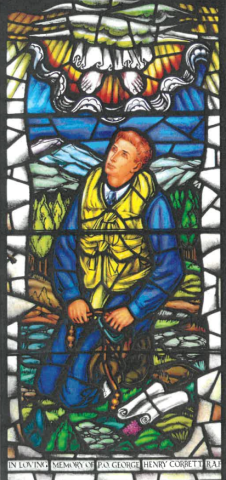
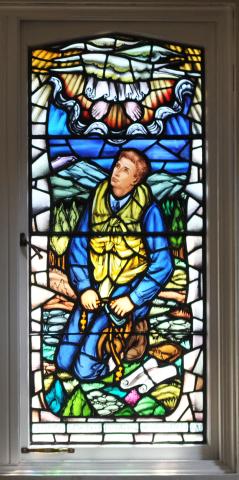
The war memorial stained glass window at Saint Luke Anglican Church honours parishioners who served and died in military service. E.g. Flying Officer Roy James Cook.
Saint Luke Anglican Church War Memorial Window
My VAC Account
My VAC Account
The war memorial stained glass window at Saint Luke Anglican Church honours parishioners who served and died in military service. E.g. Flying Officer Roy James Cook.
163 names around the podium
WEST FACING
Afghanistan 2001-2014
In honour of those members of the Canadian Armed Forces and Public Service of Canada
Who served during the Afghanistan Mission
Named in rememberance are those who made the supreme sacrifice
EAST FACING
En l'honneur des membres des Forces armées canadiennes et de la fonction publique du Canada
Qui ont servi pendant la mission en Afghanistan
En hommage a ceux qui ont consenti le sacrifice ultime
SOUTH FACING
Those who returned with Mental or Physical Wounds
Ceux qui sont revenus avec des blessures physiques et mentales
NORTH FACING
The Families and Loved ones
Les familles et les proches
Located in the provincial capital Victoria, the BC Afghanistan Memorial recognizes the 40,000 Canadians that served in Canada’s longest military campaign and honour those 163 that paid the supreme sacrifice for our country. The Greater Victoria Afghanistan Memorial Project Society designed, purchased and donated the memorial to Her Majesty the Queen, in the Right of British Columbia. The granite monument was quarried and manufactured in Stanstead, Quebec. On 30 September 2017 the BC Afghanistan Memorial was unveiled and dedicated by the Lt. Gov of BC in a ceremony witnessed by over a thousand of our citizens.
save on foods
MEMORIAL CENTRE
In May 1944, representatives from the Kinsmen Club and Board of Trade raised the idea of a memorial arena, and soon the good citizens of Victoria were contributing to a building fund, raising $65,000. The first estimates were $215,000, so the city covered the shortfall with a $150,000 loan. The total cost in the end would be $1.2 million. The building was the first all-concrete arena built in Canada and the official opening ceremony on September 25 drew 2,000 people.
Victoria Memorial Arena was built by efforts of Second World War Veterans in honour of those from the area who had given their lives in that war. The arena stood until 2003 when it was demolished to make room for the present Save-On-Foods Memorial Centre.
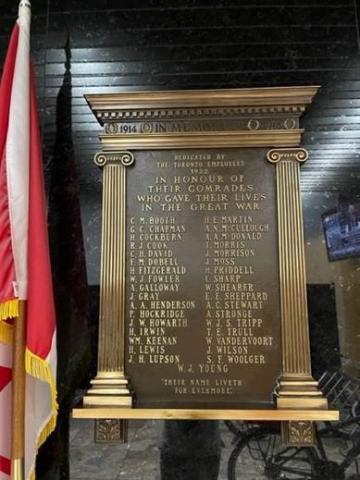
This Roll of Service was erected in honour of members of St. Andrews Lodge No. 49 A.F. & A.M. who served in the First World War. It was presented to the Lodge by Brother E.B. Mckay in memory of Brother Captain J.H. McGregor.
The Observation Post commands one of the most dramatic views in the city, overlooking the Straits and the Gulf Island. Gonzales Hill is an undeveloped natural area (1.99 hectare) in a residential neighborhood, accessible from Denison Road. What remains of the observation Post is the concrete bunker - originally disguised as a residence, with peaked roof and awning-covered windows - which housed the range finder. This was the foundation of the "house " constructed as a blind during WWII.
The Fortress Observation Post Gonzales was built using civilian contractors during the years 1938-1940 by the Department of Defence as part of a World War II fortress observation system It was one of four in the fortress system network, the others being at Mt. Tolmie, Mary Hill (William Head), and Church Hill. (Smythe Head). Only Gonzales and Mt Tolmie remain. The Post features a Barr-Stroud Range Finder, which was trained on the Juan de Fuca Strait and on houses below the building. ostensibly to pick up any signaling, etc. It was one of several in a Victoria-Esquimalt area network and was an observation post, never a gun emplacement. Significant information was transmitted to Fort Rodd Hill Plotting room. The Gonzales Post was the link to the easternmost anchor gun battery, and protected the naval Base and the shipping lines. The post was operational from 1942 until the early fifties.
This Roll of Honor was erected in memory of members of A.F. & A.M. Vancouver & Quadra Lodge No. 2 First World War Roll of Honor who served in the First World War.
[Merchant Navy window/fenêtre de la marine marchande]
I GO TO PREPARE A PLACE FOR YOU
MERCHANT NAVY
[Navy window/fenêtre marine]
IN THE BEGINNING WAS THE WORD
ROYAL CANADIAN NAVY
[Air Force window/fenêtre de l’Armée de l’air]
AND THEY STRAIGHTAWAY LEFT
THEIR NETS AND FOLLOWED HIM
AND IN HONOUR OF ALL WHO SERVED IN THE SECOND GREAT WAR 1939-1945
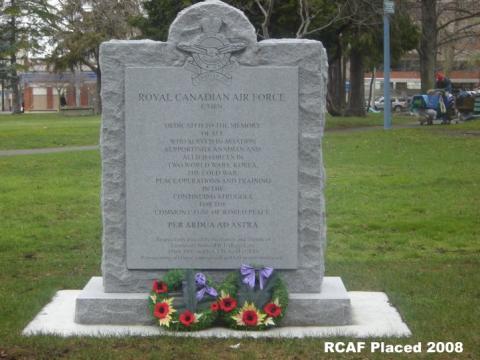
ROYAL CANADIAN AIR FORCE
[Army window/fenêtre de l’armée]
THIS IS MY BELOVED SON
IN WHOM I AM WELL PLEASED
TO THE GLORY OF GOD AND IN LASTING REMEMBERANCE OF THOSE WHO GAVE THEIR LIVES
THE CANADIAN SCOTTISH
DEAS GU CATH
The four windows on the north wall below the balcony were installed in 1946 as a memorial to those who died in the Second World War.
The Navy window is a Christmas scene and bears the fouled anchor of the Navy and the burning bush representing the Presbyterian Church.
The Army window depicting the baptism of Jesus. It displays the crests of Canada and the Canadian Scottish Regiment, this is seen in the left-hand column. At the time, the Rev J. Lewis Mclean was also the chaplain of the Canadian Scottish Regiment. "To the Glory of God and in lasting remembrance of those who gave their lives" "The Canadian Scottish" "This is my beloved son in whom I am well pleased"
The Air Force window depicts Christ calling his disciples and the ascension. It depicts the Air Force crest is paired with the crest of British Columbia
The Merchant Navy window depicts Christ calling his disciples and the ascension. It depicts the Merchant Navy crest with the image of Queen Victoria representing the City.
The windows were made in Toronto by Meikle Studios.
Christ Church Cathedral Memorial Hall is a two-storey stone Gothic Revival building which includes an auditorium, classrooms for Sunday School, a work room, guild room, recreation hall and synod office for the church. The Memorial Hall was completed before construction of the Christ Church Cathedral (which the hall was originally meant to be connected to) began, and was intended for use as a church hall. It was designed by architect John Charles Malcolm Keith. The hall was used for church functions and offices from 1923 until it was converted to an independent religious school, Christ Church Cathedral School, in 1989. It is dedicated to the memory of those who had fallen in the First World War.
WORLD WAR ONE
1914 - 1918
LEST WE FORGET
CANADIAN MERCHANT NAVY
MARINE MARCHANTE CANADIENNE
1914-18 1950-53
THE LIFELINE OF THE WORLD
(needs further research/recherche incomplète)
These stones are located in front of the Oak Bay Cenotaph. They contain plaques dedicated to the First World War, Korea, Peacekeepers and the Canadian Merchant Navy.
When Peace Comes is a monument of gratitude for the Canadian Forces, Liberators and Peacekeepers. Created from white Vancouver Island Marble that stands six and a half feet high, this liberating sculpture of peace has some very powerful symbols of transition and transformation on it. We all view things through the lenses of our own life experiences and we engage with memorials or art from that place of personal reference.
For sculptor, Maarten Schaddlelee, this sculpture represents a thank you to the soldiers and Canada for his family's peace in Holland and their new beginnings here in this land of peace. The hand and the sword represent the foe. Peace Comes is represented by the dove symbolizing Canadian Soldiers who liberated Holland by offering their lives for the freedom of the Dutch people. The illumination around the dove is the creation of peace and the prayer of keeping the peace. It was also a personal thank you to his wife Nadina's father William John Workman Stewart, a Canadian soldier, who was one of the liberators of Holland.
The flags behind the memorial are: National Flag of Canadian, Royal Union Flag, Red Ensign – Army (1957-65), White Ensign – Navy, Blue Ensign – Air Force and Red Ensign – Merchant Navy (1922-57). A sponsor’s plaque of polished granite is mounted on an abutting wall behind the curve of the memorial.