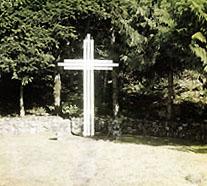
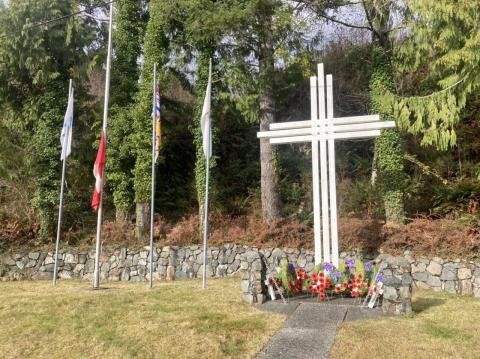
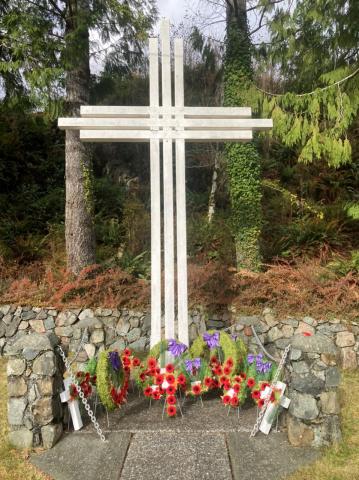
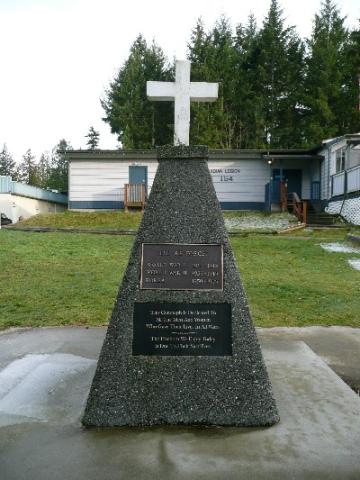
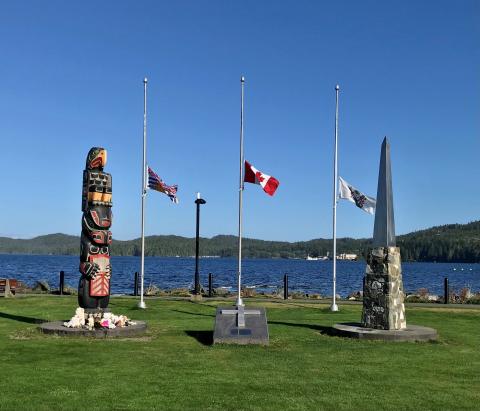
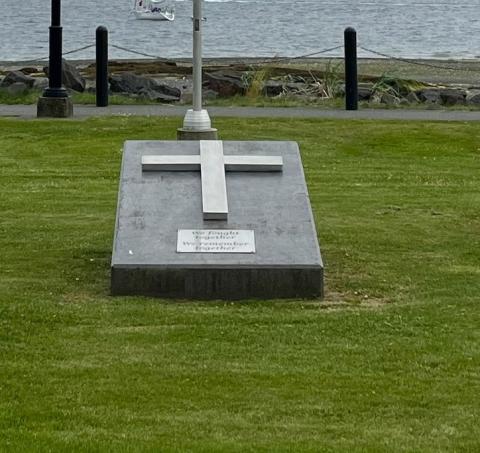
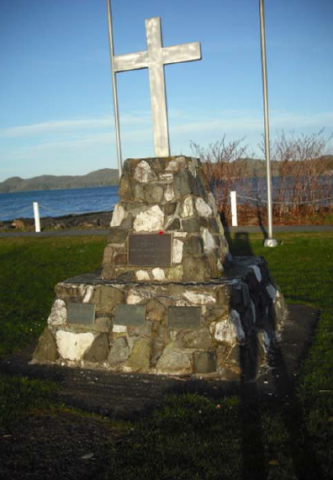
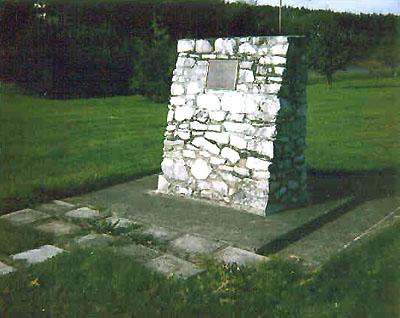
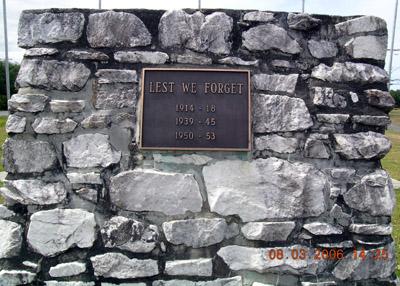
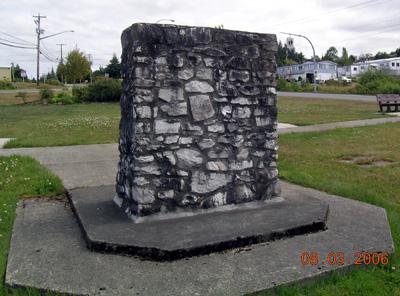
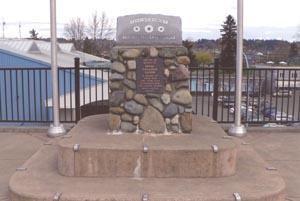
Monument in the Village of Tahsis, British Columbia constructed in memory of all war veterans.
Tahsis Memorial Cross
(no inscription/pas d'inscription)
Sign in to My VAC Account
Sign in to My VAC Account(no inscription/pas d'inscription)
Monument in the Village of Tahsis, British Columbia constructed in memory of all war veterans.
[top plaque/plaque du haut]
LEST WE FORGET
WORLD WAR I 1914 - 1918
WORLD WAR II 1939 - 1945
KOREA 1950-1953
[bottom plaque/plaque en bas]
This Cenotaph Is Dedicated To
All The Men And Women
Who Gave Their Lives In All Wars.
The Freedom We Enjoy Today
Is Due To Their Sacrifices.
Needs further research
[plaque]
IN MEMORY OF
THOSE WHO LAID DOWN THEIR LIVES
FOR THEIR COUNTRY
[plaque]
WORLD WAR
I
1914 - 1918
[plaque]
WORLD WAR
II
1939 - 1945
[plaque]
KOREA
1950 - 1953
The original Port Hardy Cenotaph at Carrot Park was built in 1982 by a group of local Veterans. By the year 2000, cracks in the mortar caused pieces to fall out. Soon pieces of rock fell out, the plaques loosened and the cross bent, showing signs of corrosion. The damage was due to years of the park being flooded and strong winds blowing salt water onto the cenotaph.
The Port Hardy and First Nations Cenotaph/Memorial Committee was formed and restoration work began on August 6, 2016. Funding was provided from the Cenotaph Restoration Program (District and Federal government), Port Hardy Royal Canadian Legion, 101 squadron, and Port Hardy Rotary Club. The cenotaph was rebuilt, using all of the facial parts from the old one, and erected on a new foundation. The cross was installed on its own foundation placed in the center of the cenotaph and the Memorial Pole. The refurbished flag poles were also moved to their new location. The new Port Hardy Cenotaph was officially unveiled on November 11, 2016.
The Memorial Pole was also restored and erected on a foundation to the left of the cross.
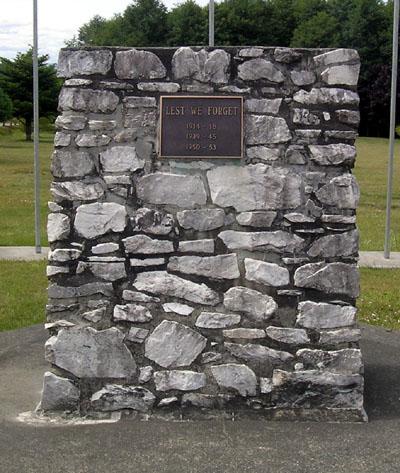
[plaque/plaque]
LEST WE FORGET
1914-18
1939-45
1950-53
Constructed by Mr. Robert Bowes, in 1985, a war veteran and member of the local Royal Canadian Legion Branch, this memorial is dedicated to the memory of the First and Second World Wars and the Korean War. Flag poles, stepstones and benches have been added to the area over the years. The Public Works department of the Town of Port McNeill care for the area the memorial.
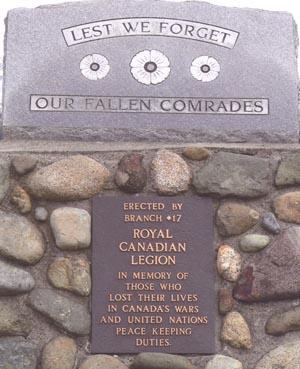
LEST WE FORGET
OUR FALLEN COMRADES
ERECTED BY
BRANCH #17
ROYAL
CANADIAN
LEGION
IN MEMORY OF
THOSE WHO
LOST THEIR LIVES
IN CANADA'S WARS
AND UNITED NATIONS
PEACE KEEPING
DUTIES
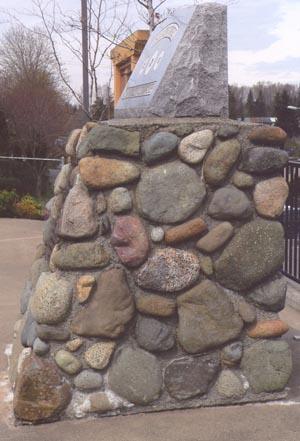
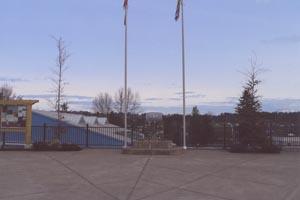
Constructed in 1996 in Memory of fallen comrades of the First and Second World Wars. Erected and paid for by Branch 17, Royal Canadian Legion of Courtenay. The work was done by the City of Courtenay. Inauguration Ceremony conducted July 1, 1997 by Reverend Ray Brandon, Legion Padre. Other dignitaries included Legion president Roche St. Pierre and city council member Doug Bell.
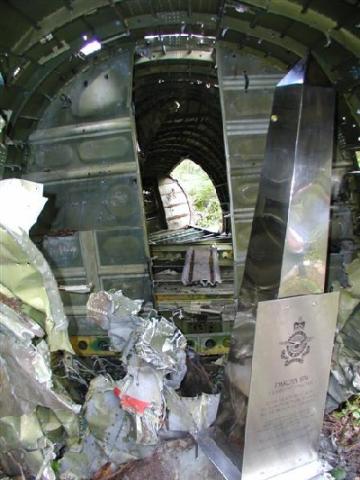
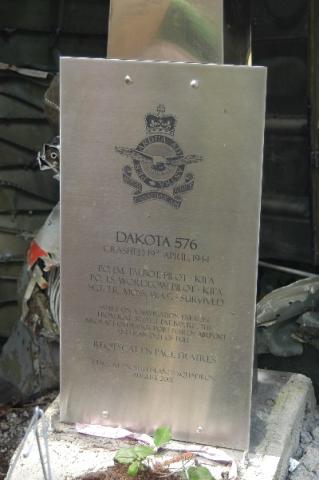
[front/devant]
DAKOTA 576
CRASHED 19TH APRIL, 1944
P.O. J.M. TALBOT, PILOT - KIFA
P.O. T.S. WORDLOW, PILOT - KIFA
SGT. T.R. MOSS, W.A.G. - SURVIVED
WHILE ON A NAVIGATION EXERCISE
FROM R.A.F. 32 O.T.U. PAT BAY, B.C. THE
AIRCRAFT OVERSHOT PORT HARDY AIRPORT
AND RAN OUT OF FUEL.
REQIESCAT EN APCE FRATRES
101 R.C.A.F. (NORTH ISLAND) SQUADRON,
AUGUST 2001
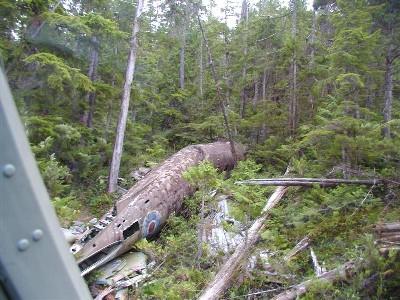
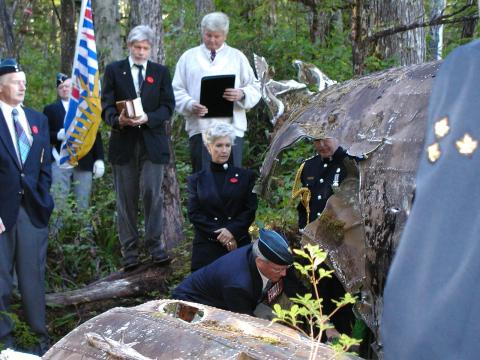
On 19 April 1944, Dakota 576 crashed into a rock killing two of the crewmen, Pilot Officer J.M. Talbot and Pilot Officer T.S. Wordlow. The wireless air gunner, Sgt. T.R. Moss was found the next day in shock but survived.
needs further research/recherche incomplète
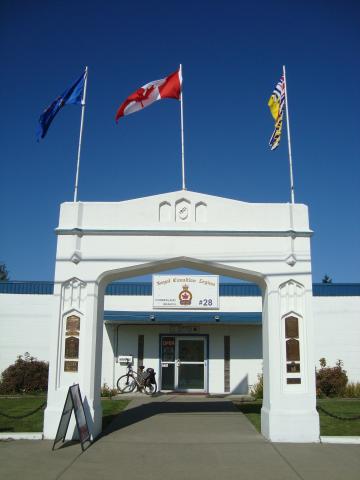
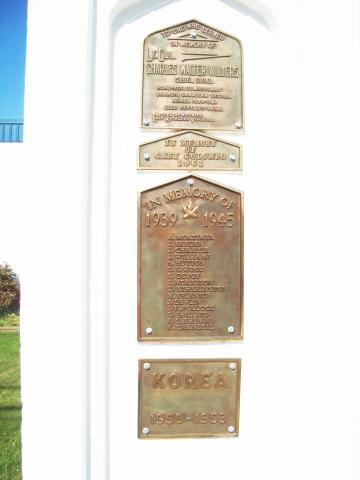
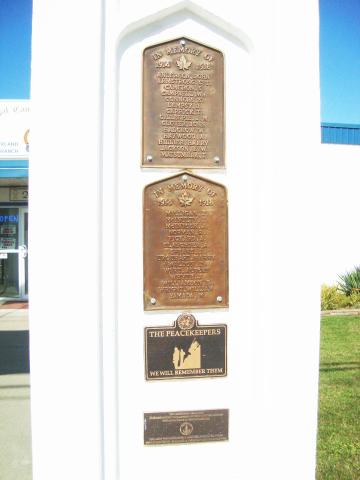
[Excerpt from Cumberland heritage: A selected history of people, buildings, institutions and sites, 1918 -1950. by Jennifer Nell Bar; Corporation of the City of Cumberland,p129-131] In 1997, the Town of Cumberland made the arch and the front 14 bollards and chain a historic site. Later that year, the Canadian Scots Regiment from Victoria, British Columbia, placed a tablet in memory of local men and women who served with the Canadian Scots. On 11 November 1918, the day Armistice was signed in France to end the First World War, Cumberland was in the middle of the Spanish Influenza epidemic. All public places were closed by order of city council. However, at two o'clock in the morning, the church bells and fire bell began ringing, and the whistles of the locomotives in the WCR round house began blowing. The phones rang throughout town, the city lit up and, by five o'clock, the citizens of Cumberland were celebrating in the streets and decorating Dunsmuir Avenue. On the first anniversary of Armistice Day in 1919, the citizens celebrated with a masquerade ball, which was hailed as the "first annual". Although the balls continued for several years on another day, it was felt that it would be more fitting to commemorate 11 November with a memorial ceremony to the dead rather than with a celebration. In 1919, the city showed its appreciation to the men who had gone overseas to fight by giving a lot to GWVA so they could build a Memorial Hall. The hall, designed by William Arthur Owen and built by H. Trehearne of Courtenay, was officially opened in October 1920. A dance hall, added in March 1922, was used by many organizations for banquets and formal functions. In 1921, the GWVA built a Memorial Arch in front of the Hall. On this Arch, they placed tablets with the names of 28 local people, including two Japanese-Canadians, who lost their lives in the service of their country during the First World War. This Arch was also designed by Owen, and the bronze tablets were manufactured by Henry Birks and Sons, Montreal. Following the Second World War, the names of the 15 locals who died in that conflict were placed on the Arch, as was a later plaque honouring all local Korean War veterans. Those who died have a maple leaf beside their names. The Tudor-arch shape of the main structure of the Memorial Arch is echoed in three inset panels at the top and long panels down the front sides. The Arch, in turn, echoed the front entrance and window shapes on the Memorial Hall. The original roughcast stucco gave much more definition to the recessed forms than the modern flat-coloured stucco. The poured concrete bollards linked with heavy chains which outline the property are contemporary with the arch, although the ground level around them had risen. The GWVA became the Royal Canadian Legion of the British Empire Service League in 1926, and Cumberland Branch was instituted as No.28. When the original Memorial Hall was gutted by fire on 17 April 1962, it was replaced by a smaller, one-story concrete block building.
[stele/stèle]
IN GRATITUDE
TO ALMIGHTY GOD
THROUGH WHOM ALONE
VICTORY IS SECURED.
TO COMMEMORATE
FOREVER
THE COURAGE AND DEVOTION
OF SIX HUNDRED AND SEVENTY SIX
OFFICERS AND MEN
OF THE 102ND BATTN
NORTH BRITISH COLUMBIANS
WHO SACRIFICED THEIR LIVES
FOR LIBERTY AND JUSTICE.
“LAMENT NO MORE WE REST CONTENT”
TRAINED AT COMOX
AND DEPARTED OVERSEAS JUNE 10TH 1916
IN COMMAND OF LIEUT-COL. J.W. WARDEN DSO
[step/marche]
W.W. I
1914-1918
W.W. II
1939-1945
KOREA
1950-1953
IN MEMORY OF
THOSE WHO SERVED
THEIR COUNTRY
This memorial is dedicated to the men of the 102 Battalion North British Columbians who lost their lives in the First and Second World Wars and the Korean War. It was erected by the Town of Comox and the Royal Canadian Legion in front of the Post Office on Comox Avenue in approximately 1920.
In 1978 it was moved to the front of the Town Hall on Beaufort Avenue and it sat to the left of the entirely new Cenotaph built to include other casualties from all conflicts to that time.
In approximately 1995 it was determined that holding the Remembrance Day Parade on the sloping road at that site was very difficult for aging Veterans, who insisted on marching despite their age. Volunteers from Royal Canadian Legion Branch 160 poured the concrete slab and the original memorial was moved to the present site on Comox Avenue.
The granite plaques commemorating all First World War, Second World War and Korean casualties were relocated from the Cenotaph at Town Hall to the concrete apron in front of the this memorial. A granite plaque honouring “THOSE WHO SERVED THEIR COUNTRY” was added at that time. A Bronze plaque in honour of Peacekeepers was added by the Peacekeepers Association of Canada later.
The Cenotaph at Town Hall remains in its original location honoured by a plaque placed by The Town of Comox. There are Time Capsules, commemorating contemporary era, embedded in both of these Monuments.
[front/devant]
IN MEMORY OF ALL THOSE
WHO LAID DOWN THEIR LIVES
IN WORLD WARS.
1914 — 1918 - 1939 — 1945
LEST WE FORGET
[base/bas]
KOREA WAR VETERANS
1950 - 1953
[plaque]
THIS PLAQUE IS DEDICATED AS A
MEMORIAL IN HONOURED TRIBUTE
TO THE SERVICE, SACRIFICE AND
ACHIEVEMENT OF THE MEN OF
CAMPBELL RIVER AND DISTRICT
WHO GAVE THEIR LIVES IN
THE TWO WORLD WARS
1914 — 1918
1939 — 1945
"AT THE GOING DOWN OF THE SUN
AND IN THE MORNING
WE WILL REMEMBER THEM"
The Campbell River Cenotaph was spearheaded by Royal Canadian Legion Branch 137. A committee began fundraising in early 1952 and it became a community effort to erect a cenotaph with a brass plaque naming the fallen soldiers from the community. The land was donated by Carl Thulin, who also drove to Victoria to pick up and deliver the large stone monument. It was installed on the shores of Willow Bay, across from the Legion on the corner of 12th Street. The BC Power Commission donated rocks for a small seawall to protect the cenotaph and loaned their workmen for construction. A flagpole for the cenotaph was donated by the Village Commission.
The cenotaph was dedicated on Remembrance Day, 1952, but did not yet have a brass plaque naming those who were lost. Remembrance Day 1959 saw the last service at the cenotaph’s original location. It was relocated with the construction of the Tyee Plaza. The plaque was added in 1961, shortly after it had been reinstalled in the Tyee Plaza, with the names of 10 men from the First World War, and seven men from the Second World War.
During the construction of Spirit Square in 2009, the cenotaph was moved to its current location. Due to the efforts of the Campbell River Genealogical Society, the plaque was updated with two new names from the First World War and corrected spellings for four of the original names.
[upper plaque/plaque du haut]
ERECTED TO THE MEMORY
OF THE MEN AND WOMEN
WHO GAVE THEIR LIVES
IN WAR.
"THEY ARE COMPLETE
THEIR
WORK IS DONE
SO LET THEM
SLEEP IN ENDLESS REST."
[lower plaque/plaque du bas]
KOREA
1950 - 1953
Erected by Royal Canadian Legion Branch No. 198, this memorial is dedicated to the men and women killed during war. In the early years of the Legion Branch Activities, from 1948 to 1960, Remembrance Day Parades were held outside the Branch Building and if the weather was inclement, the actual service was held inside the neighbouring Community Hall Building where a white plywood Cenotaph was used. On June 23, 1961, at the Cenotaph Park, his Honour the Lt. Governor of B.C. George Pearkes unveiled the recently constructed rock cenotaph. In November 1980 a dedication of the newly reconstructed cenotaph was held. It was dedicated by Gov. General Edward Shryer around this time. On March 14, 1984 there was a motion passed to put the cenotaph in Village Square. There is no mention in the minutes of a dedication ceremony being held but there was a visit of the Lt. Governor to the Village on May 14, 1985 so it may have taken place then. The Municipal Engineer of that era, Dennis Smith, states that he, with his backhoe, and Art Granger with his forklift, moved the cenotaph from the Legion grounds and placed it in the Village Square in July 1984. The cenotaph is in a beautiful setting, right by the ocean with flags flying. And now there is also a fountain there in memory of the late Mayor Gilbert Popovich, who was also a dedicated Legion member. He was the Mayor for 27 years. Now, Mr. John Rowell, the Legion's bookkeeper, is the Mayor.