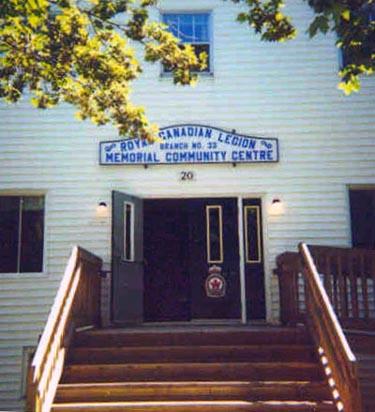
This Memorial Community Centre houses Royal Canadian Legion Branch No. 33.
Memorial Community Centre
[sign/enseigne]
ROYAL CANADIAN LEGION
BRANCH NO. 33
MEMORIAL COMMUNITY CENTRE
My VAC Account
My VAC Account[sign/enseigne]
ROYAL CANADIAN LEGION
BRANCH NO. 33
MEMORIAL COMMUNITY CENTRE
This Memorial Community Centre houses Royal Canadian Legion Branch No. 33.
[front/devant]
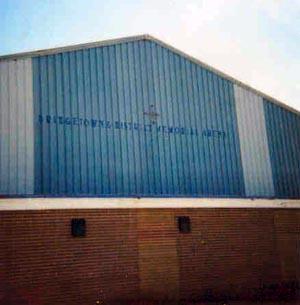
BRIDGETOWN & DISTRICT MEMORIAL ARENA
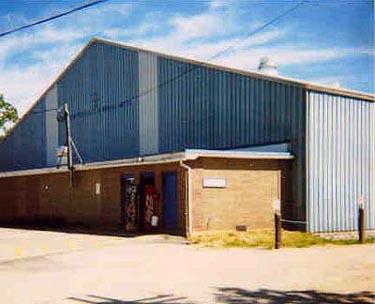
This building is the Bridgetown and District Memorial Arena.
429 SQUADRON 429
ROYAL CANADIAN
AIR FORCE
FORTUNAE NIHIL
THIS STONE WAS ERECTED BY MARK SMITH WHO SERVED OVERSEAS IN BOMBER COMMAND
IT IS DEDICATED TO ALL THE MEN & WOMEN, AIRCREW & GROUNDCREW, WHO SERVED AT LEEMING
YORKSHIRE ENGLAND DURING THE SECOND WORLD WAR IN BOMBER COMMAND SQUADRON 429 BISON.
BASIC PERIODS FOR THE 429 BISON SQUADRON
THE WELLINGTON NOV 1942 - AUG 1943. THE HALIFAX SUG 1943 - MAR 1945. THE LANCASTER MAR 1945 - MAY 1946
BOTH 427 LION SQUADRON AND 429 BISON SQUADRON WERE AT THIS STATION
(427 LION MAY 1943 - MAY 1946. 429 BISON AUG 1943 - MAY 1946)
THIS STONE IS ESPECIALLY DEDICATED TO ALL THE YOUNG AIRMEN WHO
PAID THE SUPREME SACRIFICE IN THE DEFENCE OF THEIR COUNTRY
(PART OF A POEM BY A MEMBER OF THE 429 SQUADRON)
WHEN YOU PRAY, DON'T PRAY FOR ME, NOR THE LADS WHOM I FLY.
FOR WE ARE ON A MISSION, AND WELL KNOW WE MAY DIE.
I'VE GOT TEH GRANDEST CREW AND THE BEST KITE IN THE WAR.
SO PRAY THAT STRENGHT AND COURAGE, WILL BE OURS FOR EVERMORE.
"WE WILL REMEMBER THEM"
429 Squadron Monument was unveiled in honour of the Second World War Bomber Command Squadron. It was designed and erected in 2009 by Second World War Veteran and former member of 429 Squadron, Mark Smith. He wanted to honour his comrades and keep the memories alive of the ultimate sacrifices these men gave for freedom.
Wanting something grander to honour his comrades, he designed and erected a second 429 Squadron Monument that was unveiled on April 1, 2011. Mark passed away before the unveiling.
[certificate/certificat]
FOR KING AND COUNTRY
MEMBERS OF
St. John's United Church
WHO HAVE VOLUNTEERED FOR ACTIVE SERVICE
WITH <
br> CANADA'S FIGHTING FORCES
(needs further research/recherche incomplète)
This certificate lists the names of the members of St. John's United Church who served during the Second World War.
[front/devant]
Roll of Honour
St. John's Presbyterian Church
First World War
(needs further research/recherche incomplète)
This certificate lists the names of the members of St. John's Presbyterian Church who served during the First World War.
[front/devant]
IN MEMORY OF THOSE WHOSE NAMES ARE INSCRIBED IN THE BOOK OF REMEMBRANCE
This memorial is dedicated to those whose names are written in the Book of Remembrance.
[corner stone]
SOLDIERS MEMORIAL HOSPITAL
THIS STONE WAS LAID BY
THE HONOURABLE
ROBERT LORNE STANFIELD QC, BCL
OCTOBER 12 1960
The first Soldiers Memorial Hospital was located on Gates Avenue. Several cottage hospitals were in use until Veterans Dr. John A. Sponagle and Melbourne P. Neily gathered support for a proper hospital. The Cox residence on Commercial Street was purchased, moved to Gates Avenue and Soldiers Memorial Hospital was opened on Armistice Day in 1921.
Funds for the new hospital were received from local organizations, private donations and other sources. The Imperial Order of Daughters of the Empire undertook the supply of equipment for the operating room and maintained it over the years. The Women's Institute provided all the kitchen equipment and linens.
In 1936, a committee comprised of Dr. Braine, Annapolis, Dr. O. R. Stone, Bridgetown, and Dr. L. R. Morse recommended an addition to the total number of beds to 27. In 1946, it was decided a completely new and modern hospital was needed. The present hospital site was purchased in that year from Mrs. B. B. Gwillam. Construction of the new hospital began in 1960 and the hospital was officially opened on August 2, 1961, with 69 beds. The corner stone for the Soldiers' Memorial Hospital was laid by the Honourable Robert Lorne Stanfield on October 12, 1960.
The expansion to 99 beds was carried out in 1967. The former maternity floor was renovated to house 22 beds for Veterans Affairs Canada patients and the first patients were admitted on March 19, 1984. A new Veterans Affairs Canada wing was built in 1986.
Lists the name, age, rank, trade, aircraft, target, and date killed in action.
[front center panel/panneau central avant]
ROYAL CANADIAN AIR FORCE
429 SQUADRON 429
ROYAL CANADIAN
AIR FORCE
FORTUNAE NIHIL
429 SQUADRON, BISON, WAS FOUNDED AT EAST MOOR,
YORKSHIRE, ENGLAND ON 7 NOVEMBER 1942 AS THE
RCAF'S 27TH TENTH BOMBER SQUADRON FORMED
OVERSEAS, THE UNIT FLEW WELLINGTON, HALIFAX
AND LANDCASTER AIRCRAFT ON STRATEGIC AND
TACTICAL BOMBING OPERATIONS.
AFTER HOSTILITIES IN EUROPE, IT REMAINED IN
ENGLAND AS PART OF BOMBER COMMAND'S STRIKE
FORC, UNDER WHICH IT AIRLIFTED ALLIED PRISONERS
OF WAR, AND BRITISH TROOPS FROM ITALY, BACK TO
ENGLAND. THE SQUADRON WAS DISBANDED AT
LEEMING, YORKSHIRE ON 1 JUNE 1946.
THE SQUADRON BADGE WAS AUTHORIZED BY KING
GEORGE VI, JUNE 1944, IT HAS A BISON, THE HEAD
LOWERED AND THE MOTTO FORTUNAE NIHIL (NOTHING
TO CHANCE).
ON DECEMBER 17, 1939 THE AGREEMENT CREATING
THE BRITISH COMMONWEALTH AIR TRANING PLAN
(BCATP) WAS SIGNED.
THE CANADIAN BOMBER GROUP FLEW MORE THAN
40,000 OPERATIONAL SORTIES AND DROPPED 126,122
TONS OF BOMBS AND MINES. NO FEWER THAN 814 AIR
CRAFT FROM 6 GROUP, WELLINGTONS, HALIFAX AND
LANCASTER HAD NOT COME BACK FROM OPERATIONS.
THE MISSION OF THE ALLIED FORCE WAS FULFILLED
AT 3 AM, LOCAL TIME, MAY 7, 1945. ALL HOSTILITIES
CEASE AT 2301 HOURS ON MAY 8, 1945, AND A FEW
HOURS LATER THE SURRENDER TERMS ARE FORMALLY
RATIFIED IN BERLIN.
IT SHOULD BE NOTED, THAT A BBC ANNOUNCER STATED
AT THE TIME, "HOSTILIITIES WILL END OFFICIALLY AT
ONE MINUTE AFTER MIDNIGHT TONIGHT, TUESDAY
THE 8TH OF MAY." CHURCHILL TELLS THE PEOPLE,
"BUT IN THE INTEREST OF SAVING LIVES THE FIRST
CEASE-FIRE BEGAN YESTERDAY AND WAS SOUNDED
ALONG ALL FRONTS."
AS WINSTON CHRUCHILL ONCE SAID AFTER THE WAR,
"THAT THE WORDS, 'FREEDOM', 'DEMOCRACY', AND
'LIBERATION' ARE NOT DISTORTED FROM THEIR
TRUE MEANING AS WE UNDERSTAND THEM."
429 Squadron Monument was unveiled on April 1, 2011, in honour of the Second World War Bomber Command Squadron. It was designed and erected by Second World War Veteran and former member of 429 Squadron, Mark Smith, who passed away before the unveiling. Mark wanted to honour his comrades and keep the memories alive of the ultimate sacrifices these men gave for freedom.
Mounted on the monument are flags of the United States of America, Royal Air Force, Royal Canadian Air Force, Canadian Red Ensign, Royal Australian Air Force and Royal New Zealand Air Force.
Mark had previously erected the first 429 Squadron Monument, but wanted something grander so had the second memorial built.
[left plaque/plaque gauche]
CANADA
MIDDLETON
MEMORIAL HOSPITAL
DEDICATED IN MEMORY OF THE FOLLOWING
WHO FELL IN THE GREAT WAR
1914-1919
[right plaque/plaque droite]
MIDDLETON
AND DISTRICT
DEDICATED IN MEMORY OF
THE FOLLOWING WHO FELL
IN THE SECOND WORLD WAR
1939-1945
The Middleton Memorial Hospital World Wars Plaques are dedicated to the memory of the local war dead of the First and Second World Wars. In 1921, the F.E. Cox residence on Commercial Street was purchased, moved to Gates Avenue, and converted into a hospital. The Soldiers Memorial Hospital became a corporate body under the laws of the province of Nova Scotia. The Hospitals' Board of Management was formed to direct the overall planning and operations of the hospital. Funds for the new hospital were received from local organizations, private donations and other sources.
The Imperial Order of Daughters of the Empire undertook the supply of equipment for the operating room and maintained it over the years. The workload of the hospital gradually increased over the years to the point where more space was needed. In 1936, a committee comprised of Dr. Braine, Annapolis, Dr. O.R. Stone, Bridgetown, and Dr. L.R. Morse, recommended an addition to the total number of beds at Soldiers Memorial Hospital to 27.
With the need for expansion again in 1946, it was decided to construct a new and modern hospital. The present hospital site, at the east end of the town, was purchased in that year from Mrs. B.B. Gwillam. With the advent of a Provincial Hospitalization Program and the opportunity to receive Federal and Provincial Construction Grants, construction of the new hospital began in 1960 and the hospital was officially opened in August 1961.
[front/devant]
TO • THE • MEN
THE • ROLL
A • SPENCER • ALLEN
TRUEMAN • M • ALLEN
ERNEST • J • AMIRAULT
LANDRY • AMIRAULT
LOUIS • R • AMIRAULT
FREDERICK • M • ANNABLE
JOSEPH • G • BAIN
PERCY • A • BARRYMAN
L • WOOLSEY • BINGAY
JOHN • BISHARA
G • W • LEE • BLACKADAR
BENJAMIN • D • BLAUVELT
ADELBERT • J • BORDEN
JOHN • M • BOUDREAU
EMILIEN • BOURQUE
ARTHUR • BURGESS
CAG • FRANK • CANN
JAMES • A • CANN
MALCOLM • CANN
JOSEPH • CHALLONER
NATHAN • L • CHIPMAN
COLIN • F • CHISHOLM
NATHAN • L • CHURCHILL
PIERRE • CLAIRMONT
ELKANAH • E • CLEMENTS
SIMON • CLEMENTS
FRANK • L • CORNING
RALPH • A • COSSSAR
(plaque)
TO THE GLORY OF GOD
AND DEDICATED TO THE MEMORY
OF THOSE PEOPLE OF
YARMOUTH
TOWN AND COUNTY
WHO GAVE THEIR LIVES IN
DEFENCE OF THEIR COUNTRY
AND FREEDOM'S CAUSE
1939 - 1945
THE HONOUR ROLL APPEARS
ON THE TABLETS ADJACENT
"Their names live forevermore"
(plaque)
IN MEMORY
OF
FALLEN
CANADAIN SOLDIERS
SERGEANT KIRK TAYLOR
TROOPER COREY HAYES
[right side/côté droit]
HENRI HERBERT 1922
OF • YARMOUTH • COUNTY
(plaque)
WORLD WAR II
1939 - 1945
HARRY WILLIAM DOUCETTE
WILLIAM JOSEPH MUISE
JAMES LOGAN HAMILTON
(plaque)
[back/arrière]
CLEMENT • C • JEFFERY
JOSEPH • B • JEFFERY
AMOS • R • JEFFERY
SIDNEY • J • JEFFERY
ALFRED • L • JOHNSON
HAROLD • KEEN
DONALD • KEHOE
JOSEPH • E • KING
FRANK • F • KINNEY
RAYMOND • KOHLIER
LOUIS • LAWRENCE
EUGENE • M • LEWIS
T • • HAROLD • LONG
ERNEST • S • MARSHALL
LLOYD • H • MARSHALL
EDGAR • K • S • MATTHEWS
BENJAMIN • H • MCGRAY
HORACE • J • MCLAUGHLIN
DONALD • L • MORINE
GEORGE • M • MOSES
WILLIAM • S • MOSES
JOHN • E • MOULAISON
ALBERT • J • MUISE
JOHN • ALFRED • MUISE
ARTHUR • MUISE
JOHN • E • MUISE
JOHN • F • MUISE
JOHN • R • MUISE
NELSON • MUISE
(plaque)
(plaque)
KOREAN WAR
1950 - 1953
IN HONOUR OF
THOSE WHO SERVED
AND
IN MEMORY OF
THOSE WHO DIED
LEST WE FORGET
EDWIN HERMAN GOODWIN
[left side/côté gauche]
AN • DOM • MCMXIV-MCMXIX
(plaque)
In November 1920, a banner headline in the Yarmouth Telegram read: "Local Council of Women Urge War Memorial", bringing the idea to construct a war memorial to the attention of everyone. A decision was made by the Town Council and a committee was appointed to proceed with the planning of a worthy memorial. In January, the tasks of collecting the money for the construction and collecting the list of names to be inscribed on the monument began.
The statue of a soldier was designed by Henri Hébert of Montreal. It is seven feet tall, cast in bronze and weighs 680 kilograms. The soldier wears a leather vest and leg wrappings over his puttees; his rifle is covered with a canvas to keep it dry. He is war-weary, caked in mud and has a cigarette stub between his lips. Hébert is the only artist to represent that cigarettes were common in a soldier's life.
The base section was designed and fabricated by Noble & Hyde of Montreal, an architectural firm that designed many monuments already erected in Canada. The granite was supplied by the Standard Granite quarries. The cost for the entire monument was $16,500, all of which was raised by volunteers canvassing for donations. At the time of the unveiling a sum of $10,272 had been collected, the remainder of the amount was collected after.
The monument was unveiled on June 9, 1923, by the sister of Malcolm Cann. Malcolm Cann along with three others, were the first Canadians to be killed in the line of duty in the First World War. At the time of the unveiling, there were 173 names to be put on the monument. A record was made of every man in Yarmouth County who fell, which included the date and place he was born, where he enlisted, where he died and the brigade in which he was serving at the time of his death. A copy of this record was kept in a vault at the Court House.
Following the end of the Second World War, bronze plaques with the names of those who had lost their lives were added around the base of the monument. After the Korean War, a separate granite marker was placed next to the base to commemorate those lost in that war.