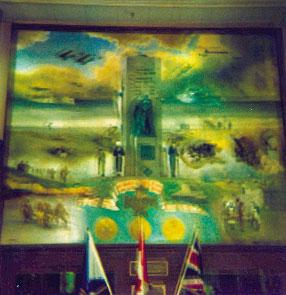
The mural is a representation of all services in war and peace.
Camp Hill Memorial Mural
Sign in to My VAC Account
The mural is a representation of all services in war and peace.
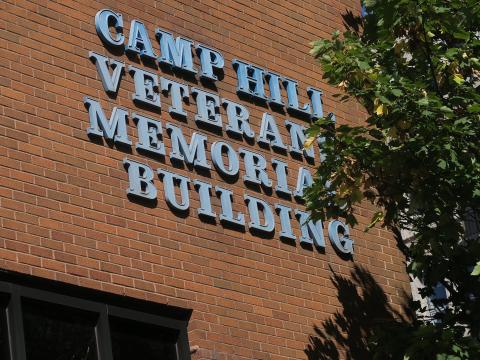
[building/bâtiment]
CAMP HILL
VETERANS
MEMORIAL
BUILDING
[plaque]
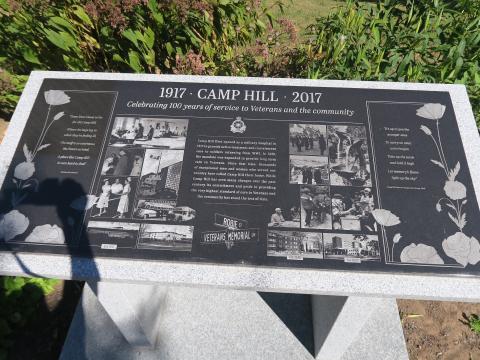
1917 CAMP HILL 2017
Celebrating 100 years of service to Veterans and the community
"Some lines I must write
for old Camp Hill
Where the boys lay in
when they're feeling ill,
The staff is so courteous,
the Sisters so kind,
A place like Camp Hill
is sure had to find"
-MacDonald undated
Camp Hill first opened as a military hospital in
1917 to provide active treatment and convalescent
care to soldiers returning from WWI. In 1928,
the mandate was expanded to provide long term
care to Veterans. Since that time, thousands
of exceptional men and women who served our
country have called Camp Hill their home. While
Camp Hill has seen many changes over the past
century its commitment and pride in providing
the very highest standard of care to Veterans and
the community has stool the test of time.
"It's up to you the
younger ones
To carry on what
we've begun
Take up the torch
and hold it high
Let memory's flame
light up the sky"
Camp Hill Veterans' Songwriters Group, 2010
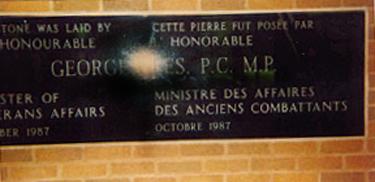
[stone/pierre]
THIS STONE WAS LAID BY
THE HONOURABLE
GEORGE HEES, P.C. M.P.
MINISTER OF VETERANS AFFAIRS
OCTOBER 1987
CETTE PIERRE FUT POSÉE PAR
L'HONORABLE
GEORGE HEES, P.C. M.P.
MINISTRE DES AFFAIRES
DES ANCIENS COMBATTANTS
OCTOBRE 1987
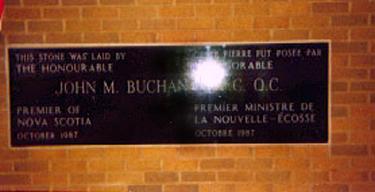
[stone/pierre]
THIS STONE WAS LAID BY
THE HONOURABLE
JOHN M. BUCHAN, P.C. Q.C.
PREMIER OF
NOVA SCOTIA
OCTOBER 1987
CETTE PIERRE FUT POSÉE PAR
L'HONORABLE
JOHN M. BUCHAN, P.C. Q.C.
PREMIER MINISTRE DE
LA NOUVELLE-ÉCOSSE
OCTOBRE 1987
The Camp Hill Veterans Memorial Building supports residents diverse in life experiences, but united by their service to our country. During the First World War, the Military Hospital Commission in Canada built military hospitals across the country to provide medical and supportive care to returning soldiers.
Camp Hill Hospital opened its doors in the fall of 1917, and even though it was meant as a temporary hospital, it continued to provide support during the Second World War and Korean War and in the years that followed.
Only months after opening, on December 6, 1917, the city was devastated by the Halifax Explosion. Camp Hill played a role in response efforts. Originally built to care for 225 soldiers, within the first 24 hours following the explosion it cared for 1,400 of the most critically injured. Because of its location on the hill, it was not damaged. Soldiers gave up beds and medical staff worked without relief until people from away could help.
By 1928, Camp Hill’s care expanded to provide residential care to Veterans. A hundred years since it opened, there was a shift in the type of support needed from a rehabilitation focus right after the war to caring for an aging generation of Veterans.
Along with providing medical care, Camp Hill Veterans Memorial Hospital provides many social programs, recreation projects and outdoor space. The QEII’s Veterans Memorial Garden, came to fruition with commitment and fundraising efforts led by Shirley Robertson, a former resident’s wife, in collaboration with the QEII Foundation. The relaxing and safely gated atmosphere houses many social events and five commemorative celebrations each year. Twice a year, about 80 Canadian military soldiers come to clean and upkeep the Garden. The Veterans all watch from their windows and comment on how they are doing.
[front/devant]
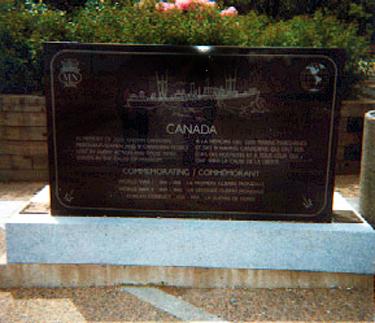
CANADA
IN MEMORY OF 2200 KNOWN CANADIAN
MERCHANT SEAMEN AND 91 VESSELS
LOST BY ENEMY ACTION AND THOSE WHO
SERVED IN THE CAUSE OF FREEDOM
A LA MÉMOIRE DES 2200 MARINS MARCHANDS
ET DES 91 VAVIRES CANADIENS QUI ONT PÉRU
LORS DES HOSTILITÉS ET A TOUS CEUX QUI
ONT SERVI LA CAUSE DE LA LIBERTÉ.
COMMEMORATING/COMMEMORANT
WORLD WAR I 1914 - 1918 LA PREMIERE GUERRE MONDIALE
WORLD WAR II 1939 - 1945 LA SECONDE GUERRE MONDIALE
KOREAN CONFLICT 1950 - 1953 LA GUERRE DE COREE
[rear/arrière]
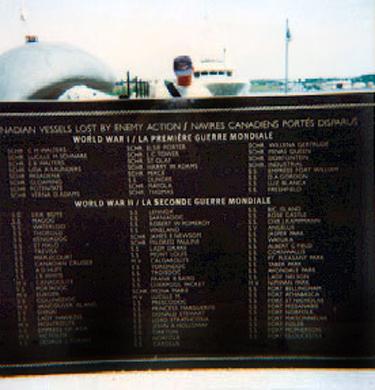
CANADIAN VESSELS LOST BY ENEMY ACTION/NAVIRES CANADIENSPORTES DISPARUS
WORLD WAR I/LA PREMIERE GUERRE MONDIALE
SCHR. C.M. WALTERS
SCHR. LUCILLE M. SCHNARE
SCHR. E.B. WALTERS
SCHR. UDA A. SAUNDERS
SCHR. PASADENA
SCHR. GLOAMING
SCHR. POTENTATE
SCHR. VERNA D. ADAMS
SCHR. ELSIE PORTER
SCHR. L.C. TOWER
SCHR. ST. OLAF
SCHR. HARRY W. ADAMS
SCHR. PERCÉ
S.S. DUNDEE
SCHR. MAYOLA
SCHR. THOMAS
SCHR. WILLENA GERTRUDE
SCHR. MINAS QUEEN
SCHR. DORFONTEIN
SCHR. INDUSTRIAL
S.S. EMPRESS FORT WILLIAM
S.S. D.A. GORDON
S.S. LUZ BLANCA
S.S. FRESHFIELD
WORLD WAR II/LA SECONDE GUERRE MONDIALE
S.S. ERIK BOYLE
S.S. MAGOG
S.S. WATERLOO
S.S. THOROLD
S.S. KENORDOC
S.S. ST. MALO
S.S. TREVISA
S.S. MAPLECOURT
S.S. CANADIAN CRUISER
S.S. A.D. HUFF
S.S. J.B. WHITE
M.V. CANADOLITE
S.S.PORTADOC
M.V. EUROPA
S.S. COLLINGDOC
M.V. VANCOUVER ISLAND
S.S. SHINAI
S.S. LADY HAWKINS
M.V. MONTROUTE
S.S. EMPRESS OF ASIA
VICTOLITE
S.S. GEORGE I. TORIAN
S.S. LENNOX
S.S. SARNIADOC
S.S. ROBERT W. POMEROY
S.S. VINELAND
SCHR. JAMES E. NEWSOM
SCHR. MILDRED PAULINE
S.S. LADY DRAKE
S.S. MONT LOUIS
M.V. CALGAROLITE
S.S. TORONDOC
S.S. TROISDOC
S.S. FRANK B. BAIRD
S.S. LIVERPOOL PACKET
SCHR. MONA MARIE
M.V. LUCILLE M.
S.S. PRESCODOC
S.S. PRINCESS MARGUERITE
S.S. DONALD STEWART
S.S. LORD STRATHCONA
S.S. JOHN A. HOLLOWAY
S.S. OAKTON
S.S. NORFOLK
S.S. CAROLUS
S.S. BIC ISLAND
S.S. ROSE CASTLE
S.S. CHR. J. KAMPMANN
S.V. ANGELUS
S.S. JASPER PARK
S.S. WATUKA
S.S. ALBERT C. FIELD
S.S. CORNWALLIS
S.S. PT. PLEASANT PARK
S.S. TABER PARK
S.S. AVONDALE PARK
S.S. LADY NELSON
M.V. NIPIWAN PARK
S.S. FORT BELLINGHAM
S.S. FORT ATHABASCA
S.S. FORT ST. NICHOLAS
S.S. FORT MISSANABIE
S.S. FORT NORFOLK
S.S. FORT MAISONNEUVE
S.S. FORT FIDLER
S.S. FORT MCPHERSON
S.S. FORT GLOUCESTER
This memorial is dedicated to the Canadian Merchant Seamen and Canadian vessels lost by enemy action during the First and Second World Wars and the Korean Conflict. It was dedicated on November 11, 1993, sponsored by the Canadian Merchant Navy Association and assisted by the Armed Forces. On October 22, 1993, the Merchant Navy Memorial was mounted at Sackville Landing, Halifax. It was sponsored by the Canadian Merchant Navy Association with donations from Canadians.
The significance of the memorial is that it honours the memory of thousands of Canadians who volunteered their service and lives for their country in wartime, which occurred half a century ago. The Merchant Navy provided a vital role in the Allied success of World War II, by carrying troops, food, fuel, and war supplies overseas to the armed forces and civilian population. The black rectangle-shaped African granite monument on a gray granite base is nearly six feet long, four and a half feet high and weighs over 5,000 pounds. Both sides are engraved with various marine symbols. Conspicuous is the S.S. Point Pleasant Park, a 10,000-ton Parkship, built in Canada and torpedoed off the coast of West Africa in World War II. "Canada" is in large block letters. "Mother Earth" in upper right corner is depicted by a six inch terrestrial sphere, displaying North and South America, Atlantic and Pacific Oceans.
The Canadian Merchant Navy insignia, worn in wartime as a lapel pin, is in the upper left corner. Both official languages describe the memory of 2,200 known Canadian Merchant Seamen and 91 Canadian vessels lost by enemy action and those who served in World War I, World War II, and the Korean conflict. Two anchors at bottom corners depict a destroyed vessel at rest on the ocean floor. A rope border inside the perimeter represents the continuity of seamanship and the marine profession. Engraved in the rear is a similar rope and then names of 24 Canadian vessels lost in World War I and 67 vessels lost in World War II. A time capsule, a 3" x 12" insulated cylinder, containing various items is fitted inside a stainless steel vacuum sealed four inch pipe. Contents include Senate Report "It's Almost Too Late", letters from three levels of government, C.M.N.A. membership, a set of 1993 Canadian coins, M.N. Report, copy of "Red Duster" and front page of the Chronicle Herald, September 23, 1993. Captain E. Wagner designed the memorial. Professor Horst Deppe produced the drawings. Commander Tony and Jane Law were artistic consultants. Heritage Monuments, Windsor, Nova Scotia, manufactured the memorial.
Since November 11, 1993, the Merchant Navy Memorial remembers and honours all those men and women who served their country in World War II. The special significance is the memory of 2,200 known Canadian Merchant Seamen and 91 Canadian vessels lost by enemy action and those who served in the cause of freedom, commemorating wars of this century.

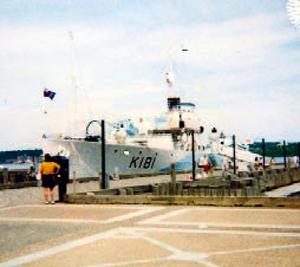
CANADA'S NATIONAL NAVAL MEMORIAL
SECOND WORLD WAR CORVETTE
BERTHED ON HALIFAX'S WATERFRONT
OWNED AND OPERATED BY NAVAL MEMORIAL TRUST
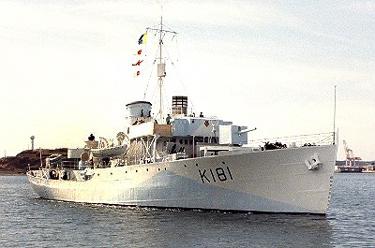
This ship is owned and operated by the Naval Memorial Trust and is berthed on Halifax's waterfront. HMCS Sackville is an iconic symbol of the Battle of the Atlantic and the sacrifice of those who gave their lives and of all those who served and continue to serve Canada at sea.
In August 2011, Governor General David Johnston, patron of the Canadian Naval Memorial Trust, toured the ship and met with Veterans and other trustees.
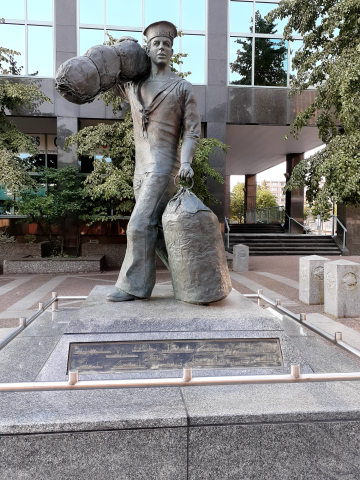
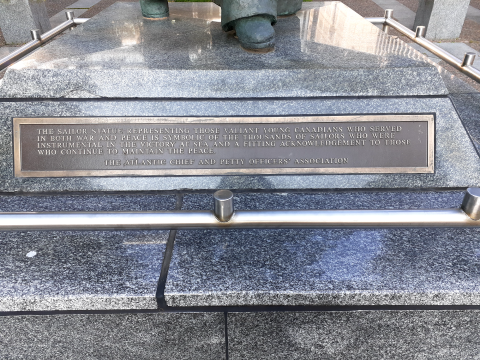
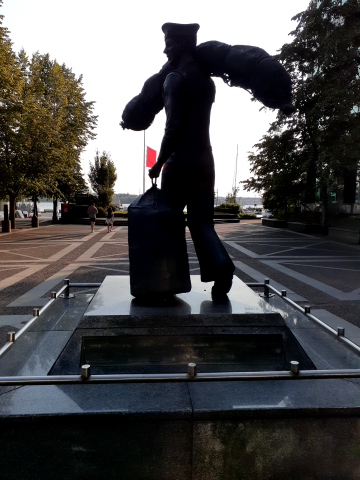
THE SAILOR STATUE REPRESENTING THOSE VALIANT YOUNG CANADIANS WHO SERVED
IN BOTH WAR AND PEACE IS SYMBOLIC OF THE THOUSANDS OF SAILORS WHO WERE
INSTRUMENTAL IN THE VICTORY AT SEA AND A FITTING ACKNOWLEDGEMENT TO THOSE
WHO CONTINUE TO MAINTAIN THE PEACE.
THE ATLANTIC CHIEF AND PETTY OFFICERS' ASSOCIATION
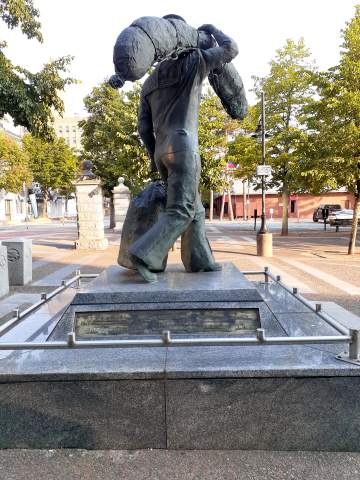
This memorial is dedicated to the sailors who served in both war and peace. It was erected by the Atlantic Chief and Petty Officers' Association.
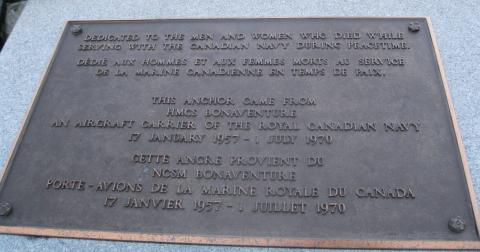
[plaque]
DEDICATED TO THE MEN AND WOMEN WHO DIED WHILE
SERVING WITH THE CANADIAN NAVY DURING PEACETIME.
DÉDIÉ AUX HOMMES ET AUX FEMMES MORTS AU SERVICE
DE LA MARINE CANADIENNE EN TEMPS DE PAIX
THIS ANCHOR CAME FROM
HMCS BONAVENTURE
AN AIRCRAFT CARRIER OF THE ROYAL CANADIAN NAVY
17 JANUARY, 1957 - 1 JULY, 1970
CETTE ANCRE PROVENT DU
NCSM BONAVENTURE
PORTE-AVIONS DE LA MARINE ROYALE DU CANADA
17 JANVIER 1957 – 1 JUILLET 1970
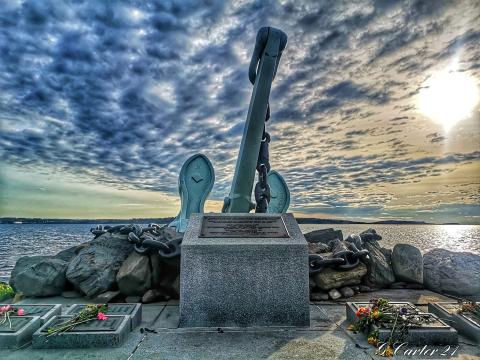
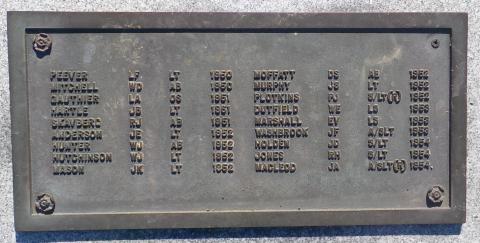
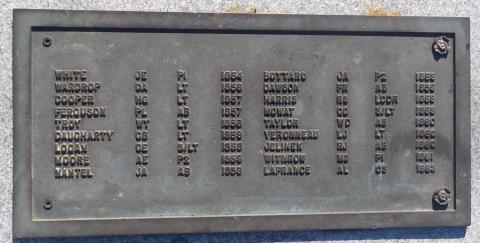
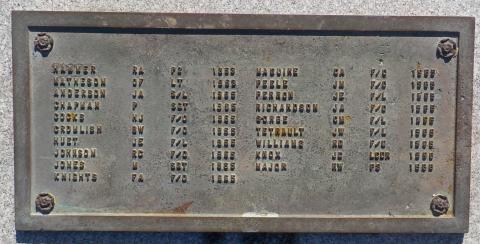
The Bonaventure Anchor Memorial, also known as the Canadian Peacetime Sailors’ Memorial, stands on the shore at Point Pleasant Park in Halifax, Nova Scotia, where the principal naval base of the Royal Canadian Navy is located. The site previously served as the location of a searchlight battery that formed part of the their Second World War harbour defences.
The monument was dedicated in 1973 by Rear Admiral Robert Walter Timbrell, CMM, DSC, CD, then Commander of Maritime Command. It consists of an anchor and chain from HMCS Bonaventure, the Royal Canadian Navy’s last aircraft carrier, in commission from 1957 to 1970 (and commanded by Rear Admiral (then Captain) Timbrell between 1963 and 1965). The anchor is mounted on a concrete base with bronze plaques displaying the sailors’ names. This anchor is a stockless pattern, made by W.L. Byers and Co. Ltd. of Sunderland in North East England, serial number 6299W. It stands 12 feet tall and weighs approximately nine tons.
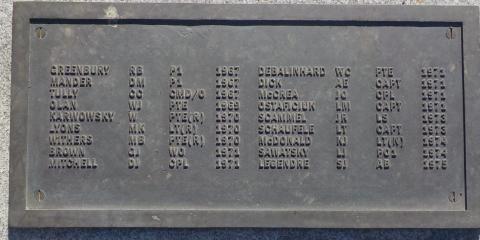
This anchor is a memorial to those who died while serving with the Canadian Navy during peacetime and the names on the panels are those who have no known grave in Canada. The chain from the anchor to the water signifies a connection to those lost or buried at sea or buried on foreign lands. Its dedication statement read: "To commemorate the personnel of the Armed Forces of Canada who lost their lives at sea in the performance of their duties and for whom there is no known grave”. At some unknown time the dedication was changed to read: “Dedicated to the men and women who died while serving with the Canadian Navy during Peacetime.”
The monument contains 131 names, the earliest of whom died in 1948 and the most recent in 1994. Among them are the names of nine members of HMCS Kootenay who died during an explosion in the ship in 1969 during naval exercises 210 miles west of Plymouth England. The Bonaventure Anchor Memorial was in dire need of attention for many years. On May 1, 2017 a campaign for action was initiated by Allan “Dinger” Bell, a 1969 HMCS Kootenay survivor, with the support of Veterans and military support organizations. All three levels of government and all three services (Navy, Army and Air Force) became engaged and worked to secure, repair and update the memorial. This work was completed in 2019 which included the addition of 46 names. A re-dedication of the Bonaventure Anchor Memorial was held at the HMCS Kootenay 50th Commemoration ceremony on October 23, 2019.
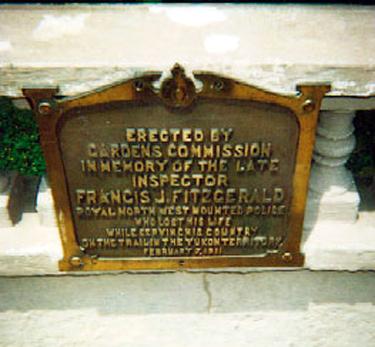
ERECTED BY
GARDENS COMMISSION
IN MEMORY OF THE LATE
INSPECTOR
FRANCIS J. FITZGERALD
ROYAL NORTH WEST MOUNTED POLICE
WHO LOST HIS LIFE
WHILE SERVING HIS COUNTRY
ON THE TRAIL IN THE YUKON TERRITORY
FEBRUARY 7, 1911
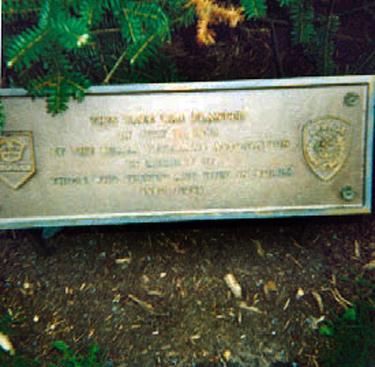
This memorial is dedicated to Francis J. Fitzgerald.
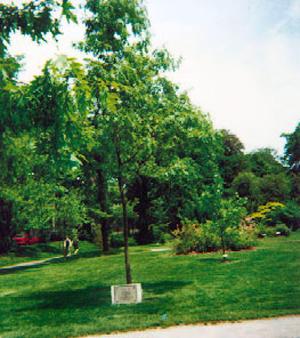
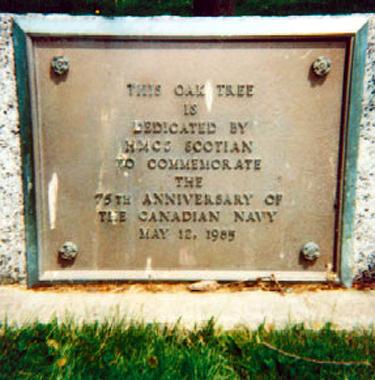
THIS OAK TREE
IS
DEDICATED BY
HMCS SCOTIAN
TO COMMEMORATE
THE
75TH ANNIVERSARY OF
THE CANADIAN NAVY
MAY 12, 1985
This memorial commemorates the 75th Anniversary of the Canadian Navy. It was dedicated by HMCS Scotian on May 12, 1985.
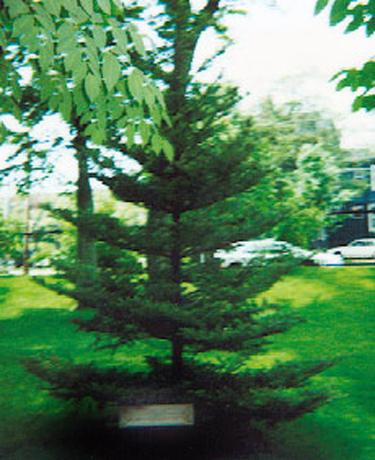
THIS TREE WAS PLANTED
ON 31 JULY 1988
BY THE KOREA VETERANS ASSOCIATION
IN MEMORY OF
THOSE WHO SERVED AND DIED IN KOREA
1950 - 1953
This memorial is dedicated to those who served and those killed in the Korean War. It was erected by the Korea Veterans Association.
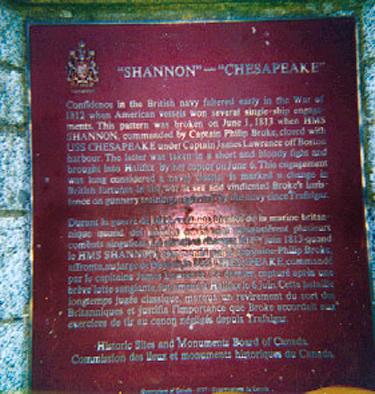
"SHANNON" - "CHESAPEAKE"
Confidence in the British navy faltered early in the War of
1812 when American vessels won several single-ship engage-
ments. This pattern was broken on Jun 1, 1813 when HMS
SHANNON, commanded by Captain Philip Broke, closed with
USS CHESAPEAKE under Captain James Lawrence off Boston
harbour. The latter was taken in a short and bloody fight and
brought into Halifax by her captor on June 6. This engagement
was long considered a naval classic. It marked a change in
British fortunes in the war at sea and vindicated Broke's insis-
tence on gunnery training neglected by the navy since Trafalgar.
Durant la guerre de 1812 [The wording is not clear in the photo./Le texte n’est pas clair sur la photo.] bientôt de la marine britan-
nique quand des navires américans remportèrent plusieurs
combats singuliers. La situation changea le 1er juin 1813 quand
le HMS SHANNON commandé par le capitaine Philip Broke,
affronta au large de Boston, le USS CHESAPEAKE, commandé
par le capitaine James Lawrence. Ce dernier, capturé après une
brève lutte sanglante, fut amené à Halifax le 6 juin. Cette bataille
longtemps jugée classique, marque un revirement du sort des
Britanniques et justifia l'importance que Broke accordait aux
exercices de tir au canon mégligés depuis Trafalgar.
Historic Sites and Monuments Board of Canada
Commission des lieux et monuments historiques du Canada
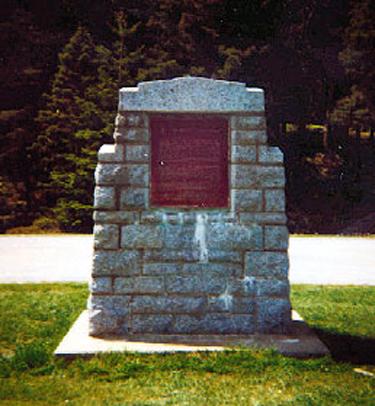
This memorial is dedicated to Her Majesty's Ship (HMS) SHANNON and its engagement with the USS CHESAPEAKE. It was erected by the Historic Sites and Monuments Board of Canada.