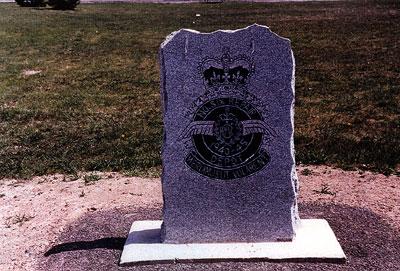
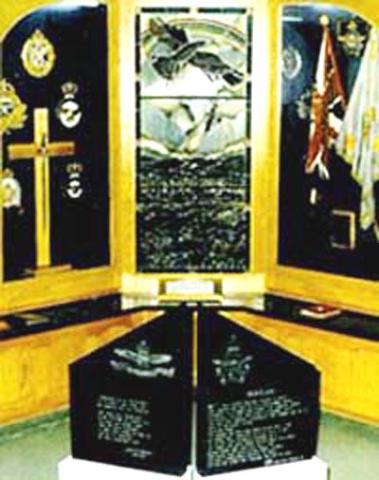
This memorial is dedicated to the No. Six Repair Depot, Royal Canadian Air Force of the Second World War.
No. Six Repair Depot Memorial
NO. SIX REPAIR DEPOT
RCAF
1940-45
MERUIMUSUT VOLARENT
Sign in to My VAC Account
Sign in to My VAC AccountNO. SIX REPAIR DEPOT
RCAF
1940-45
MERUIMUSUT VOLARENT
This memorial is dedicated to the No. Six Repair Depot, Royal Canadian Air Force of the Second World War.
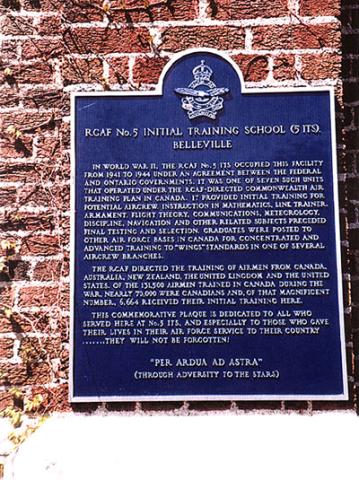
RCAF NO. 5 INITIAL TRAINING SCHOOL (5 ITS).
BELLEVILLE
IN WORLD WAR II, THE RCAF NO. 5 ITS OCCUPIED THIS FACILITY
FROM 1941 TO 1944 UNDER AN AGREEMENT BETWEEN THE FEDERAL
AND ONTARIO GOVERNMENTS. IT WAS ONE OF SEVEN SUCH UNITS
THAT OPERATED UNDER THE RCAF-DIRECTED COMMONWEALTH AIR
TRAINING PLAN IN CANADA. IT PROVIDED INITIAL TRAINING FOR
POTENTIAL AIRCREW. INSTRUCTION IN MATHEMATICS, LINK TRAINER,
ARMAMENT, FLIGHT THEORY, COMMUNICATIONS, METEOROLOGY,
DISCIPLINE, NAVIGATION AND OTHER RELATED SUBJECTS PRECEDED
FINAL TESTING AND SELECTION. GRADUATES WERE POSTED TO
OTHER AIR FORCE BASES IN CANADA FOR CONCENTRATED AND
ADVANCED TRAINING TO “WINGS” STANDARDS IN ONE OF SEVERAL
AIRCREW BRANCHES.
THE RCAF DIRECTED THE TRAINING OF AIRMEN FROM CANADA,
AUSTRALIA, NEW ZEALAND, THE UNITED KINGDOM AND THE UNITED
STATES. OF THE 131,500 AIRMEN TRAINED IN CANADA DURING THE
WAR, NEARLY 70,000 WERE CANADIANS AND, OF THAT MAGNIFICENT
NUMBER, 6,664 RECEIVED THEIR INITIAL TRAINING HERE.
THIS COMMEMORATIVE PLAQUE IS DEDICATED TO ALL WHO
SERVED HERE AT NO. 5 ITS, AND ESPECIALLY TO THOSE WHO GAVE
THEIR LIVES IN THEIR AIR FORCE SERVICE TO THEIR COUNTRY
….…THEY WILL NOT BE FORGOTTEN!
“PER ARDUA AD ASTRA”
(THROUGH ADVERSITY TO THE STARS)
This memorial is dedicated to all the members of the Royal Canadian Air Force No. 5 especially those who gave their lives in the Air Force service to their country in the Second World War.
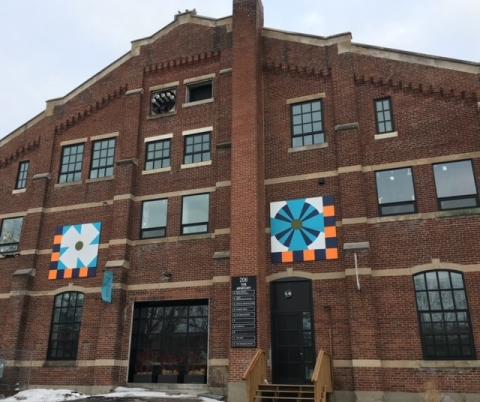
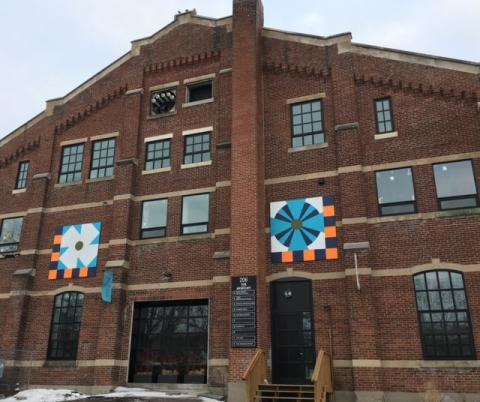
In 2019, the Armoury had two quilts commissioned by the Prince Edward County Barnyard Quilt Trails. The Like a Rolling KeySTONE quilt represents The Armoury's architecture and signature keystone window. The circles denote unity and working together for the common good. The green pays tribute to our Indigenous neighbours, whose ancestral land we stand on.
The other barn quilt is Strong and FREEdom.
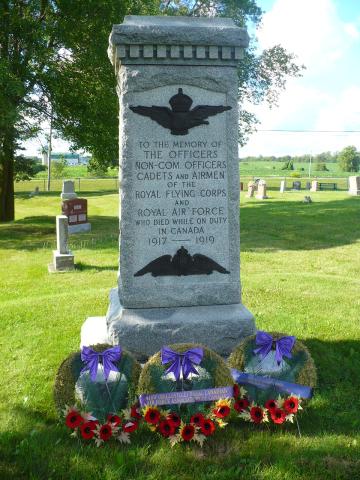
TO THE MEMORY OF
THE OFFICERS
NON-COM. OFFICERS
CADETS AND AIRMEN
OF THE
ROYAL FLYING CORPS
AND
ROYAL AIR FORCE
WHO DIED WHILE ON DUTY
IN CANADA
1917 — 1919
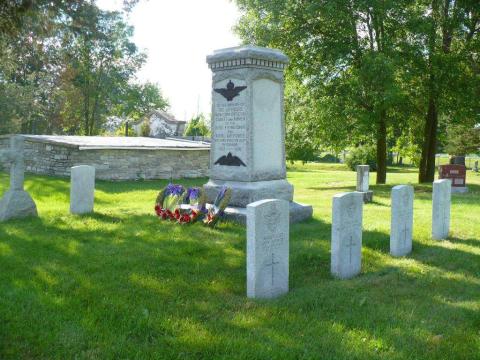
This memorial is dedicated to those who died from the Royal Flying Corps and the Royal Air Force while on duty in Canada, 1917 to 1919. Deseronto was one of several small towns in Ontario which hosted air training establishments. In this area there were two flying schools, Camp Rathburn and Camp Mohawk, which operated between 1917 and 1919.
[front/devant]
(plaque)
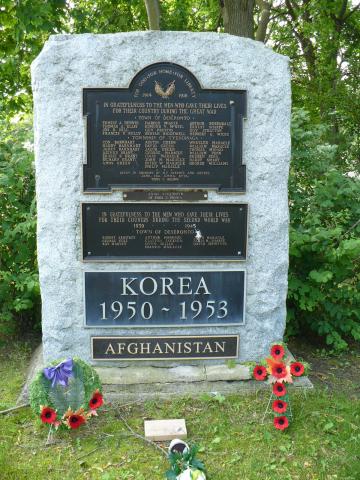
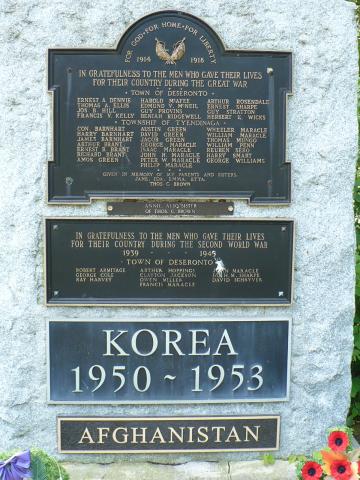
FOR GOD FOR HOME FOR LIBERTY
1914-1918
IN GRATEFULNESS TO THE MEN WHO GAVE THEIR LIVES
FOR THEIR COUNTRY DURING THE GREAT WAR
TOWN OF DESERONTO
TOWNSHIP OF TYENDINAGA
GIVEN IN MEMORY OF MY PARENTS AND SISTERS,
JANE, IDA, EMMA, ETTA.
THOS C. BROWN
(plaque)
ANNIE ALSO SISTER
OF THOS C. BROWN
(plaque)
IN GRATEFULNESS TO THE MEN WHO GAVE THEIR LIVES
FOR THEIR COUNTRY DURING THE SECOND WORLD WAR
1939 - 1945
TOWN OF DESERONTO
(plaque)
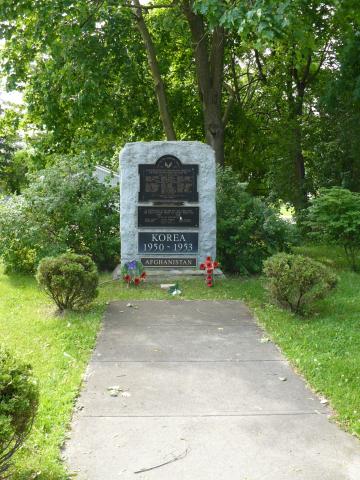
KOREA
1950-1953
(plaque)
AFGHANISTAN
The Deseronto Cenotaph was unveiled in a ceremony on September 3, 1923 and attended by many of the townspeople. A piece of land for the cenotaph, forty feet square, was purchased by the Town of Deseronto from the Rathbun Company, at a cost of $100.
The memorial was donated by former Deseronto resident, Thomas Carson Brown. Thomas was born on 21 April 1870, the son of Thomas Brown and Emily Varty. He had nine siblings and lived in Lennox and Addington County where the family had a farm. His mother died in childbirth when Thomas was seven years old. By 1881, the family had moved to Mill Point (Deseronto). In the 1891 census, when he was 21, Thomas’s trade is given as bricklayer. His father died just six weeks after the census was taken.
It was through the bricklaying trade that Thomas C. Brown would go on to earn his fortune in New York State, where his firm constructed a number of public buildings, including the Plattsburgh Normal School, and a large section of the Clinton Correctional Facility at Dannemora. Deseronto’s newspaper, The Tribune, reported Brown’s marriage in August 1899 to Hattie B. Humphrey, noting that “the groom is well and favourably known in Deseronto, where he passed his boyhood days. He is now engaged in the contracting business in Little Falls. He is a brother of Mrs. Jas. Sexsmith.” Thomas’s sister, Jane Brown, married James Sexsmith in Deseronto in January 1884. She died of pneumonia in 1910.
Brown went on to serve as a Senator in the New York Senate between 1925 and 1930, where he took a keen interest in prison reform issues. He clearly never forgot his home town of Deseronto, as the generous gift of a war memorial demonstrates. It is not just a war memorial, however, as Thomas C. Brown ensured that his parents and five of his sisters (Jane, Ida, Etta, Emma and Annie) were also commemorated on the structure.
(Courtesy of Community Archives of Belleville and Hastings County)
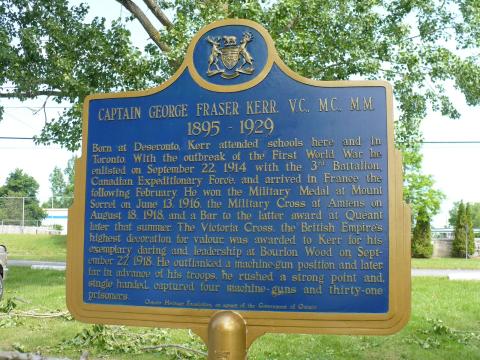
CAPTAIN GEORGE FRASER KERR. V.C., M.C., M.M., 1895-1929
Born at Deseronto, Kerr attended schools here and in Toronto. With the outbreak of the First World War he enlisted on September 22, 1914, with the 3rd Battalion, Canadian Expeditionary Force and arrived in France the following February. He won the Military Medal at Mount Sorrel on June 13, 1916, the Military Cross at Amiens on August 18, 1918 and a Bar to the latter award at Queant later that summer. The Victoria Cross, the British Empires highest decoration for valour, was awarded to Kerr for his exemplary daring and leadership at Bourbon Wood on September 27, 1918. He outflanked a machine-gun position and later, far in advance of his troops, he rushed a strong point and single-handed, captured four machine-guns and thirty-one prisoners.
Erected by the Archeological and Historical Sites Board of Ontario
The Captain George Kerr, V.C. Plaque was erected in 1973 by the Ontario Archaeological and Historic Sites Board.
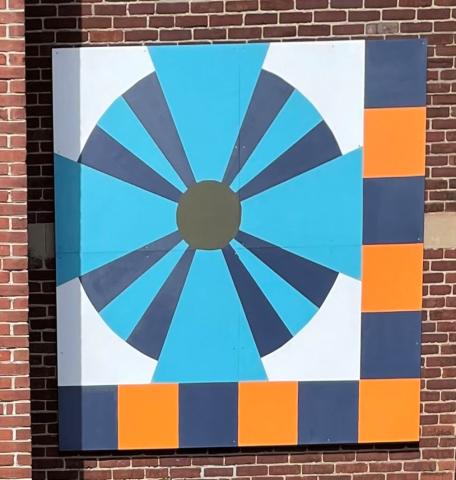
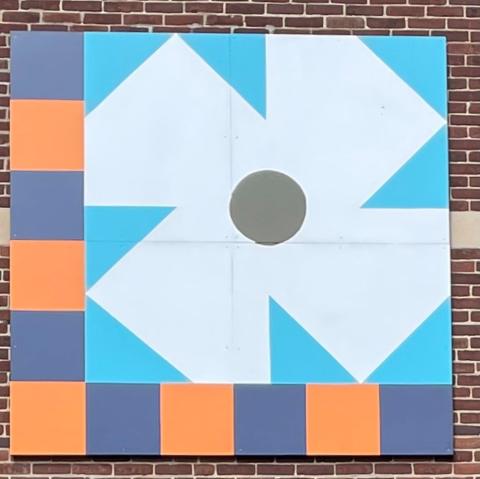
In 2019, the Armoury had two quilts commissioned by the Prince Edward County Barnyard Quilt Trails. The Strong and FREEdom quilt represents the Hastings and Prince Edward Regiments, locally known as the Hasty P's. The Regimental Colours of royal blue and orange encircle a white poppy, a symbol of peace.
The other barn quilt is Like a Rolling KeySTONE.
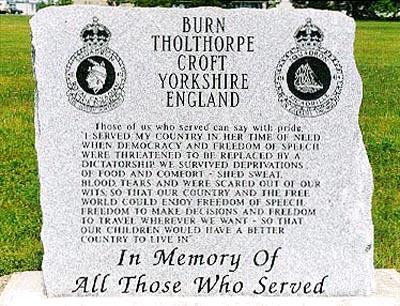
BURN
THOLTHORPE
CROFT
YORKSHIRE
ENGLAND
Those of us who served can say with pride,
"I SERVED MY COUNTRY IN HER TIME OF NEED
WHEN DEMOCRACY AND FREEDOM OF SPEECH
WERE THREATENED TO BE REPLACED BY A
DICTATORSHIP. WE SURVIVED DEPRIVATIONS
OF FOOD AND COMFORT - SHED SWEAT,
BLOOD, TEARS AND WERE SCARED OUT OF OUR
WITS, SO THAT OUR COUNTRY AND THE FREE
WORLD COULD ENJOY FREEDOM OF SPEECH,
FREEDOM TO MAKE DECISIONS AND FREEDOM
TO TRAVEL WHEREVER WE WANT - SO THAT
OUR CHILDREN WOULD HAVE A BETTER
COUNTRY TO LIVE IN."
In Memory Of
All Those Who Served
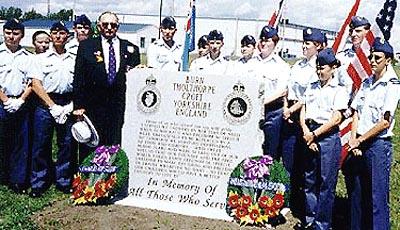
This memorial was erected on July 18, 1998, in memory of Second World War personnel who served in the 431 Iroquois and 434 Bluenose Squadrons at Burn, Tholthorpe, Croft and Yorkshire, England.
431 Iroquois Squadron veteran, Bill Baluk, was the project coordinator who worked two years on fulfilling his dream of a memorial. Through fundraising, the former crew members, families and supporters covered the cost of the new memorial, complete with squadron crests and mottoes.
The 431 Squadron was formed at Burn, Yorkshire, England on November 11, 1942, as the RCAF's 28th - 11th Bomber - squadron formed overseas. The 434 Squadron was formed at Tholthorpe, Yorkshire, England on June 13, 1943, as the RCAF's 31st - 13th Bomber - squadron formed oversea. Both units flew Wellington, Halifax and Canadian-built Lancaster aircraft on strategic and tactical bombing operations.
After hostilities in Europe, they were selected as part of the Tiger Force for duty in the Pacific, and returned to Canada for reorganization and training. The sudden end of the war in the Far East resulted in the squadrons being disbanded at Dartmouth, Nova Scotia on September 5, 1945. The 431 squadron's nickname was Iroquois and was later adopted by the Town of Simcoe, Ontario. The 434 squadron's nickname was Bluenose and was later adopted by the Rotary Club of Halifax, Nova Scotia.
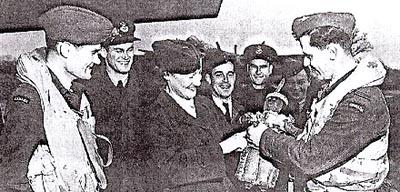
When the RCAF's Bomber group's Iroquois Squadron began flying Canadian-built Lancasters, the unit's mascot, Minnie Simcoe, flew with a different crew member on every attack. Minnie's surname is the name of the town that sponsors the squadron.
Photo 35069-020c.jpg: Minnie is handed into the safekeeping of the pilot of the "Simcoe Warrior", Canadian Lanc version. F/L Melvin Chisholm of Lafleche, Saskatchewan, wearing Mae West at right. Left is his navigator, F/O Hugh McNenly, Massey, Ontario, also wearing Mae West; centre, Nursing Sister Louise Dawson, of West Summerland, BC hands Minnie over.
RCAF
MEMORIAL
MUSEUM
ARC
MUSÉE
COMMÉMORATIF
The Royal Canadian Air Force (RCAF) was created on April 1, 1924. It drew together those who served in the Royal Flying Corps and Royal Naval Air Service during the First World War, and in the Canadian Air Force of 1920 to 1924. In 1968, with the unification of the Canadian Forces, the RCAF lost its formal title; however, its proud traditions live on in Canada's current Air Force.
In 1984, a small museum was opened at CFB Trenton and granted exclusive use of the title RCAF Memorial Museum. A fascinating collection of artefacts and memorabilia were preserved and by 1992, a new and larger facility was needed.
A fund-raising program was launched in July 1993 and a total of $335,000 was contributed by donors from across Canada. The function of the Museum is to perpetuate the heritage of Canadian Military aviation and it is dedicated to the memory of the airmen and airwomen who gave their lives in both peace and war.
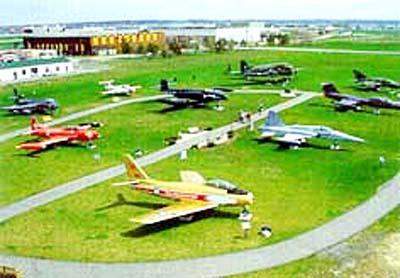
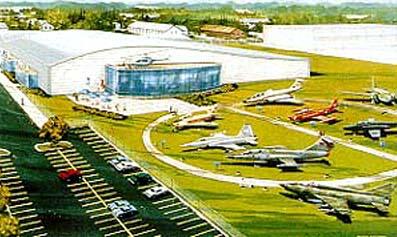
In the spring of 1984, the museum moved into a 13,000 square-foot building situated within a large Airpark on a public road with unrestricted access for visitors. The Airpark quickly became the home of an extensive collection of aircraft valued at over $4 million. An extension to the museum, providing an additional 7,200 square feet of space, was added in 1996.
The volume of donations of artefacts and memorabilia continuesd and the museum's inventory outgrew its housing capacity. The next phase involved a further extension to provide a total space of approximately 64,000 square feet. Expected to cost almost five million dollars, a major fund-raising program was initiated. A "Donors' Wall" highlights specific aircraft plaques which are allocated according to the donation level. An "AD ASTRA" Commemorative Stone program has also been established.
[above the gates/au-dessus des grilles]
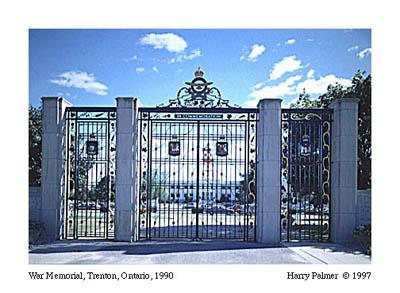
IN COMMEMORATION
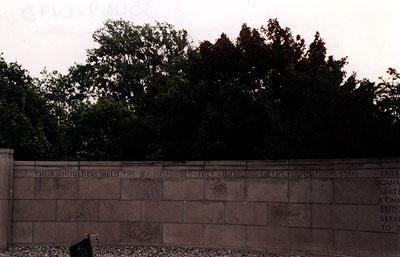
[carved in stone at the side of the gates/inscription gravée dans la pierre à côté des grilles]
THEIR SHOULDERS HELD THE SKY SUSPENDED. THEY STOOD AND EARTH’S FOUNDATIONS STAY.
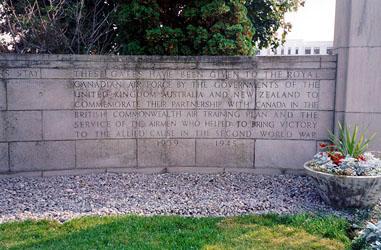
THESE GATES HAVE BEEN GIVEN TO THE ROYAL
CANADIAN AIR FORCE BY THE GOVERNMENTS OF THE
UNITED KINGDOM, AUSTRALIA AND NEW ZEALAND TO
COMMEMORATE THEIR PARTNERSHIP WITH CANADA IN THE
BRITISH COMMONWEALTH AIR TRAINING PLAN AND THE
SERVICE OF THE AIRMEN WHO HELPED TO BRING VICTORY
TO THE ALLIED CAUSE IN THE SECOND WORLD WAR.
1939 - 1945
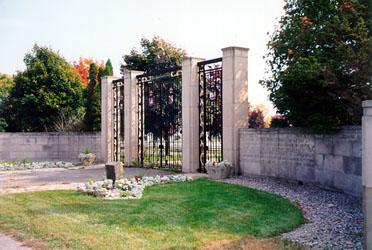
To commemorate the successful organization and operation of the wartime British Commonwealth Air Training Plan (BCATP), representatives of the governments of the United Kingdom, Australia and New Zealand, met at the Royal Canadian Air Force (RCAF) Station on September 30, 1949 and presented the Memorial Gates to Canada. It is a permanent memorial to the British Commonwealth Air Training Plan and serves as a token of their gratitude to the Government and the people of Canada for the generous part they played in the training and care of thousands of Commonwealth airmen during the war.
Representatives, The Right Honourable Arthur Hendesron (British Secretary of State for Air), The Right Honourable Francis Forde (High Commissioner for the Commonwealth of Australia), and The Honourable James Thorn (High Commissioner for the Dominion of New Zealand), were presented with gold keys to unlock the gates. Each gate bears the crest of their countries. After the gates were opened, their keys were presented to The Right Honourable Louis St. Laurent, Prime Minister of Canada who received them on behalf of the people of Canada. The key to one of the gates bore the Australian Coat of Arms.
Members of the RCAF’s first post-war fighter squadron, 410 Squadron, gave a display of formation and single plane aerobatics flying Vampire jets. Harvard aircraft also performed a fly-past and formed the letters “R C A F” in the skies above Trenton.
The gates were designed by R. L. Luke, the architect of the Royal Air Force and are a false entrance to the base used only on ceremonial occasions. The gates originally incorporated a line of oak trees which have been replaced mostly by maples. Each crest of the four BCATP countries were mounted one of the four gates.
More than 130,000 air crew from Australia, Canada, New Zealand and the United Kingdom trained under the BCATP from 1940 to 1945. The plan’s success was praised by leaders such as Sir Winston Churchill and President Franklin D. Roosevelt, who gave Canada the proud title “the aerodrome of democracy”.
The gates received Royal dedication when Princess Elizabeth entered the RCAF Station during a Royal tour of Canada in October, 1951 and were rededicated as part of the BCATP's 60th anniversary, during a military ceremony on Saturday, July 4, 2009.