
On May 14, 2016, the Town of Oakville added the HMCS Oakville Plaque in Tannery Park.
The HMCS Oakville Memorial is also located in the park.
Sign in to My VAC Account
Sign in to My VAC AccountHistory
The Battle of the Atlantic (September 1939 – May 1945)
The Second World War began when Nazi Germany invaded Poland. Britain, France, and Canada were quick to declare war, but the enemy was strong and well equipped. By the fall of 1941 things looked very dark for the Allies; Germany had defeated France and was now attacking Britain. Canada and America sent vital supplies to Britain, which could only be transported by sea – something that Germany was determined to stop by using U-boats (submarines).
The “Battle of the Atlantic” was the fight that pitted supply convoys against the German Navy. The Royal Canadian Navy (RCN) played a vital role in this battle and relied heavily on a new kind of warship: the Flower-Class Corvette. Small, lightly armed and fast, corvettes were excellent submarine hunters and perfect for escorting convoys. One of the most famous corvettes of the Second World War was named after the Town of Oakville.
HMCS Oakville Christening Ceremony (November 5, 1941)
HMCS (K178) Oakville was built in Port Arthur, Ontario, and launched on June 21, 1941. On November 5, 12 local school children, representing each school in the district, were chosen to travel to Toronto to board the ship for its journey to the Town of Oakville. Joining them were the Hon. Angus L. Macdonald, Minister of National Defence for Naval Affairs, and Rear-Admiral Percy W. Nelles, Chief of Naval Staff. At 2 p.m. the ship arrived and dropped anchor offshore near this spot. Thousands of spectators in Lakeside Park cheered for the ship and crew while the mayor, Dr. Franklin Murray Deans, welcomed the commanding officer and dignitaries.
Battle with U94 (August 28, 1942)
HMCS Oakville was escorting convoy TAW-15 (Trinidad, Aruba, Battle with U94 (August 28, 1942) Key West) in the Caribbean when she attacked, captured, and sunk U-boat U94. In the early morning of August 28, 1942, a plane that was escorting the convoy spotted a surfaced U-boat. It immediately dived, dropping depth charges that alerted HMCS Oakville to the danger. U94 was trying to submerge and escape, but not before Oakville launched five depth charges. The force of the 300-pound explosives damaged U94 enough that the submarine could not fully submerge.
A two-man boarding party from HMCS Oakville, made up of Sub-Lieutenant Harold Lawrence and Stoker Petty Officer Arthur Powell, leapt aboard U94. Armed only with pistols they captured the U-boat, killing two of its crew and taking the rest prisoner. Lawrence bravely entered the sinking submarine to look for codes, but was forced to abandon his efforts, narrowly escaping as the submarine sunk beneath the waves.
After U94
The crew of HMCS Oakville was recognized for its bravery with four medals and six citations. After the battle the ship went to Galveston, Texas to be refitted. Although she had a few more encounters with the enemy, she did not sink another U-boat. At the end of the war HMCS Oakville was sold to the Venezuelan Navy, and was renamed Patria. In 1959 she was decommissioned for the last time. Lieutenant Governor Lincoln Alexander dedicated a stone cairn here in Tannery Park to honour the officers and crew of HMCS Oakville in 1989.
Did You Know?
HMCS stands for “His/Her Majesty’s Canadian Ship.”
The christening ceremony was one of largest public spectacles in the Town of Oakville’s history and one of the largest christening ceremonies of a Canadian warship during the Second World War.
HMCS Oakville is one of just over 30 Canadian warships to have sunk a U-boat in the Second World War.
Information courtesy of Sean E. Livingston, author of “Oakville’s Flower: The History of HMCS Oakville”
Learn more about the history of Oakville Harbour at oakvillehistory.org.
TOWN OF OAKVILLE
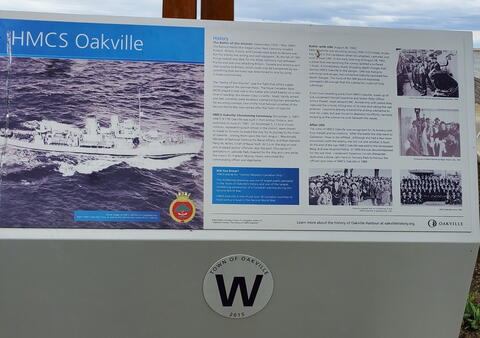
On May 14, 2016, the Town of Oakville added the HMCS Oakville Plaque in Tannery Park.
The HMCS Oakville Memorial is also located in the park.
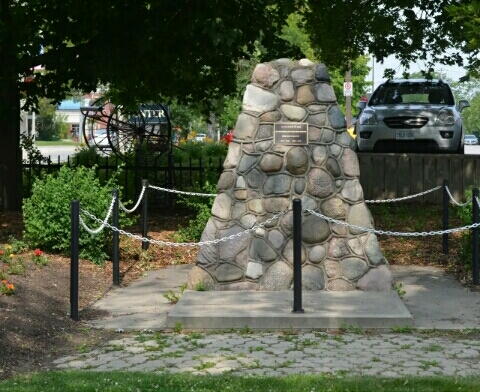
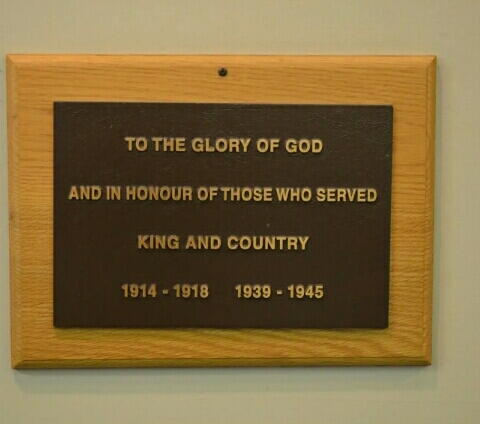
The Bronte Cenotaph is at Bronte Gore Park
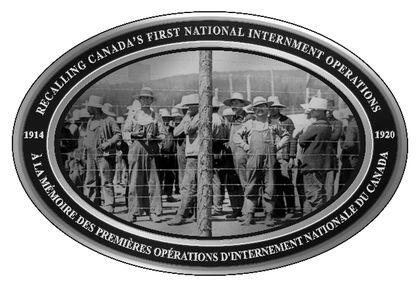
This memorial recalls a historic injustice Canadians should pause to remember, as we recall the First World War and the valour of all those Canadian men, and some women, who served. It is a tribute to mark the memory of the thousands of "enemy aliens" who had their civil rights stripped, and were subsequently imprisoned during Canada's first national internment operations of 1914-1920, following the implementation of the War Measures Act. 2014 marks the 100th anniversary of the War Measures Act - adopted on August 22, 1914 during the First World War. It was used to imprison Ukrainian-Canadians, and other ethnic groups, including German, Hungarian, Serbian, Croatian, and Armenian communities, into one of Canada's 24 internment camps.
Dr. Lubomyr Luciuk, a professor at the Royal Military College of Canada and former chair of the Ukrainian Canadian Civil Liberties Association (UCCLA), had taken it upon himself to lead the way and organize the memorial. In the CTO ("One Hundred") project, 100 aluminum plaques were simultaneously unveiled at 100 different locations across the country at 11:00am local time on August 22, 2014. The first plaque was unveiled in Amherst, Nova Scotia, followed by a wave of plaque unveilings moved west, from province to province, culminating in Nanaimo, British Columbia. The plaques, which cost $1,000 to make, were funded by the generosity of the Endowment Council of the Canadian First World War Interment Recognition Fund.
Each plaque features a photo of internment prisoners confined behind a wire fence at the Castle Mountain Internment Camp in Banff, Alberta. The Castle Camp, which was built in 1915 at the base of Castle Mountain, was a Canadian internment camp which held immigrant prisoners of Ukrainian, Austrian, Hungarian, and German descent.
[centre/centre]
Oakville-Trafalgar Memorial Hospital
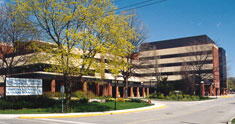
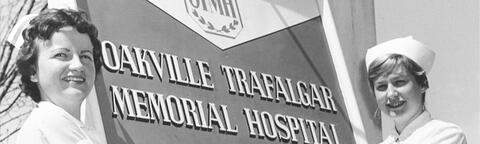
Oakville-Trafalgar Memorial Hospital (OTMH) offers a comprehensive range of primary and secondary care services, in addition to some tertiary services to the residents of Oakville. Some major programs they offer include: specializations in maternal/child care, intensive care, emergency and ambulatory care, medicine, mental health, surgery, rehabilitation, and geriatrics.
This hospital was built in 1937, as a small, four-bed care facility, on the corner of 8th Line and MacDonald in Oakville. It was built by the Ontario Provincial Government, and is dedicated to the Veterans of the First and Second World Wars from the Oakville area and district. A new hospital is being built to accommodate the needs of a growing and aging community.
[front/devant]
TRAFALGAR
MEMORIAL
Plaque/Plaque
MUNICIPAL CORPORATION
TOWNSHP OF TRAFALGAR
IN MEMORY OF THOSE
OF TRAFALGAR TOWNSHIP
WHO GAVE THEIR LIVES
WHILE SERVING
THEIR KING AND COUNTRY
IN THE TWO WORLD WARS
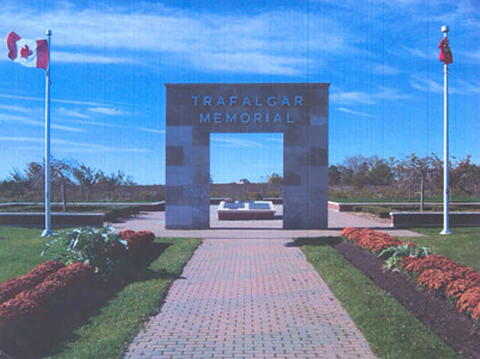
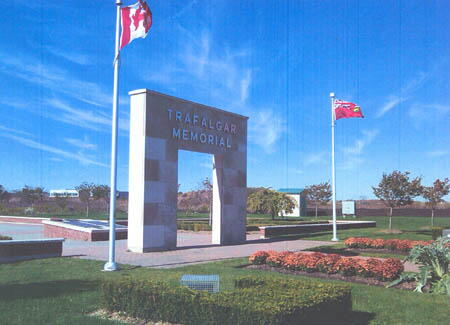
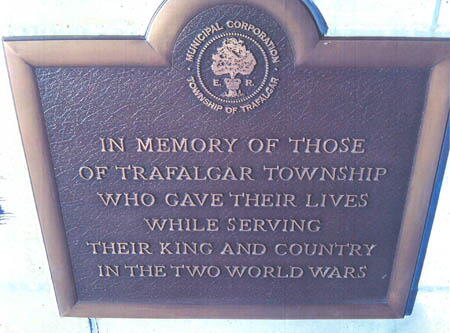
This is the "Trafalgar Memorial". This memorial was erected by the Town of Oakville and unveiled on November 10, 2005. This monument was dedicated to the Veterans of Trafalgar Township who served in World War I, World War II and the Korea War. The memorial is characterized by a large arch, with limestone panels on the front and brick on the back. Much of the building materials were salvaged from a building (now demolished) called "Trafalgar Memorial Hall". The memorial also features a low brick garden wall that pays homage to the original footprint of the old hall (originally located at the SE corner of Trafalgar Road and Dundas Street). There is also an inclined tablet that holds a variety of bronze plaques listing the names of the men and women who served in WWI, WWII, and the Korean War. There is also one replica plaque that was made to replace the original plaque included at the original memorial hall. The tablet dimensions match the size of the opening in the arch and was meant to subtly represent those who had fallen in service. Trafalgar Township originally included most of the area now known as the Town of Oakville, and portions of what is now Milton. Up until 1962, the Town of Oakville was only a very small area at the mouth of the Sixteen Mile Creek.
MY GRACE IS SUFFICIENT FOR THEE
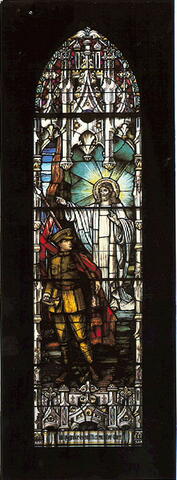
The Soldier's Window is dedicated to the 17 members of St. John's United Church congregation who died in the First World War. The stained glass window, manufactured in 1919 by Luxfer Prism Co. Ltd. of Toronto, was erected by the congregation of St. John's United Church. The Unveiling Service and Dedication took place July 25, 1920. The cover of the church bulletin that sunny Sunday read: "Unveiling of the Memorial Window erected in loving memory of OUR HEROES who fell in the Great War... Greater love hath no man than this, that a man lay down his life for his friends. " John 15:13. The sermon Life and Sacrifice was delivered by Capt. the Rev. J.W. Magwood, the dedicatory prayer by Capt. the Rev. W.B. Caswell. The choir anthem, There is a Green Hill Far Away, was followed by a solo by Mrs. W.T. Merry entitled, God Shall Wipe Away All Tears from Their Eyes. The Ladies' Octet sang Abide With Me. Of the ten stained glass windows in the church, The Soldier's Window is the most unusual. Instead of the conventional Biblical scene, it depicts a contemporary man in what is otherwise a religious setting. The Canadian soldier with the maple leaves on his collar and cap, bears no visible military rank or insignia, emphasizing his Everyman quality. He carries only a bugle or small trumpet and a flag, which appears to be the Canadian Red Ensign, precursor of the present day Maple Leaf. The bars of the Union Jack in the flag's upper right-hand corner form a red cross which he appears to carry over his right shoulder, just as his Savior behind him bore a similar burden. The soldier's stance is reluctant, pulling away from his ultimate fate. The promise of salvation is echoed in the scriptural reference at the bottom of the window, 2 Corinthians 12:9 My grace is sufficient for thee. The choice of colours in the window is also symbolic. Gold, red, blue and white are predominant. As sun streams through the window, the soldier's khaki uniform is transformed into a burnished, verdigrised gold, re-echoed in the bugle, the flag's fringe, and Christ's halo. Gold represents something of great value and purity. Red, of course, symbolizes the blood of life, sacrifice, loyalty, and our communion with God. It appears in the flag, which is draped around the soldier and within the flag, in the red cross of St. George, patron saint of England. Blue is visible in the sky above the soldier, but not above Christ, suggesting He is otherworldly, and in the top right-hand corner of the flag, part of the cross of St. Andrew, a white x-shaped cross on a blue background. Blue, the ancient colour of purity, also symbolizes great courage and endurance. White, the ancient colour of mourning, enrobes Christ and also represents purity and innocence. Below the window are two plaques commemorating those members of the church who died in the First and Second World Wars. The cost of the window in 1919 was $210. Today, its replacement value would exceed $10,000.
[front/devant]
A TRIBUTE
TO THE DEAD
AN ADMONITION
TO THE LIVING
LEST WE FORGET
[right side/côté droite]
SECOND WORLD WAR
1939 1945
[back/arrière]
KOREA
1950 1953
[left side/côté gauche]
FIRST WORLD WAR 1914 1918
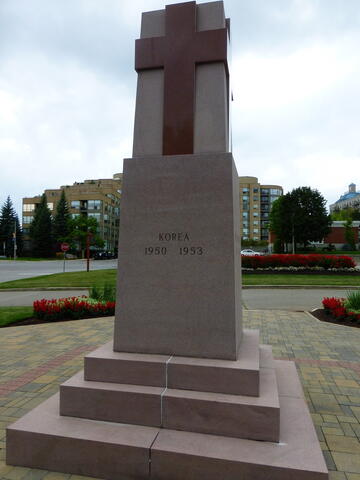
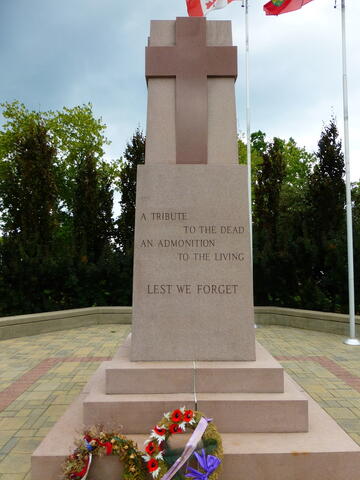
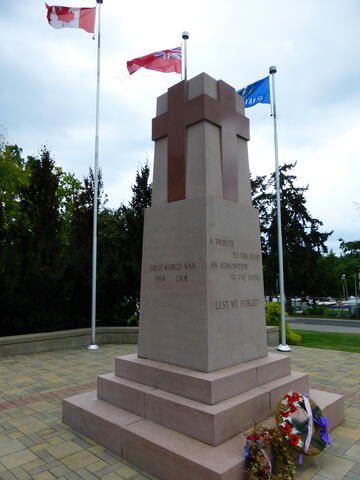
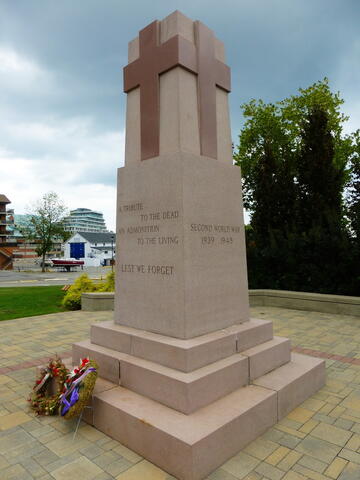
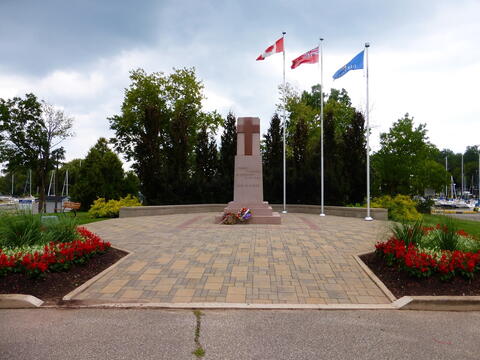
This memorial is dedicated to those from the Oakville area who died in the First World War, Second World War and Korean War.
[Central column front/devant de Colonne centrale]
TO THE GLORIOUS MEMORY OF THOSE WHO PAID
THE SUPREME SACRIFICE
FROM THIS DISTRICT
IN THE GREAT WAR
1914-1918
THEIR NAME LIVE FOR EVER MORE
(A list of names of individual soldiers who died in WWI)
[Central column back/arrière de Colonne centrale]
YPRES
SANCTUARY WOOD
THE SOMME
VIMY RIDGE
HILL 70
PASSCHENDAELE
AMIENS
BOURLON WOOD
CAMBRAI
MONS
(A list of names of individual soldiers who died in WWI)
[Central column sides/Cotés de Colonne centrale]
(A list of names of individual soldiers who died in WWI)
[Central column Base/Base de Colonne centrale]
KOREA 1950-1953
<br
[right benche/banc de droite]
GREATER LOVE HATH NO MAN(A list of names of soldiers who died in WWII)
[left bench/banc de droite]
THEIR NAME LIVE FOR EVER MORE
(A list of names of soldiers who died in WWII)
1939-1945
(A list of namesof soldiers who died in WWII)
1939-1945
[right curved walls/murs courbés droit]
TO THE BRAVE MEN AND WOMEN OF OAKVILLE
WHO SERVED IN THE FIRST WORLD WAR (1914-1918)
[left curved walls/murs courbés gauche]
TO THE BRAVE MEN AND WOMEN OF OAKVILLE
WHO SERVED IN THE SECOND WORLD WAR (1939-1945)


The original memorial (central column) was dedicated to those who lost their lives in World War One. Following the Second World War, a secondary addition was made to the primary column. A pair of carved stone benches flanks the central column, dedicated to the soldiers who died in WWII. A small bronze plaque was also added to the base of the central column dedicated to commemorate the Korea war. A third (major) addition was completed in 2010. Two new curved walls were added on either side of the memorial. A total of 20 new bronze plaques display the names of all veterans who served in WWI and WWII.
[plaque]
TO COMMORATE
THE OFFICERS AND CREW OF
HMCS OAKVILLE
1942 - 1945
THEY SERVED IN CANADA'S
TIME OF NEED
[plaque]
THIS CAIRN WAS ERECTED BY
THE TOWN OF OAKVILLE
BRANCH 114 ROYAL CANADIAN LEGION
AND THE BURLINGTON BRANCH
ROYAL CANADIAN NAVAL ASSOCIATION
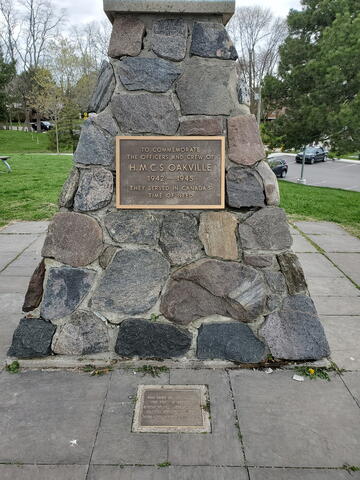
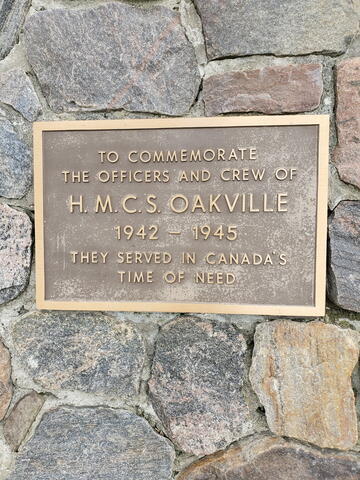
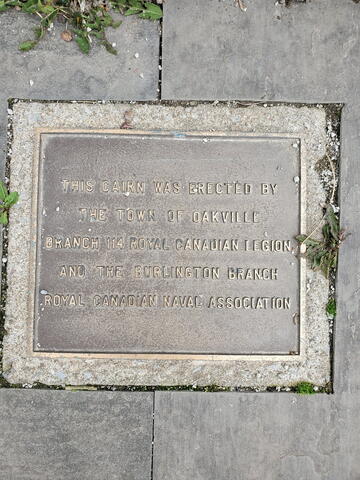
On June 11, 1989, Lieutenant Governor Lincoln Alexander unveiled a cairn in Tannery Park dedicated to the Officers and Crew of HMCS OAKVILLE. On May 14, 2016, the Town of Oakville added the HMCS Oakville Plaque in Tannery Park.
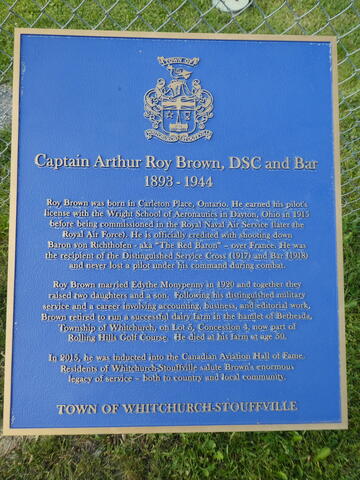
Captain Arthur Roy Brown, DSC and Bar
1893 - 1944
Roy Brown was born in Carleton Place, Ontario. He earned his pilot's
license with the Wright School of Aeronautics in Dayton, Ohio in 191
before being commissioned in the Royal Naval Air Service (later the
Royal Air Force). He is officially credited with shooting down
Baron von Richthofen -aka "The Red Baron" - over France. He was
the recipient of the Distinguished Service Cross (1917) and Bar (1918)
and never lost a pilot under his command during combat.
Roy Brown married Edythe Moneypenny in 1920 and together they
raised two daughters and a son. Following his distinguished military
service and a career involving accounting, business, and editorial work,
Brown retired to run a successful dairy farm in the hamlet of Bethesda,
Township of Whitchurch, on Lot 6, Concession 4, now part of
Rolling Hills Golf Course. He died at his farm at age 50.
In 2015, he was inducted into the Canadian Aviation Hall of Fame.
Residents of Whitchurch-Stouffville salute Brown's enormous
legacy of service - both to country and local community.
TOWN OF WHITCHURCH-STOUFFVILLE
Captain Arthur Roy Brown was born on December 23, 1893, in Carleton Place, Ontario. In the summer of 1915, he applied to Britain’s Royal Naval Air Service but was told he first needed a private pilot’s license. The nearest Canadian flying school was full, so he attended the Wright School of Aviation in Dayton, Ohio and obtained his pilot’s license on November 13, 1915. He enrolled in the Royal Naval Air Service and was sent to Royal Naval Air Service Station Chingford in northeast London to learn the fundamentals of military flying and dropping bombs.
He was injured on May 2, 1916, when he crashed a training airplane and was hospitalized for two months. In March 1917, Brown was posted to No. 9 Naval Squadron, was injured again and did not recover until May. On November 2, Brown was awarded the Distinguished Service Cross for his aerial victories and for aiding a fellow pilot under attack by four German aircraft, even though his own machine guns had jammed. By April 1918, he had shot down nine enemy aircraft.
On the morning of April 21, 1918, Brown and other pilots in 209 Squadron became involved in a dogfight with a German squadron including top ace Manfred von Richthofen and his cousin, novice pilot Wolfram von Richthofen. The Red Baron broke off to pursue Canadian pilot “Wop” May, who was on the tail of his cousin. Brown saw that his friend was in trouble and disengaged to attack Richthofen. He fired a long burst from behind and pulled out of a steep dive to avoid a collision. Richthofen continued over Allied territory and was fired at by British and Australian soldiers until he crashed into a field.
Four days later, Brown was grounded and hospitalized with severe food poisoning and extreme exhaustion, then sent to England to recover. Soon afterwards, he was recommended to receive the Distinguished Service Cross with Bar. Released from hospital on June 6, Brown reported for duty as an instructor with No. 2 School of Aerial Fighting and Gunnery in Yorkshire. On July 15 just after takeoff, his engine failed, the aircraft stalled and crashed. Seriously injured again, Roy spent eight months in hospital before being sent back to Canada on March 8, 1919 and was released from the Royal Air Force in April 1920 with the rank of Captain. Captain Brown tried to join the Royal Canadian Air Force when the Second World War began, but was rejected.