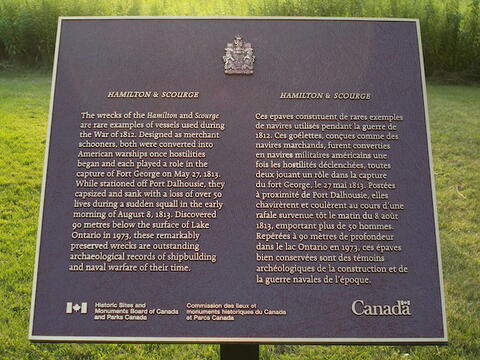
Two War of 1812 ships were sunk off Port Dalhousie on Aug 8, 1813. 50 lives were lost. The well preserved wrecks were discovered in 1973.
Hamilton & Scourge Wrecks
Wrecks of Hamilton and Scourge
Historic Sites and Monument Board and Parks Canada
Sign in to My VAC Account
Sign in to My VAC AccountWrecks of Hamilton and Scourge
Historic Sites and Monument Board and Parks Canada
Two War of 1812 ships were sunk off Port Dalhousie on Aug 8, 1813. 50 lives were lost. The well preserved wrecks were discovered in 1973.
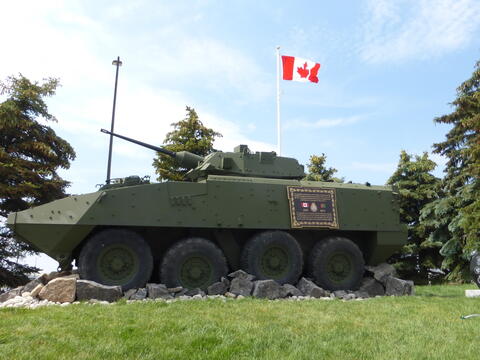
[plaque]
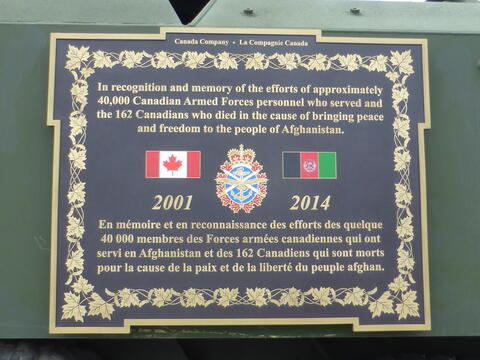
Canada Company • La Compagnie Canada
In recognition and memory of the efforts of approximately
40,000 Canadian Armed Forces personnel who served and
the 162 Canadians who died in the cause of bringing peace
and freedom to the people of Afghanistan.
2001 2014
En mémoire et en reconnaissance des efforts des quelque
40 000 membres des Forces armées canadiennes qui ont
servi en Afghanistan et des 162 Canadiens qui sont morts
pour la cause de la paix et de la liberté du peuple afghan.
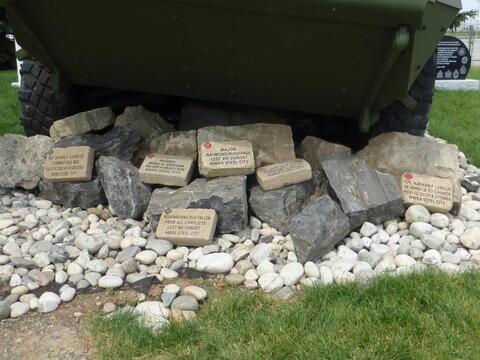
[stones/pierres]
REMEMBERING OUR FALLEN
FROM ALL CONFLICTS
LEST WE FORGET
NWRA STEEL CITY
SGT. SHAWN A EADES CD
1 COMBAT ENG. REG.
KIA 8/20/2008 AFGHANISTAN
NWRA STEEL CITY
PRIVATE
MARK A. GRAHAM
NEVER FORGOTTEN
NWRA STEEL CITY
MAJOR
RAYMOND RUCKPAUL
LEST WE FORGET
NWRA STEEL CITY
CPL. JUSTIN M. STARK
CANADIAN FORCES
LEST WE FORGET
NWRA STEEL CITY
CPL. NATHAN F. CIRILLO
IN SERVICE TO CANADA
KOD 10/22/2014 OTTAWA
NWRA STEEL CITY
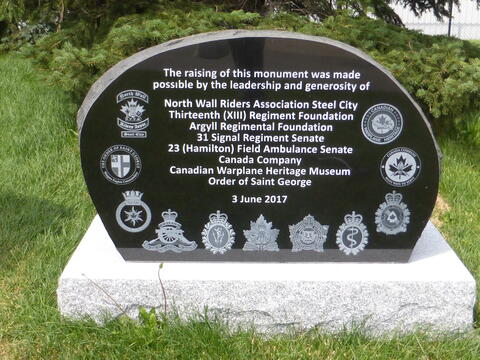
[slab/dalle]
The raising of this monument was made
possible by the leadership and generosity of
North Wall Riders Association Steel City
Thirteenth (XIII) Regiment Foundation
Argyll Regiment Foundation
31 Signal Regiment Senate
23 (Hamilton) Field Ambulance Senate
Canada Company
Canadian Warplane Heritage Museum
Order of Saint George
3 June 2017
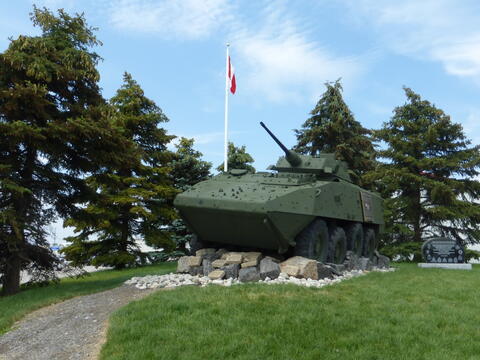
This memorial is a tribute to the mission in Afghanistan and to local soldiers who have lost their lives in the face of duty. The Light Armoured Vehicle (LAV) is decorated with a plaque acknowledging the details of the mission. A granite stone beside the vehicle list those responsible for the memorial and at the front of the LAV vehicle are smaller individual stones dedicated to Canadian Forces personnel who lost their lives in the course of duty.
Light Armoured Vehicles (LAV) III were originally manufactured by Canadians at General Dynamics Land Systems Canada in London, Ontario and were instrumental to troops in carrying out their missions while in Afghanistan. The monuments were created from decommissioned LAV III hulls, donated by the Government of Canada and built by Militex Coating Inc. and Fanshawe College students in London, Ontario.
On November 5, 2014, the Canada Company Light Armoured Vehicle (LAV) lll Monument Program was launched to recognize the 40,000 Canadians Armed Forces who served in Afghanistan and to commemorate the 162 Canadians who lost their lives. The program closed after awarding 33 monuments to communities across Canada.
Shawn Allen Eades Memorial Parkette
This park is named in memory of Sergeant Shawn Allen Eades.
Shawn Allen Eades was born on 26 March 1975 in Hamilton, completing his high school education in Portage La Prairie, MB. At the nage of 17, he enrolled in 26th Field Artillery Regiment in Portage but on 9 June 1994 joined the Regular Force as a Field Engineer. He completed his engineer training at The Canadian Forces School of Military Engineering in Chilliwack before being posted to 1 Combat Engineer Regiment. He accompanied the Regiment in the move to its new home in Edmonton where he was employed in various capacities in the field troops. Shawn completed numerous field engineer, leadership, explosive ordnance disposal and counter-IED courses while at 1 CER and deployed on four operational tours. In 1999, he was a member of Task Force Kosovo in Pristina, Serbia followed by his first tour in Afghanistan. In his two subsequent deployments to Kandahar, he took on leadership positions, first as an Improvised Explosive Device Disposal (IEDD) section commander and as a recce NCO during his last tour. It is during this latter deployment that Sergeant Shawn Eades was killed on 20 August 2008, along with two colleagues, when a roadside bomb detonated near their armoured vehicle on a notoriously dangerous section of a highway in Zharey District, south east of Kandahar. Sergeant Shawn Allen Eades is buried at the National Military Cemetery at Beechwood Cemetery, Ottawa.
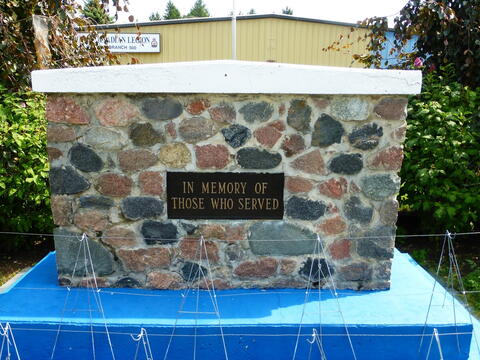
IN MEMORY OF
THOSE WHO SERVED
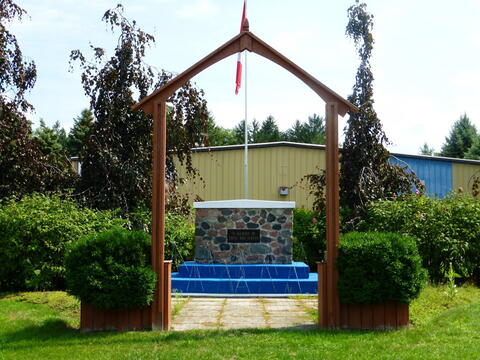
This memorial sits in front of the Royal Canadian Legion Beverly Branch #500. It was constructed in July of 1964 and has been used for Remembrance Day ceremonies ever since. Lynden is a small village, a rural suburb of the City of Hamilton, home to around 500 people. The memorial is in memory of those who served. A tall arch stands in front of the walkway leading to the cobblesone wall with a simple plaque.
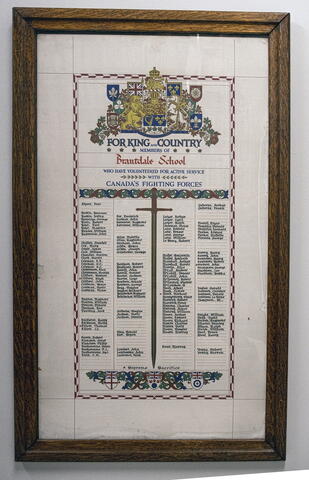
Brantdale School Second World War Honour Roll was located in the school at 15 Brantdale Avenue until sometime in the 1990s when it was acquired by Hamilton-Wentworth District School Board Educational Archives.
[front/devant]
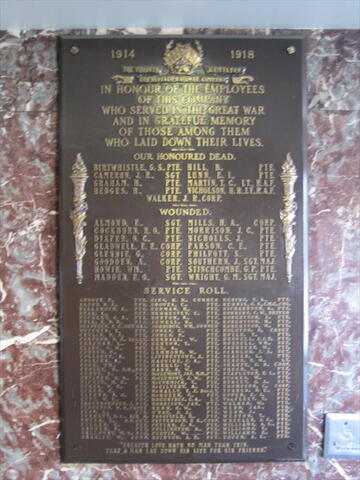
Toronto, Hamilton, and Buffalo Railroad
In Honour of the employees
of this company
who served in the Great War
and in grateful memory
of those among them
who laid down their lives
***
Our Honoured dead
***
Wounded
***
Service roll
***
"Greater love hath no man than this
that a man life down this life for his friends"
A memorial plaque, placed by the Toronto, Hamilton, and Buffalo Railroad to honour their employees who lost their lives in service during World War I. It was unveiled in 1921.
[front/devant]
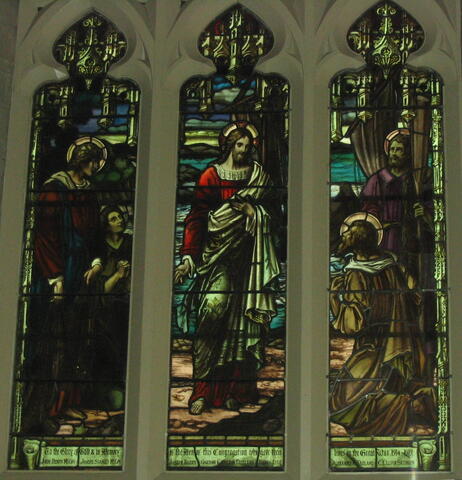
*Window #1, depicts one standing female angel and one kneeling female angel
To the Glory of God and in Memory
John Henry McCoy, Joseph Stanley McCoy
[front/devant]
*Window #2, depicts standing Jesus
of the members of this Congregation who gave their
Joseph Berry, Gordon Cameron Freeland, Harry Lyle
[front/devant]
*Window #3, one standing soldier and one kneeling soldier, dressed as Roman soldiers
lives in the Great War 1914-1919.
Alexander Farlane, C.E. Loyd Skedden
The stained glass windows were dedicated in 1921 to commemorate the fallen of the First World War. The congregation of MacNab Street Presbyterian Church erected the memorial, which was created by Robert McCausland Limited. There are three windows.
The inscription is meant to be read as the top line across all 3 windows, with the names of the fallen on the second line. It reads "To the Glory of God and in Memory of the members of this Congregation who gave their lives in the Great War 1914-1919."
[front/devant]
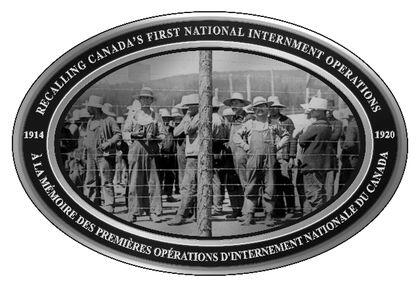
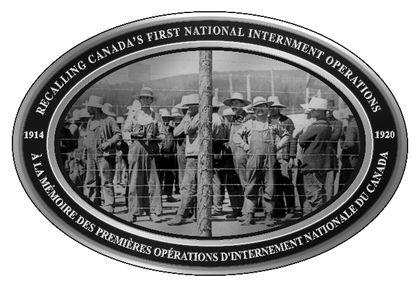
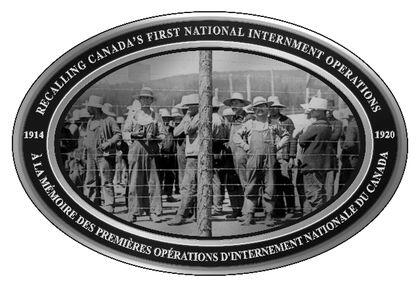
Recalling Canada's First National Internment Operations 1914-1920
A la mémoire des premières opérations d’internement nationale du Canada 1914-1920
This memorial recalls a historic injustice Canadians should pause to remember, as we recall the First World War and the valour of all those Canadian men, and some women, who served. It is a tribute to mark the memory of the thousands of "enemy aliens" who had their civil rights stripped, and were subsequently imprisoned during Canada's first national internment operations of 1914-1920, following the implementation of the War Measures Act. 2014 marks the 100th anniversary of the War Measures Act - adopted on August 22, 1914 during the First World War. It was used to imprison Ukrainian-Canadians, and other ethnic groups, including German, Hungarian, Serbian, Croatian, and Armenian communities, into one of Canada's 24 internment camps.
Dr. Lubomyr Luciuk, a professor at the Royal Military College of Canada and former chair of the Ukrainian Canadian Civil Liberties Association (UCCLA), had taken it upon himself to lead the way and organize the memorial. In the CTO ("One Hundred") project, 100 aluminum plaques were simultaneously unveiled at 100 different locations across the country at 11:00am local time on August 22, 2014. The first plaque was unveiled in Amherst, Nova Scotia, followed by a wave of plaque unveilings moved west, from province to province, culminating in Nanaimo, British Columbia. The plaques, which cost $1,000 to make, were funded by the generosity of the Endowment Council of the Canadian First World War Interment Recognition Fund.
Each plaque features a photo of internment prisoners confined behind a wire fence at the Castle Mountain Internment Camp in Banff, Alberta. The Castle Camp, which was built in 1915 at the base of Castle Mountain, was a Canadian internment camp which held immigrant prisoners of Ukrainian, Austrian, Hungarian, and German descent.