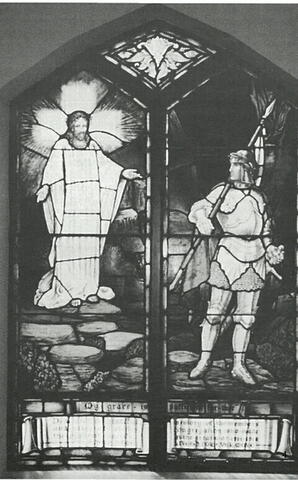
Parishioners erected a stained glass war memorial window featuring a crusading knight going into battle with the blessing of Christ wearing a cassock.
Central United Church Memorial Window
By grace of the Lord
Sign in to My VAC Account
Sign in to My VAC AccountBy grace of the Lord
Parishioners erected a stained glass war memorial window featuring a crusading knight going into battle with the blessing of Christ wearing a cassock.
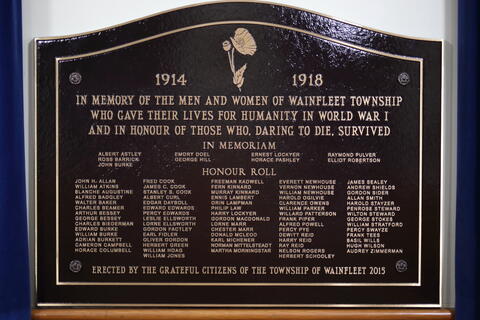
1914 1918
IN MEMORY OF THE MEN & WOMEN OF WAINFLEET
WHO GAVE THEIR LIVES FOR HUMANITY IN WORLD WAR I
AND IN HONOUR OF THOSE WHO, DARING TO DIE, SURVIVED.
IN MEMORIAM
ALBERT ASTLEY EMORY DOEL ERNEST LOCKYER RAYMOND PULVER
ROSS BARRICK GEORGE HILL HORACE PASHLEY ELLIOT ROBERTSON
HONOUR ROLL
JOHN H. ALLAN FRED COOK FREEMAN KADWELL EVERETT NEWHOUSE JAMES SEALEY
WILLIAM ATKINS JAMES C. COOK FERN KINNARD VERNON NEWHOUSE ANDREW SHIELDS
BLANCHE AUGUSTINE STANLEY S. COOK MURRAY KINNARD WILLIAM NEWHOUSE ALLAN SMITH
ALFRED BADGLEY ALBERT CURL ENNIS LAMBERT HAROLD OGILVIE ALLAN SMITH
WALTER BAKER EDGAR DAYBOLL ORIN LAMPMAN CLARENCE OWENS HAROLD STAYZER
CHARLES BEAMER EDWARD EDWARDS PHILIP LAW WILLIAM PARKER PENROSE STEWARD
ARTHUR BESSEY PERCY EDWARDS HARRY LOCKYER WILLARD PATTERSON WILTON STEWARD
GEORGE BESSEY LESLIE ELLSWORTH GORDON MACDONALD FRANK PIPER GEORGE STOKES
CHARLES BIEDERMAN LORNE ELLSWORTH LORNE MARR ALFRED POWELL WILLIAM STRATFORD
EDWARD BURKE GORDON FACTLEY CHESTER MARR PERCY PYE PERCY SWAYZE
WILLIAM BURKE EARL FIDLER DONALD MCLEOD DEWITT REID FRANK TEES
ADRIAN BURKETT OLIVER GORDON KARL MICHENER HARRY REID BASIL WILLS
CAMERON CAMPBELL HERBERT GREEN NORMAN MITTELSTEADT RAY REID HUGH WILSON
HORACE COLUMBELL WILLIAM HOAG MARTHA MORNINGSTAR NELSON ROGERS AUDREY ZIMMERMAN
WILLIAM JONES HERBERT SCHOOLEY
ERECTED BY THE GRATEFUL CITIZENS OF THE TOWNHIP OF WAINFLEET.
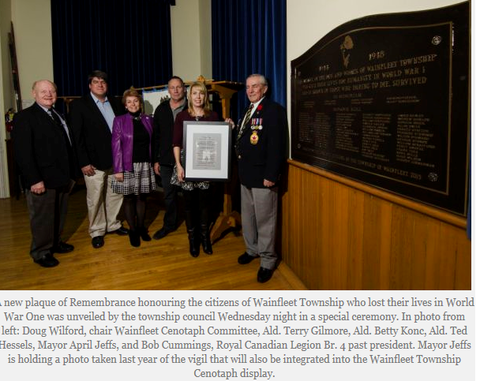
This memorial plaque is dedicated to the men and women of Wainfleet who died as well as those who served in the First World War. It was erected by the citizens of the Township of Wainfleet.
The plaque of Remembrance honouring the citizens of Wainfleet Township who lost their lives in World War One was unveiled by the township council in Dec 2015. Money left over from the building of the Wainfleet Township Cenotaph was used to build a plaque for the First World War citizens that resembles the one from the Second World War that is in council chambers. Funding also came from the community and organizations in the community.
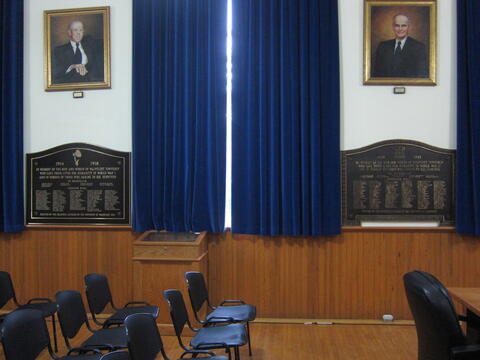
The Wainfleet Second World War Memorial Plaque is also located here.
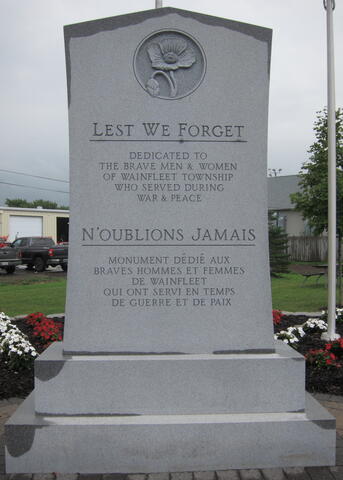
[front/devant]
LEST WE FORGET
DEDICATED TO
THE BRAVE MEN & WOMEN
OF WAINFLEET TOWNSHIP
WHO SERVED DURING
WAR & PEACE
N'OUBLIONS JAMAIS
MONUMENT DEDIE AUX
BRAVES HOMMES ET FEMMES
DE WAINFLEET
QUI ONT SERVI EN TEMPS
DE GUERRE ET DE PAIX
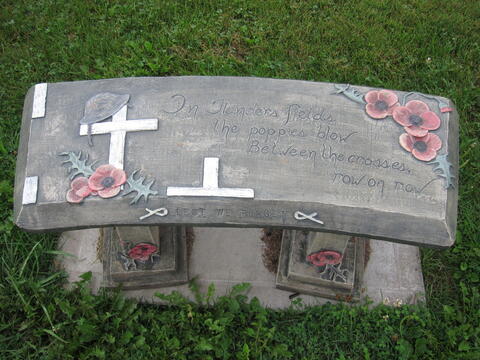
[bench/banc]
In Flanders fields
the poppies blow
Between the crossed,
row on row
LEST WE FORGET
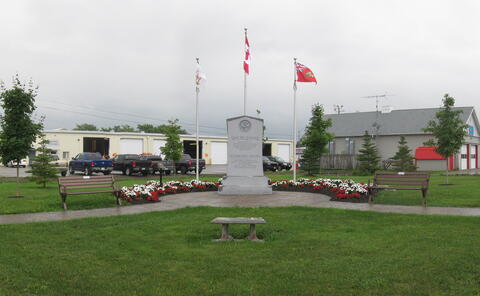
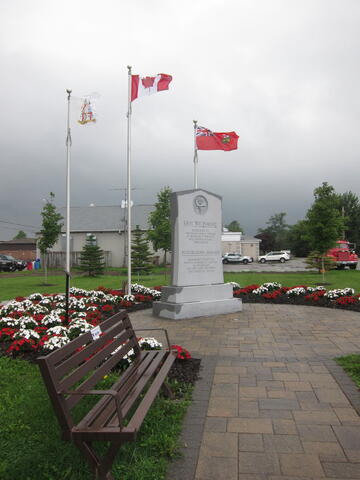
The Wainfleet Cenotaph is dedicated to the brave men and women of Wainfleet Township who served during war and peace.
[hospital sign/panneau de l’hôpital]
Haldimand
War Memorial
Hospital
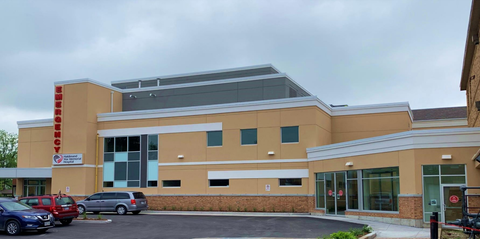
[emergency entrance/entrée des urgences]
Haldimand
War Memorial
Hospital
[section of hospital at Lock Street W and John Street/section de l’hôpital à l’angle de la rue Lock O. et de la rue John]
HALDIMAND
WAR MEMORIAL
HOSPITAL
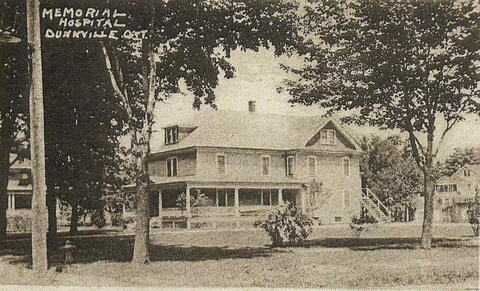
The residents of Dunnville wanted to commemorate the soldiers who had fought overseas in the First World War. William Fry, publisher of the Dunnville Chronicle, obtained the property on John Street between Lock and Broad, formerly owned by the late Judge Swayze. Dunnville Mayor B. Edgscombe and businessman turned politician Frank R. Lalor were approached and Lalor used $5,000 he had earned as a Member of Parliament to purchase the property.
On October 15, 1920, he turned the deed over to the Dunnville Women’s Patriotic Society. One stipulation was that the property was to be used as a public hospital to be called Haldimand War Memorial Hospital in memory of the brave soldiers who gave their lives in the war. The hospital was opened on February 3, 1920 with just 20 beds, a small nursery, a small operating room, and a portable x-ray machine.
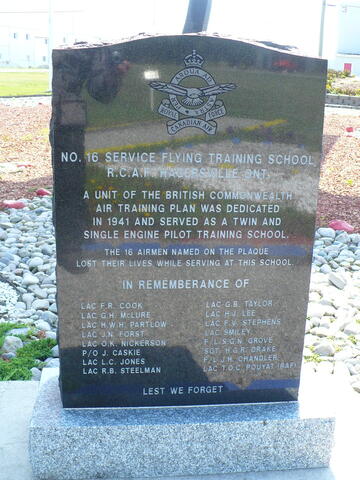
[Hagersville stone/pierre d'Hagersville]
PER ARDUA AD ASTRA
ROYAL CANADIAN AIR FORCE
NO. 16 SERVICE FLYING TRAINING SCHOOL
R.C.A.F. HAGERSVILLE ONT.
A UNIT OF THE BRITISH COMMONWEALTH
AIR TRAINING PLAN WAS DEDICATED
IN 1941 AND SERVED AS A TWIN AND
SINGLE ENGINE PILOT TRAINING SCHOOL.
THE 16 AIRMEN NAMED ON THE PLAQUE
LOST THEIR LIVES WHILE SERVING AT THIS SCHOOL.
IN REMEMBRANCE OF
LEST WE FORGET
[Dunville stone/pierre de Dunnville]
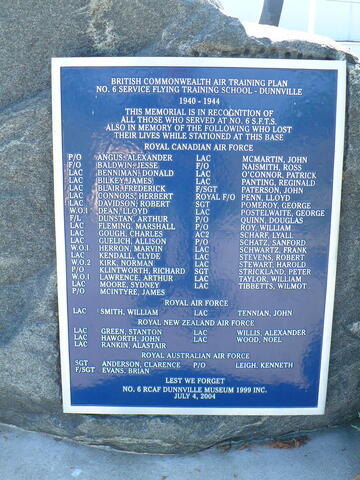
BRITISH COMMONWEALTH AIR TRAINING PLAN
NO. 6 SERVICE FLYING TRAINING SCHOOL - DUNNVILLE
1940 - 1944
THIS MEMORIAL IS IN RECOGNITION OF
ALL THOSE WHO SERVED AT NO. 6 S.F.T.S.
ALSO IN MEMORY OF THE FOLLOWING WHO LOST
THEIR LIVES WHILE STATIONED AT THIS BASE
ROYAL CANADIAN AIR FORCE
ROYAL AIR FORCE
LAC SMITH, WILLIAM
LAC TENNIAN, JOHN
ROYAL NEW ZEALAND AIR FORCE
LAC GREEN, STANTON
LAC HAWORTH, JOHN
LAC RANKIN, ALASTAIR
LAC WILLIS, ALEXANDER
LAC WOOD, NOEL
ROYAL AUSTRALIAN AIR FORCE
SGT ANDERSON, CLARENCE
F/SGT EVANS, BRIAN
P/O LEIGH, KENNETH
LEST WE FORGET
NO. 6 RCAF DUNNVILLE MUSEUM 1999 INC.
JULY 4, 2004
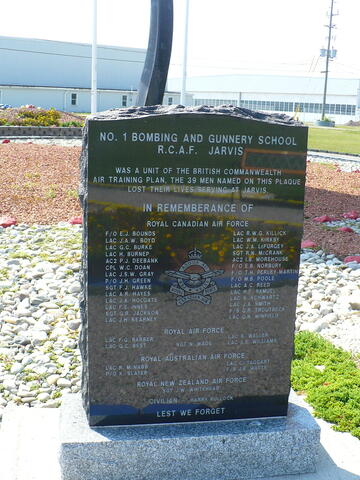
[Jarvis stone/pierre de Jarvis]
NO. 1 BOMBING AND GUNNERY SCHOOL
R.C.A.F. JARVIS
WAS A UNIT OF THE BRITISH COMMONWEALTH
AIR TRAINING PLAN, THE 39 MEN NAMED ON THIS PLAQUE
LOST THEIR LIVES SERVING AT JARVIS
IN REMEMBRANCE OF
ROYAL CANADIAN AIR FORCE
ROYAL AIR FORCE
LAC F.G. BARBER
LAC G.C. BEST
SGT N. WADE
LAC R. WALLER
LAC J.S. WILLIAMS
ROYAL AUSTRALIAN AIR FORCE
LAC R. McNABB
P/O K. SLATER
LAC C. TAGGART
F/S J.B. WATTS
ROYAL NEW ZEALAND AIR FORCE
SGT J.W. WHITEHEAD
CIVILIAN - HARRY BULLOCK
LEST WE FORGET
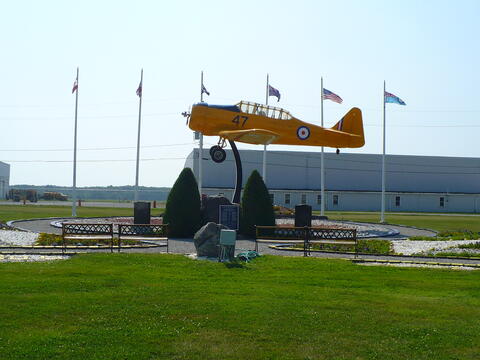
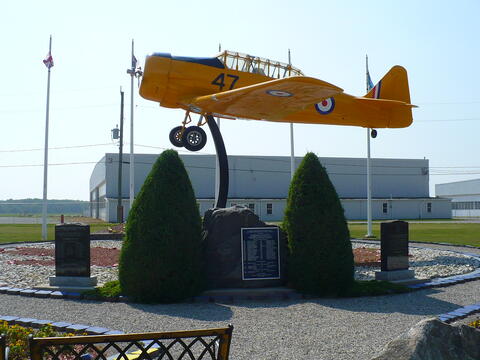
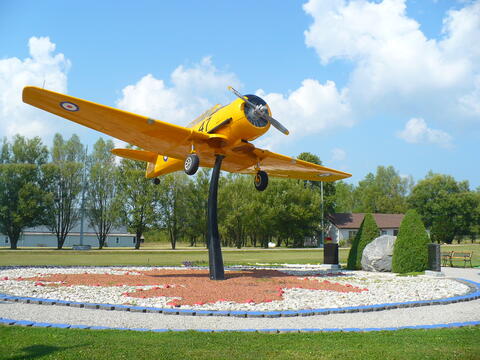
This memorial was dedicated by the No. 6 RCAF Dunnville Museum in July 2004, to the 47 men who lost their lives while training at No. 6 Service Flying Training School. The 10th Anniversary, July 3, 2009, saw the first dedication of 85 memorial bricks, four memorial benches, stones with the lists of names of those lost at Hagersville and Jarvis bases, and a rededication of the entire memorial.
Each year the ceremony includes the dedication of new memorial bricks and the rededication of the memorial. This large monument is situated on what was the parade grounds when No. 6 was an operational base. Flowers and coloured stones are shaped in the form of the Royal Canadian Air Force Crest. The top portion is shaped like a crown, in the center of the circle is a Harvard on a pedestal with the number 47 on it to signify the number of men who lost their lives while training at this base. The maple leaf is in red stone, the white portions on the sides and towards the bottom are white stones with flowers.
Memorial bricks on each side of the memorial are being placed for those who did not serve in the Royal Canadian Air Force, including members of the No. 6 RCAF Dunnville Museum. The main circle is surrounded by a stone walkway and inside this circle, memorial bricks are being placed for the Veterans who served in the Royal Canadian Air Force.
There are four donated memorial benches at the bottom of the walkway. The flags each signify a country of the men who trained at No. 6 Service Flying Training School (Australia, New Zealand, Canada, United States of America and England) as well as, the Royal Canadian Air Force flag.
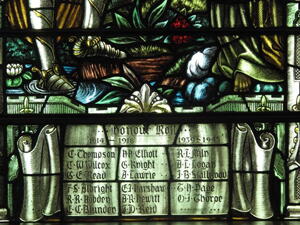
[inscription/inscription]
Honour Roll
[left side/côté gauche]
1914 - 1918
[right side/côté droite]
1939 - 1945
[left column/colonne de gauche]
C. Thompson
C.W. Wilcox
G.C. Read
F.S. Albright
R.R. Hobden
C.C. Blunden
[centre column/colonne de centre]
H.H. Elliott
G. Knight
A. Lawrie
C.J. Harshaw
A.R. Hewitt
J.D. Reid
[right column/colonne de droite]
R.L. Miln
A.L. Logan
J.B. Stallwood
T.H. Page
O.J. Thorpe
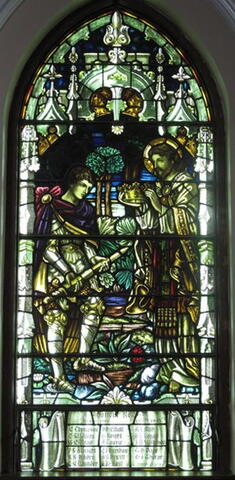
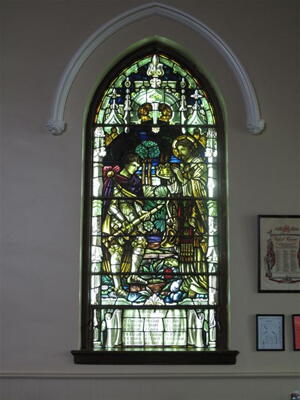
Erected by the Trinity United Church, this stained glass window depicting an Honour Roll, is dedicated to those veterans listed, lost during the First and Second World Wars. This memorial was unveiled in the 1940s.
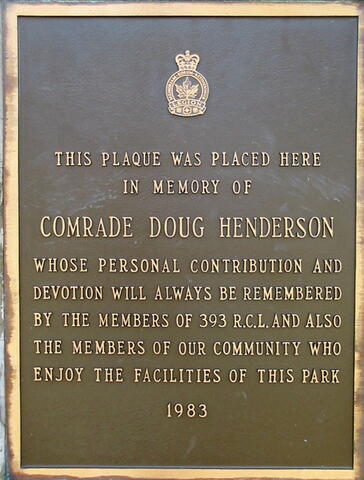
[brass plaque on left gate pillar/Plaque de laiton sur le pilier de la porte de gauche]
THIS PLAQUE WAS PLACED HERE
IN MEMORY OF
COMRADE DOUG HENDERSON
WHOSE PERSONAL CONTRIBUTION AND
DEVOTION WILL ALWAYS BE REMEMBERED
BY THE MEMBERS OF 393 R.C.L. AND ALSO
THE MEMBERS OF OUR COMMUNITY WHO
ENJOYED THE FACILITIES OF THIS PARK.
1983
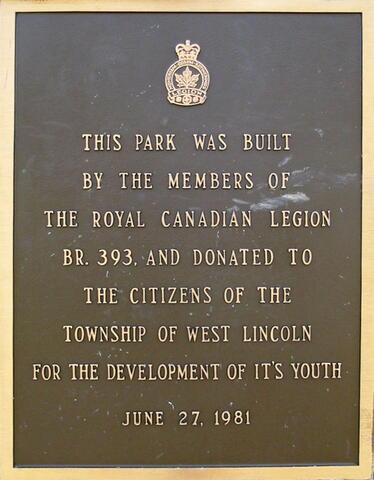
[brass plaque on right gate pillar/translate]
THIS PARK WAS BUILT
BY MEMBERS OF
THE ROYAL CANADIAN LEGION
BR. 393 AND DONATED TO
THE CITIZENS OF THE
TOWNSHIP OF WEST LINCOLN
FOR THE DEVELOPMENT OF IT'S YOUTH
JUNE 27, 1981
[granite slab at base of right gate pillar/Plaque de laiton sur le pilier de la porte de droite]
LEST WE FORGET
1914-1918
1939-1945
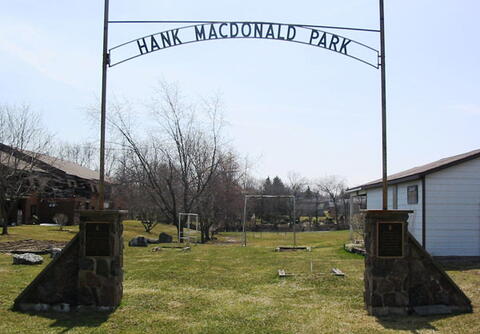
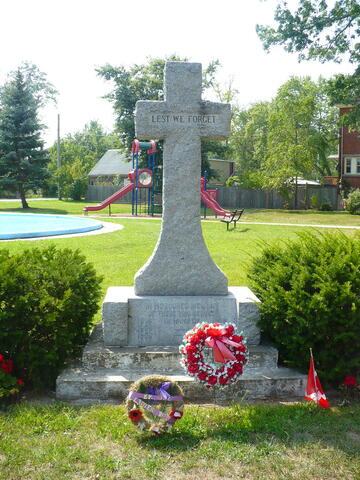
This memorial is dedicated to Comrade Doug Henderson for his personal contribution and devotion, by the Royal Canadian Legion - Branch 393, erected in 1981.
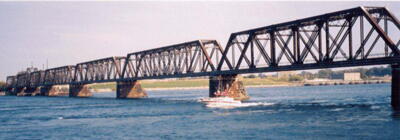
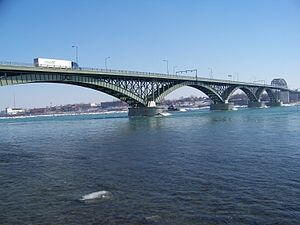
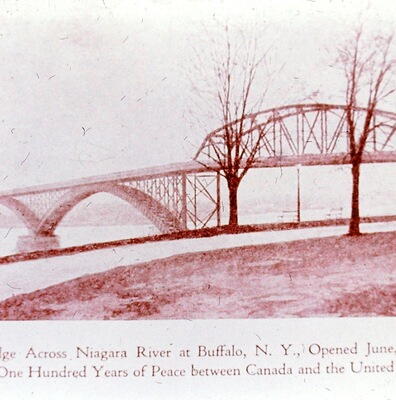
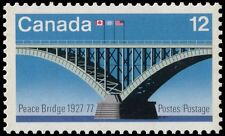
The Peace Bridge was constructed in 1927 to recognize over 100 years of peace and prosperity between the U.S. and Canada. The Peace Bridge is an international bridge between Canada and the United States at the east end of Lake Erie at the source of the Niagara River, about 20 kilometres upriver of Niagara Falls. The Peace Bridge was dedicated on August 7, 1927. The bridge is a 2580 foot long steel structure with three lanes. The Peace Bridge is the second busiest border crossing between the US and Canada.
The Peace Bridge is located near the center of downtown Buffalo, New York, and Fort Erie, Ontario, where it crosses the Niagara River. The main approaches to the Peace Bridge on the United States side are the New York State Thruway (I-190) and Porter Avenue, a four-lane arterial. On the Canadian side, the principal approach highways are the Queen Elizabeth Way ("QEW"), a four-lane controlled-access highway, Highway 3, a regional four-lane highway and the Niagara Parkway. The Peace Bridge addresses are 100 Queen Street Fort Erie, ON L2A 3S6 Canada and 1 Peace Bridge, Buffalo, NY 14213, United States.
The building of the Peace Bridge was approved by the International Joint Commission on August 6, 1925. A major obstacle to building the bridge was the swift river current, which averages 7.5 to 12 miles per hour (12.1 to 19.3 km/h). Construction began in 1925 and was completed in the spring of 1927. On March 13, 1927, Edward Lupfer who served as chief engineer, drove the first car across the bridge. On June 1, 1927, the bridge was opened to the public.
The Peace Bridge measures 3,580 feet in length from abutment to abutment. The roadway is 36 feet wide from curb to curb with two six-foot pedestrian sidewalks on either side of the bridge. The superstructure of the Peace Bridge consists of riveted steel with reinforced concrete deck slabs and a latex modified concrete wearing surface. Today, the Peace Bridge has been modified to a three-lane bridge with twelve-foot wide lanes, able to accommodate heavy-duty commercial loads. The center lane of this three-lane bridge is reversible, allowing for two-lane operation in one direction during peak hours.
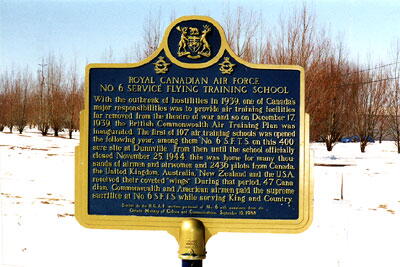
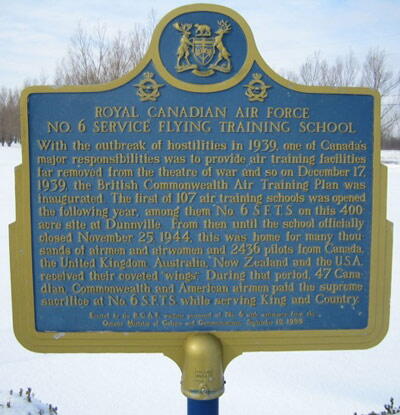
ROYAL CANADIAN AIR FORCE
NO. 6 SERVICE FLYING TRAINING SCHOOL
With the outbreak of hostilities in 1939, one of Canada’s
major responsibilities was to provide air training facilities
far removed from the theatre of war and so on December 17,
1939, the British Commonwealth Air Training Plan was
inaugurated. The first of 107 air training schools was opened
the following year, among them No. 6 S.F.T.S. on this 400-
acre site at Dunnville. From then until the school officially
closed November 25, 1944, this was home for many thou-
sands of airmen and airwomen and 2436 pilots from Canada,
the United Kingdom, Australia, New Zealand and the U.S.A.
received their coveted "wings". During that period, 47 Cana-
dian, Commonwealth and American airmen paid the supreme
sacrifice at No. 6 S.F.T.S. while serving King and Country.
Erected by the R,C.A.F., wartime personnel of No. 6 with assistance from the
Ontario Ministry of Culture and Communications, September 10, 1988
This memorial plaque title "Royal Canadian Air Force No. 6 Service Flying Training School" was erected by and dedicated to the Royal Canadian Air Force No. 6 Service Flying Training School.
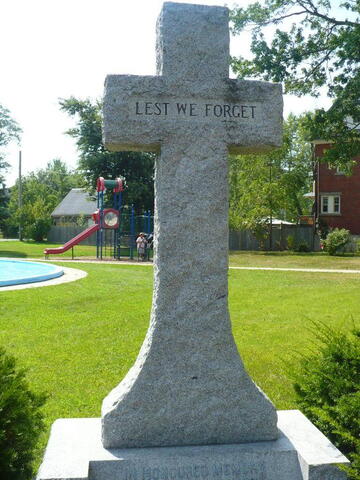
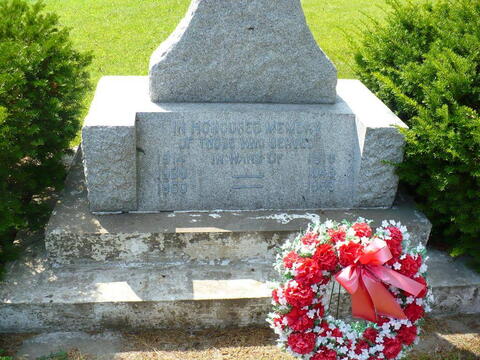
LEST WE FORGET
IN HONOURED MEMORY
OF THOSE WHO SERVED
IN WARS OF
1914 - 1918
1939 - 1945
1950 - 1953
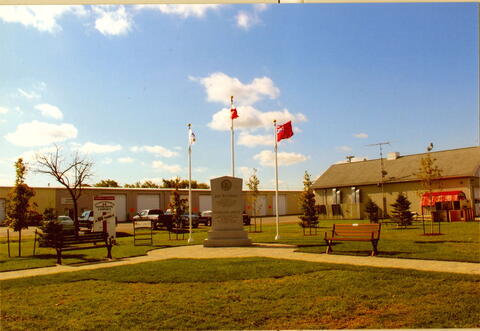
This memorial is dedicated to those who fought in the First and Second World Wars and the Korean War. It was erected by the Town of Dunnville.