Québec

Province Code
PQ
City/Municipality
Maniwaki
Memorial Number
24029-030
Type
Address
54 Makwa Mikan
Location
Kitigan Zibi Cultural Centre
in Canada
Yes
GPS Coordinates
0, 0
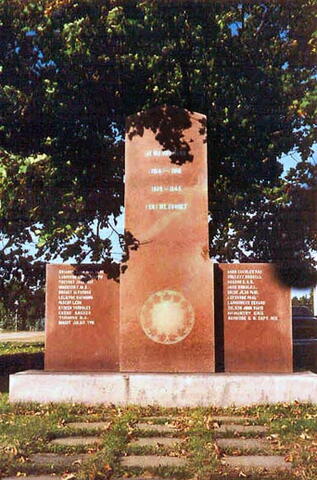
Inscription

[inscription/inscription]

LEST WE FORGET
ERECTED BY THE PEOPLE OF THE RIVER
DESERT BAND IN MEMORY OF THOSE
WHO SERVED THEIR COUNTRY
[left column/colonne de gauche]
WAR WORLD 1
1914 - 1918
BATISTE JOSEPH JOHN
BRASCOUPE JIM
CARLE JOSEPH
CARLE JOHN
COOKO JOHN
COOKO JOE
DANCY PIERRE
JACKO CLEMENT PETER
MCDOUGALL JACKO
MITCHELL WILLIE
MITCHELL JOSEPH
ODJICK JOSEPH
COMMANDA MOISE
KAPONICHIN SIMON
ODJICK ABRAHAM

[right column/colonne de droite]

BATISTE ANGUS
BRENNAN HARRY
BRASCOUPE JIMMY
BRASCOUPE SIMON
BRASCOUPE XAVIER
BUDGE KENNETH
BUDGE RAYMOND
CARLE PADDY
CAYER SIMON
CAYER JIM
CHABOT CLARENCE
CHABOT EDGAR
CHABOT JIM
CHAUSSE JIM
COOKO BERNICE
COOKO BERTHA
COOKO JOHN
COOKO MATTHEW
COTE SAM
DANCY ANGUS
DUMOUNT SIMON
MCDOUGALL GORDON
MCDOUGALL JOSEPH W.
MENESS FRANK
ODJICK BAZIL
ODJICK ROBERT SIMON
OTTAWA JOE
SCOTT MICHAEL
WHITEDUCK DANIEL

Image
Photo Credit
Francis McDougall
Caption
stele
Province
Body Content

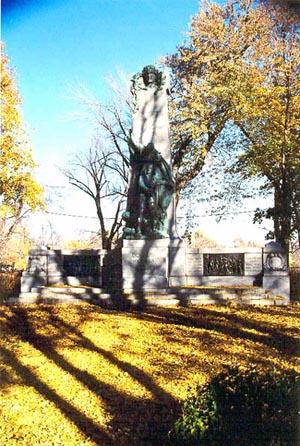
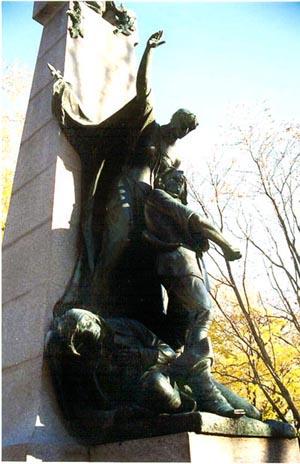
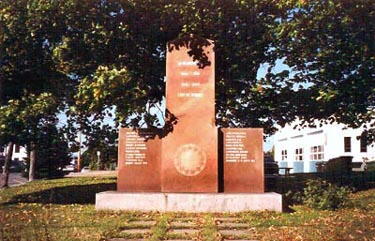
Originally erected in 1988 and replaced by the current memorial in 1994, by surviving Algonquin veterans and families. This memorial is dedicated to the community members who served in Canadian Forces during the First and Second World Wars, Korea and peacetime.

City
Maniwaki
Country
Type Description
Granite stele with concrete base
Memorial CF Legacy ID
8038
City/Municipality
Pointe-Claire
Memorial Number
24029-029
Type
Address
703 Donegani Avenue
Location
Last Post Fund National Field of Honour, Falaise Road
in Canada
Yes
GPS Coordinates
45.4386443, -73.8365496
Image
Province
Body Content

This road commemorates the Battle of the Falaise Pocket. It is a part of the National Field of Honour cemetery.

The Battle of the Falaise Pocket, fought during the Second World War from August 12-21, 1944, was the decisive engagement of the Battle of Normandy. Taking its name from the pocket around the town of Falaise within which Army Group B, consisting of the German Seventh and Fifth Panzer Armies became encircled by the advancing Western Allies, the battle is also referred to as the Falaise Gap after the corridor which the Germans sought to maintain to allow their escape. Two-thirds of Falaise was destroyed before the town was taken by a combined force of Canadian and Polish troops of the Canadian First Army. The battle resulted in the destruction of the bulk of Germany’s forces west of the River Seine and opened the way to Paris and the German border.

City
Pointe-Claire
Country
Type Description
Street; street sign
Memorial CF Legacy ID
8769
City/Municipality
Pointe-Claire
Memorial Number
24029-028
Type
Address
703 Donegani Avenue
Location
Last Post Fund National Field of Honour, Coronel Road
in Canada
Yes
GPS Coordinates
45.4386443, -73.8365496
Image
Province
Body Content

This road commemorates the Battle of Coronel. It is a part of the National Field of Honour cemetery.

The First World War naval Battle of Coronel took place on November 1, 1914, off the coast of central Chile near the city of Coronel. Forces led by Vice-Admiral Graf von Spee defeated a Royal Navy squadron commanded by Rear-Admiral Sir Cradock. The engagement probably took place as a result of a series of misunderstandings. Neither admiral expected to meet the other in full force. Once the two met, Cradock understood his orders were to fight to the end, despite the odds heavily against him. Although Spee had an easy victory, destroying two enemy armoured cruises for just three men injured, the engagement also cost him half his supply of ammunition, which was impossible to replace. Shock at the British losses led to an immediate reaction and the sending of more ships which in turn destroyed Spee and the majority of his squadron at the Battle of the Falkland Islands.

The Battle of Coronel marks Canada’s first causalities of the First World War. Midshipmen M. Cann, J.V.W. Hatheway, W.A. Palmer and A.W. Silver had been seconded to the RN and were killed when their ship, HMS Good HOPE, was sunk during the battle.

City
Pointe-Claire
Country
Type Description
Street; street sign
Memorial CF Legacy ID
8768
City/Municipality
Pointe-Claire
Memorial Number
24029-027
Type
Address
703 Donegani Avenue
Location
Last Post Fund National Field of Honour, Chateauguay Road
in Canada
Yes
GPS Coordinates
45.4386443, -73.8365496
Image
Province
Body Content

This road commemorates the Canadian participation in the Battle of Chateauguay. It is a part of the National Field of Honour cemetery.

The Battle of the Chateauguay was an engagement of the War of 1812. On October 26, 1813, a British force consisting of 1,630 regulars, volunteers and militia from Lower Canada and Mohawk warriors, commanded by Lieutenant Colonel Charles-Michel d’Irumberry de Salaberry, repelled an American force of about 2,600 attempting to invade Lower Canada and ultimately attack Montreal.

The Battle of the Chateauguay was one of the two battles (the other being the Battle of Crysler’s Farm) which caused the Americans to abandon the Saint Lawrence Campaign, their major strategic effort in the autumn of 1813.

City
Pointe-Claire
Country
Type Description
Street; street sign
Memorial CF Legacy ID
8767
City/Municipality
Pointe-Claire
Memorial Number
24029-026
Type
Address
703 Donegani Avenue
Location
Last Post Fund National Field of Honour, Amiens Road
in Canada
Yes
GPS Coordinates
45.4386443, -73.8365496
Image
Province
Body Content

This road commemorates the Canadian participation in the Battle of Amiens. It is a part of the National Field of Honour cemetery.

The Battle of Amiens, 8-11 August, 1918, went of Amiens, was the opening phase of the Allied offensive later known as the Hundred Days Offensive that ultimately led to the end of the First World War. A coordinated assault, spearheaded by the Australian and Canadian Corps, the battle involved aircraft, tanks, artillery, cavalry and infantry. Allied forces advanced over 11 kilometers on the first day, one of the greatest advances of the war. The battle is also notable for its effects on both sides’ moral and the large number of surrendering German forces. This led Erich Ludendorff to describe the first day of the battle as “the black day of the German Army”. Amiens marked the end of trench warfare on the Western Front, fighting becoming mobile once again until the armistice was signed on 11 November 1918.

City
Pointe-Claire
Country
Type Description
Street; street sign
Memorial CF Legacy ID
8766
City/Municipality
Pointe-Claire
Memorial Number
24029-025
Type
Address
703 Donegani Avenue
Location
Last Post Fund National Field of Honour, William Bishop, VC Road
in Canada
Yes
GPS Coordinates
45.4386443, -73.8365496
Inscription

[front/devant]

Air Marshall William Avery "Billy" Bishop, VC, CB, DSO & Bar, MC, DFC, ED, citation from London Gazette, no.30228, 11 August 1917.

"For most conspicuous bravery, determination and skill.

Captain Bishop, who had been sent out to work independently, flew first of all to an enemy aerodrome; finding no machine about, he flew on to another aerodrome about three miles south-east, which was at least twelve miles the other side of the line.  Seven machines, some with their engines running, were on the ground.  He attacked these from about fifty feet, and a mechanic, who was starting one of the engines, was seen to fall.  One of the machines got off the ground, but at a height of sixty feet Captain Bishop fired fifteen rounds into it at very close range, and it crashed to the ground.

A second machine got off the ground, into which he fired thirty rounds at 150 yards range, and it fell into a tree.

Two more machines then rose from the aerodrome.  One of these he engaged at the height of 1,000 feet, emptying the rest of his drum of ammunition.  This machine crashed 300 yards from the aerodrome, after which Captain Bishop emptied a whole drum into the fourth hostile machine, and then flew back to his station.

Four hostile scouts were about 1,000 feet above him for about a mile of his return journey, but they would not attack.

His machine was very badly shot about by machine gun fire from the ground.”

Image
Province
Body Content

This road is named in honour of Air Marshal William Avery “Billy” Bishop, VC, CB, DSO & Bar, MC, DFC, ED.

William Avery Bishop was born in Owen Sound, Ontario on 8 February 1894. During the outbreak of the Great War, he was a cadet at the Royal Military College, in Kingston. He enrolled in the 9th Mississauga Horse, Canadian Expedition Force, on 30 September 1914, and he later transferred to the Royal Flying Corps. Bishop, who already had the Distinguished Service Order and Military Cross, became the first Canadian Airman to be awarded the Victoria Cross for his single-handed early morning attack on an enemy airfield near Cambrai, France. On 2 June 1917, he found seven aircraft on the ground; he attacked and destroyed three, and was later credited with the destruction of the remaining four aircraft. Bishop continued air operations until August 1917 and returned to the front in June 1918. He emerged as the British Empire’s second highest scoring ace, with 72 official victories.

In the Second World War Bishop was an Air Marshal in the Royal Canadian Air Force and assisted in recruiting. He later died in Palm Beach, United States, on 11 September 1956.

City
Pointe-Claire
Country
Type Description
Street; street sign
Memorial CF Legacy ID
8778
City/Municipality
Pointe-Claire
Memorial Number
24029-024
Type
Address
703 Donegani Avenue
Location
Last Post Fund National Field of Honour, W. Clark Kennedy, VC Road
in Canada
Yes
GPS Coordinates
45.4386443, -73.8365496
Inscription

[front]

Lieutenant-Colonel William Hew Clark-Kenedy's citation, London Gazette, no.31067, 14 December 1918

“For most conspicuous bravery, initiative and skilful leading on the 27th and 28th August, 1918, when in command of his battalion.

On the 27th he led his battalion with great bravery and skill from Crow and Aigrette trenches in front of Wancourt to the attack on the Fresnes-Rouvroy line.  From the outset the brigade, of which the 24th Battalion was a central unit, came under very heavy shell and machine-gun fire, suffering many casualties, especially amongst leaders.  Units became partially disorganised and the advance was checked.  Appreciating the vital importance to the brigade front of a lead by the centre, and undismayed by annihilating fire, Lt.-Col. Clark-Kennedy, by sheer personality and initiative, inspired his men and led them forward.  On several occasions he set an outstanding example by leading parties straight at the machine-gun nests which were holding up the advance and overcame these obstacles.

By controlling the direction of neighbouring units and collecting men who had lost their leaders, he rendered valuable services in strengthening the line, and enabled the whole brigade front to move forward.

By the afternoon, very largely due to the determined leadership of this officer and disregard for his own life, his battalion, despite heavy losses, has made good the maze of trenches west of Cherisy and Cherisy Village, had crossed the Sensee Rivert bed, and had occupied Occident Trench in front of the heavy wire of the Fresnes-Rouvroy line; under continuous fire he then went up and down his line until far into the night, improving the position, giving wonderful encouragement to his men, and sent back very clear reports.

On the next day he again showed valorous leadership in the attack on the Fresnes-Rouvroy line and Upton Wood.  Though severely wounded soon after the start he refused aid, and dragged himself to a shell-hole, from which he could observe.  Realising that his exhausted troops could advance no further he established a strong line of defence and thereby prevented the loss of most important ground.  Despite intense pain and serious loss of blood he refused to be evacuated for over five hours, by which time he had established the line in a position from which it was possible for the relieving troops to continue the advance.

It is impossible to overestimate the results achieved by the valour and leadership of this officer."


Image
Province
Body Content

This road is named in honour of Lieutenant-Colonel William Hew Clark-Kennedy, VC, CMG, DSO.

William Hew Clark-Kennedy was born in Dunskay, Scotland on 3 March 1880. After service with the British Army in the South African War, he came to Canada in 1902.

Clark-Kennedy joined the Royal Highlanders of Canada in 1914, and during the First World War rose to command the 24th Infantry Battalion, Canadian Expeditionary Force. Lieutenant-Colonel Clarke-Kennedy was four times mentioned in dispatches, received the Distinguished Service Order and bar, was made a Companion of the Order of St Michael & St George, and was awarded the Croix de Guerre by France.

Lieutenant-Colonel Clark-Kennedy received the Victoria Cross for his conduct in the Battle of Arras on 27 and 28 August 1918. Over the course of those two days, his battalion suffered numerous casualties near Wancourt in France as it strove to advance through heavy artillery and machine gun fire. In the face of such strong enemy resistance, Clark-Kennedy led his men forward to eliminate machine gun positions preventing the progress of the offensive.

This enabled the entire brigade to reach the Fresnes-Rouvray line. Though wounded, Lieutenant-Colonel Clark-Kennedy remained in command of his battalion until its objective was consolidated.

Clark-Kennedy died in Montreal, Quebec on 25 October 1961.

City
Pointe-Claire
Country
Type Description
street; street sign
Memorial CF Legacy ID
8777
City/Municipality
Pointe-Claire
Memorial Number
24029-023
Type
Address
703 Donegani Avenue
Location
Last Post Fund National Field of Honour, Paul Bernatchez Road
in Canada
Yes
GPS Coordinates
45.4386443, -73.8365496
Image
Province
Body Content

This road is named in honour of Major-General J.P.E. Bernatchez, CBE, CMM, DSO, CD.

Major-General Joseph Paul Émile Bernatchez was born in Montmagny, Quebec in March 1911. He enlisted at the Royal Military College in Kingston in August 1929, graduating with distinction in June 1934. He joined the Royal 22e Régiment and in April 1935, he left for the UK to round out his military knowledge. He returned to Canada in February 1937. He was promoted to Captain at the beginning of the Second World War and went overseas as the officer commanding “B” Company, Royal 22e Régiment. He was soon promoted to Major and in the fall of 1941, he took command of the unit at the rank of Lieutenant-Colonel. In July 1943, he commanded his battalion during the Pachino peninsula landings in Sicily. In March 1944, he was appointed Commander of the 3rd Infantry Brigade. He was decorated with the Distinguished Service Order in Italy and was also mentioned in Despatches. In March 1945, he arrived in Holland with the other Canadian troops from the Italian front. He remained there until the end of hostilities. In 1951, he became the Commanding Officer of the Canadian military mission in the Middle East and was later promoted to Major-General and Commander of Quebec Command. Major-General Bernatchez died on November 13, 1983.

City
Pointe-Claire
Country
Type Description
street; street sign
Memorial CF Legacy ID
8775
City/Municipality
Pointe-Claire
Memorial Number
24029-022
Type
Address
703 Donegani Avenue
Location
Last Post Fund National Field of Honour
in Canada
Yes
GPS Coordinates
45.4386443, -73.8365496
Image
1 of 2 images
Image
1 of 2 images
Province
Body Content

This traffic circle is named in honour of Lieutenant Colonel Charles-Michel d’Irumberry de Salaberry, CB. At the centre of the traffic circle is another memorial, NICMM 24029-013, dedicated to the veterans of the First and Second World Wars and the Korean War.

Charles-Michel d’Irumberry de Salaberry was born in Beauport, near Quebec City, in November 1778. He enlisted in the British Army in 1792 at the age of 14, and saw action with the 60th Regiment in the West Indies and in the Netherlands. He was given a company command in 1803, continuing to serve in Europe and the West Indies. In 1810, de Salaberry was recalled to Canada with the rank of Lieutenant-Colonel. He served as aide-de-camp to Major General Francis de Rottenburg, but in 1812 he was appointed to command a new corps of volunteers, the Canadian Voltiguers (light infantry). Les Voltiguers were essentially militia men, but de Salaberry trained them as regulars similar to the Fencible units raised in Upper Canada. In November 1812, de Salaberry commanded the advance guard of the force that turned away an American attack at La Colle Mill. Later, some Voltiguers took part in the decisive Battle of Crysler’s Farm. In October 1813, he confronted the Americans threatening Montreal. Colonel de Salaberry, at the head of some 300 Voltiguers and Canadian and Indian volunteers, repulsed several thousand American troops. In 1817, he was made a Companion of the Order of the Bath. He later became a legislative councilor for Lower Canada until his death in February 1829.

City
Pointe-Claire
Country
Type Description
traffic circle
Memorial CF Legacy ID
8774
City/Municipality
Pointe-Claire
Memorial Number
24029-021
Type
Address
703 Donegani Avenue
Location
Last Post Fund National Field of Honour
in Canada
Yes
GPS Coordinates
45.4386443, -73.8365496
Image
1 of 2 images
Image
1 of 2 images
Province
Body Content

This traffic circle is named in honour of General Sir Arthur Currie, GCMG, KCB, VD, Légion d’honneur and Croix de Guerre (with palm)- France, Order of the Crown and Croix de Guerre – Belgium, Distinguished Service Medal – US. At the centre of the traffic circle is another memorial, NICMM 24029-012, dedicated to General Sir Arthur Currie and members of the Army who gave their lives.

General Sir Arthur William Currie was born in December 1875, in the hamlet of Napperton, near Strathroy. He moved to Victoria in 1894 and taught at public schools in the area. In 1897, he joined the 5th Regiment, Canadian Garrison Artillery (C.G.A.) and has the unique distinction of starting his military career as a pre-war militia gunner before rising through the ranks to become the first Canadian commander of the four divisions of the unified Canadian Corps of the Canadian Expeditionary Force. He was the first Canadian to attain the rank of full general. Currie’s success was based on his ability to rapidly adapt brigade tactics to the exigencies of trench warfare, using set-piece operations. Currie was not afraid to voice his disagreement with orders or to suggest strategic changes to a plan of attack, and is generally considered to be among the most capable commanders of the Western Front and one of the finest commanders in Canadian military history. A courageous and innovative officer, he is best remembered for his involvement in formulating the plan for the great victory at Vimy Ridge. Then, as the first Canadian commander of the Canadian Corps, his brilliant leadership produced the sweeping Canadian victories of the War’s Last Hundred Days. After the war, Currie was offered the position of Principal and Vice-Chancellor of McGill University. He held this post with distinction from 1920 until his death in November, 1933.

City
Pointe-Claire
Country
Type Description
Traffic circle
Memorial CF Legacy ID
8773