Québec

Province Code
PQ
City/Municipality
Beaconsfield
Memorial Number
24031-010
Type
Address
269 Shore Road
Location
Heroes Park
in Canada
Yes
GPS Coordinates
45.4254328, -73.8629403
Inscription

[front/devant]

Général le très honorable
General The Right Honourable
Georges Philias Vanier

[left side/côté gauche]

En homage
Gouverneur general: 1959 à 1967
Nommé le : 1er août 1959
Assermenté le : 15 septembre 1959 à Ottawa
Né le : 23 avril 1888 à Montréal (Québec)
Décédé le 5 mars 1967

Georges Philias Vanier naquit à Montréal le 23 avril 1888. Ayant grandi au sein d’une famille de la classe moyenne où l’on parlait surtout l’anglais, il a toutefois pu parfaire son français plus tard, dans le cadre de ses études. Après avoir obtenu un diplôme au Collège Loyola axé sur la dévotion confessionnelle, il songea un certain moment à se consacrer à la prêtrise. Ayant obtenu plus tard un diplôme en droit de l’université Laval, il fut appelé au Barreau du Québec en 1911. Toutefois, il se sentit interpellé lors du déclenchement de la Première Guerre mondiale et considéra qu’il était de son devoir de participer à l’effort de guerre. Il s’enrôla donc dans les Forces canadiennes dès 1915.

À l’âge de 26 ans, Georges Vanier entra dans les rangs du premier bataillon canadien-français, le Royal 22e Régiment, où il fut appelé à jouer un rôle organisationnel important. Le bataillon ayant été mobilisé sur le front dans les tranchées françaises, dès 1915, Georges Vanier participa à plusieurs affrontements historiques, notamment la bataille de la crête de Vimy et la bataille de Passchendaele. En 1918, à peine 74 jours avant la signature de l’armistice, il perdit sa jambe droite dans une attaque à la guerre lui a valu de nombreuses distinctions, notamment la Croix militaire (à deux reprises), la Croix de la Légion d’honneur décernée par le gouvernement français, l’Étoile de 1914 – 1915, la Médaille de guerre britannique, la Médaille de la victoire, ainsi que l’Ordre de Service distingué.

En 1919, de retour à Montréal après la guerre, il se consacrera d’abord au droit. En 1920, il sera nommé commandant au sien du Royal 22e Régiment où il sera finalement promu colonel.

Au cours des années qui menèrent à la Deuxième Guerre mondiale, George Vanier occupa plusieurs postes, notamment comme aide de camp du gouverneur général et comme conseiller pour le désarmement auprès de la Société des Nations, à Genève. De 1931 à 1938, il fut posté au sien du Haut-commissariat du Canada à Londres, avant d’être nommé ministre à l’Ambassade du Canada à Paris, dès 1939. Contraint de fuir Paris en raison des hostilités du début de la guerre, il organisa d’abord l’évacuation de citoyens canadiens et d’autres réfugiés. En 1944, Georges Vanier devint ambassadeur du Canada en France et participa à l’élaboration des ententes internationales pour encadrer les efforts d’après-guerre. Il délaissa finalement le monde diplomatique en 1954, mais demeura toutefois très engagé envers son pays. Enfin, le 15 septembre 1959, le major-général Vanier devint le tout premier gouverneur général du Canada né au Québec. Animé d’une volonté de démocratiser la fonction de gouverneur général aux yeux de la population canadienne (le poste était encore très associé à l’impérialisme britannique) et de rappeler aux Canadiens la richesse du patrimoine français de leur pays, il s’employa sans tarder à promouvoir une politique du bilinguisme dans le but d’améliorer les relations entre les deux principaux groupes linguistiques.

Pendants ses années à Rideau Hall, il a eu l’occasion de parcourir toutes les régions du Canada, où il a effectué 131 visites au cours des quelles il a pu s’arrêter dans des écoles, des hôpitaux, des centres de détention ainsi que d’autres établissements et lieux d’intérêt. Au cours de cette période, Georges Vanier a prononcé plus de 500 allocutions.

George Philias Vanier s’éteignit le 5 mars 1967 à l’âge de 78 ans, et fut inhumé plus tard à la Citadelle de Québec.

[right side/côté droit]

In honour
Governor General : 1959 – 1967
Appointed : August 1, 1959
Sworn in: September 15, 1959, Ottawa
Born: April 23, 1888, Montreal, Quebec
Died: March 5, 1967

Georges Philias Vanier was born in Montreal on April 23, 1888. He grew up in a middle-class, mostly English speaking household, only later perfecting his French through his studies. He earned a degree in church devotional fellowship at Loyola College and briefly considered entering the priesthood. He then earned a subsequent degree in law at Université Laval and was called to the Quebec Bar in 1911. However, with the start of the First World War, he felt it was his duty to participate in the war effort and enlisted in the Canadian Forces in 1915.

At the age of 26, he joined and played an important role in organizing the Royal 22nd Regiment, also known as the “Van Doos”, the first battalion raised by French Canadians. The battalion went to war in France’s tranches in 1915. Georges participated in many important battles including the Battle of Vimy Ridge, and the Battle of Passchandaele. In 1918, only 74 days before the armistice, he lost his right leg in an attack at Chérisy and stayed in Europe to recover. By the end of the war, he had earned many honours, including the Military Cross (on two occasions), the Cross of the Legion of Honour from the government of France, the 1914-1915 Star, the British War Medal, the Victory Medal, and a Distinguished Service Order.

Upon his returned to Montreal following the war in 1919, he practised law and, in 1920, was made commanding officer and subsequently colonel of the Royal 22nd Regiment.

In the years leading up to the Second World War, Georges held several position, including aide-de-camp to the Governor General and advisor to the League of Nations disarmament in Geneva. Between 1931 and 1938, he was posted to the Canadian High Commission in London and in 1939 he was named minister at the Canadian Embassy in Paris. With the hostilities of the impending war approaching, he arranged the evacuation of Canadian nationals and other refugees before leaving Paris himself. In 1944, Georges became Canada’s ambassador to France, working on international agreements focused on port-war efforts. He retired from diplomatic service in 1954, however he continued to be deeply committed to serving his country. Major-General Vanier became the first Quebec native to be appointed Governor General of Canada, on September 15, 1959. With the desire to make the position of Governor General (still affected by British Imperialism) more representative of the Canadian people, and to remind Canadians of their country’s rich French heritage, Georges immediately began promoting a policy of bilingualism, wanting to improve relations between both major linguistic groups.

During Georges’ tenure as Governor General, he travelled all across Canada, making a total of 131 tours, visiting schools, hospitals and jails, among other institutions and attractions. Georges also made more than 500 speeches.

Georges Philias Vanier died on March 5, 1967, at the age of 78 and was later buried at La Citadelle in Quebec City.

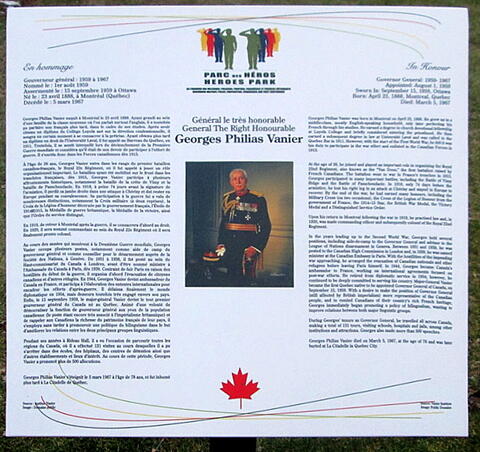
Image
1 of 2 images
Image
1 of 2 images
War or Conflict Term
Province
!4v1649683613652!6m8!1m7!1sbhI-m99Rs9sZcKT3JK-gkQ!2m2!1d45.42543278158772!2d-73.86294033022338!3f325.0192655530806!4f-2.1198910502704678!5f1.5353860272464637"
Body Content

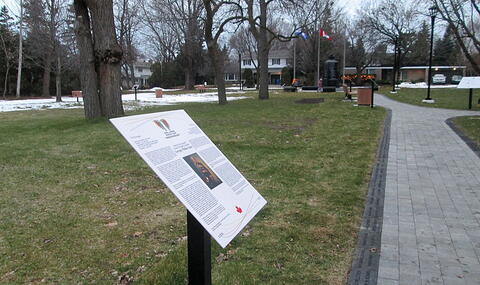
This memorial is dedicated to the memory of Major-General Georges-Philéas Vanier PC, DSO, MC, CD.

Major-General Georges-Philéas Vanier was a Canadian soldier who served as Governor General of Canada. He was born and educated in Quebec. After obtaining a BA and a law degree, he served in the Canadian Army during the First World War on the European battlefields. On 1918, while leading an attack on the village of Chérisy, he was shot in the chest and both legs, eventually losing one leg to his wounds. Subsequently, Vanier returned to Canada and remained in the military until the early 1930s, when he was posted to diplomatic missions in Europe. With the outbreak of the Second World War, Vanier rejoined toe military, commanding troops on the home front. In 1942 he was promoted to the rank of major general, and made the Canadian Envoy Extraordinary and Minister Plenipotentiary to the governments of Belgium, Czechoslovakia, Greece, the Netherlands, Norway, Poland, and Yugoslavia, as well as the representative of the Canadian government to the Free French all of which were governments in exile. In 1959, he was appointed Governor General of Canada remaining in this post until his death in 1967. Vanier proved to be a popular governor general, with his war record earning respect from Canadians.

City
Beaconsfield
Country
Type Description
Panel on a pedestal
Memorial CF Legacy ID
8794
City/Municipality
Beaconsfield
Memorial Number
24031-009
Type
Address
269 Shore Road
Location
Heroes Park
in Canada
Yes
GPS Coordinates
45.4254096, -73.8629058
Image
Photo Credit
Neural Mass
Province
!4v1615383933734!6m8!1m7!1s18chg3VrE0q0uuC2PcNrRw!2m2!1d45.42540959616458!2d-73.8629058339333!3f316.98991494958307!4f2.7719868474521547!5f1.6787129176623816"
Body Content

The Path of Heroes stands to complement the Beaconsfield War Memorial (24031-007), erected by the Beaurepaire-Beaconsfield Historical Society in partnership with the Royal Canadian Legion and Beaconsfield High School. It recognizes police, firefighters and other first responders who have served and sacrificed in service to the community.

In 2010, The City of Beaconsfield and its citizens were honored when the city flag flew in the Canadian Headquarters of the 1st Battalion, Royal 22nd Regiment Battle Group in Kandahar, Afghanistan. Major R Gratton, a Beaconsfield resident and member of the Second Field Regiment (Reserve artillery Regiment in Montreal) was then deployed in Afghanistan made a promise to create a citizen committee to build a cenotaph to honour the service of the military but also those who are in harm’s way in the service to the population of Canada. The Path of Heroes is a part of this dedication, which also includes The Heroes Park Project and the Beaconsfield War Memorial.

City
Beaconsfield
Country
Type Description
Pathway
Memorial CF Legacy ID
8798
City/Municipality
Beaconsfield
Memorial Number
24031-008
Type
Address
269 Shore Road
Location
Heroes Park
in Canada
Yes
GPS Coordinates
45.4254018, -73.8629512
Inscription

[front/devant]

[left side/côté gauche]

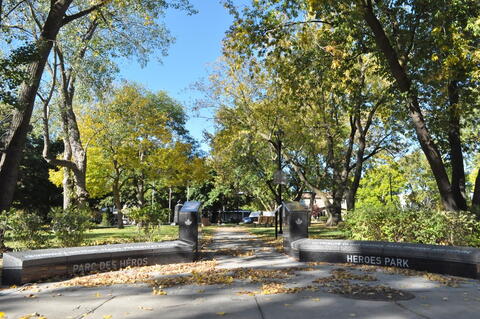
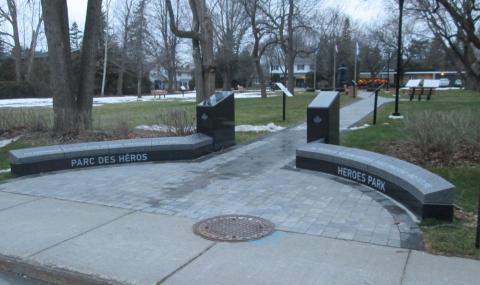
Parc des Héros. En hommage à nos héros passés, présents, et futurs.

[right side/côté droit]

Heroes Park. In tribute to our heroes past, present, and future.

[back/arrière]

[left side/côté gauche]

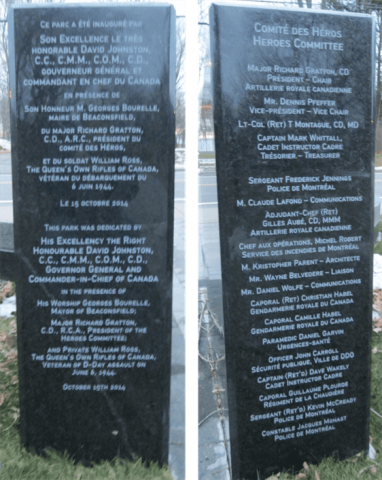
Ce parc a été inauguré par son Excellence le Très Honorable David Johnson, C.C, C.M.M., C.O.M., C.D., Gouverneur Général et commandant en Chef du Canada, en présence de Son Honneur M. Georges Bourelle, Maire de Beaconsfield, du major Richard Gratton, C.D., A.R.C., Président du Comité des Héros et du soldat William Ross, The Queen’s Own Rifles of Canada, vétéran du débarquement du 6 juin 1944. Le 15 octobre 2014.

This par kwas dedicated by His Excellency the Right Honourable David Johnson, C.C, C.M.M., C.O.M., C.D., Governor General and Commander-in-Chief of Canada. In the presence of His Worship Georges Bourelle, Mayor of Beaconsfield, Major Richard Gratton, C.D., R.C.A., President of the Heores Committee, and Private William Ross, The Queen’s Own Rifles of Canada, veteran of the D-Day assault on 6 June 1944. October 15th 2014.

[right side/côté droit]

Comité des Héros
Heroes Committee

Major Richard Gratton, CD, Président-Chair. Artillerie Royale Canadienne
Mr. Dennis Pfeffer, Vice president, Vice chair
Lt-Col (Ret) T. Montague, CD, MD
Captain Mark Whittall Cadet Instructor Cadre, Trésorier-Treasurer
Sergeant Frank Jennings, Police de Montréal
M. Claude Lafond, Communications
Adjudant-Chef (Ret) Gilles Aubé, CD, MMM, Artillerie Royale Canadienne
Chef aux opérations Michel Robert, Service des incendies de Montréal
M. Kristopher Parent, Architecte
Mr. Wayne Belvedere, Liaison
Mr. Daniel Wolfe, Communications
Caporal (Ret) Christian Habel, Gendarmerie Royale du Canada
Caporal Camille Habel, Gendarmerie Royale du Canada
Paramedic Daniel Gauvin, Urgences-Santé
Officer John Carroll, Sécurité Publique, Ville de DDO
Captain (Ret) Dave Wakely, Cadet Instructor Cadre
Caporal Guillaume Plourde, Régiment de la Chaudière
Sergeant (Ret) Kevin McCready, Police de Montréal
Constable Jacques Monast, Police de Montréal

[monument/monument]

[front & rear/devant et arrière]

Honneur, Service, Sacrifice. Nous nous souviendrons d’eux.

[left & right/gauche et droite]

Honour, Service, Sacrifice. Lest we forget.

Image
Photo Credit
Richard Turcotte
Caption
“Gate front”
1 of 4 images
Image
Caption
“Gate rear”
1 of 4 images
Image
Caption
Monument
1 of 4 images
Image
Caption
Close up of monument
1 of 4 images
Province
!4v1618238851798!6m8!1m7!1sEDJh6PUlV_C8C857vVzgSg!2m2!1d45.42540184649223!2d-73.86295117692568!3f334.1224197589583!4f0.6543164706015716!5f1.9587109090973311"
Body Content

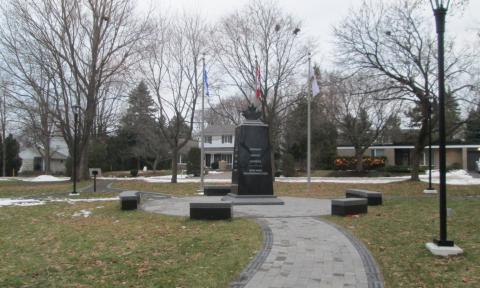
The Heroes Park Project commemorates the 100th anniversary of the First World War. The entrance to the park has a “gate”, consisting of low, curved walls with an inscribed front. The walls end in short columns, inscribed on the back, and a large, black stone monument is located in the middle of the park.

In 2010, The City of Beaconsfield and its citizens were honored when the city flag flew in the Canadian Headquarters of the 1st Battalion, Royal 22nd Regiment Battle Group in Kandahar, Afghanistan. Major R Gratton, a Beaconsfield resident and member of the Second Field Regiment (Reserve artillery Regiment in Montreal) was then deployed in Afghanistan made a promise to create a citizen committee to build a cenotaph to honour the service of the military but also those who are in harm’s way in the service to the population of Canada. Heroes Park is a part of this dedication, which also includes the Beaconsfield War Memorial and the Path of Heroes.

City
Beaconsfield
Country
Type Description
Park
Memorial CF Legacy ID
8796
City/Municipality
Beaconsfield
Memorial Number
24031-007
Type
Address
269 Shore Road
Location
Heroes Park
in Canada
Yes
GPS Coordinates
45.4260257, -73.8636142
Inscription

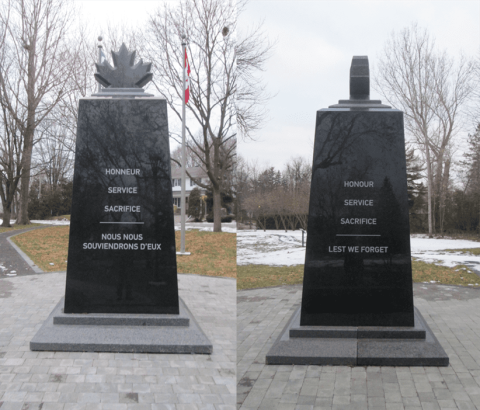
HONOUR

SERVICE

SACRIFICE

LEST WE FORGET

HONNEUR

SERVICE

SACRIFICE

NOUS NOUS SOUVIENDRONS D'EUX

Province
!4v1614355096761!6m8!1m7!1s2o2viuDNy-GNv3Q_Y5Bekw!2m2!1d45.42602565467826!2d-73.86361417561494!3f126.54227690730035!4f-0.5214637464176946!5f2.299968626952992"
Body Content

The Beaconsfield War Memorial is the central element of the Heroes Park project, erected by the Beaurepaire-Beaconsfield Historical Society in partnership with the Royal Canadian Legion and Beaconsfield High School. It is dedicated to the men and women who have served and sacrificed in all of Canada’s military operations.

In 2010, The City of Beaconsfield and its citizens were honored when the city flag flew in the Canadian Headquarters of the 1st Battalion, Royal 22nd Regiment Battle Group in Kandahar, Afghanistan. Major R Gratton, a Beaconsfield resident and member of the Second Field Regiment (Reserve artillery Regiment in Montreal) was then deployed in Afghanistan made a promise to create a citizen committee to build a cenotaph to honour the service of the military but also those who are in harm’s way in the service to the population of Canada. Beaconsfield War Memorial is a part of this dedication, which also includes Heroes Park and the Path of Heroes.

City
Beaconsfield
Country
Type Description
Shaft - black granite
Memorial CF Legacy ID
8797
City/Municipality
Sainte-Anne-de-Bellevue
Memorial Number
24031-006
Type
Address
Anciens-Combattants Boulevard
in Canada
Yes
GPS Coordinates
45.4083449, -73.9512712
Inscription

[front/devant]

Ste Anne de Bellevue

Boul des Anciens Combattants

Image
Province
!4v1620241323542!6m8!1m7!1sDBiyeobKIePJiY1FPMdzvQ!2m2!1d45.40834493964353!2d-73.95127117038435!3f233.24527474863623!4f8.973899152391937!5f3.325193203789971"
Body Content

This street is named and dedicated to all Veterans.

City
Sainte-Anne-de-Bellevue
Country
Type Description
Street
Memorial CF Legacy ID
8822
City/Municipality
Dorval
Memorial Number
24031-005
Type
Address
Roméo-Vachon Boulevard North
Location
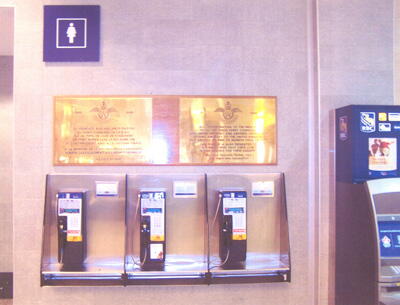
Inside the Montréal-Pierre Elliott Trudeau International Airport
in Canada
Yes
GPS Coordinates
45.4578264, -73.7516112
Inscription

[Left plaque/plaque de gauche]

1940 1946

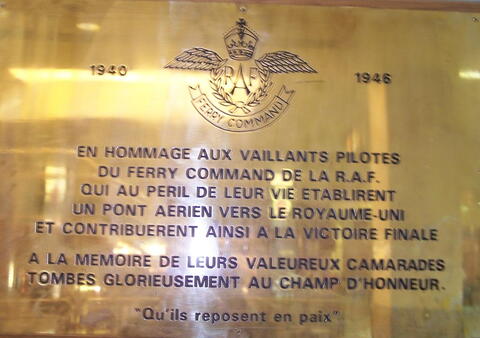
EN HOMMAGE AUX VAILLANTS PILOTES
DU FERRY COMMAND DE LA R.A.F.
QUI AU PERIL DE LEUR VIE ETABLIRENT
UN PONT AERIEN VERS LE ROYAUME-UNI
ET CONTRIBUERENT AINSI A LA VICTOIRE FINALE

A LA MEMOIREDE LEURS VALEUREUX CAMARADES
TOMBES GLORIEUSEMENT AU CHAMP D'HONNEUR.

"Qu'ils reposent en paix"

[Right plaque/plaque de droite]

1940 1946

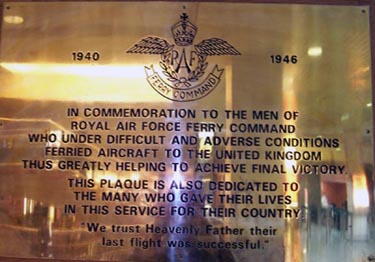
IN COMMEMORATION TO THE MEN OF
ROYAL AIR FORCE FERRY COMMAND
WHO UNDER DIFFICULT AND ADVERSE CONDITIONS
FERRIED AIRCRAFT TO THE UNITED KINGDOM
THUS GREATLY HELPING TO ACHIEVE FINAL VICTORY

THIS PLAQUE IS ALSO DEDICATED TO
THE MANY WHO GAVE THEIR LIVES
IN THIS SERVICE FOR THEIR COUNTRY.

'We trust Heavenly Father their
last flight was successful."

Image
Photo Credit
Aéroports de Montréal - Pierre-Paul Pharand
Caption
plaque
1 of 4 images
Image
Caption
inscription
1 of 4 images
Image
Caption
inscription
1 of 4 images
Image
Caption
surroundings
1 of 4 images
War or Conflict Term
Province
!4v1649856340767!6m8!1m7!1sCAoSLEFGMVFpcE5ua2lPUXlhLUhpNjBnSlVXdWhKZGVXbkxEZlhUU0F0ME95V1hY!2m2!1d45.457826358336!2d-73.751611236542!3f311.144922273303!4f4.5789271264161755!5f1.6093594525169843"
Body Content

This memorial is dedicated to the pilots of the Royal Air Force Ferry Command.

City
Dorval
Country
Type Description
Plaque - gilt metal
Memorial CF Legacy ID
7836
City/Municipality
Sainte-Anne-de-Bellevue
Memorial Number
24031-004
Type
Address
24 Sainte-Anne Street
Location
Kelso Park
in Canada
Yes
GPS Coordinates
45.4027065, -73.946383
Inscription

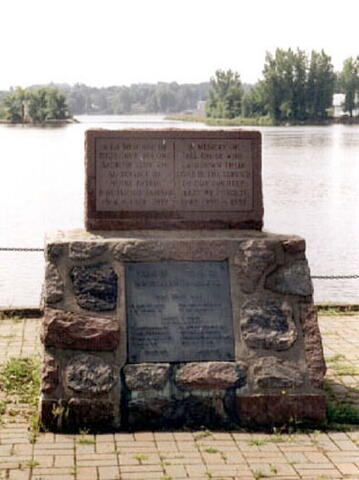
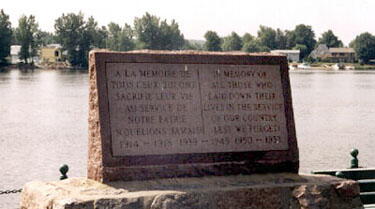
[stele/stèle]
A LA MÉMOIRE DE
TOUS CEUX QUI ONT
SACRIFIÉ LEUR VIE
AU SERVICE DE
NOTRE PATRIE
N'OUBLIONS JAMAIS!
1914 - 1918 1939 - 1945 1950 - 1953

IN MEMORY OF
ALL THOSE WHO
LAID DOWN THEIR
LIVES IN THE SERVICE
OF OUR COUNTRY
LEST WE FORGET!

Image
Photo Credit
Michel Litalien
Caption
front view
1 of 2 images
Image
Caption
details
1 of 2 images
Province
!4v1620240808669!6m8!1m7!1sMrI5ZxZcUxNUFrwZPA43bA!2m2!1d45.40270650116474!2d-73.94638303817327!3f167.43080313904647!4f-1.5493778034968813!5f3.325193203789971"
Body Content

This memorial is dedicated to those who died while serving in the First and Second World Wars and the Korean War. It was erected by the Royal Canadian Legion. The stele was added to the top of the cairn which is dedicated to the founders of Sainte-Anne-de-Bellevue.

City
Sainte-Anne-de-Bellevue
Country
Type Description
Stele
Memorial CF Legacy ID
6629
City/Municipality
Dorval
Memorial Number
24031-003
Type
Address
Roméo-Vachon Boulevard North
Location
Inside the Montréal-Pierre Elliott Trudeau International Airport
in Canada
Yes
GPS Coordinates
45.4577071, -73.7475767
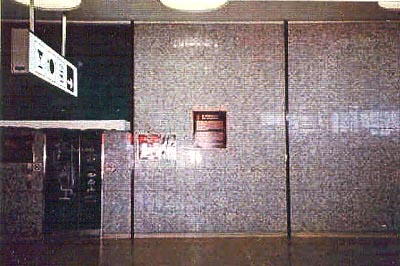
Inscription

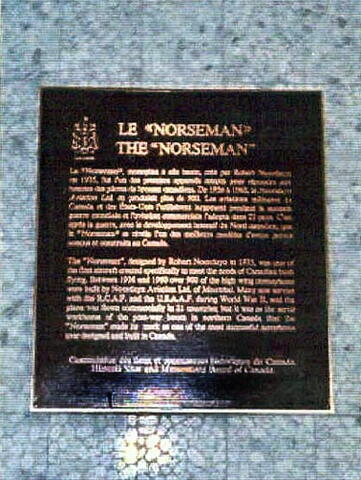
LE <>
THE "NORSEMAN"

Le <>, monoplan à aile haute, créé par Robert Noorduyn en 1935, fut l’un des premiers appareils conçus pour répondre aux besoins des pilotes de brousse canadiens. De 1936 à 1960, la Noorduyn Aviation Ltd. en produisit plus de 900. Les aviations militaires du Canada et des États-Unis l’utilisèrent largement pendant la seconde guerre mondiale et l’aviation commerciale l’adopta dans 21 pays. C’est après la guerre, avec le developpement intensif du Nord canadien, que le "Norseman" se révéla l’un des meilleurs modèles d’avion jamais conçus et construits au Canada.

The "Norseman", designed by Robert Noorduyn in 1935, was one of the first aircraft created specifically to meet the needs of Canadian bush flying. Between 1936 and 1960 over 900 of the high wing monoplanes were built by Noorduyn Aviation Ltd. of Montreal. Many saw service with the R.C.A.F. and the U.S.A.A.F. during World War II, and the plane was flown commercially in 21 countries
but it was as the aerial workhorse of the postwar boom in northern Canada that the "Norseman" made its mark as one of the most successful aeroplanes ever designed and built in Canada.

[The balance of the wording is not clear in the photo./Le reste du texte n'est pas clair sur la photo.]
Historic Sites and Monuments Board of Canada

Image
Photo Credit
Parks Canada, Quebec Service Centre/Parcs Canada, Centre de services du Québec
Caption
front view
1 of 2 images
Image
Caption
plaque
1 of 2 images
War or Conflict Term
Province
Body Content

This memorial is dedicated to the "Norseman" high-wing monoplane, one of the first aircraft created for Canadian bush flying and one of the most successful aeroplanes ever designed and built in Canada. It was used by the R.C.A.F. and U.S.A.A.F. during the Second World War. The plaque was erected in 1979.

City
Dorval
Country
Type Description
Plaque - bronze
Memorial CF Legacy ID
5919
City/Municipality
Dorval
Memorial Number
24031-002
Type
Address
Lakeshore Drive & Pine Beach Boulevard
Location
Pine Beach Park
in Canada
Yes
GPS Coordinates
45.4403762, -73.7612228
Inscription

[front/devant]

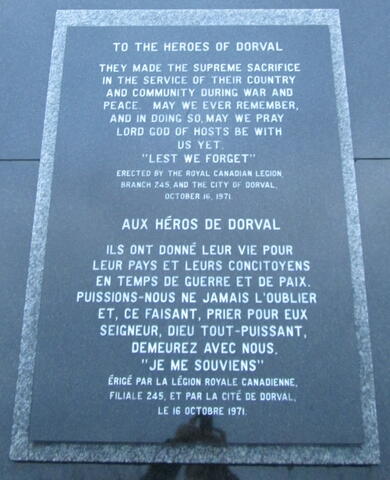
TO THE HEROES OF DORVAL. THEY MADE THE SUPREME SACRIFICE IN THE SERVICE OF THEIR COUNTRY AND COMMUNITY DURING WAR AND PEACE. MAY WE EVER REMEMBER AND IN DOING SO MAY WE PRAY - LORD GOD OF HOST BE WITH US YET. "LEST WE FORGET".

ERECTED BY THE ROYAL CANADIAN LEGION BRANCH 245 AND THE CITY OF DORVAL. OCTOBER 16, 1971.

AUX HÉROS DE DORVAL, ILS ONT DONNÉ LEUR VIE POUR LEUR PAYS ET LEURS CONCITOYENS, EN TEMPS DE GUERRE ET DE PAIX. PUISSIONS-NOUS NE JAMAIS L'OUBLIER ET, CE FAISANT, PRIER POUR EUX. SEIGNER DIEU TOUT-PUISSANT DEMEUREZ AVEC NOUS. "JE ME SOUVIENS".

ÉRIGÉ PAR LA LÉGION ROYALE CANADIENNE, FILIALE 245 ET PAR LA CITÉ DE DORVAL, LE 6 OCTOBRE 1971.

Image
Photo Credit
Richard Turcotte
Caption
Cenotaph
1 of 3 images
Image
Caption
Close up of cenotaph
1 of 3 images
Image
Caption
Cenotaph- close up of plaque
1 of 3 images
Province
!4v1618508098349!6m8!1m7!1smnSUSlXKDAblVoXF9aTkCA!2m2!1d45.44037624096489!2d-73.76122281460225!3f208.2271923008457!4f2.5498586443471822!5f2.9596863743507287"
Body Content

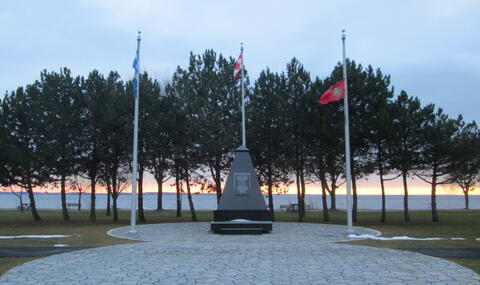
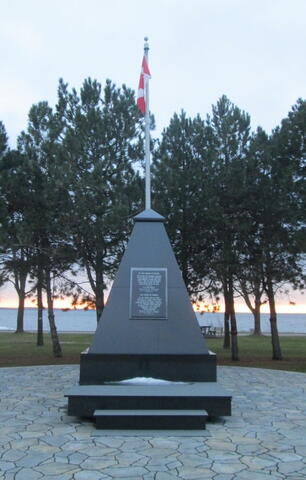
This monument, erected on 16 October 1971 by the Royal Canadian Legion Branch No. 245 (Dorval) and the City of Dorval, is dedicated to the citizens of Dorval who died for their country, in war and in times of peace.

City
Dorval
Country
Type Description
Cenotaph - stone
Memorial CF Legacy ID
4009
City/Municipality
Saint-Siméon
Memorial Number
24030-003
Type
Address
245 Saint Laurent Street
Location
Near the Motel Evangeline Bo-Fleuve, along the St. Lawrence river
in Canada
Yes
GPS Coordinates
47.84934, 69.87324
Image
Photo Credit
johanne dallaire
1 of 4 images
Image
Photo Credit
johanne dallaire
1 of 4 images
Image
1 of 4 images
Image
Photo Credit
johanne dallaire
1 of 4 images
Province
Body Content

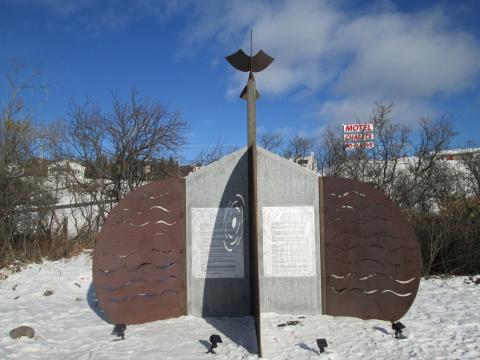
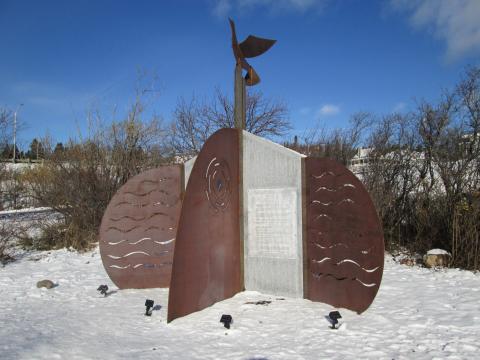
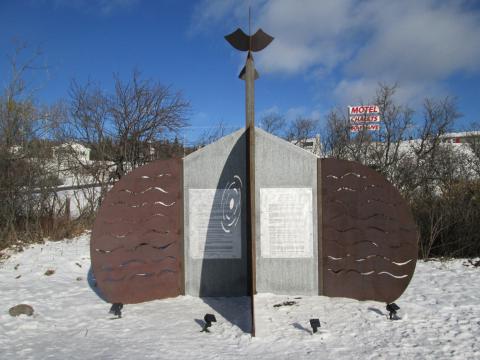
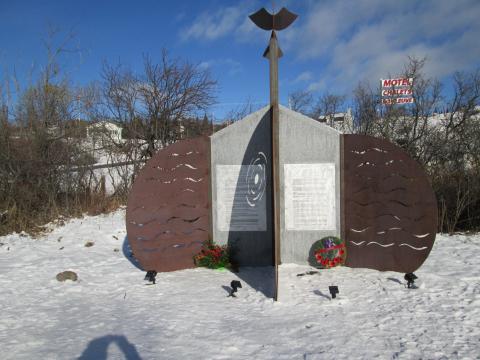
The *Havre de la paix* (Peace Harbour) monument is the first of its kind in the Charlevoix region. The municipality of Saint?Siméon is proud to give all veterans and the entire population an opportunity to come and reflect at a unique location on the banks of the St. Lawrence River. This monument was created by artist Martin Brisson, a skilled sculptor and native of Charlevoix, who lives in La Malbaie and whose passion is reflected in his works.

The municipality of Saint-Siméon created a symbolic monument as part of its 150th anniversary to honour the efforts and bravery of the people of Charlevoix and all over Canada who have given their life for peace.


City
Saint-Siméon
Country
Type Description
Monument
Photo Credit
Johanne Dallaire
Memorial CF Legacy ID
10090