Other

City/Municipality
Edmonton
Memorial Number
48011-111
Type
Address
8424 95 Ave NW
Location
St Luke's Protestant Chapel
in Canada
Yes
GPS Coordinates
53.5317698, -113.4571763
Inscription

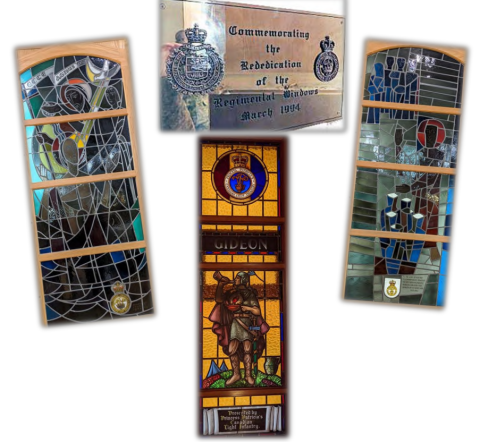
Commemorating
the
Rededication
of the
Regimental Windows
March 1994

ECCE AGNUS DEI

PRINCESS PATRICIA'S CANADIAN LIGHT INFANTRY

GIDEON

Presented by
Princess Patricia's
Canadian
Light Infantry

Image
Caption
Princess Patricia Canadian Light Infantry Regimental Windows
Province
!4v1711374087427!6m8!1m7!1sHkXODcWdQZ_tIm61uXDOfQ!2m2!1d53.53176982874862!2d-113.4571762590665!3f21.882770043446786!4f2.23927028344238!5f2.3044463758350258
Body Content

The stained glass windows from the Griesbach Chapel were rededicated at St Luke's Protestant Chapel, located in Lancaster Park, in March 1994. The windows were presented by Princess Patricia Canadian Light Infantry.

The Princess Patricia Canadian Light Infantry windows depict -

  • ECCE Agnus Dei (Lamb of God)
  • Gideon, a military leader, judge and prophet whose calling and victory over the Midianites are recounted in Judges 6-8 of the Book of Judges in the Hebrew Bible.
  • Soldiers, Jesus and angels
City
Edmonton
Country
Type Description
Stained glass window
Memorial CF Legacy ID
11316
City/Municipality
Edmonton
Memorial Number
48011-109
Type
Address
Milner Crescent
Location
Village of Griesbach
in Canada
Yes
GPS Coordinates
53.6047791, -113.5064424
Inscription

[street sign/plaque de rue]

MILNER CRES

[plaque]

needs further research/recherche incomplète

War or Conflict Term
Province
!4v1733857760157!6m8!1m7!1sdsk6i2QF8nVhu4NUEVIy6A!2m2!1d53.60477905529365!2d-113.5064423972877!3f11.836988508171999!4f-1.705320836941425!5f0.7820865974627469
Body Content

Milner Crescent was dedicated by the Canada Lands Company on January 23, 2018, as part of their redevelopment of Edmonton’s former Canadian Forces Base (Griesbach Barracks).

Canada Lands Company in collaboration with the South Alberta Light Horse Regiment officially named the new street in honour of prominent Edmontonian Stanley A. Milner and the Milner family. The Milners represent an outstanding example of Alberta’s service to Canada’s military. Seven family members, including fathers, brothers and wives, served from the First World War to Stanley Milner’s work with the South Alberta Light Horse Regiment.

Stanley Milner exemplified his family’s commitment to the military, serving in the 2nd Battalion, Saskatoon Light Infantry and the Canadian Officer Training Program. He also served as Honourary Colonel of the South Alberta Light Horse Regiment and founded the South Alberta Light Horse Regiment Foundation, a group which preserves regimental history and provides support for retired soldiers and military families. He was also a successful businessman, city alderman and philanthropist. Stanley and his son, Kevin Milner, unveiled the new street signs and a tribute plaque.

City
Edmonton
Country
Type Description
Street, plaque
Memorial CF Legacy ID
12049
City/Municipality
Edmonton
Memorial Number
48011-108
Type
Address
Roy Brown Way
Location
Village of Griesbach
in Canada
Yes
GPS Coordinates
53.6091174, -113.5058497
Inscription

[street sign/plaque de rue]

needs further research/recherche incomplète

[plaque]

needs further research/recherche incomplète

Province
!4v1733251193260!6m8!1m7!1sJXE0oH6hjqJJvRbh5hpJtA!2m2!1d53.60911737848116!2d-113.5058497063166!3f215.6400538188663!4f0.6291021975526263!5f0.7820865974627469
Body Content

Roy Brown Way was dedicated by the Canada Lands Company on January 23, 2018, as part of their redevelopment of Edmonton’s former Canadian Forces Base (Griesbach Barracks). Captain Arthur Roy Brown was the Great War flying ace credited for bringing down German Baron Manfred von Richthofen, the legendary Red Baron. Although controversy will always follow the cause of the Baron's demise, generally sources give credit to Captain Brown for firing the fatal shot.

Brown was born on December 23, 1893, in Carleton Place, Ontario. In the summer of 1915, he applied to Britain’s Royal Naval Air Service but was told he first needed a private pilot’s license. The nearest Canadian flying school was full, so he attended the Wright School of Aviation in Dayton, Ohio and obtained his pilot’s license on November 13, 1915. He enrolled in the Royal Naval Air Service and was sent to Royal Naval Air Service Station Chingford in northeast London to learn the fundamentals of military flying and dropping bombs.

He was injured on May 2, 1916, when he crashed a training airplane and was hospitalized for two months. In March 1917, Brown was posted to No. 9 Naval Squadron, was injured again and did not recover until May. On November 2, Brown was awarded the Distinguished Service Cross for his aerial victories and for aiding a fellow pilot under attack by four German aircraft, even though his own machine guns had jammed. By April 1918, he had shot down nine enemy aircraft.

On the morning of April 21, 1918, Brown and other pilots in 209 Squadron became involved in a dogfight with a German squadron including top ace Manfred von Richthofen and his cousin, novice pilot Wolfram von Richthofen. The Red Baron broke off to pursue Canadian pilot “Wop” May, who was on the tail of his cousin. Brown saw that his friend was in trouble and disengaged to attack Richthofen. He fired a long burst from behind and pulled out of a steep dive to avoid a collision. Richthofen continued over Allied territory and was fired at by British and Australian soldiers until he crashed into a field.

Four days later, Brown was grounded and hospitalized with severe food poisoning and extreme exhaustion, then sent to England to recover. Soon afterwards, he was recommended to receive the Distinguished Service Cross with Bar. Released from hospital on June 6, Brown reported for duty as an instructor with No. 2 School of Aerial Fighting and Gunnery in Yorkshire. On July 15 just after takeoff, his engine failed, the aircraft stalled and crashed. Seriously injured again, Roy spent eight months in hospital before being sent back to Canada on March 8, 1919 and was released from the Royal Air Force in April 1920 with the rank of Captain. Captain Brown tried to join the Royal Canadian Air Force when the Second World War began, but was rejected.

City
Edmonton
Country
Type Description
Street, plaque
Memorial CF Legacy ID
12048
City/Municipality
Edmonton
Memorial Number
48011-107
Type
Address
Dallas Schmidt Drive
Location
Village of Griesbach
in Canada
Yes
GPS Coordinates
53.6088675, -113.5094417
Inscription

[street sign/plaque de rue]

needs further research/recherche incomplète

[plaque]

needs further research/recherche incomplète

Province
!4v1733249200135!6m8!1m7!1sZT-ha5JOAw6Fhae2h0OTZQ!2m2!1d53.60886745857234!2d-113.5094417074031!3f135.678757837474!4f-1.2332517894840151!5f0.7820865974627469
Body Content

Dallas Schmidt Drive was dedicated by the Canada Lands Company on January 23, 2018, as part of their redevelopment of Edmonton’s former Canadian Forces Base (Griesbach Barracks). Dallas Wilber Schmidt was born on August 9, 1922, at Wetaskiwin, Alberta. He enlisted with the Royal Canadian Air Force in Edmonton on January 8, 1941.

Flying Officer Schmidt was awarded the Distinguished Flying Cross during the Second World War for his service overseas. On his first sortie he shot down an Italian aircraft. In September of 1942, he obtained a hit with a heavy bomb on an enemy merchant vessel which subsequently sank. A few days later he attacked a destroyer, in a convoy, with gunfire. In spite of intense opposition he pressed his attack causing an explosion behind part of the ship's gun positions, which probably indicated hits on a magazine. 

After being awarded the Distinguished Flying Cross, he completed many sorties. In an engagement in November 1942, he destroyed two Junkers 52 and assisted in the destruction of a Dornier 24. His aircraft was hit in some thirty places by return fire and the port engine was set alight, but he succeeded in extinguishing the flames and flew the damaged aircraft to base, landing it safely in difficult circumstances. Some days later he shot down a Junkers 52 and shortly afterwards he destroyed a Fiat CR.42 in attacks on enemy shipping. 

Shot down on five occasions, Dallas managed to crash-land on Malta four times and baled out once. On one occasion he saved the life of Pilot Officer J.F. Briffet, an observer whose Beaufighter was forced to ditch in the sea. The aircraft sank with the loss of the pilot on October 4, 1942, but Dallas spotted Briffet struggling in the sea and threw down his own dinghy, tied to his ‘Mae West’ life jacket. Briffet, who was unhurt, managed to swim to the dinghy and scrambled aboard to await rescue.

City
Edmonton
Country
Type Description
Street, plaque
Memorial CF Legacy ID
12047
City/Municipality
Edmonton
Memorial Number
48011-106
Type
Address
Schultz Crescent
Location
Village of Griesbach
in Canada
Yes
GPS Coordinates
53.6055855, -113.5097457
Inscription

needs further research/recherche incomplète

Province
!4v1696009864627!6m8!1m7!1sDwhMgDJFTPq2MN3E6WIFAA!2m2!1d53.60558548299728!2d-113.5097457211458!3f65.18113205314518!4f-1.8914353728520865!5f0.7820865974627469
Body Content

Schultz Crescent was dedicated by the Canada Lands Company on March 10, 2015, as part of their redevelopment of Edmonton’s former Canadian Forces Base (Griesbach Barracks).

Rayne Dennis ‘Joe’ Schultz was born in Bashaw, Alberta, on December 17, 1922 and enlisted in Edmonton on July 10, 1940. He served in the Royal Canadian Air Force and the Canadian Forces for more than 36 years, the last ten of which were as the Royal Canadian Air Force Director of Flight Safety.

During the Second World War, a fighter pilot, ‘Ace’, in Mosquito aircraft he had eight victories to his credit, three of which were downed on the same night. He was engaged in the defence of Great Britain intercepting enemy aircraft; and later on Allied bomber escort duties. His leadership ability and fighter successes earned him the Distinguished Flying Cross and Bar. Post Second World War he was involved in the development of several accident prevention programs which brought international credit to Canada, including work on the Flight Data Recorder Crash Position Indicators and reduction of bird-strike hazards to aircraft.

Schultz was named to the United States Air Force Flight Safety Hall of Fame in 1977; in 1978, he was awarded the Trans Canada McKee Trophy for managing one of the most successful and highly regarded flight safety programs in the western world; and was appointed an Officer of the Order of Military Merit. Over many years, in cooperation with the military and civilian agencies associated with aviation, his dedication and pursuit of excellence resulted in significant advancement in air operations generally and flight safety accident prevention programs in particular. He was inducted as a Member of Canada’s Aviation Hall of Fame in 1997 and retired from military service in October 1977.

City
Edmonton
Country
Type Description
Street, plaque
Memorial CF Legacy ID
12046
City/Municipality
Edmonton
Memorial Number
48011-105
Type
Address
Laubman Street
Location
Village of Griesbach
in Canada
Yes
GPS Coordinates
53.6037733, -113.514397
Inscription

[street sign/plaque de rue]

LAUBMAN ST

[plaque]

needs further research/recherche incomplète

Province
!4v1733240299752!6m8!1m7!1s_yupg9zqVMCEFaLQR2BTtg!2m2!1d53.60377333781066!2d-113.5143969847435!3f332.49791118510905!4f-11.96389292560832!5f0.7820865974627469
Body Content

Laubman Street was dedicated by the Canada Lands Company on December 10, 2013, as part of their redevelopment of Edmonton’s former Canadian Forces Base (Griesbach Barracks).

Born in Provost, Alberta in 1921, Don Laubman was captivated by aviation at an early age. After his family moved to Edmonton, he would head to the city’s airport to watch the aircraft. When the Second World War broke out in 1939, he enlisted with the Royal Canadian Air Force. 

Don was posted back to Canada when his tour ended, but managed to arrange for another overseas posting, this time in command of 402 Squadron. During his wartime service he destroyed 15 enemy aircraft, all of but one between June and October 1944. For these and other flying exploits, Don was twice awarded the Distinguished Flying Cross.

Shortly after demobilization, Don re-enlisted in the Royal Canadian Air Force. His postwar career included postings to 410, 416, and 418 Squadrons. In 1949, he led the Royal Canadian Air Force’s first jet aerobatic team, the Blue Devils. After attending the Royal Canadian Air Force Staff College in 1957, he was promoted to Wing Commander, then to Group Captain, Air Commodore, Major General, and Lieutenant General. Between 1966 and 1969 Don played a key role in implementing the unification of Canada’s armed forces and, in 1970/71, he served as Commander of Canadian Forces Europe. Upon his return to Ottawa, Don ended his career as Chief of Personnel, Canadian Forces Head Quarters.

City
Edmonton
Country
Type Description
Street, plaque
Memorial CF Legacy ID
12045
City/Municipality
Edmonton
Memorial Number
48011-104
Type
Address
Greenaway Avenue
Location
Village of Griesbach
in Canada
Yes
GPS Coordinates
53.6037099, -113.5158516
Inscription

[street sign/plaque de rue]

GREENAWAY AV

[plaque]

needs further research/recherche incomplète

War or Conflict Term
Province
!4v1733240217363!6m8!1m7!1sVXUNSNijkVtaxZBkpzPOZA!2m2!1d53.60370985333872!2d-113.5158515708762!3f135.03170707002153!4f-9.404847046913375!5f1.879868633607928
Body Content

Greenaway Avenue was dedicated by the Canada Lands Company on December 10, 2013, as part of their redevelopment of Edmonton’s former Canadian Forces Base (Griesbach Barracks).

Keith Rogers Greenaway, CM, CD, D.Mil.Sc., (Hon), was born near Woodville, Ontario, on April 8, 1916. He joined the Royal Canadian Air Force in May of 1940. After graduating as a wireless operator in 1940, he served as an instructor for two years until he transferred to the navigator-wireless operator branch of the Royal Canadian Air Force. He was sent first to No. 8 Air Observer School at Ancienne Lorette, Quebec, and then to the Central Navigation School at Rivers, Manitoba, as a staff instructor. In 1944, he was promoted to Flying Officer.

For the next two years Greenaway worked with the United States Navy and the United States Air Force in experimental pressure pattern flights over the North Atlantic and experimental flights over the polar regions testing a low frequency navigation system, using bases in Edmonton, Alberta, and Fairbanks, Alaska. Greenaway was an internationally recognized authority on aerial navigation, with particular reference to polar flying.

In 1947, in association with J.W. Cox, a Defence Research Board scientist, he developed the Royal Canadian Air Force's Twilight Computer, a navigation aid for use in extreme northern latitudes. Late in 1948, Greenaway was seconded to the Defence Research Board, Ottawa, to work on high latitude navigation problems, serving in this capacity until 1954.

In 1956, Greenaway was promoted to Wing Commander and transferred to the Royal Canadian Air Force Headquarters, Ottawa. He continued with promotions and transfers until he retired from the Canadian Forces as a General in March of 1971. During his military career, he flew as crew member on 26 aircraft types, accumulating some 8,000 hours of which nearly one third were north of the Arctic Circle. Following retirement, he assisted the Advisory Committee on Northern Development.

City
Edmonton
Country
Type Description
Street, plaque
Memorial CF Legacy ID
12044
City/Municipality
Edmonton
Memorial Number
48011-103
Type
Address
Carr Road
Location
Village of Griesbach
in Canada
Yes
GPS Coordinates
53.6028593, -113.513861
Inscription

[street sign/plaque de rue]

CARR ROAD

[plaque]

needs further research/recherche incomplète

Province
!4v1733229841293!6m8!1m7!1sFt7oE7oF-UaZ56KJyUREQw!2m2!1d53.60285932867928!2d-113.5138609507024!3f269.6154117711864!4f-9.312407447780231!5f0.861829724137825
Body Content

Carr Road was dedicated by the Canada Lands Company on December 10, 2013, as part of their redevelopment of Edmonton’s former Canadian Forces Base (Griesbach Barracks).

Lieutenant-General William Kier Carr, Distinguished Flying Cross, Venerable Order of Saint John, Commander of the Order of Military Merit, Legion of Merit, Member of Canada’s Aviation Hall of Fame, was the first commander of Air Command, vice-president of Canadair and Bombardier and widely known as the father of the modern Canadian Air Force.

He was born in Newfoundland, the son of the manager of a fishery in the tiny fishing town of Grand Bank on the Burin Peninsula. Bill was a photo reconnaissance Spitfire pilot with 683 Squadron, Royal Air Force. He flew a Spitfire equipped to fly fast, to fly high and to run from the trouble that it was a magnet for. It had no guns, no armour, and no bulletproof glass. Its only weapons were its cameras, its speed and the courage of young Mr. Carr.

He would strap himself into a Spitfire and deliberately take it deep into a Europe run by Nazis, the greatest evil known to modern man. In broad daylight, he would fly over their encampments, their anti-aircraft installations, their factories, their cities, their airfields, travelling at 300 miles per hour, never positive that his oxygen system would continue to feed him life, or that his engine would continue to run in the thin air, always on the lookout for an attack. He did this 142 times.

After the war, Carr continued to fly, did post-graduate work in chemistry and physics in the United States and attended staff college. He continued to fly in the photo mapping business he learned so well in Malta and Italy – this time on Lancasters and Mitchells – until he became commanding officer of 412 Squadron at Uplands. It was here, on aircraft like the de Havilland Comet, the world’s first jet airliner, that he flew people like Her Majesty, Queen Elizabeth, Princess Margaret, French President Charles De Gaulle and Prime Minister John Diefenbaker.

After 412 Squadron, Carr moved up the command ladder in rapid steps – being promoted to the rank of group captain, commanding the United Nations air transport operation in the Congo, commanding Royal Canadian Air Force Station Namao in Alberta, and the National Defence College, being promoted to air commodore, commanding Training Command as a major-general, going to North American Aerospace Defense Command Headquarters in Colorado Springs as chief of operations and – ultimately – being promoted to lieutenant-general and becoming as Deputy Chief of the Defence Staff.

His final leadership role was as the first commander of Air Command – an entity that he was responsible for creating in 1975.

City
Edmonton
Country
Type Description
Street, plaque
Memorial CF Legacy ID
12043
City/Municipality
Edmonton
Memorial Number
48011-102
Type
Address
Naden Landing
Location
Village of Griesbach
in Canada
Yes
GPS Coordinates
53.6047466, -113.5080629
Inscription

[street sign/plaque de rue]

NADEN LANDING

[plaque]

needs further research/recherche incomplète

Province
!4v1696008753704!6m8!1m7!1s7p8gSLRFDbzCt6N-LxAtdg!2m2!1d53.60474664522147!2d-113.5080628989534!3f171.4538049445036!4f-12.749750910452576!5f0.7820865974627469
Body Content

Naden Landing was dedicated by the Canada Lands Company on December 10, 2013, as part of their redevelopment of Edmonton’s former Canadian Forces Base (Griesbach Barracks).

The Naval shore facility at Esquimalt was commissioned as HMCS Naden on September 3, 1922. It was named for facility’s Depot Ship, HMCS Naden, a small wooden schooner built in 1913 that previously had been used for costal surveys and cadet training. HMCS Naden carried books containing the names of officers and men serving in the Esquimalt area. An old British Admiralty regulation required that all personnel working ashore must appear on the books of a naval vessel for purposes of pay and discipline, even when there was little real connection between base and ship.

When the Second World War began, Naden become the principal Naval Training Centre for western Canada. The war years saw a rapid expansion of the facility to meet the huge demands of training the personnel needed for the war effort. Many from Edmonton joined others from the prairies in joining the navy and receiving their training at HMCS Naden.

HMCS Naden was renamed to Canadian Forces Base Esquimalt on April 1, 1966, as part of organizational changes, which integrated the navy, army, and air force.

City
Edmonton
Country
Type Description
Street, plaque
Memorial CF Legacy ID
12042
City/Municipality
Edmonton
Memorial Number
48011-101
Type
Address
Nonsuch Street
Location
Village of Griesbach
in Canada
Yes
GPS Coordinates
53.6020623, -113.5137643
Inscription

[street sign/plaque de rue]

needs further research/recherche incomplète

[plaque]

needs further research/recherche incomplète

Province
!4v1733166903238!6m8!1m7!1sh-GW0_YcSXCXIvQOHBRTtg!2m2!1d53.60206229434592!2d-113.5137643370358!3f359.59462696304695!4f-8.299427069778034!5f0.7820865974627469
Body Content

Nonsuch Street was dedicated by the Canada Lands Company on December 10, 2013, as part of their redevelopment of Edmonton’s former Canadian Forces Base (Griesbach Barracks).

HMCS Nonsuch is the name of the Edmonton Division of the Canadian Navy (Reserve). The name Nonsuch comes from the French "non pareil," meaning eminent beyond or above comparison, somebody or something of unequaled excellence. Many ships in the Royal Navy have borne the name Nonsuch. At the Edmonton Division, there is a plaque bearing the battle honours of Nonsuch dating, for different ships of the same name, from 1652 through to 1916. The name was used in 1947 as the name for a captured German destroyer.

The White Ensign was first in Edmonton in April 1923, when a Naval Half-Company under the command of the late Lieutenant-Commander Athol Blair MacLeod was formed. This half company grew to a strength of upward of 225 officers and men. The Hudson's Bay Company’s Edmonton horse barns in the River Valley were sold to the Department of National Defence in 1939 to house the small Naval Reserve Division that had previously been at the Prince of Wales Armories. It was called the Nonsuch in recognition of the role of that name in both the Navy and the Hudson Bay Company. 

The Naval Reserve Division went on active service on September 10, 1939. Through the years that followed, several thousand naval volunteers passed through basic training at the land-bound ship which became HMCS Nonsuch. For practical water training, a summer base was established at Lake Wabamun. The unit was de-commissioned in 1964. This street is named in recognition of its strong Edmonton history and respect for those who trained for service through the facility.

City
Edmonton
Country
Type Description
Street, plaque
Memorial CF Legacy ID
12041