Other

City/Municipality
Calgary
Memorial Number
48003-020
Type
Address
755-40th Street SE
in Canada
Yes
GPS Coordinates
51.045814443119, -113.97615563206
Inscription

[front/devant]

IN REMEMBRANCE OF OUR FALLEN COMRADES

THOSE WHOSE LIVES WERE SACRIFICED

THOSE WHO GAVE ANOTHER WAY OF LIMBS, OF SIGHT, OF AGONY A DEBT WE CANNOT PAY

LEST WE FORGET

FOREST LAWN LEGION MEMORIAL

DEDICATED 1978

WE WILL REMEMBER THEM

[side plaque/plaque de côté]

KOREA

1950 - 1953

Image
Photo Credit
Deirdre Kraft
Caption
front view
1 of 3 images
Image
Caption
side plaque
1 of 3 images
Image
Caption
details
1 of 3 images
Province
!4v1614783673804!6m8!1m7!1s1vlpuDLZ0jOQrQo8YVtNyA!2m2!1d51.04569302925312!2d-113.975823038166!3f211.81657541413602!4f-1.1176267363261445!5f3.325193203789971"
Body Content

This memorial, erected by Royal Canadian Legion Branch No. 275 (Forest Lawn) in 1978, is dedicated to the local war dead and veterans of the First and Second World Wars and the Korean War.

City
Calgary
Country
Type Description
Concrete obelisk, base and metal cross
Memorial CF Legacy ID
2043
City/Municipality
Calgary
Memorial Number
48003-019
Type
Address
4144 11 St SE, Calgary, AB
Location
Calgary Firefighters Museum
in Canada
Yes
GPS Coordinates
51.018629737403, -114.03582079885
Inscription

[plaque/plaque]

ERECTED
TO THE MEMORY
OF

PTE. J.B. GALLACHER, P.P.C.L.I.
PTE. E.F. BURTON, P.P.C.L.I.
PTE. A.F. BOWDEN, 1ST CAN. PIONEERS
PTE. W.G. BARTLETT, 1ST CAN. DIV. M.T.

MEMBERS OF THE
CALGARY FIRE BRIGADE
WHO GAVE THEIR LIVES
IN THE

GREAT EUROPEAN WAR

1914 - 1919

Image
Caption
Framed flag
1 of 3 images
Image
Caption
List of Members of the Calgary Fire Department
1 of 3 images
Image
Caption
Book - Museum of the Regiments
1 of 3 images
Province
Body Content

This plaque was originally erected by the Calgary Fire Brigade in honour of their members who died during the First World War.

City
Calgary
Country
Type Description
Marble plaque
Memorial CF Legacy ID
2044
City/Municipality
Calgary
Memorial Number
48003-013
Type
Address
2625-78 Avenue SE
in Canada
Yes
GPS Coordinates
50.9832248, -114.0004578
Inscription

[plaque/plaque]

DEDICATED TO THE HONOUR OF THOSE WHO FELL IN THE SERVICE OF OUR SOVEREIGN AND COUNTRY DURING THE GREAT WARS

W.W.I - 1914-1918

W.W.II - 1939-1945

KOREA - 1950-1953

"WE WILL REMEMBER THEM"

Image
Caption
slab (front)
Province
!4v1614783261536!6m8!1m7!1sjxGNFlD8ofSSCdZ0AYR1hA!2m2!1d50.98322477992804!2d-114.0004578213175!3f195.63611077852872!4f-2.160480848652327!5f3.325193203789971"
Body Content

This memorial is dedicated to Canada's war dead from the First and Second World Wars and the Korean War. Behind the slab stand three flagpoles.

City
Calgary
Country
Type Description
Sandstone slab
Memorial CF Legacy ID
2020
City/Municipality
Calgary
Memorial Number
48002-107
Type
Address
Barlow Trail
in Canada
Yes
GPS Coordinates
51.092932, -114.001884
Inscription

BARLOW TRAIL

Province
!4v1718125394214!6m8!1m7!1ss0yvxEwCyoySTFwY_dNP7g!2m2!1d51.09293196016328!2d-114.0018840125665!3f292.93920223574486!4f8.221068524326384!5f0.7820865974627469
Body Content

Noel Holland Barlow was born in Denbeigh, Wales in December of 1912. His father was killed in the First World War and his mother remarried after the war. The family emigrated to Canada, and in 1932 owned and operated a farm near the small town of Carseland, southeast of Calgary. Barlow worked in the mining industry to pay for flying training at the Calgary Flying Club, where he earned his Canadian Private Pilot Certificate in 1937 and then at the end of the year, his Limited Commercial Pilot’s Certificate.

He saved for a one-way ocean liner ticket to England, but was devastated to learn at the Royal Air Force recruitment office in Great Britain that, at the age of 26, he was considered too old for military pilot training despite already having a license. He had no choice but to join as ground crew.

Shortly after the start of the Second World War, he was accepted on the newly formed 242 Canadian Squadron. During the Battle of France, he was part of the ground crew team that went to support the 242 Squadron pilots operating from the area south of the Seine River. Barlow was eventually evacuated to England to rejoin the squadron under the new leadership of then acting Squadron Leader Douglas Bader, the charismatic, capable and legless fighter pilot. Bader chose Noel Barlow as his personal fitter. Throughout the Battle of Britain, Barlow worked tirelessly to keep the squadron operational and to service Bader’s machine. A strong and lifelong bond was built between the two, based on mutual respect, the highest levels of performance and their shared experience. After the Battle of Britain, Bader and Barlow remained connected as 242 Squadron flew operations across the English Channel.

Shortly after Barlow had joined the Royal Air Force, the age limit for pilot trainees had been increased, but he stayed with 242 as a fitter until Bader’s departure to lead the new wing. After 18 months, despite a promised promotion to sergeant, Barlow requested a transfer to pilot training, something that was supported in by Bader himself. He soon found himself a lowly Leading Aircraftman crossing the Atlantic Ocean, bound for the all-through No. 3 British Flying Training School in Miami, Oklahoma. While Barlow was in Oklahoma, Bader was shot down on August 9, 1941, and taken prisoner.

Barlow did not receive his wings because of a dare and too much to drink, but he was not one to quit. He enlisted in the Royal Canadian Air Force back home in Alberta, was accepted for pilot training, and finished his Service Flying Training at No. 15 Claresholm, Alberta. Following his Wings Parade, Barlow was assigned to No. 5 Operational Training Unit at Boundary Bay in British Columbia.

Barlow remained close friends with Douglas Bader, and on Bader’s frequent trips to Calgary, he and his wife always stayed with Barlow and his wife Jeanne in the small farming town of Carseland. The story goes that when Bader was visiting Calgary on one occasion, the city leaders wanted to name a street in his honour, but Bader declined, suggesting that such an honour go to his Alberta-born fitter, a simple and unknown man named Noel Holland Barlow.

City
Calgary
Country
Type Description
Street
Memorial CF Legacy ID
12557
City/Municipality
Calgary
Memorial Number
48002-106
Type
Address
McKnight Boulevard
in Canada
Yes
GPS Coordinates
51.0928811, -114.0014754
Inscription
Province
!4v1718124945416!6m8!1m7!1sUWnVz0Pzfwhpr3_HRHqrdw!2m2!1d51.09288109093362!2d-114.001475362586!3f29.658223921623602!4f10.80160868046886!5f2.0231788498875827
Body Content

William “Willie” McKnight was born in Edmonton, Alberta in 1918 and soon moved with his family to Calgary. In 1938, he joined the Royal Air Force and headed to England. In mid-April of 1939, McKnight received a short service commission as an acting Pilot Officer and earned his Royal Air Force pilot’s brevet at No. 6 Service Flying Training School. While he appeared shy and reticent, he was a fierce warrior and a leader.

McKnight was posted to 242 Squadron in November 1939. The squadron was chosen to become the Canadian unit, manned entirely by Canadians. In May 1940, 242 Squadron sent a small detachment of pilots, including McKnight, to fly with other British Expeditionary Force squadrons. Within days of his arrival in France, young McKnight scored the first of his 17 confirmed victories over Luftwaffe pilots on May 19.

During the days of the Dunkirk withdrawal, McKnight claimed six more enemy aircraft and by June 7, had become a double ace with 10 victories. His prowess in the air and his courage in the face of the enemy had already brought him notice, and in early June he was awarded his first Distinguished Flying Cross.

The last of 242 Squadron’s pilots flew back to England on June 18. The never-ending sorties and the exhausting pace had taken its toll on the young Calgarian and he was hospitalized in early July for exhaustion, weight loss and stress-related illnesses. The new squadron commander, Douglas Bader, recognized talent and regularly flew with McKnight as his wingman. With McKnight protecting his flank, Bader’s score increased as well. Throughout the next three months McKnight rapidly accumulated victories, becoming a triple ace by the end of the Battle of Britain.

In October, McKnight was awarded his second Distinguished Flying Cross or “bar” and promoted to Flying Officer. On January 12, 1941, McKnight and M.K. Brown had just made attacks on a German “E” boat and troop concentrations just inland from Gravelines, Holland, when a Messerschmitt Bf-109 was spotted by Brown. After making a hard turn to the right, he looked again for the 109 and McKnight, but neither could be seen.

In October of 1969, a roadway leading to the Calgary Airport became McKnight Boulevard. The namesake of McKnight Boulevard, a young Calgarian by the name of William Lidstone McKnight, battled for the fate of Europe in the skies over England and France. He often flew with his squadron commander, a legendary fighter pilot by the name of Douglas Bader, a man who had no legs.

Each and every night, these two fighter pilots rested, caroused, attempted to sleep and readied for the next day’s inevitable pitched battles, while the ground crews of No. 242 Canadian Squadron laboured through the days and nights to refuel, repair and rearm their Hawker Hurricanes. Bader’s loyal, diligent and talented engine fitter was another Albertan by the name of Noel Barlow. McKnight and Barlow—one died, one lived, and Bader, an Englishman, had a lot to do with their names being associated with two intersecting thoroughfares in the booming oil town of Calgary.

Later, Bader unveiled a commemorative plaque to McKnight in the passenger hall of the Calgary Airport.
City
Calgary
Country
Type Description
Street, plaque
Memorial CF Legacy ID
12556
City/Municipality
Calgary
Memorial Number
48002-105
Type
Address
7550 Ogden Dale Road SE
Location
CPKC Headquarters
in Canada
Yes
GPS Coordinates
50.9920559, -114.0013095
Inscription

CANADIAN PACIFIC

Image
Caption
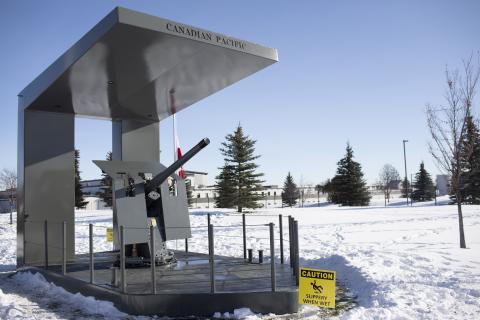
12-Pounder Naval Gun
Province
!4v1716556085750!6m8!1m7!1sF5jVMHZdeIjxxl8dCJcq2Q!2m2!1d50.99205590819255!2d-114.0013095193409!3f66.73610382280047!4f0.9974444102852544!5f1.8054517594922146
Body Content

The quick firing 12-pounder was a three-inch (76.2 mm caliber) naval gun introduced in 1894 and commonly used until the middle of the 20th century. It was employed on several warships in the Royal Navy and the Royal Canadian Navy throughout the Second World War (1939 to 1945). 

This 12-pounder naval gun was produced in Ogden Shops by the Canadian Pacific (CP) munitions department and is on loan to CP by the Naval Museum of Alberta. Originally acquired from the Maritime Command Museum in Halifax, Nova Scotia, CP transported it back to the Ogden Shops in Calgary on July 2, 1993. It was restored in preparation for display at The Military Museums before transport to its current location in 2022.

Ten warships were named after Alberta cities and towns during the Second World War, including four minesweepers armed with Ogden Shops 12-pounders. This gun may have been aboard one of them.

At the commencement of the Second World War, Canadian Pacific (CP) President Edward Beatty placed the company’s full resources at the disposal of Canada and the British Empire in support of the war effort. He instructed the employees of CP: “On our readiness to meet the challenge, and, each of us, to do our duty, there hangs the fate of a nation – the destiny of future generations.”

That readiness saw two locomotive shops refitted to produce armaments. The Angus Shops in Montreal would build 1,420 Valentine tanks and other equipment to support the war effort. The Ogden Shops in Calgary were refitted at the beginning of 1941. The first gun was completed that November and shipped to the Halifax dockyards. By the end of the war, the Ogden Shops had produced over 3,000 guns and 1,650 gun mounts for use by the Royal Navy, the Royal Canadian Navy and the United States Army. With the conclusion of the Second World War in August 1945, Ogden Shops returned to maintaining locomotives. The naval gun production by Canadian Pacific remains one of the most significant Calgarian contributions to the Canadian war effort.

Just 200 meters east of this location, the Ogden Locomotive Shops (Building 7) first opened in 1913 and remained in use for locomotive maintenance until 2011.

City
Calgary
Country
Type Description
Artillery - 12-pounder naval gun
Photo Credit
CPKC Archives
Memorial CF Legacy ID
12487
City/Municipality
Calgary
Memorial Number
48002-104
Type
Address
7550 Ogden Dale Road SE
Location
CPKC Archives
in Canada
Yes
GPS Coordinates
50.9944291, -114.0022808
Inscription

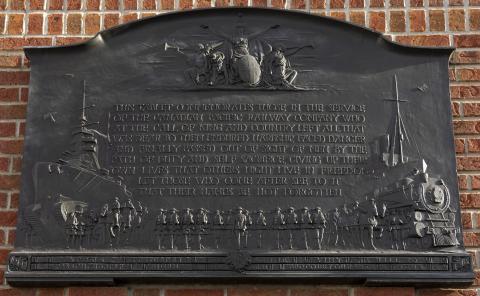
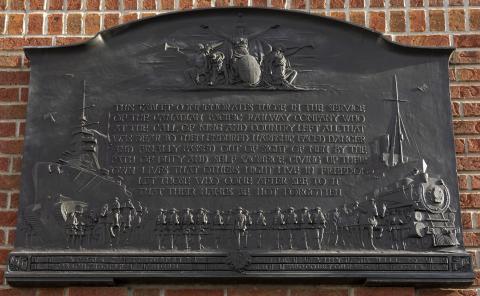
THIS TABLET COMMEMORATES THOSE IN THE SERVICE
OF THE CANADIAN PACIFIC RAILWAY COMPANY WHO
AT THE CALL OF KING AND COUNTRY LEFT ALL THAT
WAS DEAR TO THEM, ENDURED HARDSHIP, FACED DANGER
AND FINALLY PASSED OUT OF SIGHT OF MEN BY THE
PATH OF DUTY AND SELF SACRIFICE. GIVING UP THEIR
OWN LIVES THAT OTHERS MIGHT LIVE IN FREEDOM
LET THOSE WHO COME AFTER SEE TO IT
THAT THEIR NAMES BE NOT FORGOTTEN.

1914  YPRES  FESTUBERT  THE SOMME  VIMY  HILL 70  1918
PASSCHENDAELE  AMIENS  CAMBRAI  DROCOURT QUEANT  MONS

War or Conflict Term
Province
!4v1716317289385!6m8!1m7!1sSU-BbK1oJOCoOU5c9usLLw!2m2!1d50.99442907959982!2d-114.0022807811072!3f26.09!4f1.1500000000000057!5f0.5970117501821992
Body Content

This Montreal Canadian Pacific Railway Great War Tablet was dedicated at the Angus Shops on April 28, 1922. It was relocated to CPKC Archives. 

To honour those who served and gave their lives during the Great War, the Canadian Pacific Railway (CPR) erected a series of bronze memorial tablets in over twenty select locations along their railway system and offices in Canada, United States, England and China. The tablet depicts Britannia, the national personification of Britain, as a helmeted female warrior with a lion to her right and a shield at her feet, HMS Lion (Admiral Beatty's flagship during the Battle of Jutland) with airplanes above and a tank in front, Canadian Pacific Steamship RMS Empress of Russia (used during the war as an armed merchant cruiser and transport ship), Canadian troops, and a CPR locomotive in a nod to all those who travelled by train across Canada before heading overseas. The plaque was designed by Archibald Pearce, Chief Engineer's Department, Montreal, with its model and casting by the Bromsgrove Guild at Worcester, England.

Original location Current location
CPR Office, Saint John, New Brunswick McAdam Railway Museum, McAdam, New Brunswick
Du Palais CPR Station, Quebec City, Quebec Du Palais CPR Station, Quebec City, Quebec
Viger Station, Montreal, Quebec Exporail, Montreal, Quebec
Windsor Station, Montreal, Quebec Windsor Station, Montreal, Quebec
Angus Shops, Montreal, Quebec CPKC Archives, Calgary, Alberta (in storage)
North Toronto Station, Toronto, Ontario Union Station, Toronto, Ontario
West Toronto Station, Toronto, Ontario unknown
North Bay Station, North Bay, Ontario North Bay Memorial Park, North Bay, Ontario
Fort William Union Station, Fort William, Ontario Thunder Bay Station, Thunder Bay, Ontario
Weston Shops, Winnipeg, Manitoba Weston Shops, Winnipeg, Manitoba
Saskatoon Station, Saskatoon, Saskatchewan Thomas Cook Restaurant, Saskatoon, Saskatchewan
Moose Jaw Station, Moose Jaw, Saskatchewan Old Moose Jaw Station, Moose Jaw, Saskatchewan
Regina Station, Regina, Saskatchewan Casino Regina, Regina, Saskatchewan
Calgary Station, Calgary, Alberta CPKC Headquarters, Calgary, Alberta
Calgary Natural Resources Building, Calgary, Alberta The Military Museums, Calgary, Alberta
Edmonton Station, Edmonton Alberta CPKC Archives, Calgary, Alberta (in storage)
Nelson Station, Nelson, British Columbia Nelson Museum, Archives & Gallery, Nelson, British Columbia
Vancouver Station, Vancouver, British Columbia unknown
Steamship Office, Victoria, British Columbia Royal British Columbia MuseumVictoria, British Columbia
CPR Office, New York, New York, United States Exporail
CPR Office, Liverpool, England Royal Liver Building, Liverpool, England
CPR Building, Charing Cross, London, England unknown
CPR Office, Hong Kong, China Believed destroyed during Japanese occupation in the Second World War.

All tablets were unveiled simultaneously on the same date along with three identical Winged Victory memorials in Montreal, Winnipeg and Vancouver.

City
Calgary
Country
Type Description
Tablet - bronze
Memorial CF Legacy ID
12481
City/Municipality
Calgary
Memorial Number
48002-103
Type
Address
7550 Ogden Dale Road SE
Location
CPKC Archives
in Canada
Yes
GPS Coordinates
50.9944291, -114.0022808
Inscription

THIS TABLET COMMEMORATES THOSE IN THE SERVICE
OF THE CANADIAN PACIFIC RAILWAY COMPANY WHO
AT THE CALL OF KING AND COUNTRY LEFT ALL THAT
WAS DEAR TO THEM, ENDURED HARDSHIP, FACED DANGER
AND FINALLY PASSED OUT OF SIGHT OF MEN BY THE
PATH OF DUTY AND SELF SACRIFICE. GIVING UP THEIR
OWN LIVES THAT OTHERS MIGHT LIVE IN FREEDOM
LET THOSE WHO COME AFTER SEE TO IT
THAT THEIR NAMES BE NOT FORGOTTEN.

1914  YPRES  FESTUBERT  THE SOMME  VIMY  HILL 70  1918
PASSCHENDAELE  AMIENS  CAMBRAI  DROCOURT QUEANT  MONS

Image
Caption
Canadian Pacific Railway Great War Tablet
War or Conflict Term
Province
!4v1716293536513!6m8!1m7!1sSU-BbK1oJOCoOU5c9usLLw!2m2!1d50.99442907959982!2d-114.0022807811072!3f26.08751330284275!4f1.1509980415640655!5f0.7820865974627469
Body Content

The Edmonton Canadian Pacific Railway Great War Tablet was dedicated at the Canadian Pacific Railway Station, Jasper Avenue and 109th Street on April 28, 1922. It was relocated to the CPKC Archives and is currently in storage.

To honour those who served and gave their lives during the Great War, the Canadian Pacific Railway (CPR) erected a series of bronze memorial tablets in over twenty select locations along their railway system and offices in Canada, United States, England and China. The tablet depicts Britannia, the national personification of Britain, as a helmeted female warrior with a lion to her right and a shield at her feet, HMS Lion (Admiral Beatty's flagship during the Battle of Jutland) with airplanes above and a tank in front, Canadian Pacific Steamship RMS Empress of Russia (used during the war as an armed merchant cruiser and transport ship), Canadian troops, and a CPR locomotive in a nod to all those who travelled by train across Canada before heading overseas. The plaque was designed by Archibald Pearce, Chief Engineer's Department, Montreal, with its model and casting by the Bromsgrove Guild at Worcester, England.

Original location Current location
CPR Office, Saint John, New Brunswick McAdam Railway Museum, McAdam, New Brunswick
Du Palais CPR Station, Quebec City, Quebec Du Palais CPR Station, Quebec City, Quebec
Viger Station, Montreal, Quebec Exporail, Montreal, Quebec
Windsor Station, Montreal, Quebec Windsor Station, Montreal, Quebec
Angus Shops, Montreal, Quebec CPKC Archives, Calgary, Alberta (in storage)
North Toronto Station, Toronto, Ontario Union Station, Toronto, Ontario
West Toronto Station, Toronto, Ontario unknown
North Bay Station, North Bay, Ontario North Bay Memorial Park, North Bay, Ontario
Fort William Union Station, Fort William, Ontario Thunder Bay Station, Thunder Bay, Ontario
Weston Shops, Winnipeg, Manitoba Weston Shops, Winnipeg, Manitoba
Saskatoon Station, Saskatoon, Saskatchewan Thomas Cook Restaurant, Saskatoon, Saskatchewan
Moose Jaw Station, Moose Jaw, Saskatchewan Old Moose Jaw Station, Moose Jaw, Saskatchewan
Regina Station, Regina, Saskatchewan Casino Regina, Regina, Saskatchewan
Calgary Station, Calgary, Alberta CPKC Headquarters, Calgary, Alberta
Calgary Natural Resources Building, Calgary, Alberta The Military Museums, Calgary, Alberta
Edmonton Station, Edmonton Alberta CPKC Archives, Calgary, Alberta (in storage)
Nelson Station, Nelson, British Columbia Nelson Museum, Archives & Gallery, Nelson, British Columbia
Vancouver Station, Vancouver, British Columbia unknown
Steamship Office, Victoria, British Columbia Royal British Columbia MuseumVictoria, British Columbia
CPR Office, New York, New York, United States Exporail, Montreal, Quebec
CPR Office, Liverpool, England Royal Liver Building, Liverpool, England
CPR Building, Charing Cross, London, England unknown
CPR Office, Hong Kong, China Believed destroyed during the Japanese occupation in the Second World War.

All tablets were unveiled simultaneously on the same date along with three identical Winged Victory memorials in Montreal, Winnipeg and Vancouver.

City
Calgary
Country
Type Description
Tablet - bronze
Photo Credit
CPKC Archives
Memorial CF Legacy ID
12478
City/Municipality
Calgary
Memorial Number
48002-102
Type
Address
4520 Crowchild Trail SW
Location
The Military Museums
in Canada
Yes
GPS Coordinates
51.0144937, -114.1146763
Inscription

THIS TABLET COMMEMORATES THOSE IN THE SERVICE
OF THE CANADIAN PACIFIC RAILWAY COMPANY WHO
AT THE CALL OF KING AND COUNTRY LEFT ALL THAT
WAS DEAR TO THEM, ENDURED HARDSHIP, FACED DANGER
AND FINALLY PASSED OUT OF SIGHT OF MEN BY THE
PATH OF DUTY AND SELF SACRIFICE. GIVING UP THEIR
OWN LIVES THAT OTHERS MIGHT LIVE IN FREEDOM
LET THOSE WHO COME AFTER SEE TO IT
THAT THEIR NAMES BE NOT FORGOTTEN.

1914  YPRES  FESTUBERT  THE SOMME  VIMY  HILL 70  1918
PASSCHENDAELE  AMIENS  CAMBRAI  DROCOURT QUEANT  MONS

Image
Caption
Canadian Pacific Railway Great War Tablet
War or Conflict Term
Province
!4v1716292300657!6m8!1m7!1sz73TfusWYvOILx1QTxqHQg!2m2!1d51.01449365364322!2d-114.1146763140109!3f236.48311817748242!4f2.670632565090102!5f0.7820865974627469
Body Content

This Canadian Pacific Railway Great War Tablet was first dedicated at the Calgary Natural Resources Building on April 28, 1922. It was later moved to The Military Museums.

To honour those who served and gave their lives during the Great War, the Canadian Pacific Railway (CPR) erected a series of bronze memorial tablets in over twenty select locations along their railway system and offices in Canada, United States, England and China. The tablet depicts Britannia, the national personification of Britain, as a helmeted female warrior with a lion to her right and a shield at her feet, HMS Lion (Admiral Beatty's flagship during the Battle of Jutland) with airplanes above and a tank in front, Canadian Pacific Steamship RMS Empress of Russia (used during the war as an armed merchant cruiser and transport ship), Canadian troops, and a CPR locomotive in a nod to all those who travelled by train across Canada before heading overseas. The plaque was designed by Archibald Pearce, Chief Engineer's Department, Montreal, with its model and casting by the Bromsgrove Guild at Worcester, England.

Original location Current location
CPR Office, Saint John, New Brunswick McAdam Railway Museum, McAdam, New Brunswick
Du Palais CPR Station, Quebec City, Quebec Du Palais CPR Station, Quebec City, Quebec
Viger Station, Montreal, Quebec Exporail, Montreal, Quebec
Windsor Station, Montreal, Quebec Windsor Station, Montreal, Quebec
Angus Shops, Montreal, Quebec CPKC Archives, Calgary, Alberta (in storage)
North Toronto Station, Toronto, Ontario Union Station, Toronto, Ontario
West Toronto Station, Toronto, Ontario unknown
North Bay Station, North Bay, Ontario North Bay Memorial Park, North Bay, Ontario
Fort William Union Station, Fort William, Ontario Thunder Bay Station, Thunder Bay, Ontario
Weston Shops, Winnipeg, Manitoba Weston Shops, Winnipeg, Manitoba
Saskatoon Station, Saskatoon, Saskatchewan Thomas Cook Restaurant, Saskatoon, Saskatchewan
Moose Jaw Station, Moose Jaw, Saskatchewan Old Moose Jaw Station, Moose Jaw, Saskatchewan
Regina Station, Regina, Saskatchewan Casino Regina, Regina, Saskatchewan
Calgary Station, Calgary, Alberta CPKC Headquarters, Calgary, Alberta
Calgary Natural Resources Building, Calgary, Alberta The Military Museums, Calgary, Alberta
Edmonton Station, Edmonton Alberta CPKC Archives, Calgary, Alberta (in storage)
Nelson Station, Nelson, British Columbia Nelson Museum, Archives & Gallery, Nelson, British Columbia
Vancouver Station, Vancouver, British Columbia unknown
Steamship Office, Victoria, British Columbia Royal British Columbia MuseumVictoria, British Columbia
CPR Office, New York, New York, United States Exporail, Montreal, Quebec
CPR Office, Liverpool, England Royal Liver Building, Liverpool, England
CPR Building, Charing Cross, London, England unknown
CPR Office, Hong Kong, China Believed destroyed during the Japanese occupation in the Second World War.

All tablets were unveiled simultaneously on the same date along with three identical Winged Victory memorials in Montreal, Winnipeg and Vancouver.

City
Calgary
Country
Type Description
Tablet - bronze
Photo Credit
CPKC Archives
Memorial CF Legacy ID
12477
City/Municipality
Calgary
Memorial Number
48002-101
Type
Address
Valour Circle SW
Location
Valour Park
in Canada
Yes
GPS Coordinates
51.0175847, -114.1339339
Inscription

needs further research/recherche incomplète

Province
!4v1702567898142!6m8!1m7!1sCAoSLEFGMVFpcE9PbnN0WmZteWJ6b3JXNjcwQnZkS0s2TGJ3TU52ZVRqcmtveXAw!2m2!1d51.01758472276353!2d-114.1339338627419!3f143.03!4f0.23999999999999488!5f0.5995535474791206
Body Content

In September 2005, three seven feet high statues were commissioned by Canada Lands Company to honour the military personnel who served in the Canadian Forces during the Second World War. The three bronze figures of young servicemen in uniform and full kit appear to be emerging from the eight feet high bas relief bronzes mounted on natural stone plinths. Each branch of the Canadian Armed Forces is represented by a statue; a pilot for the Air Force; a soldier for the Army; and a sailor for the Navy. The statues were created by renowned bronze sculptor Don Begg of Studio West Bronze Foundry Ltd. 

City
Calgary
Country
Type Description
Statues
Memorial CF Legacy ID
12147