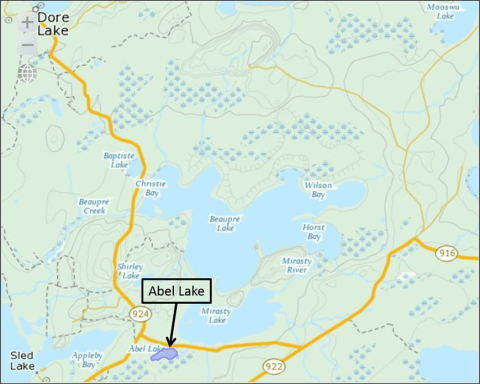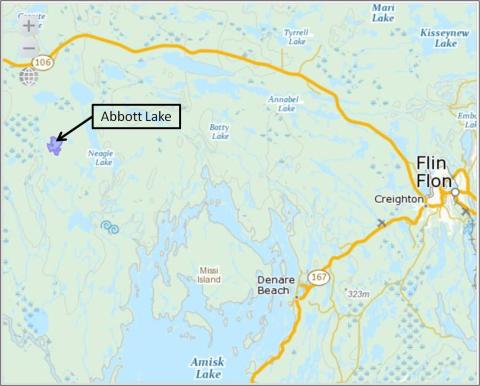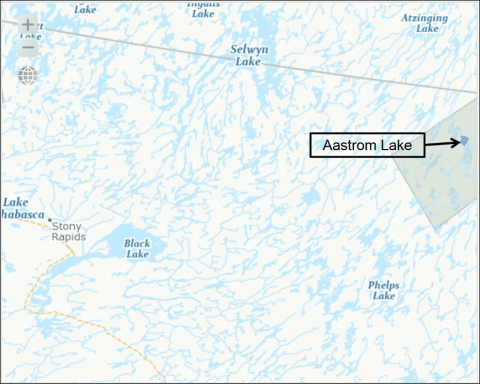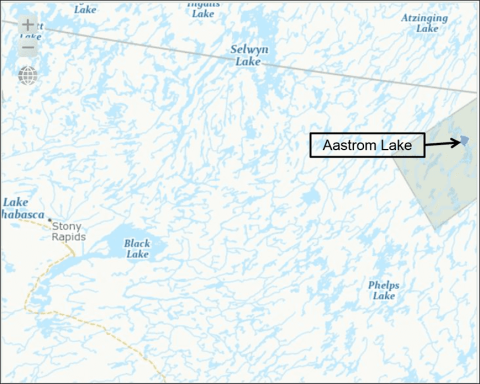
Anderson Lake was named on 24 February 2015 in honour of Corporal Jordan Anderson who was killed by an improvised explosive device on July 4, 2007, while serving in Afghanistan.
Other
Goddard Lake
Goddard Lake was named on 24 February 2015 in memory of Captain Nichola Kathleen Sarah Goddard who died on 17 May 2006 during her service in Afghanistan.
Wasden Lake
Wasden Lake was dedicated in memory of Private Harold Douglas Wasden on 26 July 1961 by the Government of Saskatchewan.
Harold Douglas Wasden was born in April 1919. His parents emigrated from Sheffield, England, shortly after the First World War and settled in Renown, Saskatchewan. The family spent much of the 1920s and 30s in Manitoba before returning to Saskatchewan and establishing a farm southeast of Spiritwood. After completing his schooling, Harold Douglas Wasden worked on the family farm then enlisted in the Canadian Army in 1942 in Saskatoon. He became a member of the South Saskatchewan Regiment and notably participated in the Battle of the Scheldt, October - November, 1944. Following this exhausting battle, the Canadians deployed along the Maas River, patrolling their front and preparing for the opening of the Battle of the Rhineland in February 1945. During this period Private Harold Douglas Wasden was killed on 11 December 1944 in the Nijmegan Salient.
Dustin Wasden Island on Wasden Lake was dedicated to Private Wasden's nephew Corporal Dustin Wasden.
Dustin Wasden Island
Dustin Wasden Island was dedicated in memory of Corporal Dustin Wasden on 21 December 2009 by the Government of Saskatchewan. The Island can be found in the province's northern reaches on Wasden Lake, named in honour of Dustin's great-uncle Harold D. Wasden, who died in 1944 in the Netherlands while serving with the South Saskatchewan Regiment.
Born in July 1983 in Prince Albert, Saskatchewan, Dustin spent his early years in Leoville before moving to Mildred in 1991. Active in the 4H Club throughout his youth, he graduated from Spiritwood Highschool in 2001. In November 2004, he joined the Canadian Forces and completed his basic training in February 2005, followed by his field engineer training at the Canadian Forces School of Military Engineering, in Gagetown, New Brunswick. In the fall of 2005, he was posted to 1 Combat Engineer Regiment in Edmonton, Alberta, completing a mountain operations course during his time at 1 Combat Engineer Regiment. On 24 February 2008 Dustin deployed to Kandahar with 12 Field Squadron, 1 Combat Engineer Regiment. On 20 August 2008, Corporal Wasden was killed, along with two other sappers, when a roadside bomb detonated near their armoured vehicle on a notoriously dangerous stretch of highway in southern Afghanistan. He was 25 years old.
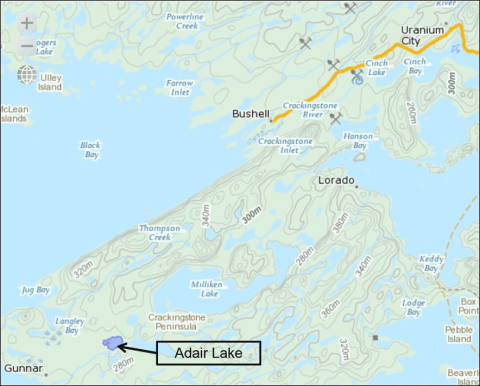
Adair Lake
[on map/sur la carte]
Adair Lake
Adair Lake is named in honour of Flight Sergeant Arthur Dunham Adair. The lake was dedicated on April 1, 1954 by the Government of Saskatchewan.
Arthur Dunham Adair was born in Fairlight, Saskatchewan in January 1916, his father and mother having moved from Ontario to Saskatchewan in the early 1890’s. Following his studies, Adair became a teacher before enlisting at Regina late in October 1940. After completing his aircrew training, he was assigned as an air observed with No. 9 Squadron, RAF. Flight Sergeant Arthur Dunham Adair was killed in action on June 21, 1942 when his Wellington bomber was shot down during a mission. He is buried at Leens General Cemetery in Groningen, The Netherlands.
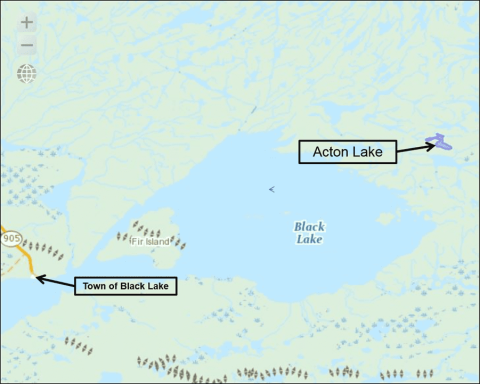
Acton Lake
[on map/sur la carte]
Acton Lake
Acton Lake is named in honour of Pilot Officer George Nelson Acton. The lake was dedicated on May 3, 1951 by the Government of Saskatchewan.
George Nelson Acton was born in Thessalon, Ontario, 90km east of Sault Ste. Marie, in March 1912. He moved to Saskatchewan with his parents in 1917 and took up farming in the Dorintosh area in 1933. He farmed and trapped until he enlisted in June 1942. Assigned as an air gunner to 408 (Goose) Squadron RCAF, Pilot Officer George Nelson Acton was killed in action on June 26, 1943 over Gelsenkirchen, Germany, and is buried at Reichswald Forest War Cemetery near Kleve.
Acorn Lake
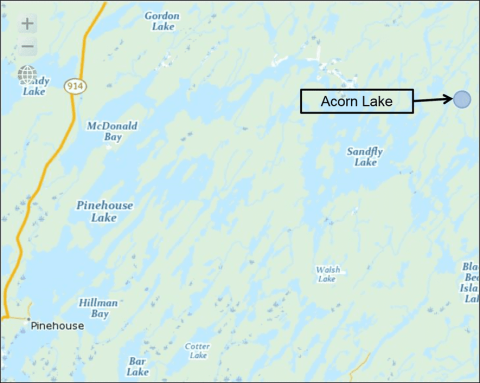
[on map/sur la carte]
Acorn Lake
Acorn Lake is named in honour of Private Wilfred Lorne Acorn. The lake was dedicated on April 5, 1961 by the Government of Saskatchewan.
Wilfred Lorne Acorn was born in Prince Albert, Saskatchewan, in February 1918. He was employed on the family farm near Davis, Saskatchewan, south-east of Prince Albert, until his enrollment in March 1942. Following his training, he became a member of the 1st Canadian Parachute Battalion. Private Wilfred Lorne Acorn was killed in action on February 18, 1945 during operations to clear the west bank of the Rhine River. He is buried at Groesbeek Canadian War Cemetery, The Netherlands.
Acaster Lake
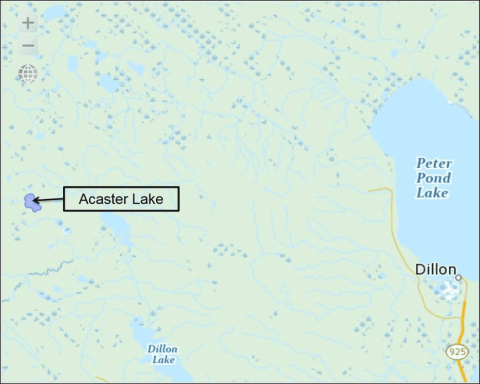
[on map/sur la carte]
Acaster Lake
Acaster Lake is named in honour of Leading Seaman Douglas Haig Acaster. The lake was dedicated on September 6, 1951 by the Government of Saskatchewan.
Douglas Haig Acaster was born at Beausejour, Manitoba in March 1918. Following his studies he was employed as a teacher in the North Battleford, Saskatchewan area before enlisting in June 1939. He was assigned as a cook to HMCS CHIPPEWA, the RCNVR unit at Winnipeg, when he died of leukemia on July 13, 1944. He is buried in North Battleford.
Abrams Bay
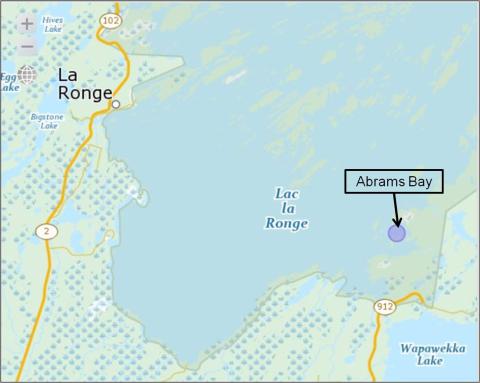
[on map/sur la carte]
Abrams Bay
Robert William Abrams was born in May 1924 in Rockhaven, Saskatchewan, south-west of North Battleford. His family had moved from Meaford, ON to Rockhaven in 1905. Robert was born on the homestead and was engaged in farming when he enlisted in Saskatoon in 1942. Following aircrew training, he was assigned to No. 576 Squadron Royal Air Force. Robert William Abrams was killed in action in March 1945 on his first operational mission, when his Lancaster bomber collided in midair with another aircraft over Chemnitz, Germany. He is commemorated on the Runnymede Memorial near London, England, for airmen from the north European theater who died with no known grave.
Abram Island
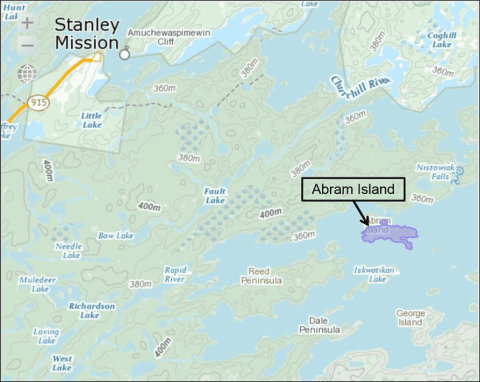
[on map/sur la carte]
Abram Island
Abram Island is named in honour of Lieutenant Allan Francis Abram. The island was dedicated on February 3, 1950 by the Government of Saskatchewan.
Allan Francis (Frank) Abram was born in August 1919 in Southey, Saskatchewan. He attended Central Collegiate and Regina College and completed a law degree just before enlisting at Saskatoon in 1942, where he was assigned to the Calgary Regiment. Lieutenant Abram was killed in action in May 1944 near Panaccioni, Italy during operations to breach the GUSTAV LINE, when his Sherman tank was struck by a round from an enemy self-propelled gun. He is buried at Cassino War Cemetery, Frosinone, Italy.