Other

City/Municipality
Vancouver
Memorial Number
59026-063
Type
Address
2690 Larch Street
Location
Kitsilano War Memorial Community Centre
in Canada
Yes
GPS Coordinates
49.2615535, -123.1625269
Inscription

[mural/murale]

HABITAT
KOOLAID
CENTRE for DIALOGUE
HEADLINES THEATRE

YOU
ARE
HERE

AROUND THE
NEIGHBOURHOOD
PEOPLE WAGE
PEACE

SIMON HELPS A
REFUGEE CHILD
PUT SOLDIERING
BEHIND HER

COEXIST

AMNESTY

UNIFICATION

LE CANADA
50 and au
service de la
PAIX

peace unto us

ARMISTICE

"Those
who survived war understand
the meaning of
peace"

ABE LOSES RADIO
CONTACT WITH THE
HALIFAX

ELSEWHERE, DR. HAVIN
WONDERS HOW YUSSEF
IS MANAGING

[storyboard/scénarimage]

A Path To Peace
COMMUNITY MURAL PROJECT

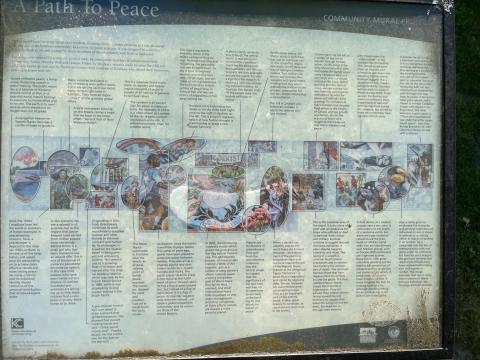
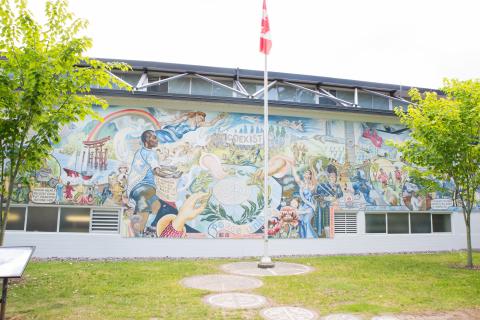
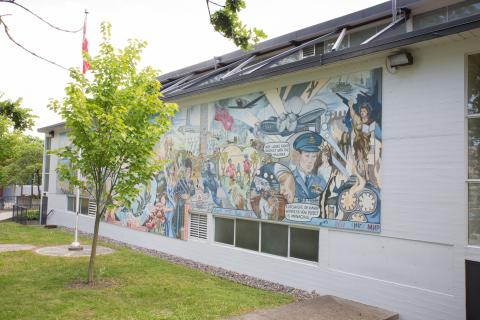
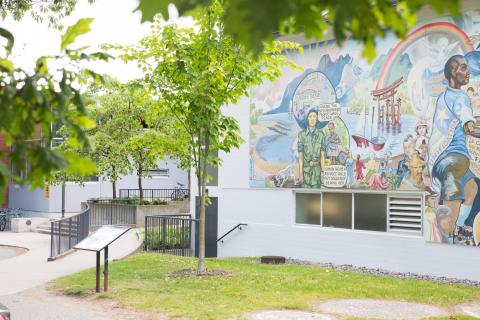
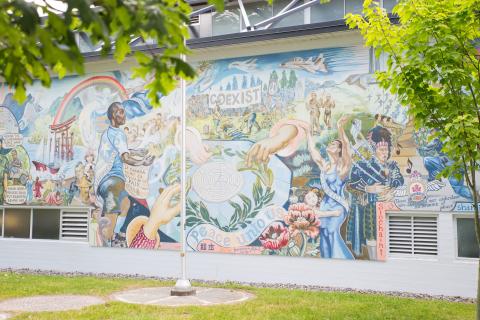
The mural contains many images and symbols, focusing on our Centre's presence as a war memorial site and of the Kitsilano community as a centre for peace activism. It was designed by artist-in-residence Ruth Jones, and painted by thirty members of the community with Ruth as facilitator.

The design was inspired by a memory journal made by community members in collaboration with Community Artists Dorothy Wolf and Lizanne Fisher, by the peace mosaics made by artist Dan Hill and KCC community groups, and by Ruth's interaction with residents of Kitsilano who shared their memories, beliefs and hopes with her.

Nature embodies peace; a living peace. Protecting nature is peace-making. The public water, sky and beaches of Kitsilano should remind us that, in a peaceful world, nature belongs to everyone (custodianship) and to no one. The earth is its own miracle which should not be fought over out of greed.

A navigation beacon on Spanish Banks becomes a candle of hope to guide us.

Many societies dedicated to peace-making and conflict resolution have sprung up in our midst, many started right here in Kitsilano. They form an important part of growing global effort.

A local newspaper blowing on breeze carries a headline we hope to see more often: "Accord: Pact of Non-Violence Holds".

This is a Japanese Peace monument. Its mystery and beauty inspire thoughts of peace in people of all nations. A gateway to spiritual values.

The rainbow is an ancient sign for peace in many cultures. For example, in China, it is often drawn as a symbol of the sky dragon, connecting heaven and earth. It embodies peoples' hope for a better world.

This figure represents Amnesty, which is the state's version of forgiveness. Without forgiving and forgetting, the peace process gets bogged down. So she is here to help heal wounds and soothe tempers, old grudges, and attitudes of self-righteousness. She holds an olive branch, symbol of peace-time, in front of her, and lets the chains of imprisonment fall away behind her.

Bombers are transforming into doves as the sky shifts from night time on the right to daytime on the left. This is a mythic representation of how human thought is transforming to grasp a new global harmony.

A peace march, winds its way through the central mural. It represents our communities relentless marching for peace over many decades, and links us to peace marches and vigils around the world. It is also a sign that the majority is seeking a new way of relating between nations. As musician Ben Harper sings: "If the people lead, the leaders will have to follow".

At the mural centre, the theme starts to shift from war and it consequences to one of conflict resolution and a search for a new way of dialogue between nations. Two soldiers are shown laying down their weapons with good intent, trusting that they won't ambush one another in the process... a metaphor for any two people attempting a reconciliation.

The F18 is Canada's contemporary bomber. It opens the skies on military missions.

Crosses march up the hill as a symbol of the loss of Canada through military action. On the ridge is the Vimy Memorial which commemorates the battles when many Canadian dies in a very short time - a virtual massacre. We hope that in showing it in the light of dawn, we can express how loss from war continues to motivate us to work for peace and no take it for granted. The inclusion of the red ensign (our original flag) points to the history of Canada and her growth as a nation, due to the bravery of those who fought so that today we may live in freedom and peace.

Kitty Hawks were the "Little Friends" of big bombers like the Halifax. They would accompany them on missions and attempt to gun down any attacking fighter planes. Rumours suggest that a squadron of Kitty Hawks, being ferried by Canadian women pilots to bases in Alaska during WWII, froze up over the Rockies and were lost without a trace. Department of National Defense may have buried the evidence, but stories by those who remember hearing news still circulate.

A woman stands in rags on a bombed-out building, she is in no immediate danger and sings defiantly out, thus serving as a symbol of the inextinguishable strength of the human spirit in adversity. She plays the role of the story teller, motioning with her outstretched arm towards the path through war that leads to peace. A sea battle takes place above, and is shown to honour Canadian troops who served in the Royal Navy. Our local Veteran's Legion motto is "Those who experienced war understand the meaning of peace". Visit Billy Bishop Branch #176, 1407 Laburnum Street, to talk with a veteran.

Since the 1950's Canadians have led the world in numbers of troops deployed in peacekeeping missions. Here, a peacekeeper is depicted in the original 1950's uniform to remind us of the long history and experience we are building on to achieve more effective results and more lasting peace. His name is Simon, and his individual identity should remind us of the personal contribution that all peacekeepers make.

In this scenario, we see a relaxed trust possible due to the respect that peacekeepers have earned from civilian populations worldwide. Behind Simon is a small girl who has been trained to use an assault rifle. This is one of thousands of scenarios peacekeepers come up against, in this case child soldiers who have been hardened to a lifestyle of warfare. Successful programmers are springing up to help these children find a new place in society. More needs to be done.

Originating in Kitsilano, Greenpeace continues its work worldwide to suppress nuclear and other threats to the environment and humanity. Its philosophy is based on the Quaker belief in being present and witnessing conflict. This vessel is one of a growing fleet of thirteen, and named after the original Rainbow Warrior, which was sunk by the French Secret Service in 1985, while it was attempting to stop nuclear testing in the South Pacific.

A pre-schooler here at KCC was asked to draw a picture that symbolized peace. She showed four people holding hands and said "I think peace means love". Thanks, Miaoli, for the inspiration for the kids on the sea-wall.

The Peace March culminates in Kitsilano near the beach, an original rallying point of earlier peace marches. The marchers, dressed for wind and weather, look on as hands build the Unity mosaic.

Unification. Since the institution of the Olympic Games thousands of years ago, sports have been played to symbolize peace between nations. They also act as a (mostly) playful and nonviolent outlet for competitiveness and rivalry. This soccer player takes his place in the mural as the fulfillment of peace through sport. He has a flag draped around him, but instead of a flag of nationalism, it is a flag of peace. Its one star suggests unity between nations and states — a global empathetic community — and its colours are those of the United Nations.

In 2002, the community created a mosaic which graces the grass around the flag pole in front of you. The participatory process, of many people making a Work of Art together, acts as a symbol of every person's efforts towards peace creating the greater goal of World Peace. One family feud resolved, one set of international Peace Talks organised, or one anger management workshop completed, all these efforts contribute toward a more peaceful planet.

Poppies are the flowers of remembrance. They spill from the remembrance ceremony into the central image to suggest that the significance of our loss from war lives on to contribute to our daily understanding of, and efforts on behalf of, peace.

When a dancer was asked to express the word Peace she formed this pose - an embodiment of the yearning towards an ideal that seems to require the will of the Beyond. She is present as the allegorical figure "Armistice": a peace that is negotiated and signed by opposing sides. We see, between her outstretched arms, surrendering troops. They are an important part of the path to peace. It takes great bravery to surrender, as one must put one's trust in the enemy.

This is the transition area of the mural. It is the place of grief and remembrance for those who suffered or died in wartime, both civilian and military. Symbols combine to suggest loss and cherished memories. A piper playing suggest solemnity and ritual. The laying of a wreath is common to all funeral processions and to ceremonies marking the anniversary of death. The cenotaph honours those that have departed due to conflicts around the globe. The four soldiers honour recent troops lost in battle in Afghanistan. They are echoed (four soldiers shown facing toward the lost brothers) to suggest that when the living honour the dead, the dead live on through their memory.

A field doctor, at a medical outpost near a war zone, is concerned over the health of a landmine victim. But the most tragic landmine casualties are the thousands of children worldwide who are injured every year. Medical groups, such as Doctors Without Borders, are organized to treat these victims with great care while pointing out the need to ban production of weapons such as landmines and cluster bombs which, in peace time ? to claim innocent victims. A nurse imagines the best for a young survivor who, although awaiting fitting for an artificial leg, is still able to join in the game.

Abe, a name given to emphasize the humanity and personal experience of individuals in war, is shown in uniform as a ranking officer in charge of soldiers in air combat. He is concerned over the loss of communication with one plane under his command. It is hard for us to imagine the grief and remorse that responsible officers must have experienced in losing men and women in combat. This image expresses that war is more than societal evil. Many precious individuals relationships are built and lost.

needs further research/recherche incomplète

Image
Caption
A Path to Peace storyboard
1 of 5 images
Image
Caption
A Path to Peace
1 of 5 images
Image
Caption
A Path to Peace
1 of 5 images
Image
Caption
A Path to Peace
1 of 5 images
Image
Caption
A Path to Peace
1 of 5 images
Province
!4v1719336684865!6m8!1m7!1sCjXtgOyBWqU7LCjfgBjCTg!2m2!1d49.26155354750299!2d-123.162526873413!3f93.2661837847078!4f4.29134849333235!5f2.1627690956993737
Body Content

A Path to Peace was erected by Ruth Jones and volunteers from the Kitsilano Community in the summer of 2003. The mural contains many images and symbols, focusing on the Kitsilano War Memorial Community Centre's presence as a war memorial site and of the Kitsilano community as a centre for peace activism. It was designed by artist-in-residence Ruth Jones, and painted by thirty members of the community with Ruth as facilitator.

The design was inspired by a memory journal made by community members in collaboration with Community Artists Dorothy Wolf and Lizanne Fisher, by the peace mosaics made by artist Dan Hill and KCC community groups, and by Ruth's interaction with residents of Kitsilano who shared their memories, beliefs and hopes with her.

Images depicted in the mural are:

  • The water, sky and beaches of Kitsilano remind us that, in a peaceful world, nature belongs to everyone (custodianship) and to no one. The earth is its own miracle which should not be fought over out of greed.
  • A navigation beacon on Spanish Banks becomes a candle of hope to guide us.
  • Images of Kitsilano buildings, many societies dedicated to peace-making and conflict resolution started right here in Kitsilano.
  • A peacekeeper in the original 1950's uniform reminds us of the long history to achieve lasting peace. His name is Simon, and his individual identity reminds us of the personal contribution that all peacekeepers make.
  • Behind Simon is a small girl who has been trained to use an assault rifle. This is one of thousands of scenarios peacekeepers come up against, in this case child soldiers who have been hardened to a lifestyle of warfare.
  • A local newspaper blowing on breeze carries a headline: "Accord: Pact of Non-Violence Holds".
  • A preschooler, Miaoli, inspired the image of kids on the sea-wall to symbolize peace.
  • The Japanese Peace monument, its mystery and beauty inspire thoughts of peace in people of all nations. A gateway to spiritual values.
  • The rainbow is an ancient sign for peace in many cultures.
  • A Peace March in Kitsilano near the beach, an original rallying point of earlier peace marches. The marchers, dressed for wind and weather, look on as hands build the Unity mosaic.
  • The soccer player fulfills peace through sport. He has a flag of peace draped around him. Its one star suggests unity between nations and states — a global empathetic community — and its colours are those of the United Nations.
  • A figure represents Amnesty, which is the state's version of forgiveness. She holds an olive branch, symbol of peace-time, in front of her, and lets the chains of imprisonment fall away behind her.
  • Bombers are transforming into doves as the sky shifts from night time on the right to daytime on the left. This is a mythic representation of how human thought is transforming to grasp a new global harmony.
  • A peace march, winds its way through the central mural. It represents our communities relentless marching for peace over many decades, and links us to peace marches and vigils around the world. It is also a sign that the majority is seeking a new way of relating between nations. As musician Ben Harper sings: "If the people lead, the leaders will have to follow".
  • At the mural center, the theme starts to shift from war and it consequences to one of conflict resolution and a search for a new way of dialogue between nations. Two soldiers are shown laying down their weapons with good intent, trusting that they won't ambush one another in the process... a metaphor for any two people attempting a reconciliation.
  • In 2002, the community created a mosaic around the flag pole. The participatory process, of many people making a Work of Art together, acts as a symbol of every person's efforts towards peace creating the greater goal of World Peace.
  • Poppies are the flowers of remembrance.
  • The F18 is Canada's contemporary bomber. It opens the skies on military missions.
  • A dancer inspired the allegorical figure "Armistice": a peace that is negotiated and signed by opposing sides. Surrendering troops are between her outstretched arms. It takes great bravery to surrender, as one must put one's trust in the enemy.
  • Crosses march up the hill, as a symbol of the loss of Canada through military action, to the Vimy National Memorial. The red ensign (our original flag) points to the history of Canada and her growth as a nation, due to the bravery of those who fought so that today we may live in freedom and peace.
  • Symbols combine to suggest loss and cherished memories. A piper playing suggest solemnity and ritual. The laying of a wreath is common to all funeral processions and to ceremonies marking the anniversary of death. The cenotaph honours those that have departed due to conflicts around the globe. The four soldiers honour recent troops lost in battle in Afghanistan. They are echoed (four soldiers shown facing toward the lost brothers) to suggest that when the living honour the dead, the dead live on through their memory.
  • A field doctor, at a medical outpost near a war zone, is concerned over the health of a landmine victim. A nurse imagines the best for a young survivor who, although awaiting fitting for an artificial leg, is still able to join in the soccer game.
  • Kitty Hawks were the "Little Friends" of big bombers like the Halifax. They would accompany them on missions and attempt to gun down any attacking fighter planes.
  • A ranking officer, shown in uniform in charge of soldiers in air combat, is concerned over the loss of communication with one plane under his command.
  • A woman stands in rags on a bombed-out building and sings defiantly out, thus serving as a symbol of the inextinguishable strength of the human spirit in adversity. She plays the role of the story teller, motioning with her outstretched arm towards the path through war that leads to peace. A sea battle takes place above, and is shown to honour Canadian troops who served in the Royal Navy.
City
Vancouver
Country
Type Description
Mural
Photo Credit
Kitsilano War Memorial Community Centre
Memorial CF Legacy ID
12615
City/Municipality
Vancouver
Memorial Number
59026-062
Type
Address
837 West Hastings Street
Location
Terminal City Club
in Canada
Yes
GPS Coordinates
49.2862861, -123.1154557
Inscription

needs further research/recherche incomplète

Image
Caption
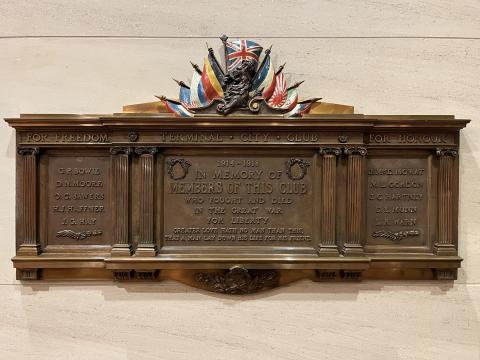
Terminal City Club Great War Tablet
War or Conflict Term
Province
!4v1716482991477!6m8!1m7!1swxCHEt_KSw-rr08UgeOdzQ!2m2!1d49.28628610873826!2d-123.1154556923154!3f35.23250420696873!4f10.599269306819068!5f1.427923223230679
Body Content

The Great War Tablet was installed shortly after Armistice Day in 1918. The Metropolitan Building at 837 West Hastings Street was constructed in 1912 to house the Metropolitan Club, which later became the Terminal City Club. This building stood until 1998, when it was replaced by the 30-storey Terminal City Tower.

City
Vancouver
Country
Type Description
Tablet
Photo Credit
Terminal City Club
Memorial CF Legacy ID
12484
City/Municipality
Vancouver
Memorial Number
59026-061
Type
Address
6190 Agronomy Road
Location
University of British Columbia Technology Enterprise Facility III
in Canada
Yes
GPS Coordinates
49.2614111, -123.2468672
Inscription

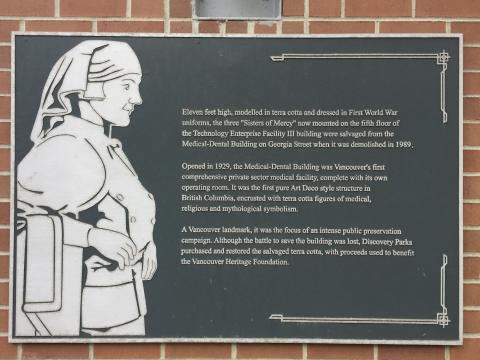
Eleven feet high, modelled in terra cotta and dressed in First World War
uniforms, the three "Sisters of Mercy" now mounted on the fifth floor of
the Technology Enterprise Facility III building were salvaged from the
Medical-Dental Building on Georgia Street when it was demolished in 1989.

Opened in 1929, the Medical-Dental Building was Vancouver's first
comprehensive private sector medical facility, complete with its own
operating room. It was the first pure Art Deco style structure in
British Columbia, encrusted with terra cotta figures of medical,
religious and mythological symbolism.

A Vancouver landmark, it was the focus of an intense public preservation
campaign. Although the battle to save the building was lost, Discovery Parks
purchased and restored the salvaged terra cotta, with proceeds used to benefit
the Vancouver Heritage Foundation.

Image
Photo Credit
The University of British Columbia
Caption
Sisters of Mercy plaque
Province
!4v1698066173520!6m8!1m7!1s8fbCB3RrfYmDy66eASEdhw!2m2!1d49.26141108211351!2d-123.2468672048522!3f115.10192964503186!4f19.41600462871274!5f0.7820865974627469
Body Content

In 1989, the Georgia Medical-Dental Building at the corner of Georgia and Hornby Streets was demolished to make way for a new 23-storey office tower. A public campaign was raised to save the original statues for the new building. However, as these proved both extremely heavy and difficult to remove, replicas had to be made. When the new tower opened in 1991, the replicas were mounted at about the third-storey level, easily visible from the streets. The original statues were purchased and restored by Discovery Parks. They were installed on the Technology Enterprises Facility III on the University of British Columbia campus.

This building and a memorial plaque were designed by Chernoff Thompson Architects, who liked the statues and their history.

City
Vancouver
Country
Type Description
Statues
Memorial CF Legacy ID
12066
City/Municipality
Vancouver
Memorial Number
59026-060
Type
Address
Georgia and Hornby Streets
Location
Cathedral Place
in Canada
Yes
GPS Coordinates
49.2838048, -123.1200781
Image
Photo Credit
Archives 2008-022.040.
Caption
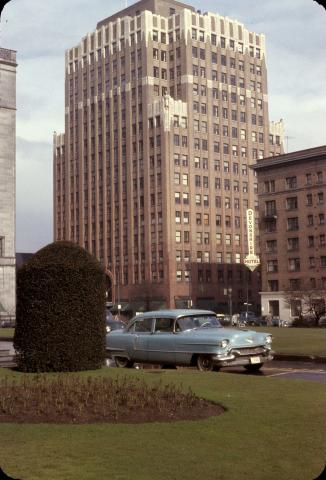
Georgia Medical-Dental Building viewed from the Vancouver Art Gallery steps, 1950s.
1 of 3 images
Image
Photo Credit
Archives AM1536-: CVA 70-28.
Caption
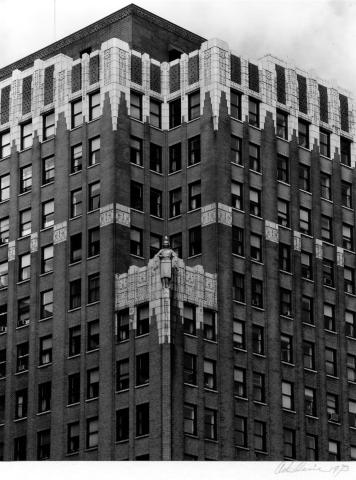
Medical-Dental Building featuring one of the three Nursing Sisters statues, 1973.
1 of 3 images
Image
Caption
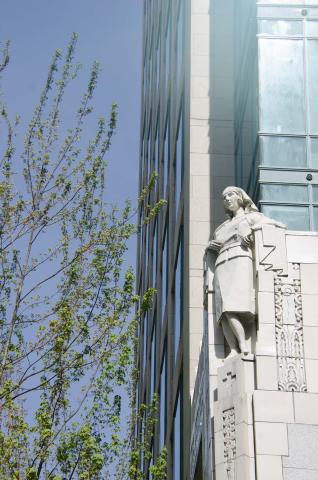
First World War Nursing Sister statue at Cathedral Place.
1 of 3 images
Province
!4v1697827089560!6m8!1m7!1szwRJf_2QlWZMsfEjONnlSA!2m2!1d49.28380475885776!2d-123.1200781289929!3f357.53075875635784!4f32.36214913388967!5f0.7820865974627469
Body Content

The Georgia Medical-Dental Building at the corner of Georgia and Hornby Streets was designed by McCarter Nairne and Partners in 1929. At about the tenth story level, the building was graced with three 11 feet high, terracotta statues depicting a First World War Nursing Sister, one on each of the building’s three visible corners. Architects John Young McCarter and George Colvil Nairne both served overseas during the war. McCarter was seriously wounded and credited the Nursing Sisters with saving his life. They founded their architectural firm in 1921 and when they obtained the contract for the Medical-Dental Building, they decided to honour the Nursing Sisters. The statues were designed by Joseph Francis Watson. 

In 1989, the building was demolished to make way for a new 23-storey office tower. A public campaign was raised to save the original statues for the new building. However, as these proved both extremely heavy and difficult to remove, replicas had to be made. When the new tower opened in 1991, the replicas were mounted at about the third-storey level, easily visible from the streets. The original statues were purchased and restored by Discovery Parks. They were installed on the Technology Enterprises Facility III on the University of British Columbia campus.

Mario Tinucci of Ital-Decor arranged to make the castings so that new fiberglass figures could be made. One of the originals (the one least damaged) was re-molded to make it whole, then fiberglass replicas were made. The patched original is on display in Cathedral Place. A fiberglass replica of the head is also on display in the lobby of Cathedral Place. In 1992, the Vancouver Museum took the least-damaged head from one of the broken statues for safe-keeping; this was patched, repaired and is held for display by the museum.

City
Vancouver
Country
Type Description
Statues
Memorial CF Legacy ID
12065
City/Municipality
Vancouver
Memorial Number
59026-059
Type
Address
1490 Nanton Avenue
Location
St. John's Shaughnessy Anglican Church, nave
in Canada
Yes
GPS Coordinates
49.2474113, -123.1385954
Inscription

We build not temples unto martyrs as unto gods, but memorials unto dead men whose spirits with God are still living

War or Conflict Term
Province
!4v1691777229764!6m8!1m7!1saTOYAIvYv5p-awqO5GOoBA!2m2!1d49.24741130544336!2d-123.138595428548!3f187.02666619002946!4f12.819335849598303!5f0.8847731465062544
Body Content

This five-paneled window was commissioned in 1949, installed in 1951 and dedicated on April 22, 1951, by Bishop Godfrey Gower in memory of those who died in the two World Wars. The window was designed by stained glass artist Yvonne Williams of Toronto, Ontario.

The center panel depicts Christ on the cross with arms uplifted; a ray of light  representing God shines on a chalice; beneath, two disciples kneel at a communion table. The Province of British Columbia's coat of arms is at the bottom of the panel. Each side panel depicts men and women of Canada’s fighting forces: nurse, merchant seaman, sailor, airman, soldier and airwoman. Beneath each figure is a shield bearing the crest of the service represented.

City
Vancouver
Country
Type Description
Stained glass window
Memorial CF Legacy ID
11939
City/Municipality
Vancouver
Memorial Number
59026-058
Type
Address
1490 Nanton Avenue
Location
St. John's Shaughnessy Anglican Church, chancel
in Canada
Yes
GPS Coordinates
49.2474113, -123.1385954
War or Conflict Term
Province
!4v1691777229764!6m8!1m7!1saTOYAIvYv5p-awqO5GOoBA!2m2!1d49.24741130544336!2d-123.138595428548!3f187.02666619002946!4f12.819335849598303!5f0.8847731465062544
Body Content

The two narrow windows in the chancel are made of 11th century glass fragments from the Canterbury Cathedral in England that was shattered during Second World War bombing raids. The glass fragments were, by special permission of the Cathedral, given to Archdeacon Greig, a parishioner during the war. These windows, a memorial gift from Mrs. Greig and her family, were dedicated on December 6, 1970.

City
Vancouver
Country
Type Description
Stained glass window
Memorial CF Legacy ID
11938
City/Municipality
Vancouver
Memorial Number
59026-057
Type
Address
1490 Nanton Avenue
Location
St. John's Shaughnessy Anglican Church
in Canada
Yes
GPS Coordinates
49.2474113, -123.1385954
Inscription

ST JOHN'S SHAUGHNESSY
MEMORIAL CHURCH

THIS CORNER STONE WAS LAID BY
J.E. McMULLEN, K.C.
MAY 29, 1949.

Province
!4v1691777229764!6m8!1m7!1saTOYAIvYv5p-awqO5GOoBA!2m2!1d49.24741130544336!2d-123.138595428548!3f187.02666619002946!4f12.819335849598303!5f0.8847731465062544
Body Content

St. John's Shaughnessy Memorial Church was designed by Major G. L. Thornton Sharp and built in 1949 to stand as a memorial honouring all Vancouver’s sons and daughters who answer the call to serve their country. Funds for the project were raised from all over the Lower Mainland, some coming from outside the Anglican community, but nevertheless bonded by a common desire to build a living memorial. The cornerstone was laid by J.E. McMullen K.C., on May 29, 1949, and it was dedicated on June 18, 1950. 

City
Vancouver
Country
Type Description
Building - church
Memorial CF Legacy ID
11937
City/Municipality
Vancouver
Memorial Number
59026-056
Type
Address
Burrard Street and W 15th Avenue
Location
Canadian Memorial United Church
in Canada
Yes
GPS Coordinates
49.2580818, 0
Image
Photo Credit
Canadian Memorial United Church and Centre for Peace
Caption
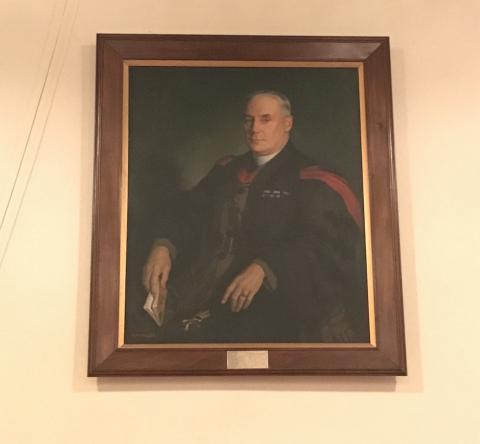
Portrait of Reverend Lieutenant-Colonel G.O. Fallis
War or Conflict Term
Province
!4v1622487793072!6m8!1m7!1sBhTo-GoGMRoV-vQ0me-CTw!2m2!1d49.25808175008721!2d-123.1459623271083!3f226.2479404422196!4f8.907012790348716!5f1.4499580245881227
Body Content

Founder's Portrait is located in the East Transept of Canadian Memorial Chapel, between the Ontario and Quebec windows. The portrait of the Reverend Lieutenant-Colonel (Lt.-Col.) G.O. Fallis, CBE, ED, BD, DD, the founder of Canadian Memorial Church. The portrait by Kenneth Forbes, R.C.A., was unveiled by Lt.-Col. Fallis' daughter, Mary M. Fallis, on November 16, 1942. Captain Howard Green, MP, gave the address and a congregational reception was held afterwards.

Canadian Memorial Chapel was born in the hearts of private soldiers who, guided by a sergeant, formed a working party to bury six of Canada's war dead. On a November night of 1915, in the Ypres Salient, France, one of the soldiers said to Reverend Lieutenant-Colonel Fallis, "Padre, after the war is over some chaplain should build a memorial in Canada in memory of fellows like these who have given their all." From that moment on, he would never lay away their beloved dead without the idea of a memorial chapel in his mind.

Canadian Memorial Chapel was dedicated on November 9, 1928. Regular services began on November 11, 1928, exactly ten years after the 1918 Armistice. As the first hymn was being sung the chief usher handed Lt.-Col. Fallis a cable. It was a message of congratulations from His Majesty King George V.

In the first week of the Second World War, Major-General R.O. Alexander, Command Officer in MD 2, Toronto, called Lt.-Col. Fallis to his office. "Fallis," he said, "you are the Senior Reserve Chaplain in this district. Get yourself a uniform and report for voluntary duty until Ottawa appoints. Already the help of the chaplains is needed." Thus began his second period of active military duty as a Chaplain and five more years of mutual devotion with men of The King's Forces.

City
Vancouver
Country
Type Description
Painting
Memorial CF Legacy ID
11116
City/Municipality
Vancouver
Memorial Number
59026-055
Type
Address
Burrard Street and W 15th Avenue
Location
Canadian Memorial United Church, Narthex
in Canada
Yes
GPS Coordinates
49.2580818, -123.1459623
Inscription

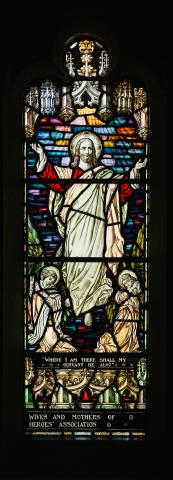
"WHERE I AM THERE SHALL MY
SERVANT BE ALSO."

WIVES AND MOTHERS OF
HEROES' ASSOCIATION.

Image
Photo Credit
Canadian Memorial United Church and Centre for Peace
Caption
The Transfigured Soldier stained glass window
War or Conflict Term
Province
!4v1622487793072!6m8!1m7!1sBhTo-GoGMRoV-vQ0me-CTw!2m2!1d49.25808175008721!2d-123.1459623271083!3f226.2479404422196!4f8.907012790348716!5f1.4499580245881227
Body Content

The Transfigured Soldier was erected in Canadian Memorial United Church by the widows, wives and mothers of Great Britain’s Heroes’ Association and was dedicated by Mrs. J.C. Kemp. It depicts a soldier dying on the battlefield with Jesus ministering to him. 

City
Vancouver
Country
Type Description
Stained glass window
Memorial CF Legacy ID
11115
City/Municipality
Vancouver
Memorial Number
59026-054
Type
Address
Burrard Street and W 15th Avenue
Location
Canadian Memorial United Church, Narthex
in Canada
Yes
GPS Coordinates
49.2580818, -123.1459623
Inscription

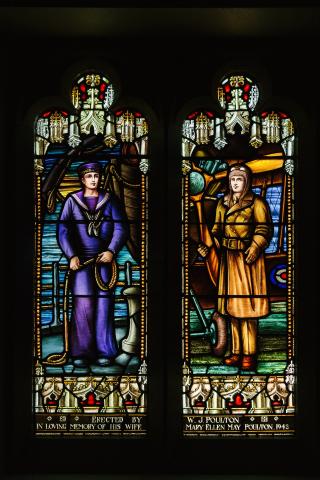
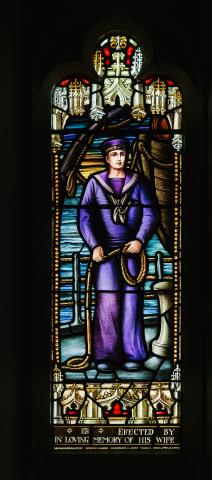
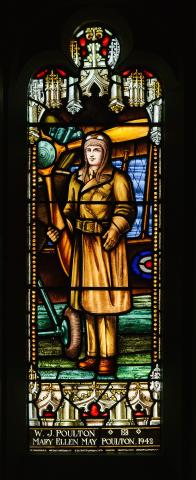
ERECTED BY W.J. POULTON
IN LOVING MEMORY OF HIS WIFE MARY ELLEN MAY POULTON, 1942

Image
Photo Credit
Canadian Memorial United Church and Centre for Peace
Caption
The Sailor and The Airman stained glass windows
1 of 3 images
Image
Photo Credit
Canadian Memorial United Church and Centre for Peace
Caption
The Sailor
1 of 3 images
Image
Photo Credit
Canadian Memorial United Church and Centre for Peace
Caption
The Airman
1 of 3 images
Province
!4v1622487793072!6m8!1m7!1sBhTo-GoGMRoV-vQ0me-CTw!2m2!1d49.25808175008721!2d-123.1459623271083!3f226.2479404422196!4f8.907012790348716!5f1.4499580245881227
Body Content

The Sailor and The Airman were both erected in Canadian Memorial United Church by Mr. William Poulton and their inscriptions are to be read together. For many years, Mr. Poulton and his wife had taken a great interest in Canadian Memorial Chapel. 

A tribute to the many young Canadians who lost their lives on the high seas while serving in Canada’s navy, The Sailor depicts an ordinary seaman with sincerity, strength and courage standing out in his strong face.

The Airman honours the hundreds of young Canadians who gave their lives in flimsy aircraft with the Royal Flying Corps or Royal Naval Air Service  and, when the two joined, the Royal Air Force. It was reproduced from a painting by Sir William Orpen, R.A., and depicts the extreme youthfulness of those who served in the Royal Air Force in the First World War. It was unveiled by Mrs. N. B. Gale, sister of the late Mrs. Wm. Poulton and dedicated by Reverend Arthur Bischlager, Naval Chaplain, Esquimalt.

City
Vancouver
Country
Type Description
Stained glass windows
Memorial CF Legacy ID
11114