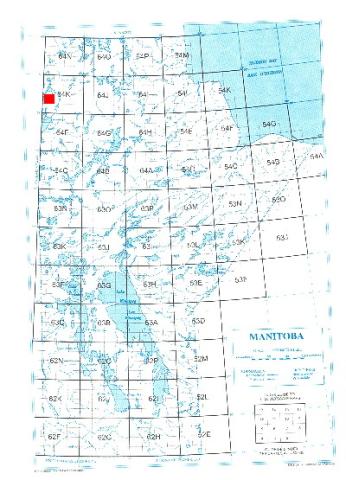
This lake was named in 1972 in honour of Private Ralph B. Aandal. He died on 16 December 1944.
Aandal Lake
no inscription/aucune inscription
My VAC Account
My VAC Accountno inscription/aucune inscription
This lake was named in 1972 in honour of Private Ralph B. Aandal. He died on 16 December 1944.
[shaft/socle]
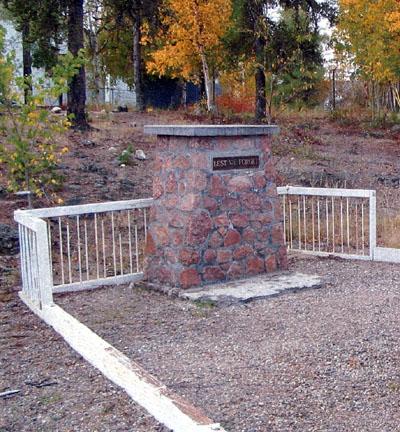
LEST WE FORGET
OUR GALLANT DEAD
YPRES TO MONS
[left plaque/plaque du gauche]
THEY SERVED TILL DEATH
WORLD WAR II
1939-45
[right plaque/plaque du droit]
THEY SERVED TILL DEATH
THE KOREAN WAR
1950-53
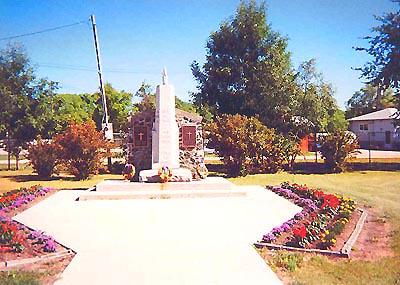
This memorial is dedicated to the memory of the losses of the First and Second World Wars and the Korean War.
no inscription/aucune inscription
On 5 May 1949, a group of three lakes in Northern Manitoba was named Mynarski Lakes in honour of P/O Andrew Charles Mynarski, who was posthumously awarded the Victoria Cross. He died in France in 1944 after risking his own life in an attempt to save a comrade trapped in their burning Lancaster bomber.
[front/devant]
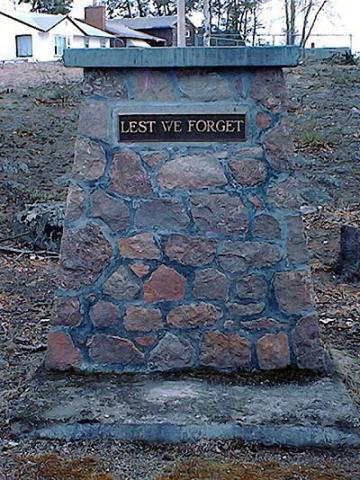
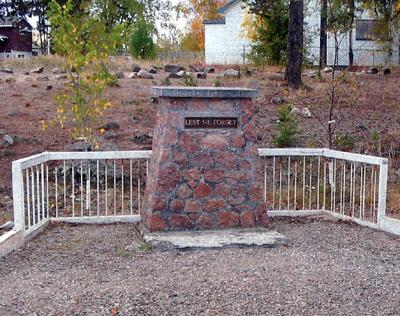
LEST WE FORGET
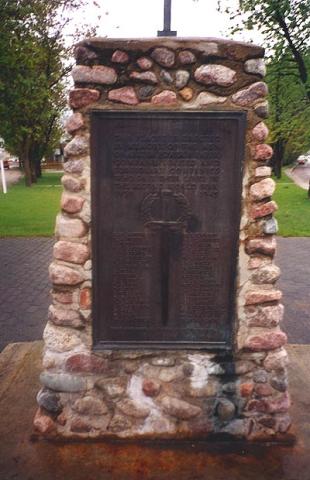
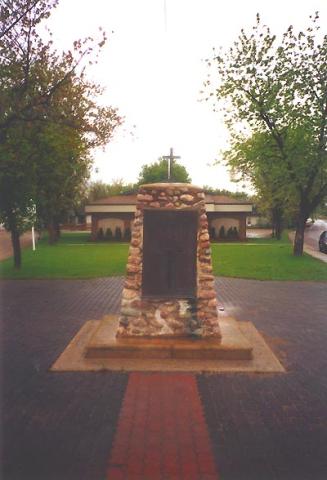
This memorial was constructed by William (Scotty) Archibald (now deceased) for Royal Canadian Legion Branch No. 236 and is dedicated to the local war dead of the First and Second World Wars and the Korean War. The stone for this project were gathered from various locations north, east, west, and south of Lynn Lake by Mr. Cyrill Anderson. The memorial and its surrounding area were upgraded by Comrade John Boudreault (now deceased). The surrounding fence is being painted in 2006, the cement will have to wait until next year. A plaque with Comrade Archibald will be added to the memorial.
[front/devant]
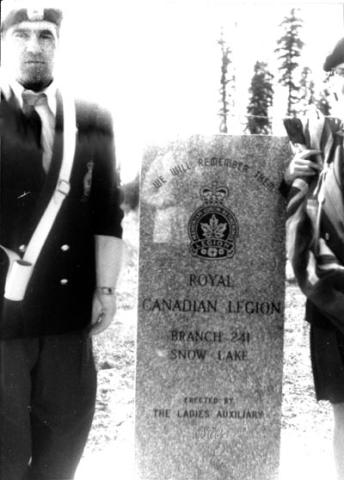
WE WILL REMEMBER THEM
ROYAL CANADIAN LEGION
BRANCH 241
SNOW LAKE
ERECTED BY THE LADIES' AUXILIARY
1972
This memorial was erected by The Ladies' Auxiliary Branch of Royal Canadian Legion Branch No. 241 (Snow Lake) in 1972.
[plaque/plaque]
THIS PLAQUE IS ERECTED IN MEMORY OF THE MEN OF ABITIBI POWER AND PAPER COMPANY LIMITED AND SUBSIDIARY COMPANIES WHO GAVE THEIR LIVES IN THE SECOND WORLD WAR
1939-1945
THEY GAVE THEIR ALL IN THE CAUSE OF FREEDOM
This cairn was constructed by the Abitibi Power and Paper Company Limited and dedicated to their employees who fought and died during the Second World War. It is now cared for by the members of Royal Canadian Legion Branch No. 64 (Pine Falls).
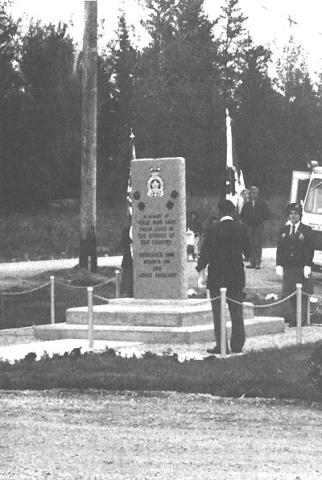
[front/devant]
IN MEMORY OF THOSE WHO GAVE THEIR LIVES IN THE SERVICE OF OUR COUNTRY
DEDICATED 1986
BRANCH 241 AND LADIES AUXILIARY
This memorial was erected in 1986 by the Ladies' Auxiliary of Royal Canadian Legion Branch No. 241 and is dedicated to the local war dead.
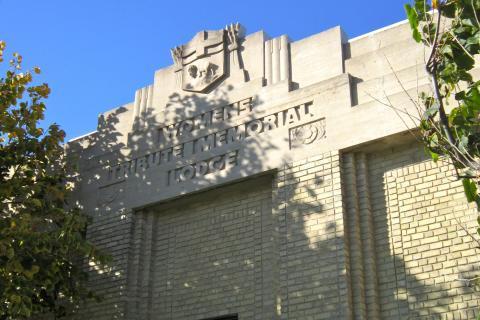
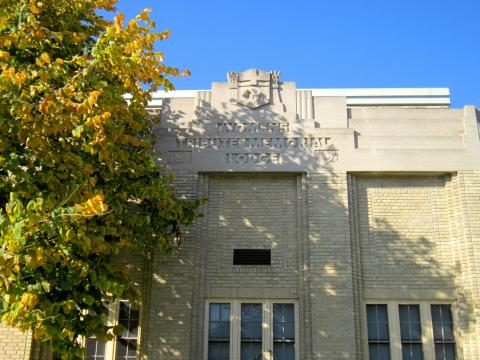
WOMENS
TRIBUTE MEMORIAL
LODGE
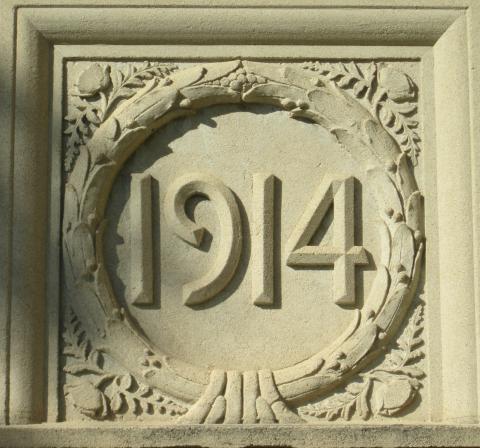
1914 1919
The Women's Tribute Memorial Lodge was completed in 1931 at a cost of approximately $32,000. The lodge was the idea of Harriet Walker, who in 1917 was inspired by a similar proposal in Toronto. The group's funding campaign lasted 14 years, operating as the Women's Tribute Association as of 1924. In 1930, they received $9,000 from the Royal Canadian Legion Deer Lodge Branch and a land grant from the Municipality of St. James.
Built next to the Deer Lodge Military Hospital, the facility's auditorium, clubrooms, offices and Memorial Room of Silence provided Veterans with a place for meeting, recreation and remembrance. The building was designed by architects George W. Northwood and Cyril W.U. Chivers, both decorated Veterans. Construction began in April 1931, with an effort to hire as many returned servicemen as possible to work on the building.
In 1978, the Deer Lodge Branch transferred operations of the building to the Valour Road Branch of the Canadian Legion. The building was closed in December 1986 and ownership was passed to the Winnipeg Foundation. It was saved from demolition by a heritage designation on July 8, 1987.
The Women's Tribute Memorial Lodge entered the spotlight in 2001 when it was used as a set in the film One Last Dance, written by and starring Patrick Swayze. The province invested $13,000 in repairs and in 2003, the Winnipeg Regional Health Authority proposed opening a Movement Disorders Clinic and it opened in 2006.
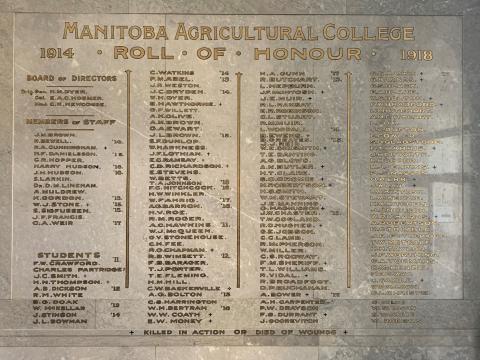
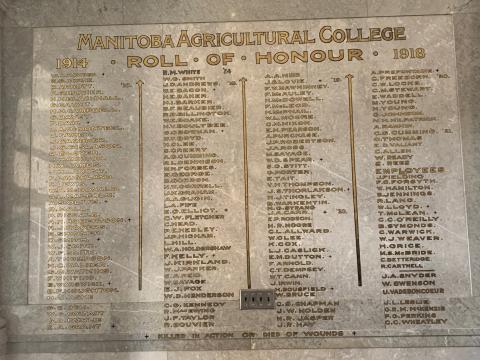
MANITOBA AGRICULTURAL COLLEGE
1914 • ROLL • OF • HONOUR • 1918
BOARD OF DIRECTORS
MEMBERS OF STAFF
STUDENTS
+ KILLED IN ACTION OR DIED OF WOUNDS
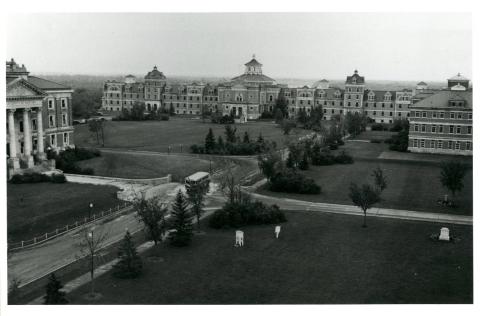
The names of University of Manitoba students and staff who served in the First World War were painted directly on the walls of the university's Administration Building, formerly the Manitoba Agricultural College. The gilded gold lettering is attributed to renowned Canadian artist Lionel LeMoine FitzGerald.
The names were copied from a Memorial Book. Mr. W.B.H. Teakes, Assistant Registrar, identified the university men in the military lists and collected the information. He was aided by Private C.F. Black and Lieutenant G.C. Young, after their return from overseas. Advice and assistance to the design were given by Professor A.A. Stoughton and the Honour Roll was made by D.C. Harvey.
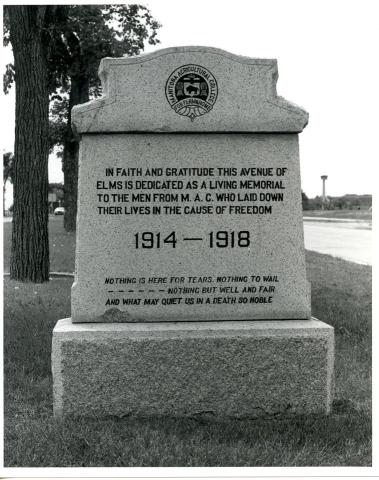
[monument at Chancellor Matheson Road and University Crescent/monument à l’angle du Chancellor Matheson Road et du University Crescent]
MANITOBA AGRICULTURAL COLLEGE
FOR FARM & HOME
IN FAITH AND GRATITUDE THIS AVENUE OF
ELMS IS DEDICATED AS A LIVING MEMORIAL
TO THE MEN FROM M. A. C. WHO LAID DOWN
THEIR LIVES IN THE CAUSE OF FREEDOM
1914 - 1918
NOTHING IS HERE FOR TEARS. NOTHING TO WAIL
- - - - - - NOTHING BUT WELL AND FAIR
AND WHAT MAY QUIET US IN A DEATH SO NOBLE
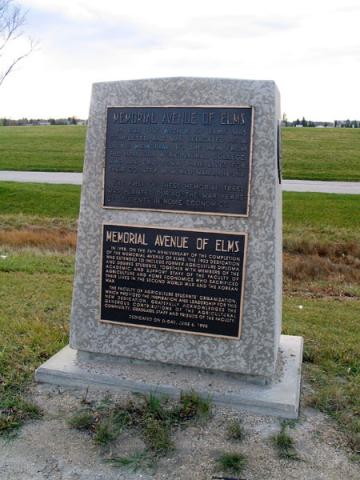
[plaques at Chancellor Matheson Road from Pembina Highway/plaques à l’angle du Chancellor Matheson Road près de l’autoroute Pembina]
(top plaque)
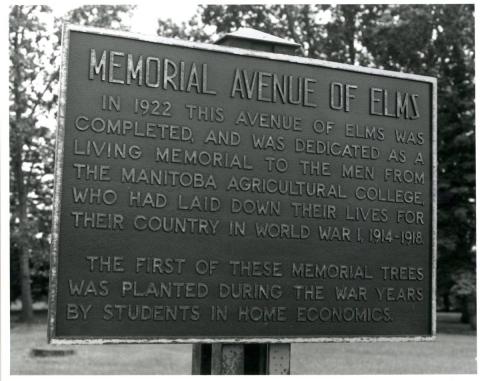
MEMORIAL AVENUE OF ELMS
IN 1922 THIS AVENUE OF ELMS WAS
COMPLETED, AND WAS DEDICATED AS A
LIVING MEMORIAL TO THE MEN FROM
THE MANITOBA AGRICULTURAL COLLEGE,
WHO HAD LAID DOWN THEIR LIVES FOR
THEIR COUNTRY IN WORLD WAR I, 1914-1918.
THE FIRST OF THESE MEMORIAL TREES
WAS PLANTED DURING THE WAR YEARS
BY STUDENTS IN HOME ECONOMICS.
(bottom plaque)
MEMORIAL AVENUE OF ELMS
IN 1998, ON THE 76TH ANNIVERSARY OF THE COMPLETION
OF THE MEMORIAL AVENUE OF ELMS, THE 1922 DEDICATION
WAS EXTENDED TO INCLUDE FORMER AGRICULTURAL DIPLOMA
AND DEGREE STUDENTS, TOGETHER WITH MEMBERS OF THE
ACADEMIC AND SUPPORT STAFF OF THE FACULTY OF
AGRICULTURAL AND HOME ECONOMICS WHO SACRIFICED
THEIR LIVES IN THE SECOND WORLD WAR AND THE KOREAN
WAR.
THE FACULTY OF AGRICULTURAL STUDENTS' ORGANIZATION
WHICH PROVIDED THE INSPIRATION AND LEADERSHIP FOR THIS
NEW DEDICATION, GRATEFULLY ACKNOWLEDGES THE
GENEROUS CONTRIBUTIONS OF THE AGRICULTURAL
COMMUNITY, GRADUATES, STAFF AND FRIENDS OF THE FACULTY.
DEDICATED ON D-DAY, JUNE 6, 1998
The Avenue of Elms commemorates students and staff of the Manitoba Agricultural College who were killed during military service in the First World War. The first elm trees were planted during the First World War by Home Economic students. Two hundred American saplings, proceeding from the Manitoba Agricultural College (now University of Manitoba) Administration Building to Pembina Highway, were planted on May 14, 1922, by teams comprised of graduates, staff, and students of the college and also staff from the Provincial Agricultural Department.
A monument for the Avenue of Elms was unveiled at a ceremony held on 11 November 1923, attended by 500 people including Hugh Marshall Dyer (former Chair of the Board of Directors for the Manitoba Agricultural College), Louis Wilfred Moffit of Wesley College, and Premier John Bracken.
A dozen trees were moved to the campus quadrangle in 1969. Many have since been removed to slow the spread of Dutch elm disease. Today, 55 percent of the trees are replacements (80 percent on the north side of the avenue).
On 6 June 1998, the 1922 dedication was extended to include more former students and faculty who were killed during the Second World War and the Korean War with the addition of a second plaque at Chancellor Matheson Road from Pembina Highway.
In 1918, Canadians turned to the duty of commemorating the dead. Some promoted practical memorials like Roads of Remembrance. These linear tree-lined avenues had trees that were typically a single species, regularly spaced along each side of the avenue that would grow tall and stately. American elms were chosen for many of these avenues. A small plaque was used to assign a particular tree to a specific fallen soldier. In some cases, the next-of-kin was involved in purchasing the tree and/or plaque for the deceased soldier.
Roads of Remembrance were based on two symbol-laden images. The first was France’s tree-lined country avenues: “long straight roads, with large elms on either side, beautiful and useful, and loved by the Canadians overseas.” The second symbol was a living memorial: trees represented the victory of life over death. Memorial trees became living symbols of the sacrifices made overseas.