Other

City/Municipality
Whitby
Memorial Number
35096-002
Type
Address
2008 Boundary Road
Location
Intrepid Park
in Canada
Yes
GPS Coordinates
43.8557164, -78.882813
Inscription

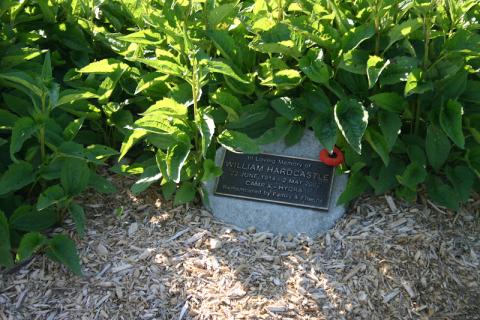
In Loving Memory of
WILLIAM HARDCASTLE
22 JUNE 1914 - 2 MAY 2002
CAMP X - HYDRA
Remembered by Family and Friends

Image
Caption
Bill Hardcastle Memorial
Province
!4v1698933032738!6m8!1m7!1sBLQBFDJcRQeYG5HRQVGmvw!2m2!1d43.85571643622595!2d-78.88281304007933!3f239.47280268273514!4f2.916249891664293!5f0.7820865974627469
Body Content

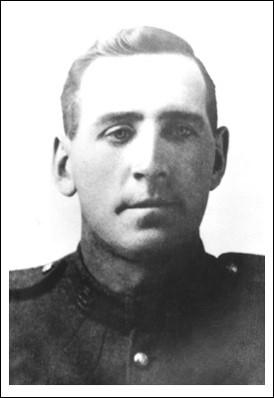
William "Bill" Hardcastle was trained during the Second World War at Camp X, an excellent location for transferring code. With a shortage of expert radio operators, Bill realized that any hope of being posted as a secret agent overseas was dwindling. There was a much greater need for trained personnel to build and operate Camp X.

The building that would house Hydra was the most mysterious looking building at the Camp. It was a four-sided structure, completely open on the inside, with windows all around but placed seven feet above the ground for obvious reasons of secrecy. The building had only one entrance and that was at the front; two large doors making it easy to bring in large equipment. One day, not long after Bill arrived, a large van drove into the Camp and delivered crates of communications components. When it all was unloaded, someone yelled, “Go to it, fellows!” Bill and his mates proceeded to build a complete, working communications installation from a photograph. They hooked it up, and Hydra was born.

Bill completed his course at Camp X and was trained to intercept, decode, re-code and then transmit messages back to North America. Bill and his partner Jack, from Toronto, were to cover South America as far south as Lima, Peru. They were advised that the plan had been aborted and they would not be needed.

Bill went off and joined the Air Force which he had tried to do earlier, but was not called up because of his colour blindness. It was now wartime and the Air Force overlooked the colour blindness because they were short of wireless operators. The exact day Bill joined the Air Force, he was told that he was needed right away for coding. He attended one course at the Air Force training centre before he was assigned to Montreal, Quebec, as an instructor-in-training. He was informed that he was to be an instructor and the very next day he was back at Camp X wearing a Royal Canadian Air Force uniform. He was given permission to keep the uniform as he was entitled to wear it, which he did proudly.

Once the equipment was operational, Bill Hardcastle and Bernie Sandbrook personally sent the very first messages to England. Bill and his colleagues received German messages which had been intercepted by agents in South America, re-coded, and then sent along to Camp X. 

Anticipating a particularly busy day, Bill Hardcastle, Hughey Durant and Bernie Sandbrook were asked to work in the Communications Building on the Morse machines. Bill recalled that he was working the teletype machines. The raw data would come in through Hydra and flow through to the Communications Building where it would be printed out in five-letter code. Bill and the others were receiving coded messages from England that particular day, turning them around and Morse Coding them to British Security Coordination in New York. Suddenly, a flurry of the highest level of priority messages starting flying out onto the printer, one after the other.

Bill was so alarmed by this seemingly endless stream of about fourteen messages that he did exactly what he was trained to do; he dropped everything else and started pounding out the keys to New York as quickly as he could. At the same time he turned to his fellow mates and said, “Hey boys, I think this is it! I think the invasion has started!” An excellent guess; it was June 6, 1944, D-Day.
City
Whitby
Country
Type Description
Stone, plaque
Photo Credit
Tim Laye, Ontario War Memorials
Memorial CF Legacy ID
12093
City/Municipality
Toronto
Memorial Number
35095-024
Type
Address
Cibola Avenue
Location
St. Andrew by-the-lake Anglican Church
in Canada
Yes
GPS Coordinates
43.6201983, -79.3698401
Inscription

INRI

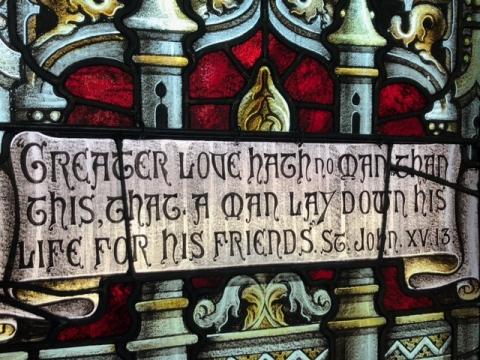
"GREATER LOVE hath no man than
this that A man lay DOWN his
LIFE FOR his FRIENDS." ST. John. CV.13.

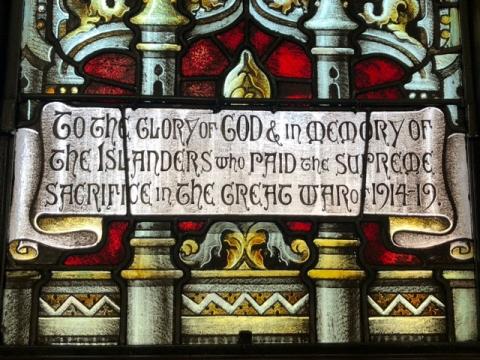
To the Glory of GOD & in memory of
the Islanders who PAID the SUPREME
SACRIFICE in the GREAT WAR of 1914-19.

Image
Photo Credit
St. Andrew by-the-lake Anglican Church
Caption
inscription
1 of 3 images
Image
Photo Credit
St. Andrew by-the-lake Anglican Church
Caption
First World War Window
1 of 3 images
Image
Photo Credit
St. Andrew by-the-lake Anglican Church
Caption
inscription
1 of 3 images
War or Conflict Term
Province
!4v1623325814474!6m8!1m7!1sCAoSLEFGMVFpcE53U1gwR1c0QUVBbFJmTzE2cERwb3lvLThrUjBUbXRzSFRBTFpN!2m2!1d43.6201983!2d-79.36984009999999!3f254.67!4f1.6299999999999955!5f0.7820865974627469
Body Content

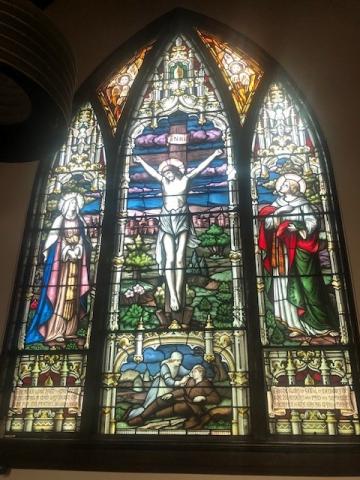
The St. Andrew by-the-lake Anglican Church First World War Window is a memorial to the 58 Islanders who gave their lives in the First World War and was created by the N.T. Lyon Company in 1919. The window was unveiled and dedicated on August 3, 1919. The unveiling was performed by Brig.-Gen. C. H. Mithcell, C.B., C.M.G., D.W.O. Bishop Reeves delivered the dedicatory address.

The names of 46 soldiers who died were read aloud at the service. Subsequent to the service, it was determined that an additional 12 Islanders died serving in the war.

The window is a beautiful work of ecclesiastical art. The center section depicts the crucifixion, with the Holy City in the background. On either side are the figures of Mary and Saint John, while beneath is a scene on the battlefield with a Red Cross nurse tending a wounded soldier in the foreground.

City
Toronto
Country
Type Description
Stained glass window
Memorial CF Legacy ID
10410
City/Municipality
Dundas
Memorial Number
35095-022
Type
Address
29 Park Street West
Location
Inside St. Paul's United Church
in Canada
Yes
GPS Coordinates
43.2671819, -79.9535483
Inscription

[plaque/plaque]

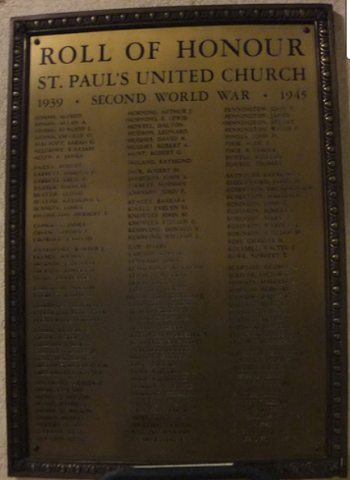
Roll of Honour
St Paul’s United Church
1939 Second World War 1945

Image
1 of 2 images
Image
1 of 2 images
War or Conflict Term
Province
!4v1624982940437!6m8!1m7!1syIZArS3CtBPXiTS_BHNckQ!2m2!1d43.26718187760525!2d-79.95354828737831!3f325.1424048023095!4f13.970392292092995!5f1.520854281346561"
Body Content

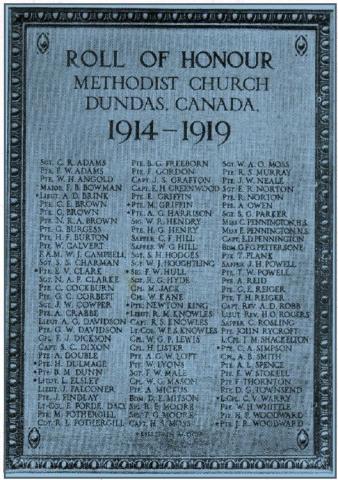
The Honour Roll is in proud and grateful memory of all those who died and all those who served in the Great War 1914-1919.

This brass plaque was erected by the parishioners of the church in memory of members who gave their lives during the Second World War. The plaque was unveiled in 1945.

City
Dundas
Country
Type Description
plaque; brass
Memorial CF Legacy ID
9192
City/Municipality
Dundas
Memorial Number
35095-021
Type
Address
29 Park Street West
Location
Inside St. Paul's United Church
in Canada
Yes
GPS Coordinates
43.2671819, -79.9535483
Inscription

[plaque/plaque]

1914 – 1918

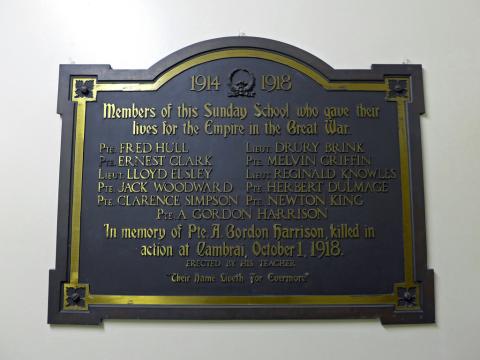
Members of this Sunday School who gave their lives for the empire in the Great War

Pte. Fred Hull
Pte. Ernest Clark
Lieut. Lloyd Elsley
Pte. Jack Woodward
Pte. Clarence Simpson
Pte. A Gordon Harrison

Lieut. Drury Brink
Pte. Melvin Griffin
Lieut. Reginald Knowles
Pte. Herbert Dulmage
Pte. Newton King

In memory of Pte A Gordon Harrison, killed in action at Cambrai, October 1, 1918
Erected by his teacher
Their names liveth for evermore

Image
War or Conflict Term
Province
!4v1624982799710!6m8!1m7!1syIZArS3CtBPXiTS_BHNckQ!2m2!1d43.26718187760525!2d-79.95354828737831!3f321.1695654820624!4f16.273810889724203!5f1.6699667798270252"
Body Content

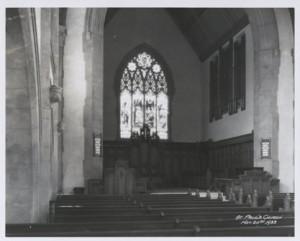
This brass plaque is located in St Paul’s United Church, erected by the teacher of the Sunday School in memory of members of the Sunday School who gave their lives during the First World War. The plaque was unveiled in 1919, and was saved in the fire that destroyed most of the old church on August 4, 1931. On Sunday, November 12, 1933, the new St’ Paul’s structure was opened and officially dedicated by the Rev. Francis Vipond.

City
Dundas
Country
Type Description
plaque; brass
Memorial CF Legacy ID
9191
City/Municipality
Dundas
Memorial Number
35095-020
Type
Address
29 Park Street West
Location
St. Paul's United Church
in Canada
Yes
GPS Coordinates
43.2671819, -79.9535483
Inscription

[inscription/inscription]

“Be thou faithful unto death, and I will give thee a crown of life” Revelation 2:10

Aimers Bertram, James Knowles Bertram, Goldwin McCausland Pirie, Robert Sterling

“In grateful memory of those who fell on the field of honor in the Great War 1914 – 1919 in defense of righteousness, justice, and liberty.”

Image
War or Conflict Term
Province
!4v1624982472174!6m8!1m7!1syIZArS3CtBPXiTS_BHNckQ!2m2!1d43.26718187760525!2d-79.95354828737831!3f316.08458887383364!4f13.376919264456532!5f1.5951686655576642"
Body Content

This stained glass window at St. Paul’s United Church depicts a 3-paneled scene which commemorates fallen soldiers who lost their lives in various battle of the First World War. It is referred to as the First World War Memorial Window. The panels include (1) Christ Knocking at the Door, (2) The Scene at Emmaus, and (3) Sowing the Seed.

The memorial window occupies the first high window on the south side of the building. The original window, which was complete in 1919, only includes the first and second panels – they were saved from a fire on August 4, 1931 that destroyed most of the old church. On Sunday, November 12, 1933, the new St’ Paul’s structure was opened and officially dedicated by the Rev. Francis Vipond.

City
Dundas
Country
Type Description
windows; stained glass
Memorial CF Legacy ID
9190
City/Municipality
Ancaster
Memorial Number
35095-019
Type
Address
437 Wilson Street East
Location
Mount Mary Immaculate Retreat Centre
in Canada
Yes
GPS Coordinates
43.2314, -79.97883
Inscription

[front/devant]

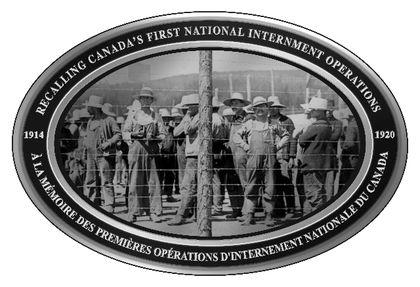
Recalling Canada's First National Internment Operations 1914-1920

A la mémoire des premières opérations d’internement nationale du Canada 1914-1920

Image
Province
Body Content

This memorial recalls a historic injustice Canadians should pause to remember, as we recall the First World War and the valour of all those Canadian men, and some women, who served. It is a tribute to mark the memory of the thousands of "enemy aliens" who had their civil rights stripped, and were subsequently imprisoned during Canada's first national internment operations of 1914-1920, following the implementation of the War Measures Act. 2014 marks the 100th anniversary of the War Measures Act - adopted on August 22, 1914 during the First World War. It was used to imprison Ukrainian-Canadians, and other ethnic groups, including German, Hungarian, Serbian, Croatian, and Armenian communities, into one of Canada's 24 internment camps.

Dr. Lubomyr Luciuk, a professor at the Royal Military College of Canada and former chair of the Ukrainian Canadian Civil Liberties Association (UCCLA), had taken it upon himself to lead the way and organize the memorial. In the CTO ("One Hundred") project, 100 aluminum plaques were simultaneously unveiled at 100 different locations across the country at 11:00am local time on August 22, 2014. The first plaque was unveiled in Amherst, Nova Scotia, followed by a wave of plaque unveilings moved west, from province to province, culminating in Nanaimo, British Columbia. The plaques, which cost $1,000 to make, were funded by the generosity of the Endowment Council of the Canadian First World War Interment Recognition Fund.

Each plaque features a photo of internment prisoners confined behind a wire fence at the Castle Mountain Internment Camp in Banff, Alberta. The Castle Camp, which was built in 1915 at the base of Castle Mountain, was a Canadian internment camp which held immigrant prisoners of Ukrainian, Austrian, Hungarian, and German descent.

City
Ancaster
Country
Type Description
plaque, aluminum
Memorial CF Legacy ID
8649
City/Municipality
Burlington
Memorial Number
35095-018
Type
Address
867 Lakeshore Road
Location
Canada Centre for Inland Waters (CCIW)
in Canada
Yes
GPS Coordinates
43.30036, -79.80348
Inscription

[front/devant]

Private Robertson V.C.

[left side/côté gauche]

Garde
Cotière

[right side/côté droit]

Coast
Guard

Image
Photo Credit
Richard Turcotte
1 of 2 images
Image
1 of 2 images
War or Conflict Term
Province
Body Content

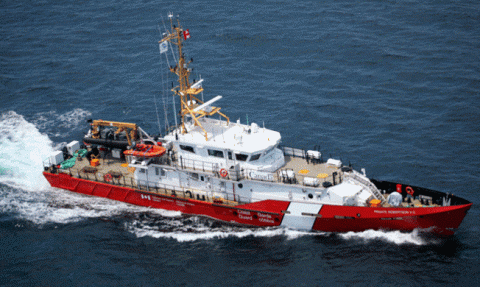
Starting its active service in May 2012, the Canadian Coast Guard Ship (CCGS) Private Robertson V.C. is a mid-shore patrol vessel. It is one of nine Hero-class patrol vessels ordered by the Department of Fisheries and Oceans/Canadian Coast Guard, in September 2009. Each of the nine Hero-class patrol vessels will be named for personnel from the Royal Canadian Mounted Police (RCMP Officers), Canadian Coast Guard (sailors, aircrew), Department of Fisheries and Oceans (fisheries officers) and Canadian Forces (soldiers, sailors, and aircrew) who are credited with performing exceptional or heroic acts during their service.

CCGS Private Robertson V.C. is named in honour of Private James Peter Robertson, V.C., born in Pictou County, Nova Scotia in October 1883. As a child Robertson moved with his family, first to Springhill, Nova Scotia, then to Medicine Hat, Alberta. He joined the Canadian Army Expeditionary Force in 1915. Robertson earned the Victoria Cross during the final assault on Passchendaele, Belgium, November 6, 1917, with the 27th Infantry Battalion. His platoon was held up by barbed wire and a German machine gun. He was able to dash round to an opening on the flank of the enemy position and rush the gun. After a desperate struggle, Robertson killed four of the crew, and then turned the enemy gun on the remainder. This enabled his platoon to continue towards its objective, with Robertson still firing the captured gun at the enemy as it retreated. Later, when two of his own snipers were wounded in front of their trench, he went out and carried one of them in under severe fire. When he returned for the second sniper, he was killed by a bursting shell.

City
Burlington
Country
Type Description
Vessel - patrol
Photo Credit
Richard Turcotte
Memorial CF Legacy ID
8697
City/Municipality
Hamilton (Waterdown)
Memorial Number
35095-017
Type
Address
317 Dundas Street East
Location
Waterdown Memorial Hall
in Canada
Yes
GPS Coordinates
43.3339449, -79.8923134
Inscription

MEMORIAL HALL
1914 - 1918

Image
Caption
front
1 of 3 images
Image
Caption
right side
1 of 3 images
Image
Caption
front view (originally)
1 of 3 images
War or Conflict Term
Province
!4v1622743607735!6m8!1m7!1s_TJModSFfnIy8Lw9KDykaw!2m2!1d43.33394473887184!2d-79.89231336816196!3f306.9221897648795!4f-0.9123618464963528!5f0.7820865974627469
Body Content

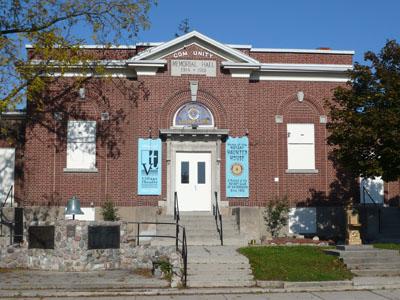
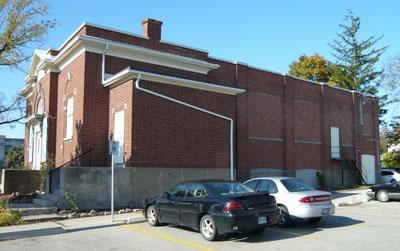
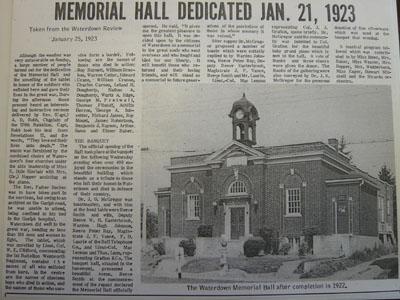
Waterdown Memorial Hall was dedicated at a Memorial Service on January 14, 1923. During the service, a commemorative tablet containing the names of all villagers who had enlisted in the First World War and the 19 who had died was unveiled. A second plaque was erected by the Royal Canadian Legion Branch 551 to the honour those who served in the great wars.

The building is one of three buildings to serve as a Veterans memorial in the City. The other two are located in Binbrook and Carlisle. When built, it was one of 12 such buildings in Canada.

City
Hamilton (Waterdown)
Country
Type Description
Building - hall
Memorial CF Legacy ID
8132
City/Municipality
Dundas
Memorial Number
35095-016
Type
Address
129 York Road
Location
Grove Cemetery
in Canada
Yes
GPS Coordinates
43.2711298, -79.9461094
Inscription

[front/devant]

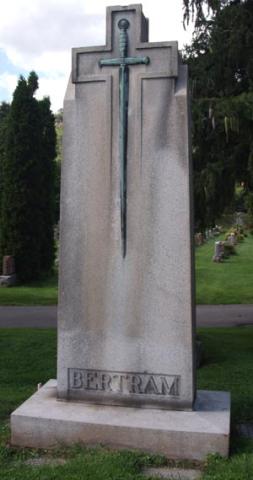
BERTRAM

Image
Photo Credit
David McInnis
Caption
front
War or Conflict Term
Province
!4v1636566933124!6m8!1m7!1saM6-3G0cJyPUT5AvSvgBrw!2m2!1d43.27112977652654!2d-79.94610935003625!3f310.5675648249679!4f5.751605510656475!5f1.3836124447282798"
Body Content

This memorial was erected by the Bertram Family, date of unveiling is unknown. This memorial is a vertical granite stele approximately 8 feet high on which a bronze Crusader's Cross is embedded. At the base of the stele there are individual markers with the names of the family members including the family patriarch, Sir Alexander Bertram, the first Chairman of Sir Sam Hughes Shell Committee.

Included are the names of two family members who were killed in the First World War. Captain James Knowles Bertram, killed in action September 22, 1916 and Lieutenant Aimers Stirling Bertram, killed in action July 10, 1917.

Canadian Great War Project - Lieutenant Stirling Bertram, 1888 - 1917. Stirling Aimers Bertram born in Dundas, Ontario, on August 19th, 1888, the second son of Henry Bertram and Jennie Graham. Aimers attended Queen's University in Kingston, Ontario in order to obtain an engineering degree, and received his Bachelor of Science in April of 1912. This degree would have been beneficial in his future role at the Bertram Works. After graduation, he went to Montreal and took a position as a foreman in the C.P.R. shops to gain more experience.

In 1916, two years after war broke out, Aimers enlisted with the 58th Westmount Rifles and was shipped overseas the following year after being commissioned a Lieutenant. Two months later, on June 28, 1917, he was severely wounded in both the arm and the leg but it was reported that he was doing well. He was shipped to London and while undergoing an operation on the leg, he died on July 10, 1917, at the age of 28. He is buried in Brookwood Cemetery in London.

In Lachine, Quebec, can be found a tablet dedicated to his memory and his father and other members of the Bertram family were able to attend the service in his honour. He was also issued with the British War Medal and the Victory Medal for his service in the Canadian Expeditionary Force. His mother, Jennie Bertram, was awarded the Cross of Sacrifice, and this can be seen in the Dundas Historical Society Museum, along with that awarded to the mother of James Knowles Bertram, his cousin.

The war letters written by Aimers and his brother Lennard Halliday Bertram as well as those written by James Knowles Bertram are available at the Dundas Museum.

 - Contributed by Jean A. Freeman (Bertram and Pirie Descendant) From the "McGill Honor Roll, 1914 - 1918. McGill University, Montreal, Quebec, 1926.

James Knowles Bertram - Medicine, 1911-15 - Born at Dundas, Ont., December 6th, 1889. Appointed Captain and Adjutant in the 20th Battalion, Canadian Expeditionary Force (C.E.F.), November 1st, 1914. Transferred to the 1st Infantry Brigade with the rank of Staff Captain. Served in France. Killed in action. September 22nd, 1916, near Albert, on the Somme.

City
Dundas
Country
Type Description
granite stele
Memorial CF Legacy ID
7928
City/Municipality
Waterdown
Memorial Number
35095-014
Type
Address
79 Hamilton Street N
Location
Royal Canadian Legion Branch 551
in Canada
Yes
GPS Coordinates
43.3337883, -79.8995036
Inscription

[front/devant]

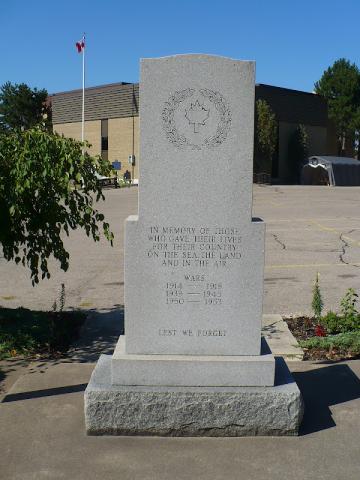
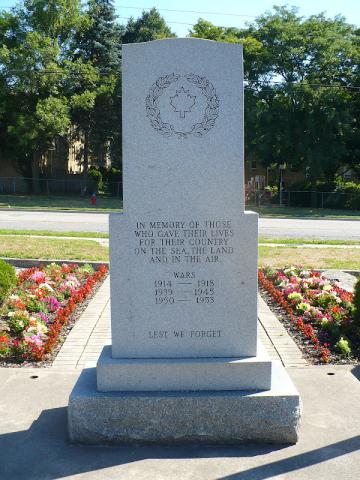
IN MEMORY OF THOSE
WHO GAVE THEIR LIVES
FOR THEIR COUNTRY
ON THE SEA, THE LAND
AND IN THE AIR

WARS
1914 - 1918
1939 - 1945
1950 - 1953

LEST WE FORGET

[back/arrière]

IN MEMORY OF THOSE
WHO GAVE THEIR LIVES
FOR THEIR COUNTRY
ON THE SEA, THE LAND
AND IN THE AIR

WARS
1914 - 1918
1939 - 1945
1950 - 1953

LEST WE FORGET 

Image
Caption
back
1 of 3 images
Image
Caption
Waterdown Cenotaph
1 of 3 images
Image
Caption
surroundings
1 of 3 images
Province
!4v1622744080093!6m8!1m7!1srEtey0bIQuutMszw3LpQOw!2m2!1d43.33378902411258!2d-79.89950489261304!3f230.6309702893065!4f-6.41158724600642!5f2.1525363736509866"
Body Content

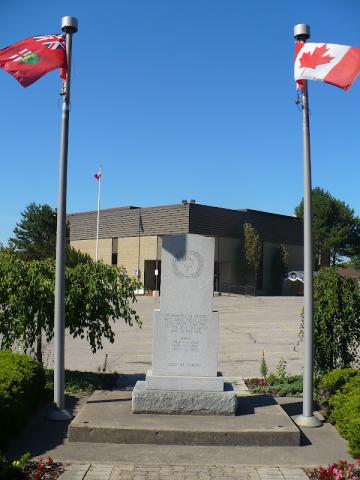
This memorial is dedicated to those who gave their lives in major conflicts and in all branches of the service. This memorial consists of two parts, erected by the Royal Canadian Legion Branch 551. First is the stone memorial, found near the sidewalk, dedicated to those who gave their lives in major conflicts and in all branches of the service. Second and beside the front doors of the Legion, is an Ontario Historical Plaque dedicated to Leo Clarke, awarded the Victoria Cross in 1916 during the Battle of the Somme. Also beside the plaque is an anti-aircraft gun, with no plaque or markings.

City
Waterdown
Country
Type Description
Stele
Photo Credit
Tim Laye, Ontario War Memorials
Memorial CF Legacy ID
7326