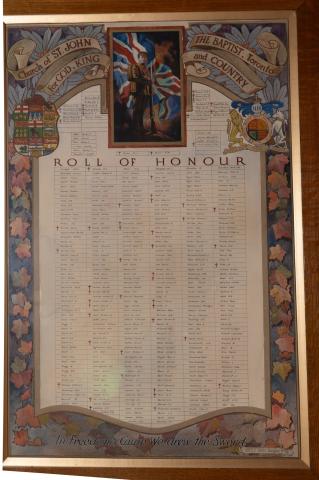
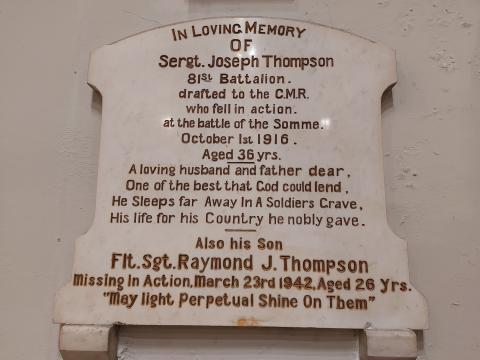
Mr. and Mrs. Wm. Millard donated an altar cross at St. Margaret New Toronto dedicated to their sons George and William Millard of the 15th Battalion, who both died serving in the First World War in April 1915.
Other
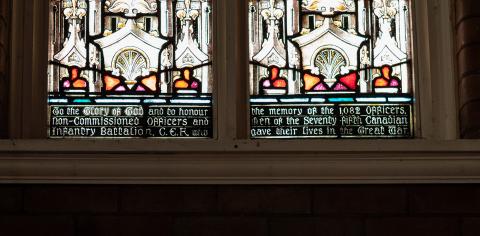
St. Margaret New Toronto First World War Windows
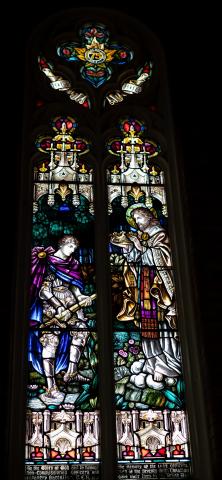
Branch #3 of the Canadian Legion British Empire Service League donated windows dedicated to parishioners of St. Margaret New Toronto who gave their lives during the First World War.
St. George the Martyr First World War Tablet
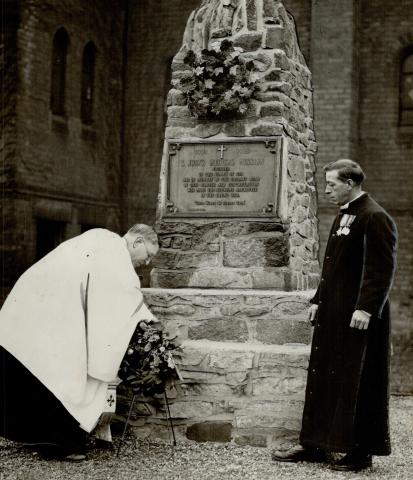
On January 30, 1921, a bronze tablet was unveiled in St. George the Martyr at 205 John Street and dedicated to the 31 members of the congregation who lost their lives in the First World War, along with 258 men and several nurses who served in the war. The tablet was unveiled by Richard Waldron, the oldest member of the congregation, whose son had fallen in the war and while the ceremony was conducted by Bishop Farthing of Montreal and special preacher Bishop Bidwell.
During the early morning hours of February 13, 1955, a fire demolished much of the church.
St. Jude’s, Roncesvalles First World War Window
“Greater love hath no man
than this that a man lay down
his life for his friends" ST. JOHN 15.13
On December 15, 1919, at St. Jude’s, Roncesvalles Church, a stained-glass window was dedicated in honour of its 14 parishioners who lost their lives in the First World War. The ceremony was performed by Assistant Bishop of Toronto, William Day Reeve. Constructed by Luxfer Prism Co., the window was installed in the north wall of the church. It is a reproduction of James Clark's The Great Sacrifice, which is at St. Mary Magdalene’s Church, in London, England. The window depicts a fallen soldier touching the feet of Christ, who is crucified on a tree beside the soldier, looking down on him.
The original St. Jude’s opened in 1890 at 437 Roncesvalles Avenue in Toronto. After the new church was built in 1912, the original building served as the parish hall until 1929, when it was demolished to make way for a larger hall. In 1977, the parish was disestablished and the building was demolished in 2004. The St. Jude’s, Roncesvalles First World War Window was moved to a new St. Jude’s in Brampton which opened in May 1980.
St. Jude’s, Roncesvalles First World War Plaque
TO THE GLORY OF GOD
AND IN
Memory of
THE MEMBERS OF THIS
CHURCH AND CONGREGATION
WHO GAVE THEIR LIVES
IN DEFENCE OF OUR LIBERTIES
IN THE GREAT WAR 1914 - 1919
E. ARMSTRONG
EGERONT BANCKS BAINES
F. S. BATTY
HENRY JOHN FARRELL
RUSSELL GARDINER
PETER GLOCKLING
ROBERT JOHN MARSH
JOHN R. MASSAM
SYDNEY V. PARKER
GEORGE R. PARKYN
DOUGLAS ROUGH
CHARLES J. SILK
W. F. SILK
GEORGE TWEEDALE
“THEIR NAME LIVETH FOR EVERMORE"
On December 15, 1919, at St. Jude’s, Roncesvalles Church, a memorial tablet was dedicated in honour of its 14 parishioners who lost their lives in the First World War. The ceremony was performed by Assistant Bishop of Toronto, William Day Reeve.
The original St. Jude’s opened in 1890 at 437 Roncesvalles Avenue in Toronto. After the new church was built in 1912, the original building served as the parish hall until 1929, when it was demolished to make way for a larger hall. In 1977, the parish was disestablished and the building was demolished in 2004. The St. Jude’s, Roncesvalles First World War Plaque went to a new St. Jude’s in Brampton which opened in May 1980.
First World War Tablet
In December of 1920, at St. John’s York Mills Church, a tablet was dedicated in honour all of its parishioners who served in the First World War.
Captain Ryerson and Lieutenant Nevitt Credence Table
On January 9, 1921, at St. John’s Church, a credence table was dedicated to the memory of Captain John Egerton Ryerson, youngest brother of the Vicar, and Lieutenant Bertram Tschudi Nevitt, youngest brother of Mrs. Ryerson. Both were members of the congregation and lost their lives in the First World War.
John Egerton Ryerson was born June 7, 1887, to Charles Egerton Ryerson and Emily Ryerson in Toronto, Ontario. He was the grandson of well-known Ontario politician and educator, Egerton Ryerson; his cousin, Dr. George Ansel Sterling Ryerson was surgeon general. John was educated at the Upper Canada College, a member of The Queen’s Own Rifles of Canada for ten years and was working as a banker at the Wychwood branch of the Canadian Bank of Commerce when he enlisted with the Canadian Expeditionary Force on January 3, 1915. Upon enlisting, he received a commission to command the 58th Battalion as captain. On September 19, while engaged at the Somme, he was killed in action.
Bertram Tschudi Nevitt was born on August 25,1895, in Toronto, Ontario; the son of Richard B. and Elizabeth E. Nevitt. He was a student and a member of The Queen’s Own Rifles of Canada when he enlisted with the Canadian Expeditionary Force on September 22, 1914. He was a lieutenant in the 1st Battalion. While at the Somme, he was reported missing on September 22, 1916, later presumed to have been killed in action.
St. John’s Church, Weston First World War Plaque
Robert Allan, M.M., M.C., Leonard Allan, Robert Boustead, Albert Boustead, Reginald Conron, Laurence France, Henry Holmes, Frederick J. Howard, Gwynnyd McRea, Oscar Mousley, Thomas H. Saunders, Allan Wade, John Wilkinson
On January 9, 1921, at St. John’s Church, a tablet was dedicated to the memory of the 14 members of the congregation who had lost their lives in the First World War. The ceremonial unveiling was performed by Lieutenant John P. Allan, Secretary of the Great War Veterans’ Association, whose two brothers were killed in the war.
Royal Canadian Dragoons Colours
On April 2, 1922, at St. John the Evangelist (Garrison Church), the Royal Canadian Dragoons Colours were deposited in the church for safe keeping during a ceremony that filled the building. Convoyed to the church by detachments of the Dragoons, Royal Canadian Regiment, and Governor General’s Body Guard, the Colours were handed over by Lieutenant-Colonel F. Gilman, DSO and placed on the altar by the Reverend Russell McLean.
St. John the Evangelist (Garrison Church) was located at the corner of Portland and Wellington Streets. The church was filled with row after row of smartly uniformed soldiers who always left the church before the rest of the congregation. By 1963, the building needed serious repairs and it was decided to demolish the building. It was replaced by a modern building that served the congregation until 1985 when the church property was sold. The Royal Canadian Dragoons Colours and military items in the church were transferred to Canadian Forces Camp Borden.
In earlier times, Colours played a prominent part in many battles. They served to identify units in battle, often marking the focal point of a struggle. Captured Colours were a prized trophy and attracted enemy attention and inspired much gallantry. By the late 19th and 20th Century, however, they were no longer carried in battle, but their status as the heart and soul of a Regiment continued, and the laying up of Colours signifies and helps keep holy the memories of the men who sacrificed their lives.
Royal Canadian Dragoons First World War Tablet
Lieut.-Col. Charles Turner Van Straubeazie, Victor A. Nordheimer, Captain Prince Antônio Gastão of Orléans-Braganza MC, Lieut. A. B. Irving, Lieut. H. D. Cunningham, Lieut. Evan E. Pierce, Lieut. D. S. Gwyn MC, Lieut. G. C. Hilliard, Lieut. John Melkie, Lieut. S. Booth.
On April 2, 1922, at St. John the Evangelist (Garrison Church), a tablet was dedicated to the memory of ten officers of the Royal Canadian Dragoons who lost their lives in the First World War. The tablet was unveiled by Major-General V.A.S. Williams and dedicated by Reverend MacLean.
St. John the Evangelist (Garrison Church) was located at the corner of Portland and Wellington Streets. The church was filled with row after row of smartly uniformed soldiers who always left the church before the rest of the congregation. By 1963, the building needed serious repairs and it was decided to demolish the building. It was replaced by a modern building that served the congregation until 1985 when the church property was sold.