On 15 May 1932 at the Church of the Ascension, brass collection plates were dedicated to the memory of the boys of the bible class who gave their lives in the First World War. The collection plates were dedicated by bible class members. The church was located at 137-139 Richmond and it is not known what happened to the collection plates.
Other
Church of the Advent First World War Baptismal Font
A stone baptismal font was dedicated to members of the Church of the Advent who were killed while serving with the military in the First World War. The church was located at 40 Pritchard Avenue until it closed and it is not known what happened to the baptismal font.
Church of the Advent First World War Plaque
This plaque was dedicated to the twenty members of the Church of the Advent who had been killed while serving with the military in the First World War. The plaque was hung on the east wall of the church. The church was located at 40 Pritchard Avenue until it closed and it is not known what happened to the plaque.
Christ Church, Mimico First World War Tablet
The names of those parishioners were as follows: C. H. Blake, T. Burn, J. Coulton, W. J.Higgins, A. Hockney, E. Hogg, J. McKinstry, J.Neale, A. Riddleswort, C. Stoot, N. Telford, W.G. Tizzard, L. Wood.
A bronze tablet was unveiled at Christ Church, Mimico dedicated to the memory of its parishioners who had been killed in the First World War. The church was located at 329 Royal York Road until it was destroyed by two fires in 2006. The plaque was saved and moved when a decision was made to amalgamate with the church of St. James, Humber Bay to become Christ Church St. James.
Royal Grenadiers Window
In proud memory of the Officers, non-commissioned Officers & Men of the Royal Grenadiers
who gave their lives for their King and Country in the Great War 1914-1919.
On 5 June 1921 a three pane stained glass window was dedicated to members of the 10th Regiment Royal Grenadiers who fell in the First World War. The unveiling ceremony was conducted by Colonel A. Primrose in front of a large crowd consisting of members of the regiment and friends. The window represents the signing of the Magna Carta by King John.
Jarvis Window
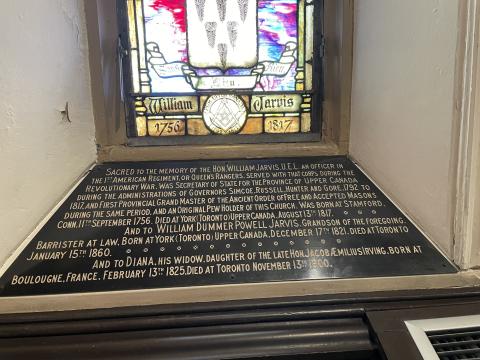
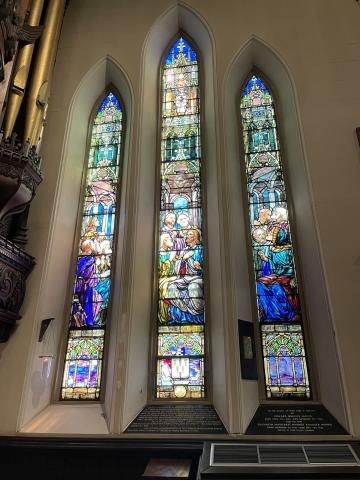
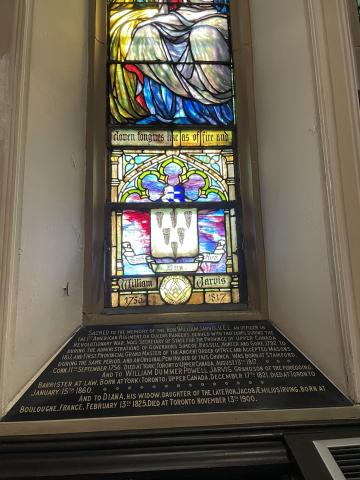
The Jarvis Window was dedicated to Lieutenant William Dummer Powell Jarvis after his death in the First World War on 24 April 1915. Two years later a plaque in his honour was erected near the window. His grandfather the Honorable William Jarvis was an officer in the 1st American Regiment (or Queen's Rangers) and served in the Revolutionary War.
This Tiffany style window was made by New York Studio of Calvert and Kimberley. It depicts the Holy Ghost to the Apostles at Pentecost - 50 days after Easter and ten after the Ascension.
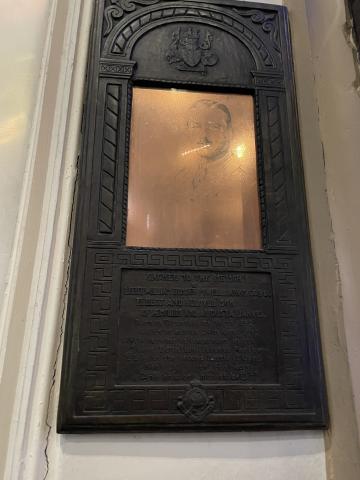
Lieutenant William Dummer Powell Jarvis Plaque
SACRED TO THE MEMORY
OF
LIEUT. WILLIAM DUMMER POWELL JARVIS GGBG
ELDEST AND BELOVED SON
OF AEMILIUS AND AUGUSTA JARVIS.
Born in Toronto, 31st March, 1892
Killed in action, 24th April 1915
While serving as Lieutenant in the
Third Battalion-Toronto Regiment
C.E.F. at the second Battle of Ypres
Near St. Julien Flanders
"And how can man die better"
The Lieutenant William Dummer Powell Jarvis Plaque was unveiled by Canon Arthur FitzWalter Wynne Plumptre at St. James Cathedral on 6 March 1917. It was erected near the stained glass window that was dedicated to him two years earlier. The ceremony was attended by 150 people.
123rd Overseas Battalion Royal Grenadiers Colours
On 30 October 1927 the 123rd Overseas Battalion Royal Grenadiers Colours were ceremoniously deposited at St. James Cathedral. The ceremony conducted by Reverend Charles Hedley was attended by 700 officers, non-commissioned officers, and men of the battalion. During the ceremony, a wreath was hung on the Royal Grenadiers’ memorial window on the west wall of the nave. The 123rd Battalion served at Vimy Ridge, Avion, Passchendaele, Amiens, Cambrai, and Mons. During this period 365 men of the Battalion were killed and over 1,000 were wounded.
In earlier times, Colours played a prominent part in many battles. They served to identify units in battle, often marking the focal point of a struggle. Captured Colours were a prized trophy and attracted enemy attention and inspired much gallantry. By the late 19th and 20th Century, however, they were no longer carried in battle, but their status as the heart and soul of a Regiment continued, and the laying up of Colours signifies and helps keep holy the memories of the men who sacrificed their lives.
4th Canadian Mounted Rifles Colours
Unknown
On 8 June 1919 the 4th Canadian Mounted Rifles Colours were hung on the west wall of the nave in St. James Cathedral.
In earlier times, Colours played a prominent part in many battles. They served to identify units in battle, often marking the focal point of a struggle. Captured Colours were a prized trophy and attracted enemy attention and inspired much gallantry. By the late 19th and 20th Century, however, they were no longer carried in battle, but their status as the heart and soul of a Regiment continued, and the laying up of Colours signifies and helps keep holy the memories of the men who sacrificed their lives.
1st Battalion Canadian Machine Gun Corps Colours
Following the First World War, the 1st Battalion Canadian Machine Gun Corps Colours were hung on the east wall of the nave in St. James Cathedral. Brass tablets beneath the Colours list the battles in which the battalion took part.
In earlier times, Colours played a prominent part in many battles. They served to identify units in battle, often marking the focal point of a struggle. Captured Colours were a prized trophy and attracted enemy attention and inspired much gallantry. By the late 19th and 20th Century, however, they were no longer carried in battle, but their status as the heart and soul of a Regiment continued, and the laying up of Colours signifies and helps keep holy the memories of the men who sacrificed their lives.