The Book of Remembrance was started in 1947 and records all deceased Veterans who previously re-sided in the Memorial Pavilion and now the Lodge at Broadmead (now known as Veterans Memorial Lodge).
Other
Veterans' Chapel
The Memorial Pavilion, previously Veterans' Hospital, dates back to 1947 when the first patients were transferred from Gordon Health and Occupational Centre.
The Veterans' Chapel was constructed in 1952. Inspired by the Veterans' contribution to world peace, Dr. Douglas Kendell planned a series of stained glass windows for the Veterans' Chapel. With the aid of the Women's Auxiliary, a three year fundraising campaign resulted in 10 stained glass windows for the chapel. There are stained glass windows to honour the Army, Navy, Air Force, Merchant Marine, and Women's Services. The stained glass windows were commissioned by Goddard and Gibb of London, England. The Veterans' Chapel was dedicated in 1956.
Additional stained glass windows on the door and walls incorporate broken fragments of glass gathered from blitzed churches, abbeys, and public buildings of Europe and Great Britain during the Second World War. Sources of the glass fragments include Christ Church, Oxford, Westminster Abbey, All Hallows Church and the Middle Temple Hall; Caen Monastery in Normandy; and Churches in Belgium and Germany.
In 1994, when the Lodge at Broadmead (now known as Veterans Memorial Lodge) was constructed, the Veterans' Chapel was relocated to the new building. The local branch of the War Amputations of Canada with the Veterans' Care Society played an active role in the restoration of the stained glass windows in their new location.

The Book of Remembrance is also located in the chapel.
Women's Services
THE LEAVES OF THE TREE WERE
FOR THE HEALING OF THE NATION
THEY SERVED
AND
EQUALLY
The Women's Services window depicts the Angel of Mercy. The Army, Navy, Air Force and Medical Services insignias are in the corners. The inscription verse is from the Book of Revelation Chapter 2 and references healing from the Cross of Jesus.
The Veterans' Chapel was constructed in 1952. Inspired by the Veterans' contribution to world peace, Dr. Douglas Kendell planned a series of stained glass windows for the Veterans' Chapel. With the aid of the Women's Auxiliary, a three year fundraising campaign resulted in 10 stained glass windows for the chapel. There are stained glass windows to honour the Army, Navy, Air Force, Merchant Marine, and Women's Services. The stained glass windows were commissioned by Goddard and Gibb of London, England. The Veterans' Chapel was dedicated in 1956.
Additional stained glass windows on the door and walls incorporate broken fragments of glass gathered from blitzed churches, abbeys, and public buildings of Europe and Great Britain during the Second World War. Sources of the glass fragments include Christ Church, Oxford, Westminster Abbey, All Hallows Church and the Middle Temple Hall; Caen Monastery in Normandy; and Churches in Belgium and Germany.
In 1994, when the Lodge at Broadmead (now known as Veterans Memorial Lodge) was constructed, the Veterans' Chapel was relocated to the new building. The local branch of the War Amputations of Canada with the Veterans' Care Society played an active role in the restoration of the stained glass windows in their new location.
The Air Force
SAINT RAPHAEL
MEN PUT THEIR TRUST
UNDER THE SHADOW OF THY WINGS
The Air Force window depicts St. Raphael, a leader of squadrons of angels, presumably the most suitable Patron Saint for Air Force personnel. The Lancaster bomber of the Second World War is in the middle background. The Air Force motto" "Per Aruda Ad Astra" means "Through Adversity To the Heavens." The Air Force emblem consists of a soaring eagle beneath a crown.
The Veterans' Chapel was constructed in 1952. Inspired by the Veterans' contribution to world peace, Dr. Douglas Kendell planned a series of stained glass windows for the Veterans' Chapel. With the aid of the Women's Auxiliary, a three year fundraising campaign resulted in 10 stained glass windows for the chapel. There are stained glass windows to honour the Army, Navy, Air Force, Merchant Marine, and Women's Services. The stained glass windows were commissioned by Goddard and Gibb of London, England. The Veterans' Chapel was dedicated in 1956.
Additional stained glass windows on the door and walls incorporate broken fragments of glass gathered from blitzed churches, abbeys, and public buildings of Europe and Great Britain during the Second World War. Sources of the glass fragments include Christ Church, Oxford, Westminster Abbey, All Hallows Church and the Middle Temple Hall; Caen Monastery in Normandy; and Churches in Belgium and Germany.
In 1994, when the Lodge at Broadmead (now known as Veterans Memorial Lodge) was constructed, the Veterans' Chapel was relocated to the new building. The local branch of the War Amputations of Canada with the Veterans' Care Society played an active role in the restoration of the stained glass windows in their new location.
The Navy
I WEE SEE HIS HAND
ALSO UPON THE SEA
The Navy window depicts St. Nicholas, the Patron Saint of sailors, in a squat ship. He holds three bags of gold, which according to popular legend, he gave to three impoverished brides for their dowry. He was Bishop of Myra, Turkey, about 342 A.D. His feast day is December 6. Because of his generosity, he became associated with Christmas presents. The Royal Canadian Navy crest of crown and anchor are incorporated. The Royal Canadian Navy Ensign beside the window was the gift of Royal Canadian Navy Chaplains.
The Veterans' Chapel was constructed in 1952. Inspired by the Veterans' contribution to world peace, Dr. Douglas Kendell planned a series of stained glass windows for the Veterans' Chapel. With the aid of the Women's Auxiliary, a three year fundraising campaign resulted in 10 stained glass windows for the chapel. There are stained glass windows to honour the Army, Navy, Air Force, Merchant Marine, and Women's Services. The stained glass windows were commissioned by Goddard and Gibb of London, England. The Veterans' Chapel was dedicated in 1956.
Additional stained glass windows on the door and walls incorporate broken fragments of glass gathered from blitzed churches, abbeys, and public buildings of Europe and Great Britain during the Second World War. Sources of the glass fragments include Christ Church, Oxford, Westminster Abbey, All Hallows Church and the Middle Temple Hall; Caen Monastery in Normandy; and Churches in Belgium and Germany.
In 1994, when the Lodge at Broadmead (now known as Veterans Memorial Lodge) was constructed, the Veterans' Chapel was relocated to the new building. The local branch of the War Amputations of Canada with the Veterans' Care Society played an active role in the restoration of the stained glass windows in their new location.
The Army
SAINT
GEORGE
FOR THOU HAST
MAINTAINED MY RIGHT
The Army window depicts St. George, himself a warrior, and the Patron Saint of soldiers. His tunic shows a red cross on a white background, which was adopted hundreds of years later as the flag of England, prior to its inclusion in the Union Jack (1603). The dragon at his feet is symbolic of evil adversaries. Crossed swords and maple leaves comprise the Canadian Army emblem below.
The Veterans' Chapel was constructed in 1952. Inspired by the Veterans' contribution to world peace, Dr. Douglas Kendell planned a series of stained glass windows for the Veterans' Chapel. With the aid of the Women's Auxiliary, a three year fundraising campaign resulted in 10 stained glass windows for the chapel. There are stained glass windows to honour the Army, Navy, Air Force, Merchant Marine, and Women's Services. The stained glass windows were commissioned by Goddard and Gibb of London, England. The Veterans' Chapel was dedicated in 1956.
Additional stained glass windows on the door and walls incorporate broken fragments of glass gathered from blitzed churches, abbeys, and public buildings of Europe and Great Britain during the Second World War. Sources of the glass fragments include Christ Church, Oxford, Westminster Abbey, All Hallows Church and the Middle Temple Hall; Caen Monastery in Normandy; and Churches in Belgium and Germany.
In 1994, when the Lodge at Broadmead (now known as Veterans Memorial Lodge) was constructed, the Veterans' Chapel was relocated to the new building. The local branch of the War Amputations of Canada with the Veterans' Care Society played an active role in the restoration of the stained glass windows in their new location.
The Merchant Marine
SAINT CLEMENT
HE BRINGETH THEM UNTO
THEIR DESIRED HEAVEN
The Merchant Marine window depicts St. Clement, a first century Bishop of Rome. Outside of his two epistles, little is known of him, except that he helped the merchants of first century Rome during an economic recession. St. Clement is wearing the three-tiered crown of the Archbishop of Rome (Pope). In his left hand is a large anchor - a symbol of hope and assurance. The anchor is repeated in the Merchant Marine emblem below, which include a crown in the shape of a twin-masted sailing ship. In his other hand is a twin beamed cross, like the Cross of Lorraine. Its use here reminds us of the courage of our Merchant Marines in keeping the Atlantic supply lines open against great odds.
The Veterans' Chapel was constructed in 1952. Inspired by the Veterans' contribution to world peace, Dr. Douglas Kendell planned a series of stained glass windows for the Veterans' Chapel. With the aid of the Women's Auxiliary, a three year fundraising campaign resulted in 10 stained glass windows for the chapel. There are stained glass windows to honour the Army, Navy, Air Force, Merchant Marine, and Women's Services. The stained glass windows were commissioned by Goddard and Gibb of London, England. The Veterans' Chapel was dedicated in 1956.
Additional stained glass windows on the door and walls incorporate broken fragments of glass gathered from blitzed churches, abbeys, and public buildings of Europe and Great Britain during the Second World War. Sources of the glass fragments include Christ Church, Oxford, Westminster Abbey, All Hallows Church and the Middle Temple Hall; Caen Monastery in Normandy; and Churches in Belgium and Germany.
In 1994, when the Lodge at Broadmead (now known as Veterans Memorial Lodge) was constructed, the Veterans' Chapel was relocated to the new building. The local branch of the War Amputations of Canada with the Veterans' Care Society played an active role in the restoration of the stained glass windows in their new location.
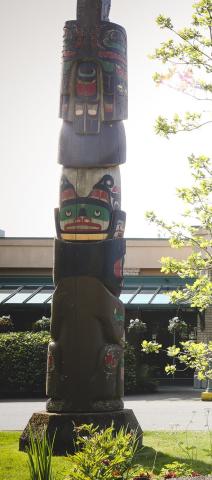
Totem Pole
In the fall of 2002, The Tillicum and Veterans Care Society (now Broadmead Care Society) commissioned Calvin Hunt to design and carve a Totem Pole for The Lodge at Broadmead in honour of the contributions and sacrifices made by Canadian Indigenous war Veterans.
A master carver from Fort Rupert, Calvin is a grandson of the renowned Mungo Martin and, like his relatives Henry, Richard, Tony and others, is a member of the richly talented Hunt families of carvers. He was assisted by his nephew Mervin Child and John Livingston in the creation of this majestic totem pole. At the top of the almost 20 feet tall totem pole is Eagle, symbolizing nobility, integrity and pride. Below Eagle is a warrior wearing a blanket with Sisiuth — a double-headed serpent — protecting him from his enemies. At the bottom is Bear holding Salmon. The bear is fearless, strong and determined spirit, while the salmon symbolizes a long journey and a safe return home.
The Totem Pole stands proudly in the grassy centre of the roundabout at the main entrance of Veterans Memorial Lodge.
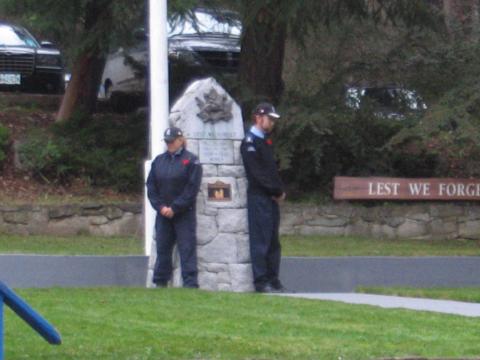
North Pender Island Cenotaph
(needs further research/recherche incomplète)
The following is an excerpt from: Histories - BC/Yukon Branches - The Royal Canadian Legion - Pender Island Branch 239 - A Cenotaph was built on the property and associated grounds are maintained by the Legion. Remembrance Day services have been held on the site for between thirty and thirty-five years.
Ashton Armoury
[plaque/plaque]
MANÈGE MILITAIRE ASHTON ARMOURY
IN MEMORY OF
LIEUTENANT -GENERAL ERNEST CHARLES ASHTON, CR, CMG, VD (1873-1956)
(needs further research/recherche incomplète)
Lt. General Ashton was chosen to be recognized by the naming of the Ashton Armoury in his honour. Lt. General Ashton was chosen for the diversity of his military career, and his many years in senior combat service support. The Ashton Armoury is the home of 11 (Victoria) Service Battalion and 11 (Victoria) Ambulance Company. The building was inaugurated 10 November 2005. Located inside the building is a memorial wall, which consists of Lt. General Ashton's orders, decorations and medals, including his brother Lt. Colonel Ashton's medals. This is located on the East wall of the entrance foyer.