The Church of The Messiah First World War Plaque was erected in the Memorial Chapel at 240 Avenue Road. A fire gutted the church and Memorial Chapel in 1976 and the plaque was destroyed.
Other
Memorial Chapel
To the Glory of God, and in honoured memory
of the men of the Parish who made the supreme
sacrifice in the Second World War.
Ivor B. Baldwin
Arthur Barrett
Allen George Bradley
Frederick H. Broad
John William Brown
Ronald D. Bryan
Frank R. Comery
John A. Dickson
Frederick F. Duff
Stanley F. Duke
David D.S. Grant
Kenneth R.O. Hendren
Frank O. Lusty
George W. Morrison
Herbert P. Morrison
Norman E. Mountford
Oliver Pratlett
J.G. Graham Rae
William B. Wilson
The Memorial Chapel was built in The Church of The Messiah at 240 Avenue Road in thankfulness to God for the conclusion of the Second World War. It was dedicated on 9 June 1946 and the names of nineteen members of the parish who made the supreme sacrifice were carved on the paneling. The chapel was dedicated by the Right Reverend H.J. Hamilton
The chapel was destroyed in a fire in 1976 that gutted the church and parish hall. Inside the Memorial Chapel were a First World War Plaque and 3rd Battalion (Toronto Regiment) Cross.
Private Samuel Tree Jerred Plaque
PRINCESS PATRICIA'S CANADIAN LIGHT INFANTRY
TO THE GLORY OF GOD
AND IN LOVING MEMORY OF
SAMUEL TREE JERRED
PRINCESS PATRICIA'S
CANADIAN LIGHT INFANTRY
KILLED IN ACTION AT YPRES
MAY 8TH 1915
AGE 33 YEARS
"FAITHFUL UNTO DEATH"
ERECTED BY HIS WIFE
On 15 December 1918, at The Church of the Messiah, a bronze tablet was dedicated to the memory of Private Samuel Tree Jerred, who had died in the First World War. Born 16 July 1883 in Upton Pine, Devonshire, England, Samuel settled in Toronto, Ontario where he worked as a real estate broker. He joined the Princess Patricia’s Canadian Light Infantry the day after war was declared. Arriving in Europe in early 1915, he was killed in action at the Second Battle of Ypres on 8 May 1915.
Memorial 35081-004 Toronto – St. Paul’s, ON
[plaque/plaque]
1914 The Great War 1919
In honour of the pupils
of North Toronto Collegiate
Institute who served in the
Great War that freedom and
the Empire might endure.
These made the supreme sacrifice:
**there follows a list of names, arranged in two columns**
These gave their willing service:
**there follows a list of names, arranged in three columns**
[bottom/bas]
Erected in grateful remembrance by the teachers and
students of the North Toronto Collegiate Institute.
This memorial is a decorated, bronze honour roll plaque at North Toronto Collegiate Institute. It was erected in grateful remembrance by the teachers and students of the North Toronto Collegiate Institute, in honour of the pupils of the Collegiate who served in the First World War.
Service Window
In 1951, a Service Window was erected in the chapel of The Church of The Messiah at 240 Avenue Road and dedicated to the Glory of God and in humble thankfulness for all the members of the parish who served in the Second World War. It was erected by their families, friends and fellow parishioners.
A fire in 1976 gutted the church and all the stained glass windows were broken. Local artist Stephen Taylor was only able to incorporate some glass into a new church window from the original stained glass as most had been too badly damaged in the fire. The new window is a memorial to Sunday School Superintendent 1891 - 1924, Grant Helliwell. His son Joseph Grant Helliwell died in the First World War and the church dedicated an alms basin in his honour.
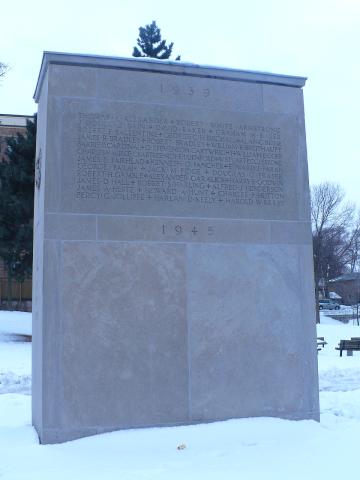
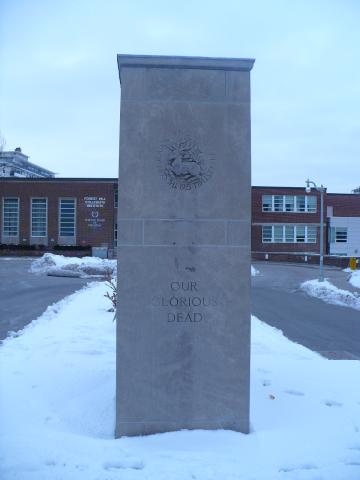
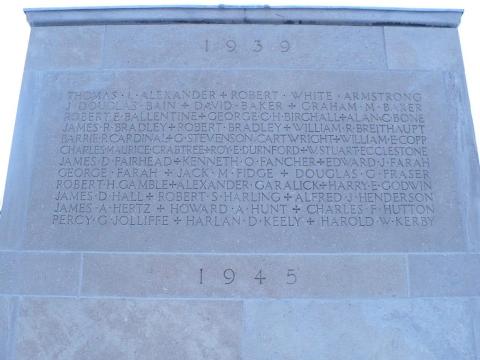
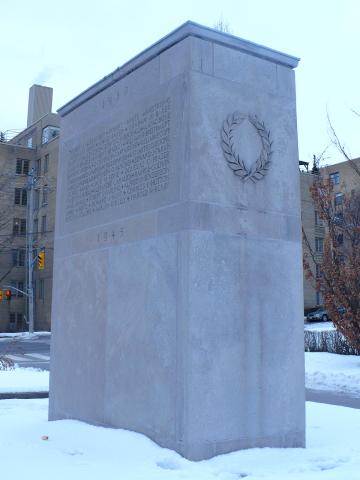
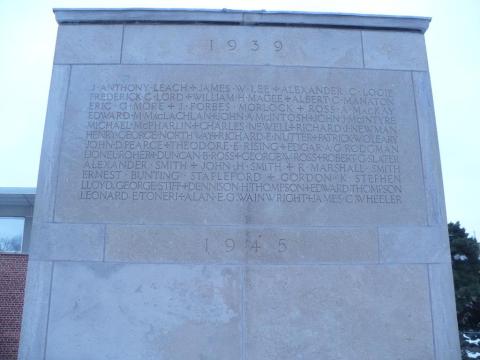
Forest Hill War Memorial
[front/devant]
THE CORPORATION OF THE VILLAGE OF FOREST HILL 1923
OUR GLORIOUS DEAD
[right side/côté droit]
1939
THOMAS L. ALEXANDER
ROBERT WHITE ARMSTRONG
J. DOUGLAS BAIN
DAVID BAKER
GRAHAM M. BAKER
ROBERT E. BALLENTINE
GEORGE C.H. BIRCHALL
ALAN C. BONE
JAMES R. BRADLEY
ROBERT BRADLEY
WILLIAM R. BREITHAUPT
BARRIE P. CARDINAL
G. STEVENSON CARTWRIGHT
WILLIAM E. COPP
CHARLES MAURICE CRABTREE
ROY E. DURNFORD
W. STUART ECCLESTONE
JAMES D. FAIRHEAD
KENNTH O. FANCHER
EDWARD J. FARAH
GEORGE FARAH
JACK M. FIDGE
DOUGLAS G. FRASER
ROBERT H. GAMBLE
ALEXANDER GARALICK
HARRY E. GODWIN
JAMES D. HALL
ROBERT S. HARLING
ALFRED J. HENDERSON
JAMES A. HERTZ
HOWARD A. HUNT
CHARLES F. HUTTON
PERCY G. JOLLIFFE
HARLAN D. KEELY
HAROLD W. KERBY
1945
[left side/côté gauche]
1939
J. ANTHONY LEACH
JAMES W. LEE
ALEXANDER C. LOGIE
FREDERICK C. LORD
WILLIAM H. MAGEE
ALBERT C. MANATON
ERIC G. MORE
J. FORBES MORLOCK
ROSS A. MacKAY
EDWARD M. MacLACHLAN
JOHN A. McINTOSH
JOHN J. McINTYRE
MICHAEL McPHARLANE
CHARLES NEWELL
RICHARD J. NEWMAN
HENRY GEORGE NORTHWAY
RICHARD E. NUTTER
PATRICK W. O'LEARY
JOHN D. PEARCE
THEODORE E. RISING
EDGAR A.G. RODGMAN
LIONEL ROHER
DUNCAN B. ROSS
GEORGE W. ROSS
ROBERT G. SLATER
ALEXANDER SMITH
JOHN H. SMITH
R. MARSHALL SMITH
ERNEST BUNTING STAPLEFORD
GORDON K. STEPHEN
LLOYD GEORGE STIFF
DENNISON H. THOMPSON
EDWARD THOMPSON
LEONARD E. TONERI
ALAN E.G. WAINWRIGHT
JAMES C. WHEELER
1945
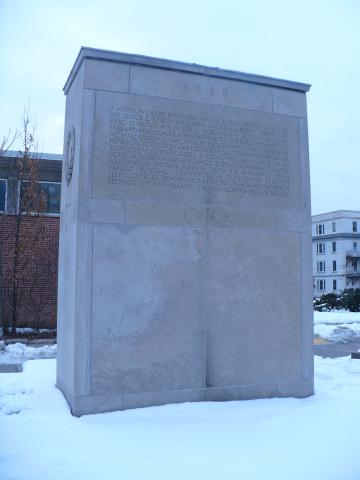
The Forest Hill War Memorial was erected in 1980, in memory of those who lost their lives in the First and Second World Wars. The limestone Memorial is located on Eglinton Avenue. Page and Steele Architects designed the Memorial.
Whitman & Barnes Manufacturing Company Honour Roll
Whitman & Barnes Manufacturing Company
Roll of Honor
St. Catherines, Ontario
Manufacturers of Carpenter’s, Machinists and Tinners Hammers, Hatchets, Screw Wrenches, Pipe Wrenches, Auto Pliers, Screw Drivers, Drop Forgings, Etc.
* Killed in Action
| Capt. W.B. Elliott, R.A.F., D.F.L. |
| Frank Armstrong |
| Jack Arthur |
| David Cotton |
| Andrew Davis |
| Herbert Hall |
| Thos. Jones |
| Richard Kearney* |
| Roland Logan |
| Harry Maynard |
| Stanley Nelson* |
| Joe O’Reilly* |
| Lorne Overholt |
| R.J. Richards |
| Harvey Secord |
| Percy Shorter, M.M. |
| Arthur Smith |
| Harry Smith |
| Frank Sturch |
| Fred Turnbull |
| Arthur A. White |
| Jack Wilson |
| Wilfred Wismer |
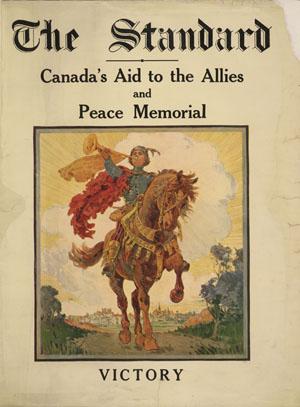
"Canada's Aid to the Allies" includes Roll of Honor – Whitman and Barnes Manufacturing - St. Catherines, Ontario
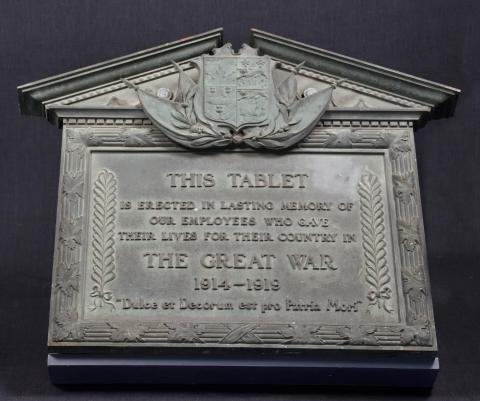
Welland Vale Manufacturing Company Limited First World War Tablet
THIS TABLET
IS ERECTED IN LASTING MEMORY OF
OUR EMPLOYEES WHO GAVE
THEIR LIVES FOR THEIR COUNTRY IN
THE GREAT WAR
1914 — 1919
"Dulce et Decorum est pro Patria Mori"
This memorial is dedicated to the employees of Welland Vale Manufacturing Company Limited who died in the First World War. It was erected by the Welland Vale Manufacturing Company Limited.
The tablet was on public display, but now anyone wishing to see it must make an appointment with the museum.
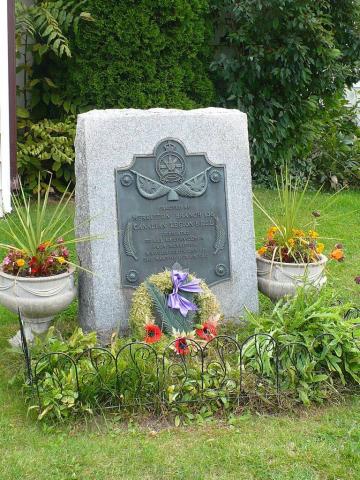
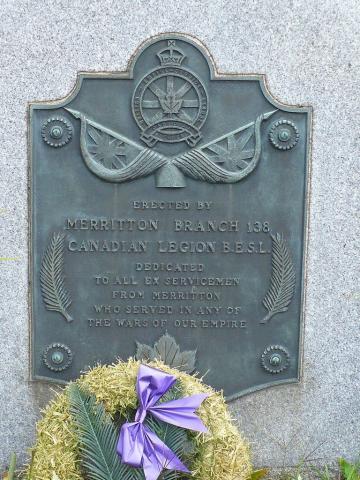
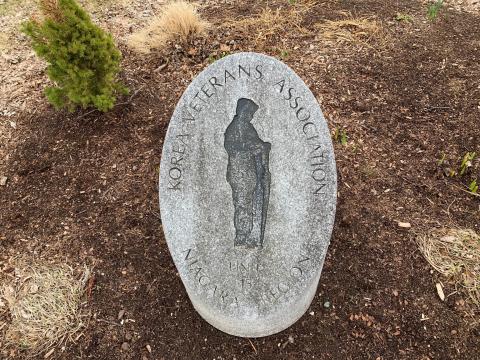
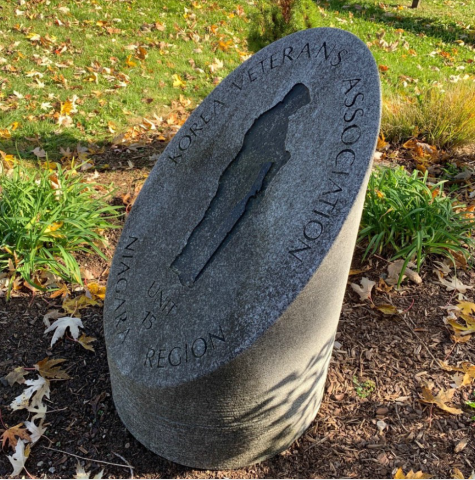
Royal Canadian Legion Branch No. 138 War Memorial
BRITISH EMPIRE SERVICE LEAGUE
CANADIAN
LEGION
ERECTED BY
MERRITTON BRANCH 138
CANADIAN LEGION B.E.S.L.
DEDICATED
TO ALL EX SERVICEMEN
FROM MERRITTON
WHO SERVED IN ANY OF
THE WARS OF OUR EMPIRE
Needs further research
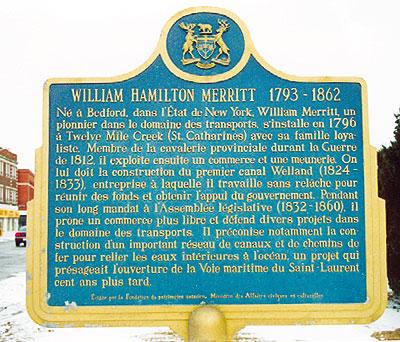
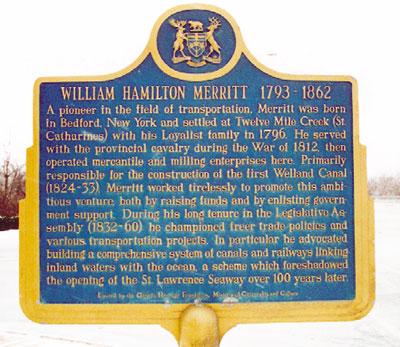
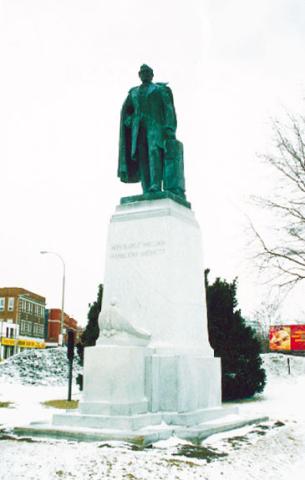
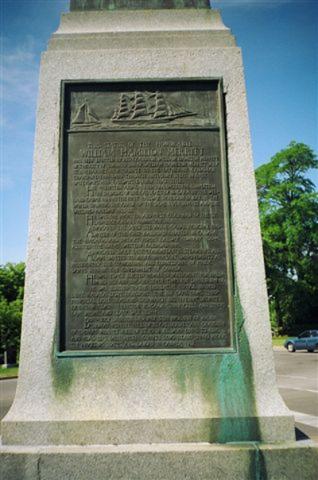
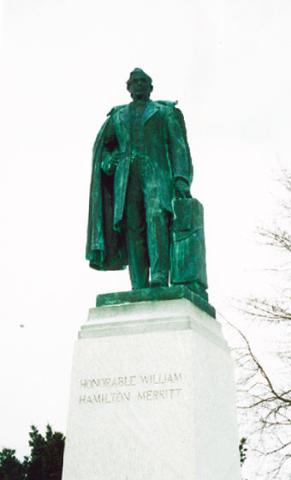
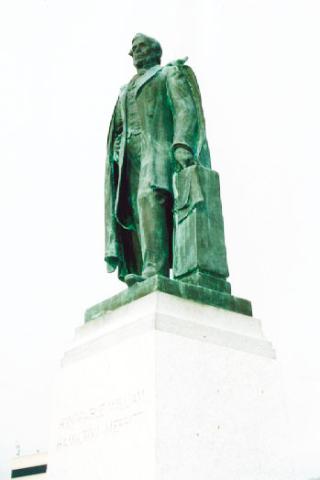
William Hamilton Merritt Plaque
[English side of plaque/plaque, du côté anglais]
WILLIAM HAMILTON MERRITT 1793-1862
A pioneer in the field of transportation, Merritt was born
in Bedford, New York and settled at Twelve Mile Creek (St.
Catharines) with his Loyalist family in 1796. He served
with the provincial cavalry during the War of 1812, then
operated mercantile and milling enterprises here. Primarily
responsible for the construction of the first Welland Canal
(1824-33). Merritt worked tirelessly to promote this ambi-
tious venture, both by raising funds and by enlisting govern-
ment support. During his long tenure in the Legislative As-
sembly (1832-60) he championed freer trade policies and
various transportation projects. In particular he advocated
building a comprehensive system of canals and railways linking
inland waters with the ocean, a scheme which foreshadowed
the opening of the St. Lawrence Seaway over 100 years later.
Erected by the Ontario Heritage Foundation, Ministry of Citizenship and Culture
[French side of plaque/plaque, du côté français]
WILLIAM HAMILTON MERRITT 1793-1862
Né à Bedford, dans l'État de New York, William Merritt, un
pionnier dans le domaine des transports, s'installe en 1796
à Twelve Mile Creek (St. Catharines) avec sa famille loya-
lilste. Membre de la cavalerie provinciale durant la Guerre
de 1812, il exploite ensuite un commerce et une meunerie. On
lui doit la construction du premier canal Welland (1824-
1833), entreprise à laquelle il travaille sans relâche pour
réunir des fonds et obtenir l'appui du gouvernement. Pendant
son long mandat à l'Assemblée législative (1832-1860), il
prône un commerce plus libre et défend divers projets dans
le domaine des transports. Il préconise notamment la con-
struction d'un important réseau de canaux et de chemins de
fer pour relier les eaux intérieures à l'océan, un project qui
présageait l'ouverture de la Voie maritime du Saint-Laurent
cent ans plus tard.
Érigée par la Fondation du patrimoine ontarien, Ministère des Affaires civiques et culturelles
A young farmer near Grantham Township before the war, William Merritt was appointed Lieutenant in the Niagara Light Dragoons, a volunteer company. They were expected to provide their own horses although they did receive a few British armaments. Their duties included carrying dispatches, long range patrols, calling in militia men and pursuing enemy raiders. Under command of his father, Thomas, the Sheriff of Niagara, Merritt and his troop were assigned to guard duty along the Niagara River. He was asked to join Brock at Detroit but was delayed and hence arrived after the capture of Fort Detroit. Nevertheless, he was awarded the special Detroit Medal. At the Battle of Queenston Heights, Merritt fought alongside Brock and years later was instrumental in the erection of Brock’s Monument.
The Dragoons were briefly disbanded in February 1813, but Merritt was instructed to raise a troop of cavalry again in March and become its Captain. During the American occupation of Niagara in 1813, the Dragoons were involved in a number of skirmishes with the United States Forces and also fought at the Battle of Stoney Creek in June.
When the Town was burnt by the United States in December, Merritt saw a glare in the sky from Twelve Mile Creek. Upon his approach, he described it as “nothing but heaps of coal and the streets full of furniture that the inhabitants had been fortunate enough to get out of their homes.”
Merritt fought at the Battle of Lundy’s Lane in July 1814 and was captured. He remained a prisoner until the end of the war. Afterwards, Merritt returned to farming and was involved in the mercantile trade in Niagara. Merritt is famous for promoting the Welland Canal between Lakes Erie and Ontario which bypassed Niagara Falls and the Portage Road.