This street commemorates those who fought at Caen in the Second World War.
Caen Circle
needs further research/recherche incomplète
My VAC Account
My VAC Accountneeds further research/recherche incomplète
This street commemorates those who fought at Caen in the Second World War.
needs further research/recherche incomplète
This streets commemorates those who served in Cyprus.
needs further research/recherche incomplète
This street commemorates those who fought at Falaise in the Second World War. Lieutenant General Guy Simonds developed an innovative plan to break through to the critical road junction at Falaise. Using radio beams, searchlights, and tracer fire to steer them, the Canadians would attack at night in conjunction with an immense air bombardment. To help nullify the German anti-tank defences, Simonds instructed his men to convert some of their self-propelled artillery into armoured personnel carriers the first of their kind. With the infantry riding in relative safety inside what were soon dubbed "Kangaroos," with the enemy blasted from above by American bombers, and using darkness as a screen, Simonds intended to puncture the enemy line.
needs further research/recherche incomplète
This street commemorates those who served in the Congo.
needs further research/recherche incomplète
This street commemorates those who served in the Korean War.
needs further research/recherche incomplète
This street commemorates those who fought at Arras in the First World War.
needs further research/recherche incomplète
This street commemorates those who fought at the Battle of the Somme in the First World War.
needs further research/recherche incomplète
This street commemorates those who fought at the Battle of Cambrai in the First World War.
needs further research/recherche incomplète
This street commemorates those who fought in the Dieppe Raid in the Second World War. Although extremely valuable lessons were learned in the Dieppe Raid, a steep price was paid. Of the 4,963 Canadians who embarked for the operation, only 2,210 returned to England, and many of these were wounded. There were 3,367 casualties, including 1,946 prisoners of war; 916 Canadians lost their lives.
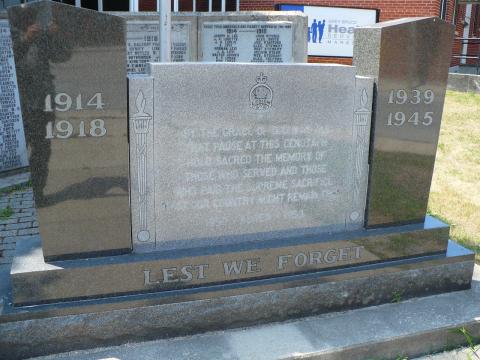
1914
1918
1939
1945
BY THE GRACE OF GOD MAY ALL
THAT PAUSE AT THIS CENOTAPH
HOLD SACRED THE MEMORY OF
THOSE WHO SERVED AND THOSE
WHO PAID THE SUPREME SACRIFICE
THAT OUR COUNTRY MIGHT REMAIN FREE
1950 KOREAN 1953
LEST WE FORGET
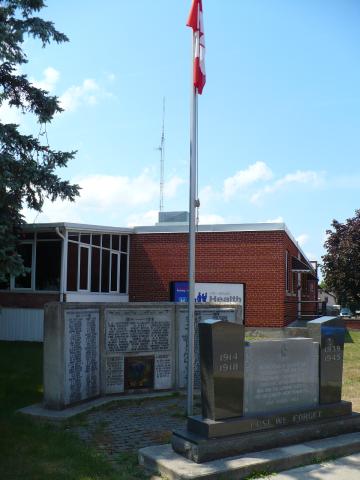
In 1923, the first memorial (a vault) was erected in the Markdale Public Cemetery. Interested citizens arranged for three large stone plaques which listed the names of the men from Markdale who joined the active forces. One plaque listed the 33 names of those who paid the supreme sacrifice in the First World War. The remaining two plaques listed the 142 names of those who joined the forces in Markdale and were fortunate enough to return home.
The Royal Canadian Legion was founded in 1925-26 and Veterans paraded to the cemetery on November 11 for their service honouring the First World War Veterans. In 1971, the vault was removed and a new one was erected further back in the cemetery grounds. Its placement was questioned and through the efforts of a local Veteran, who is now deceased, the three plaques were carefully taken down and stored at the Royal Canadian Legion Headquarters. A smaller brass plaque was created and erected in the Carnegie Library and still hangs to this day.
The same local Veteran and his committee began fundraising and sought approval from the local hospital to erect a new memorial to honour the men and women from the First and Second World Wars and the Korean War. Through hard work and the approval from the Centre Grey Hospital Board for land, a new memorial was constructed and placed on the Southeast corner of the hospital in 1979. In 1983, the Hospital Board gave approval for more ground to be given to install the three plaques with the First World War Veterans, behind the existing memorial. The new memorial was moved to its current location at the Royal Canadian Legion - Branch 333 Flesherton-Markdale.