Other

City/Municipality
Picton
Memorial Number
35069-075
Type
Address
Scheldt Court
Location
Camp Picton
in Canada
Yes
GPS Coordinates
44.0017151, -77.1330401
Inscription

SCHELDT COURT

Image
Caption
street sign
War or Conflict Term
Province
!4v1624468806498!6m8!1m7!1sUYPWyfVx6o6sAlViVGNerQ!2m2!1d44.00171514508863!2d-77.13304008436843!3f287.53304953867934!4f-2.4586131033118903!5f3.325193203789971"
Body Content

Scheldt Court is dedicated to the Canadian First Army participation in the Battle of the Scheldt.

Built in 1940 as one of many training establishments for the British Commonwealth Air Training Plan (BCATP), Camp Picton’s 700 acres became home for numerous young Commonwealth airmen undergoing bombing and gunnery training. After the Second World War, the site was used as a storage and equipment maintenance centre for the Royal Canadian Air Force before being taken over by the Royal Canadian Artillery School (anti-aircraft). With the addition of a Permanent Married Quarters (PMQ) area in the 1950’s, the base was expanded and in the early 60’s became the Home Station for the Canadian Guards regiment. The Base was closed in 1969 and the airfield was eventually transformed into an industrial site. The PMQ area was sold to individual homeowners with many of the roads retaining their original military name.


City
Picton
Country
Type Description
Street; street sign
Photo Credit
Richard Turcotte
Memorial CF Legacy ID
8667
City/Municipality
Picton
Memorial Number
35069-074
Type
Address
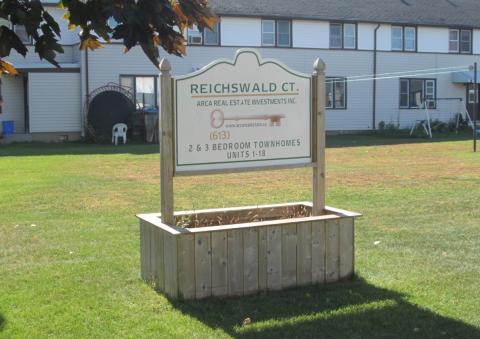
Reichswald Court
Location
Camp Picton
in Canada
Yes
GPS Coordinates
44.0012552, -77.1337629
Inscription

REICHSWALD CT.

Image
Photo Credit
Richard Turcotte
Caption
street sign
War or Conflict Term
Province
!4v1624469092427!6m8!1m7!1sL75GRBP_l2ukSDSbGkYS4g!2m2!1d44.00125515329645!2d-77.13376294885605!3f269.97490345013654!4f-1.5464292195403715!5f3.3095400816926284"
Body Content

Reichswald Court is dedicated to the Canadian participation in the Battle of The Reichswald.

Built in 1940 as one of many training establishments for the British Commonwealth Air Training Plan (BCATP), Camp Picton’s 700 acres became home for numerous young Commonwealth airmen undergoing bombing and gunnery training. After the Second World War, the site was used as a storage and equipment maintenance centre for the Royal Canadian Air Force before being taken over by the Royal Canadian Artillery School (anti-aircraft). With the addition of a Permanent Married Quarters (PMQ) area in the 1950’s, the base was expanded and in the early 60’s became the Home Station for the Canadian Guards regiment. The Base was closed in 1969 and the airfield was eventually transformed into an industrial site. The PMQ area was sold to individual homeowners with many of the roads retaining their original military name.

The Battle of the Reichswald, also known as Operation Veritable, took place in Klever Reichswald between February 8 and March 11, 1945. This operation was the northern part of an Allied pincer movement conducted by 21st Army Group primarily consisting of the 1st Canadian Army and the British XXX Corps. The operation’s objective was to clear German forces from the area between the Rhine and Maas rivers, east of the German/Dutch frontier. The operation had complications. The heavily forested terrain, squeezed between the rivers, reduced Anglo-Canadian advantages in manpower and armour and the situation was exacerbated by soft ground which had thawed after the winter and the deliberate flooding of the adjacent Rhine flood plain as well as the delay in the southern pincer movement, Operation Grenade.

Veritable started on schedule, with XXX Corps advancing through the forest and the 3rd Canadian Infantry Division, in amphibious vehicles, clearing enemy positions in the drowned Rhine flood plain. The fighting was hard, but the Allied advance continued. On February 22, once clear of the Reichswald and with the towns of Kleve and Goch in their control, the offensive was renewed and linked up with the US 9th Army (Operation Grenade) near Geldern on March 4. Fighting continued as the Germans sought to retain a bridgehead on the west bank of the Rhine at Wesel and evacuate as many men and as much equipment as possible. Finally, on March 10, the German withdrawal ended and the last bridges were destroyed.

City
Picton
Country
Type Description
Street; street sign
Photo Credit
Richard Turcotte
Memorial CF Legacy ID
8666
City/Municipality
Picton
Memorial Number
35069-073
Type
Address
Ortona Circle
Location
Camp Picton
in Canada
Yes
GPS Coordinates
44.0021623, -77.1322261
Inscription

ORTONA CIR.

Image
Photo Credit
Richard Turcotte
Caption
street sign
War or Conflict Term
Province
!4v1624469250779!6m8!1m7!1sdMrgDcHgkWXtPF60zpV0DA!2m2!1d44.00216233366892!2d-77.13222612476606!3f84.22844105282427!4f1.8282101437629876!5f3.325193203789971"
Body Content

Ortona Circle is dedicated to the Canadian participation in the Battle of Ortona.

Built in 1940 as one of many training establishments for the British Commonwealth Air Training Plan (BCATP), Camp Picton’s 700 acres became home for numerous young Commonwealth airmen undergoing bombing and gunnery training. After the Second World War, the site was used as a storage and equipment maintenance centre for the Royal Canadian Air Force before being taken over by the Royal Canadian Artillery School (anti-aircraft). With the addition of a Permanent Married Quarters (PMQ) area in the 1950’s, the base was expanded and in the early 60’s became the Home Station for the Canadian Guards regiment. The Base was closed in 1969 and the airfield was eventually transformed into an industrial site. The PMQ area was sold to individual homeowners with many of the roads retaining their original military name.

The Battle of Ortona (20-28 December 1943) was an extremely fierce battle fought between German Fallschirmjäger (paratroops) from the German 1st Parachute Division and assaulting Canadian forces from the Canadian 1st Infantry Division. It was the culmination of the fighting on the Adriatic front in Italy during “Bloody December”. The battle, dubbed “Little Stalingrad” for the deadliness of its close-quarters combat, took place in the small Adriatic Sea town of Ortona, about halfway down the Italian coast. The initial Canadian attack on the town was made on December 20 by Canadian 2nd Brigade’s Loyal Edmonton Regiment with elements of the Seaforth Highlanders of Canada under command. Meanwhile elements of the division’s 3rd Brigade launched a northerly attack to the west of the town in attempt to outflank and cut off the town’s rear communications but made slow progress because of the difficult terrain and the skillful and determined German defence. The Germans also concealed various machine guns and anti-tank emplacements throughout the town, making movement by armour and infantry increasingly difficult. The house to house fighting was vicious and the Canadians made use of a new tactic: “mouse-holing”. On December 26, Princess Patricia’s Canadian Light Infantry and the Three Rivers Regiment joined the battle. After eight days of fierce fighting, the depleted German troops withdrew from the town.

City
Picton
Country
Type Description
Street; street sign
Photo Credit
Richard Turcotte
Memorial CF Legacy ID
8663
City/Municipality
Picton
Memorial Number
35069-072
Type
Address
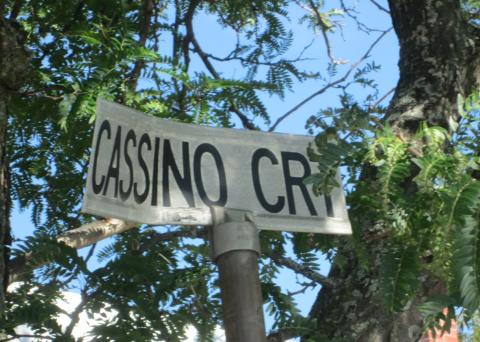
Cassino Court
Location
Camp Picton
in Canada
Yes
GPS Coordinates
44.0007762, -77.134425
Inscription

CASSINO CRT

Image
Photo Credit
Richard Turcotte
Caption
street sign
War or Conflict Term
Province
!4v1624469557994!6m8!1m7!1sU-2kKkfZvmdhGhkHXse7aA!2m2!1d44.0007776324847!2d-77.13443056569591!3f52.04509868623862!4f2.807734582984409!5f3.325193203789971"
Body Content

Cassino Court is dedicated to the Canadian participation in the Battle of Monte Cassino.

Built in 1940 as one of many training establishments for the British Commonwealth Air Training Plan (BCATP), Camp Picton’s 700 acres became home for numerous young Commonwealth airmen undergoing bombing and gunnery training. After the Second World War, the site was used as a storage and equipment maintenance centre for the Royal Canadian Air Force before being taken over by the Royal Canadian Artillery School (anti-aircraft). With the addition of a Permanent Married Quarters (PMQ) area in the 1950’s, the base was expanded and in the early 60’s became the Home Station for the Canadian Guards regiment. The Base was closed in 1969 and the airfield was eventually transformed into an industrial site. The PMQ area was sold to individual homeowners with many of the roads retaining their original military name.

The Battle of Monte Cassino was a costly series of four assaults by the Allies against the Winter Line in Italy held by Axis forces during the Italian Campaign of the Second World War. The intention was a breakthrough to Rome. At the beginning of 1944, the western half of the Winter Line was being anchored by Germans holding the Rapido, Liri, and Garigliano valleys and some of the surrounding peaks and ridges. Together, these features formed the Gustav Line. Monte Cassino and its abbey, dominated the nearby town of Cassino and the entrances to the Liri and Rapido valleys, but had been left unoccupied by the German defenders. The Germans had, however, manned some positions set into the steep slopes.

Fearing that the abbey did form part of the Germans’ defensive line, the Allies sanctioned its bombing on February 15. The destruction and rubble left by the bombing raid now provided better protection from aerial and artillery attacks, so, two days later, German paratroopers took up positions in the abbey’s ruins. Between January 17 and May 18, Monte Cassino and the Gustav defences were assaulted four times by Allied troops. The final battle, involving 1 Canadian Corps and 1st Canadian Armoured Brigade, began on May 11, 1944, and by May 13, the German right wing began to give way. Vicious fighting continued for another five days and on May 18, a patrol of Polish cavalry finally made it to the heights. The German defenders had been driven from their positions, but at a high cost. 

City
Picton
Country
Type Description
Street; street sign
Memorial CF Legacy ID
8662
City/Municipality
Picton
Memorial Number
35069-071
Type
Address
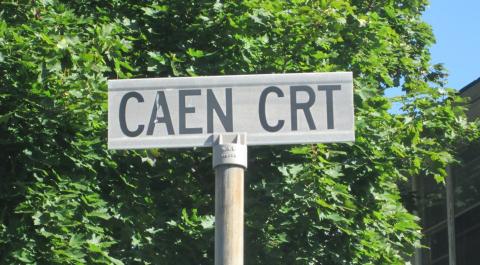
Caen Court
Location
Camp Picton
in Canada
Yes
GPS Coordinates
43.9989679, -77.1325012
Inscription

CAEN CRT

Image
Photo Credit
Richard Turcotte
Caption
street sign
War or Conflict Term
Province
!4v1624469855998!6m8!1m7!1sE4_7wMAKwclppsJG2zpdWQ!2m2!1d43.99896909385787!2d-77.13251531884961!3f144.8057318040292!4f1.4240016772714483!5f3.325193203789971"
Body Content

Caen Court is dedicated to the Canadian participation in the Battle for Caen.

Built in 1940 as one of many training establishments for the British Commonwealth Air Training Plan (BCATP), Camp Picton’s 700 acres became home for numerous young Commonwealth airmen undergoing bombing and gunnery training. After the Second World War, the site was used as a storage and equipment maintenance centre for the Royal Canadian Air Force before being taken over by the Royal Canadian Artillery School (anti-aircraft). With the addition of a Permanent Married Quarters (PMQ) area in the 1950’s, the base was expanded and in the early 60’s became the Home Station for the Canadian Guards regiment. The Base was closed in 1969 and the airfield was eventually transformed into an industrial site. The PMQ area was sold to individual homeowners with many of the roads retaining their original military name.


City
Picton
Country
Type Description
Street; street sign
Memorial CF Legacy ID
8735
City/Municipality
Picton
Memorial Number
35069-070
Type
Address
Johnson Street and Hwy 49
in Canada
Yes
GPS Coordinates
44.0112215, -77.1387778
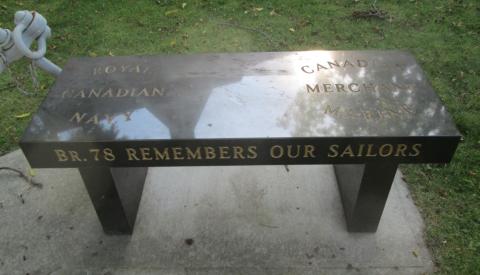
Inscription

[front/devant]

  • ROYAL
  • CANADIAN
  • NAVY
  • CANADIAN
  • MERCHANT
  • MARINE


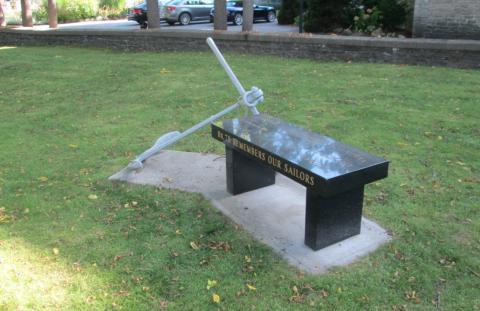
BR. 78 REMEMBERS OUR SAILORS 


Image
Caption
memorial
1 of 2 images
Image
Caption
inscription
1 of 2 images
War or Conflict Term
Province
!4v1624470251733!6m8!1m7!1sv0l-5AFF-0yqiyVSv1lhOg!2m2!1d44.01122150558856!2d-77.13877784439923!3f197.06066216411736!4f-0.7123912211964551!5f3.325193203789971"
Body Content

This memorial is dedicated to all sailors of the Royal Canadian Navy and the Canadian Merchant Marine. It was unveiled on September 21, 2001, by the Royal Canadian Legion Branch 78.

City
Picton
Country
Type Description
Anchor and bench (black stone)
Photo Credit
Richard Turcotte
Memorial CF Legacy ID
8734
City/Municipality
Picton
Memorial Number
35069-069
Type
Address
3 Johnson St
Location
Johnson Street and Hwy 49
in Canada
Yes
GPS Coordinates
44.0112246, -77.1387733
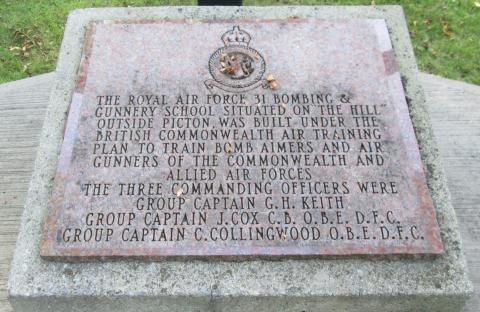
Inscription

[front/devant]

THE ROYAL AIR FORCE 31 BOMBING &
GUNNERY SCHOOL SITUATED ON "THE HILL"
OUTSIDE PICTON, WAS BUILT UNDER THE
BRITISH COMMONWEALTH AIR TRAINING
PLAN TO TRAIN BOMB AIMERS AND AIR
GUNNERS OF THE COMMONWEALTH AND
ALLIED AIR FORCES
THE THREE COMMANDING OFFICERS WERE
GROUP CAPTAIN G.H. KEITH
GROUP CAPTAIN J. COX, C.B., O.B.E., D.F.C.
GROUP CAPTAIN C. COLLINGWOOD, O.B.E., D.F.C. 

Image
Photo Credit
Richard Turcotte
Caption
memorial
War or Conflict Term
Province
!4v1624470709675!6m8!1m7!1sN8wvO89DkOotIvlfi8HBOg!2m2!1d44.01118180591818!2d-77.1386777656592!3f219.65069493221057!4f-1.8237755720423365!5f3.325193203789971"
Body Content

This memorial is dedicated to the British Commonwealth Air Training Plan 31 Bombing & Gunnery School at Camp Picton. It was unveiled by the Royal Canadian Legion Branch 78.

City
Picton
Country
Type Description
Plaque; pink stone
Photo Credit
Richard Turcotte
Memorial CF Legacy ID
8733
City/Municipality
Picton
Memorial Number
35069-068
Type
Address
347 Picton Main Street East
Location
Royal Canadian Legion Branch 78
in Canada
Yes
GPS Coordinates
44.0112246, -77.1387733
Inscription

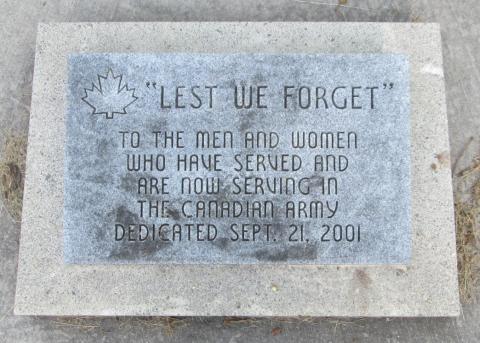
[dedication plaque/plaque commémorative]

"LEST WE FORGET".
TO THE MEN AND WOMEN
WHO HAVE SERVED AND
ARE NOW SERVING IN
THE CANADIAN ARMY.
DEDICATED SEPT. 21. 2001

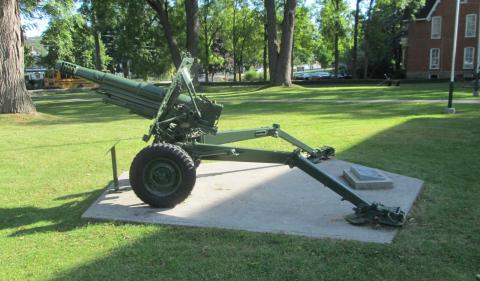
[weapon description plaque/plaque descriptive de l’arme]

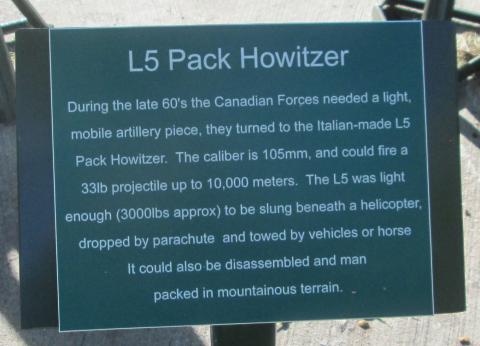
L5 Pack Howitzer

During the late 60's the Canadian Forces needed a light,
mobile artillery piece, they turned to the Italian-made L5
Pack Howitzer. The caliber is 105mm, and could fire a
33lb projectile up to 10,000m. The L5 was light
enough (3000lbs approx.) to be slung beneath a helicopter,
dropped by parachute and towed by vehicle or horse.
It could also be disassembled and man
packed in mountainous terrain.

[restoration info plaque/plaque informative sur les travaux de restauration]

A Restoration Project
of
the Eastern Ontario Gunner's Association
with the permission of the Royal Canadian Legion Br. 78.

Donations
Sandblasting and Painting
Darren Green Construction Inc,. Deseronto

Paint and Plaques: Eastern Ontario Gunner's Association

Transportation- Ed's Moving and Delivery, Picton

Printing of Decals: Printcraft, Picton

Welding / Steel Fabrication: Dave Duguay, Picton

Image
Caption
Memorial
1 of 4 images
Image
Caption
dedication plaque
1 of 4 images
Image
Caption
weapon description plaque
1 of 4 images
Image
Caption
restoration information plaque
1 of 4 images
War or Conflict Term
Province
!4v1624471152745!6m8!1m7!1sv0l-5AFF-0yqiyVSv1lhOg!2m2!1d44.01122150558856!2d-77.13877784439923!3f208.75695335375758!4f-9.57554804562291!5f3.325193203789971"
Body Content

The Picton Canadian Army Memoriali s dedicated to the men and women who have served and are now serving in the Canadian Army. It was unveiled on September 21, 2001, by the Royal Canadian Legion Branch 78.

City
Picton
Country
Type Description
Weapon with dedication plaque
Photo Credit
Richard Turcotte
Memorial CF Legacy ID
8732
City/Municipality
Picton
Memorial Number
35069-067
Type
Address
347 Picton Main Street East
Location
Royal Canadian Legion Branch 78
in Canada
Yes
GPS Coordinates
44.0112246, -77.1387733
Inscription

[front/devant]

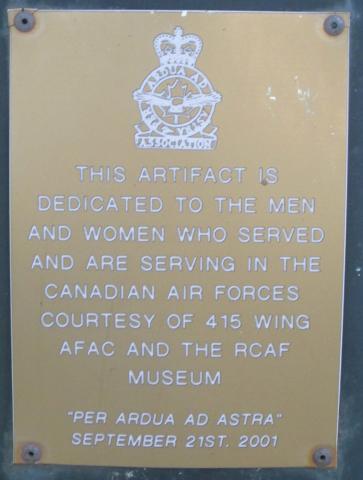
THIS ARTIFACT IS
DEDICATED TO THE MEN
AND WOMEN WHO SERVED
AND ARE SERVING IN
THE CANADIAN AIR FORCES
COURTESY OF 415 WING
AFAC AND THE RCAF
MUSEUM

"PER ARDUA AD ASTRA"
SEPTEMBER 21ST, 2001


Image
Caption
memorial
1 of 2 images
Image
Caption
plaque
1 of 2 images
War or Conflict Term
Province
!4v1624471511126!6m8!1m7!1sN8wvO89DkOotIvlfi8HBOg!2m2!1d44.01118180591818!2d-77.1386777656592!3f222.04994176900678!4f-1.6560352139551355!5f3.325193203789971"
Body Content

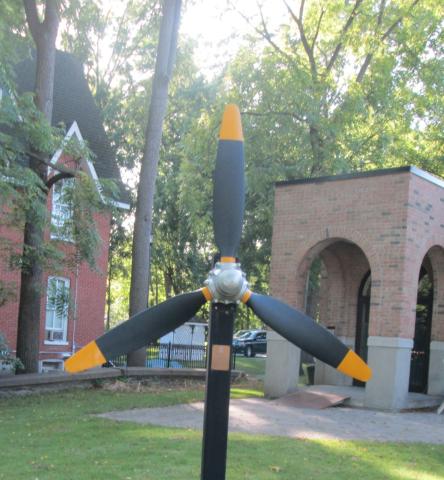
This memorial is dedicated to the men and women who served, and are serving, in the Canadian Air Forces. It consists of an aircraft propeller mounted on a stand, with a dedication plaque. It was unveiled on September 21, 2001, by the Royal Canadian Legion Branch 78.

City
Picton
Country
Type Description
Aircraft propeller, stand, plaque
Photo Credit
Richard Turcotte
Memorial CF Legacy ID
8731
City/Municipality
Trenton
Memorial Number
35069-066
Type
Address
31 Gimli Street
in Canada
Yes
GPS Coordinates
44.114760762481, -77.559376837883
Image
Photo Credit
Richard Turcotte
Caption
front
Province
!4v1622830471090!6m8!1m7!1sfU9CzYPjX-Jp8_0WHLfHUQ!2m2!1d44.11485704659466!2d-77.55789625851456!3f261.88746124623435!4f-0.5325230214643994!5f3.175957370108779"
Body Content

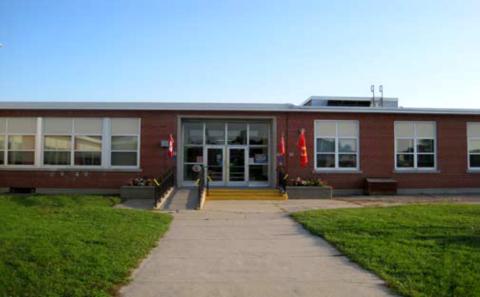
Breadner Elementary School was named in honour of Air Marshall Lloyd Samuel Breadner. The school was closed in 2017 and demolished in 2019.

Lloyd Samuel Breadner was born in July 1894 at Carleton Place. In 1915, he left the family business in Ottawa to enlist in the Royal Naval Air Service. He spent most of the First World War as a fighter pilot in France.

When the war ended, his flying skills earned him a position with the Canadian Air Board and he was appointed as the first Commanding Officer of Camp Borden 3 in 1924. He rapidly moved up the hierarchy and served as Director of the Royal Canadian Air Force (RCAF) from 1928 to 1932. In 1936, Breadner received training at the Imperial Defence College. In 1940, he succeeded in G.M. Croil as Chief of the Air Staff.

During the Second World War, Breadner is credited with turning the RCAF into one of the most powerful air forces in the world. On January 1, 1944, he was posted to London as Air Officer Commander-in-Chief, RCAF Overseas. Upon his retirement in 1945, Lloyd Breadner was promoted to Chief Air Marshal, the only Canadian ever to hold this rank. He died in March 1952 in Boston.

City
Trenton
Country
Type Description
Building; school
Photo Credit
Richard Turcotte
Memorial CF Legacy ID
8654