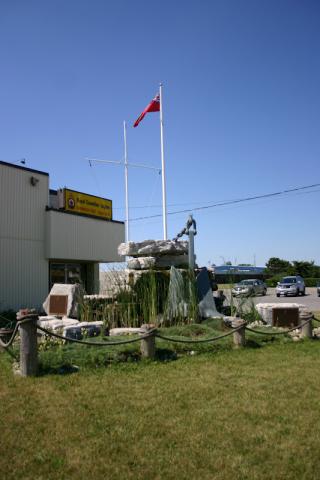
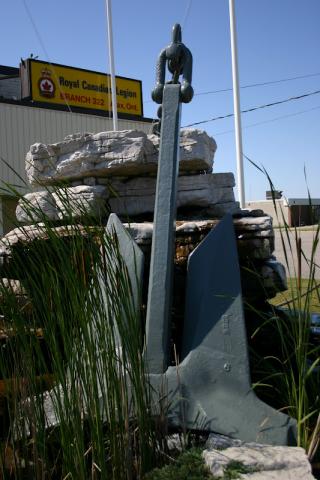
This memorial was dedicated by the citizens of the Town of Ajax in memory of all who served on HMS Ajax.
HMS Ajax Memorial
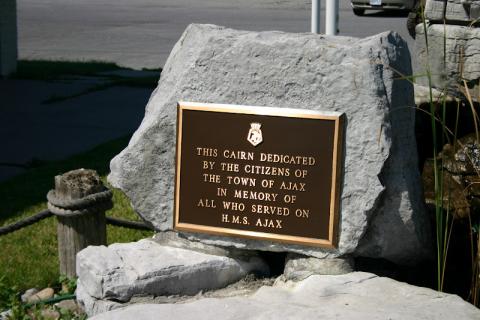
THIS CAIRN DEDICATED
BY THE CITIZENS OF
THE TOWN OF AJAX
IN MEMORY OF
ALL WHO SERVED ON
H.M.S. AJAX
My VAC Account
My VAC AccountTHIS CAIRN DEDICATED
BY THE CITIZENS OF
THE TOWN OF AJAX
IN MEMORY OF
ALL WHO SERVED ON
H.M.S. AJAX
This memorial was dedicated by the citizens of the Town of Ajax in memory of all who served on HMS Ajax.
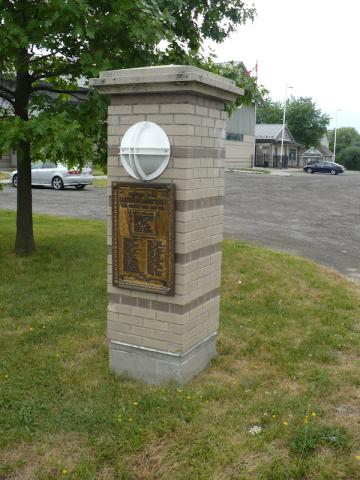
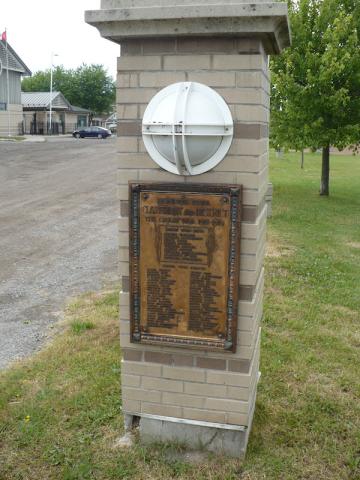
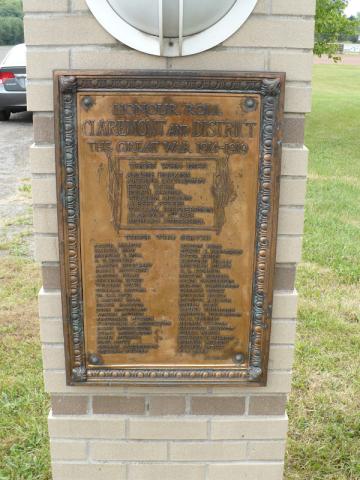
[left plaque/plaque gauche]
HONOUR ROLL
CLAREMONT AND DISTRICT
THE GREAT WAR 1914-1918
THOSE WHO DIED
WALTER ANDERSON
FREDERICK BROWN
ROSWELL CARSON
JOHN DAFOE
ROSS DERUSHA
ALBERT V. EMME
THOMAS FOSTER
HAROLD GRAHAM
GEORGE HANNETT
THOSE WHO SERVED
NURSES
MISS JEAN BENNETT MISS SOPHRONA GLEASON
MISS MEDA HOGUE
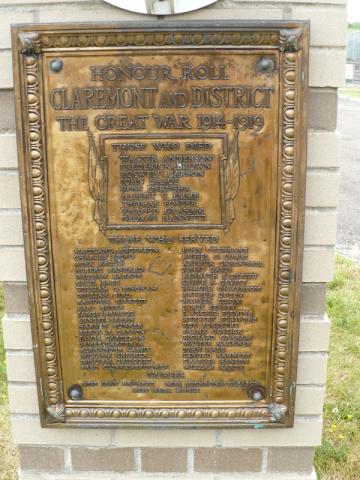
[right plaque/plaque droite]
HONOUR ROLL
CLAREMONT AND DISTRICT
THE GREAT WAR 1914-1918
THOSE WHO DIED
ARCHIE HOPKINS
ARTHUR LITTLEJOHN
PERCY LYRM
ROLPH MADILL
WILLIAM MCLEAN
ALBERT PETERS
WILLIAM SHEPERDSON
CLARENCE STOKES
RICHARD UNDERHILL
THOSE WHO SERVED
Great War Honour Roll
FRED BARNARD WAY
Fred Barnard Way was named in honour of D-Day Veteran Corporal Fred Barnard. Fred was born in Toronto, Ontario, on April 13, 1921. He enlisted in 1941 with the Queen’s Own Rifles of Canada. On D-Day, Fred and his brother Don were crouched down about six men apart from each other as they approached Juno Beach in the first wave of assault. As the front ramp dropped, Fred yelled, "Give ‘em hell, Don” and the brothers jumped into waist deep water. Those were the last words spoken between them. When Fred reached the shore, he came upon Don lying on the ground. He’d been killed by a single bullet to his chest.
Fred fought in the battle to take Carpiquet Airport and was involved in the Liberation of Caen. In Quesney Woods, Fred, at this time in charge of his platoon, was seriously wounded by shrapnel in his neck, shoulder and foot. After five months of convalescence in England, Fred boarded a ship and returned to Canada. In 2007, he was award the Legion d’Honneur by the President of France and in June 2019 the City of Uxbridge held a parade and event to recognize Fred’s contribution in the Second World War.
The entrance gates at Memorial Park were installed in 1922 shortly after Memorial Park was purchased by the Pickering Village Chamber of Commerce. The iron gates were mounted on stone pillars that were built by Bert Mantle of Claremont.
On March 26, 2012, Memorial Park Gates and Cenotaph were designated under the Ontario Heritage Act as a property of Cultural Heritage Value or Interest.
In Loving Memory of
Rt. Lieut. Morley R. Shier
SON OF MR. & MRS. JAS. M. SHIER
Killed while serving in R.N.A.S. in North Sea
Sept. 6 1918
AGE 23 YEARS
He died for this country
The Morley Shier Plaque was erected by his family in the St. Paul's Presbyterian Church. In 2016, the Lucy Maud Montgomery Society purchased the church and the plaque remained.
LIEUTENANT COLONEL SAMUEL SIMPSON SHARPE MP, DSO
WYNN WALTERS, SCULPTOR
The heroic life, the tragic death, and the poignant legacy of Sam Sharpe.
Samuel Sharpe grew up in a prominent Uxbridge area family, and served as Uxbridge's lawyer for a number of years. He was elected a Member of Parliament in 1908. When the Great War broke out in 1914, he recruited a battalion of volunteers from Uxbridge and surrounding areas and led them to Europe.
His 116th (Ontario County) Battalion saw action at Vimy and Passchendaele among other battlefields, losing many men in the mud and barbed wire of Flanders. Sharpe led his men personally into battle, and received the DSO for bravery. He was re-elected in 1917 - the only MP ever elected from the battlefield.
By 1918, Sharpe suffered increasing melancholy and then a mental collapse, the result of losing so many of his men, including John Walton, a close personal friend. In that era, it was called "shell shock". Today we know it as PTSD, (post-traumatic stress disorder), and recognize it as a serious mental condition. Sharpe was invalided to England, and then to Canada. While on a train home, he suffered a collapse, and was hospitalized in Montreal. On May 25, 1918 he jumped to his death from a hospital window. He was 46. Some said he could not face the prospect of returning to Uxbridge and facing the families of those who had died, many of whom he had recruited personally. Of the 1,100 men he had recruited, only 160 were on active duty when they returned.
The statue ... and the message
Statues of military heroes usually portray them in a historic pose. Not so with Sam Sharpe. He is depicted as he ponders writing a letter, agonizing over how to tell Mary Walton that her husband had been killed. The letter in his hand begins: "Dear Mary..." For almost 100 years, history has forgotten Samuel Sharpe, his name buried with thousands who had succumbed to "shell shock". In those days, shell shock was considered cowardice, and Sharpe was considered a disgrace to the regiment.
The life and death of Sam Sharpe helps us to understand the impact of post-traumatic stress disorder, and to understand PTSD as a condition requiring treatment, rather than bringing shame. After 100 years, Sam Sharpe returns as a hero. The statue was unveiled on May 25, 2018 - the 100th anniversary of his death.
Lieutenant Colonel Samuel Sharpe was honoured on May 25, 2018, the 100th anniversary of his death, with the unveiling of a life-size statue. The statue was funded partly through community donations, the Rotary Club of Uxbridge and the Uxbridge-Scott Historical Society. Created by sculptor Wynn Walters, the statue of Sharpe is depicted as he ponders writing a letter, agonizing over how to tell Mary Walton that her husband had been killed. The letter in his hand begins: "Dear Mary..."
For almost 100 years, history has forgotten Samuel Sharpe, his name buried with thousands who had succumbed to "shell shock". In those days, shell shock was considered cowardice, and Sharpe was considered a disgrace to the regiment. The life and death of Sam Sharpe helps us to understand the impact of post-traumatic stress disorder, and to understand that it is as a condition requiring treatment, rather than bringing shame.
Samuel Sharpe grew up in a prominent Uxbridge area family, and served as Uxbridge's lawyer for a number of years. He was elected a Member of Parliament in 1908. When the Great War broke out in 1914, he recruited a battalion of volunteers from Uxbridge and surrounding areas and led them to Europe. His 116th (Ontario County) Battalion saw action at Vimy and Passchendaele among other battlefields. Many men were lost in the mud and barbed wire of Flanders. Sharpe led his men personally into battle, and received the Distinguished Service Order for bravery. He was re-elected in 1917 - the only Member of Parliament ever elected from the battlefield.
By 1918, Sharpe suffered increasing melancholy and then a mental collapse, the result of losing so many of his men, including John Walton, a close personal friend. In that era, it was called "shell shock". Today we know it as post-traumatic stress disorder, and recognize it as a serious mental condition. Sharpe was invalided to England, and then to Canada. While on a train home, he suffered a collapse, and was hospitalized in Montreal. On May 25, 1918, he jumped to his death from a hospital window. He was 46. Some said he could not face the prospect of returning to Uxbridge and facing the families of those who had died, many of whom he had recruited personally. Of the 1,100 men he had recruited, only 160 were on active duty when they returned.
The Town of Ajax was born during the Second World War. At the time, this area was a rural part of the township of Pickering, with nothing more than some farms and little industry. In 1941, Defense Industries Limited established a munitions plant here, and a town grew around the plant, which at its peak employed over 9,000 workers, and was an integral part of the war effort.
The town name is from the British cruiser HMS Ajax, which was a key player during the Battle of the River Plate, the first Allied Naval victory in the war. In December 1939, a flotilla of British warships, including HMS Ajax, HMS Exeter and HMS Achilles, commanded by Commodore Harry Harwood, engaged and crippled the German battleship Admiral Graf Spee near the Uruguayan port of Montevideo. The German ship fled to into the port, but rather than face the overwhelming British force, the Captain scuttled his ship. The Town of Ajax takes its name from this famous battle.
This Ajax Legacy Obelisk will stand as a testimony to honour all those who have served and will serve their country to preserve freedom.
Dedicated October 4, 2009 during the visit of Veterans from the HMS Ajax, HMS Exeter and HMS Achilles on the occasion of the 70th anniversary of the Battle of the River Plate.
The Ajax Legacy Obelisk stands as a testimony to honour all those who have served and will serve their country to preserve freedom. It was dedicated on October 4, 2009, during the visit of Veterans from the HMS Ajax, HMS Exeter and HMS Achilles on the occasion of the 70th anniversary of the Battle of the River Plate.
The Dutch-Canadian Friendship Tulip Garden was erected in 2015 by the public school, which partnered with Communities in Bloom (CIB). Volunteers planted an interlaced pattern of red and white tulip bulbs in the garden beds. The blooms will offer a visual reminder next spring of the link between the two countries.
Ajax was one of the 140 communities selected from the more than 400 applications received by the Canadian Garden Council. Each of the 140 new 70th Anniversary Dutch-Canadian Friendship Tulip Gardens across the country will consist of 700 red and white tulip bulbs (350 of each colour) donated by Vesey’s Bulbs in Prince Edward Island.
The Garden was planted in fall 2015. Tulip bulbs generally bloom between the end of April and the beginning of June depending on the type of tulip and where it’s planted.
The memorial garden is dedicated as a living monument in recognition of the 70th Anniversary of the original Dutch-Canadian Friendship Tulip Garden planted in Ottawa at the end of World War II in 1945. The memorial is in appreciation of the safe haven that members of Holland’s exiled royal family received during World War II, and in recognition of the role Canadian troops played in the liberation of the Netherlands.
Naming the school Vimy Ridge P.S. represents the significant historical national contribution made by thousands of Canadian heroes and will provide a very strong foundation upon which we will build a thriving and successful school. http://www.ddsb.ca/school/vimyridge/SchoolInformation/vimy_ridge_history/Pages/default.aspx
In Loving Memory of
Goldwin D. Lapp
SON OF MR. & MRS. GEO. W. LAPP
LOST HIS LIFE IN FRANCE JAN. 18TH 1917
IN HIS 23RD YEAR
he Gave his All
The Goldwin Lapp Plaque was erected by his family in the St. Paul's Presbyterian Church. In 2016, the Lucy Maud Montgomery Society purchased the church and the plaque remained.