
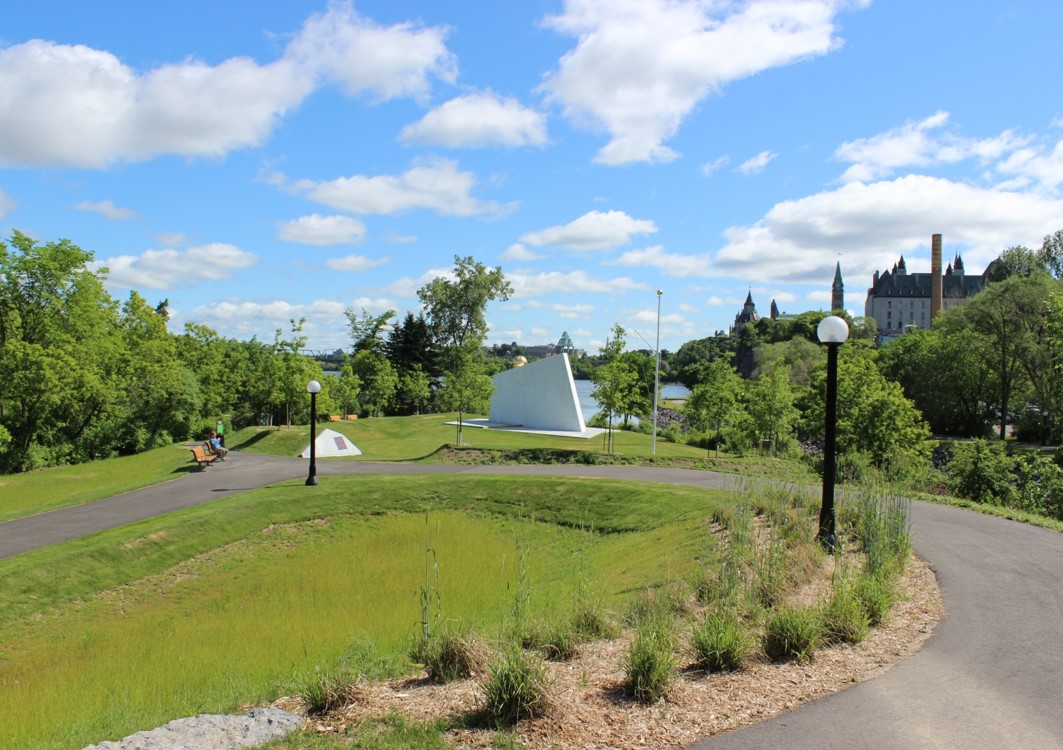



The Royal Canadian Navy Monument commemorates the contributions and sacrifices of the men and women in naval uniform who have served and continue to serve Canada at sea in times of peace and war. Built for the Navy’s Centennial in 2010, it is located at Richmond Landing, a quiet enclave in the heart of Ottawa, surrounded on three sides by water where it juts into the Ottawa River just below the Library and Archives Canada building and not far from the Canadian War Museum.
Rather than a single focal object, the site itself is a key part of the monument. It is a tranquil sloped lawn that provides for a moment of reflective pause while also offering a visceral feeling of flow and movement, like a ship at sea, and contained within the setting of the river and the sky. The monument reflects many facets of the Canadian Navy in its use of the naval colours of black, white and gold.
In addition to the symbolism of the site itself, the monument includes two main components:
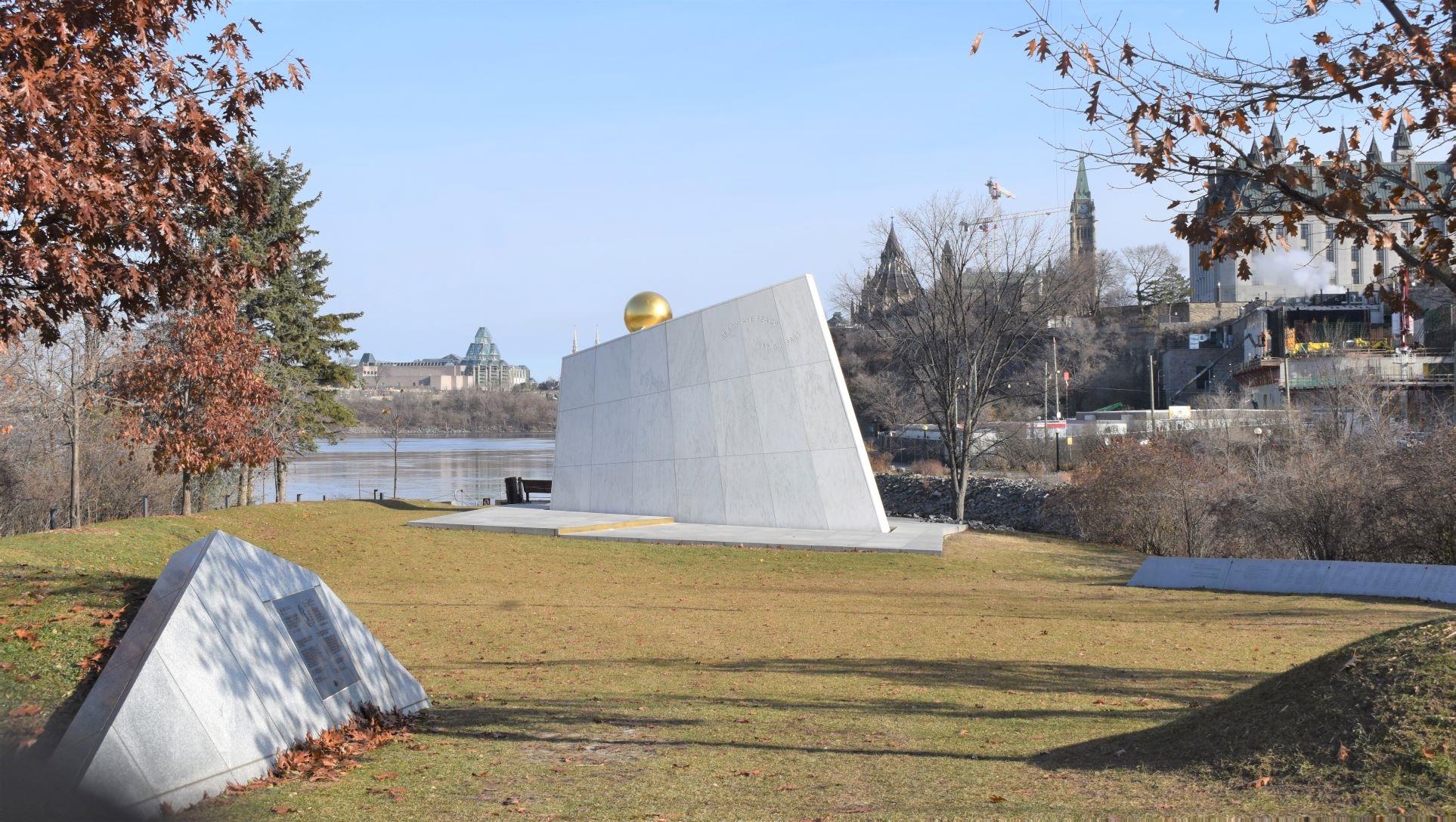
- The Naval Signature: a curved white marble structure that celebrates the navy’s past and future. Its dramatic vertical form suggests many naval associations, from sails to naval attire and even modern stealth ship design. Set into an inclined granite base, it symbolizes the sense of movement inherent in the naval experience. Cut into this inclined granite base are two bronze strips aligned with the North/South and East/West cardinal axes, referencing navigation and Canada’s tri-coastal naval reality. A curved level deck on the east side of the sloped granite plinth provides repose and a comfortable opportunity to read the Naval Battle Honours inscribed in the surface of the marble, as well as a view of the fast-moving Ottawa River. Set into the deck is a fouled anchor, a powerful naval symbol, made of black granite.
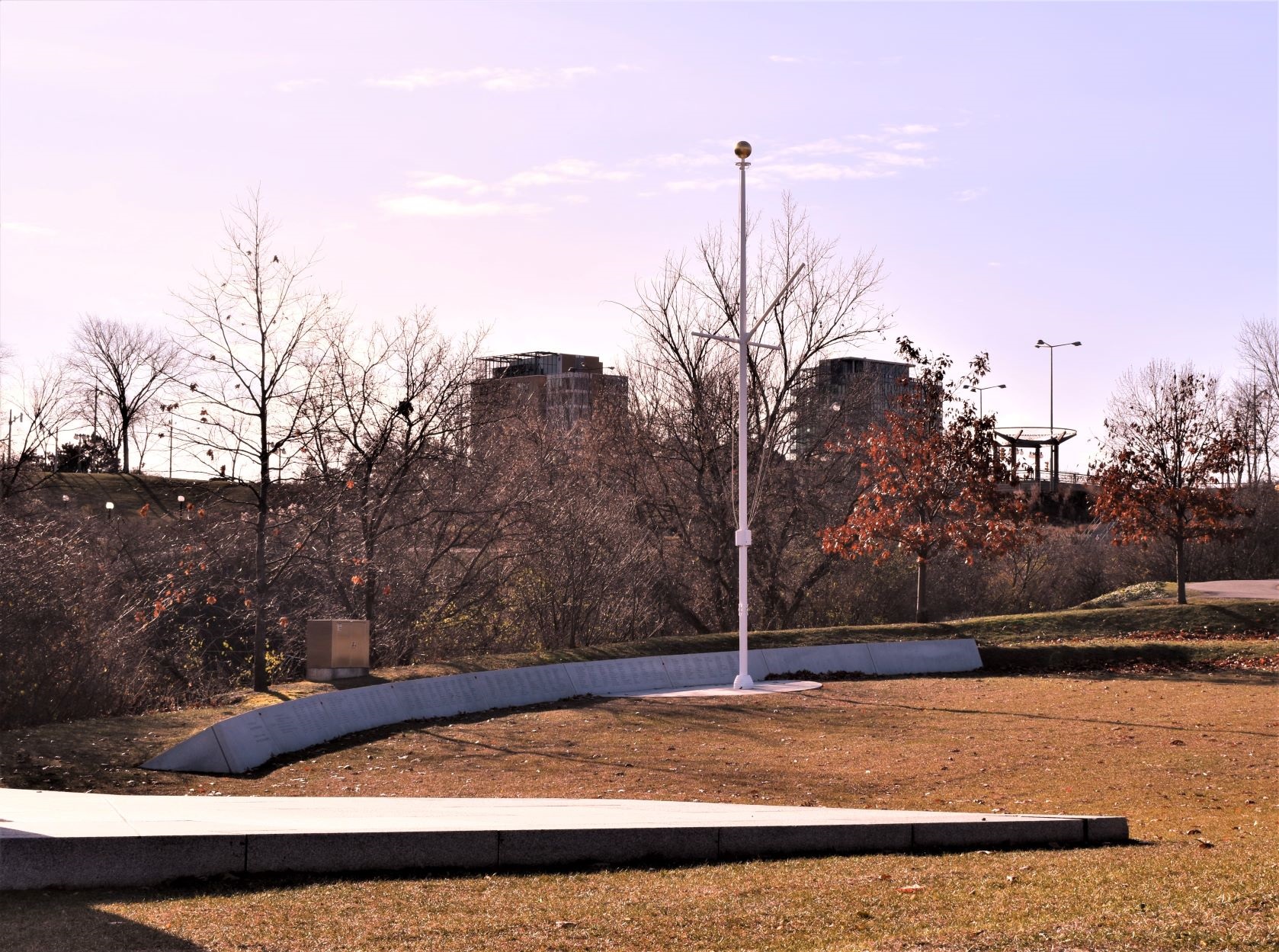
- The Navy Wake: Added to the monument in 2017, this long and low curved wall is inscribed with the names of all Her/His Majesty’s Canadian Ships and naval establishments since the navy’s founding in 1910. Its curvilinear form makes visual reference to many naval shapes including ships, sails, and waves.
And several other elements:
- Mast: contrasting the solidity of stone Naval Signature, the delicate steel navy mast provides a second spatial counterpoint within the monument space. A recognized symbol on all ships and naval establishments, the mast and its flags link past, present, and future.
- Gold spheres: mounted on both the Naval Signature and the mast, these orbs speak of sun, moon, and the global reach of the navy, and to the critical dimension of communications and navigation. The slight offset of the gilded orb on the white marble Signature contributes to the unsettled sense of horizontality.
- Entry threshold / Heart of Oak: a shallow grass berm, surrounded with symbolic oak trees. Oak is a historic shipbuilding material, immortalized in the traditional navy song Heart of Oak.
- Pier on the Ottawa River: a naval reference that makes the monument site symbolically accessible by water, though the pier could also be used for practical ceremonial purposes, for example to land dignitaries on the site from a vessel.
Al McWilliams, a Canadian artist from Vancouver, British Columbia, worked with the architects Joost Bakker and Bruce Haden to create the design of the monument. "During our initial visit to the Richmond Landing site, the three of us were unanimous in thinking that the site, as a land form, needed very little, but subtle, manipulation. The shape of this peninsula, while much like the prow of a ship, also echoed the shape of Canada, a tri-coastal nation surrounded on three sides by water."