

Citation(s);
Military service
Burial/memorial information
Baptized Joseph-Roch-Edmond Fradette. Son of Marie-Louise Clavet (deceased in 1912) and Adélard Fradette (deceased in 1918), of St-Thomas-de-Montmagny and Québec, Québec. He stated being born on 12 September 1896 when he enlisted.
Enlisted in the 57th Battalion of the Canadian Expeditionary Force, service number 502334, he was incorporated into the 41st Battalion, service number 417642, and crossed over to Great Britain on October 18, 1915, landing in Plymouth, England, on the 28th. Incorporated into the 23rd Reserve Battalion on April 20, 1916, he was transferred to the 22nd Battalion on June 28. He left for France on the 29th and landed in Boulogne, Pas-de-Calais, the same day. He joined his new unit and went to the front line on July 2 to take part in the fighting at Zillebeke, Belgium. He was initially reported missing between September 14 and 18, 1916, and was finally recognized as having been killed in action on September 16, 1916, during the Battle of Courcelette. His body was never found.
Digital gallery of Private Edmond Fradette
Digital gallery of
Private Edmond Fradette

Digital gallery of
Private Edmond Fradette
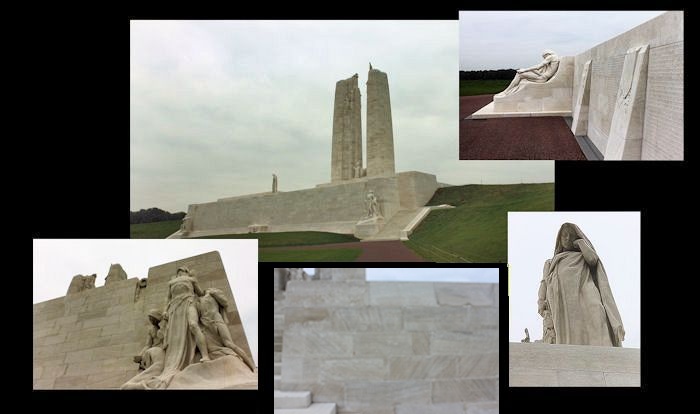
Image gallery
In the Books of Remembrance
Commemorated on:
Page 87 of the First World War Book of Remembrance.
Request this page
Download this page

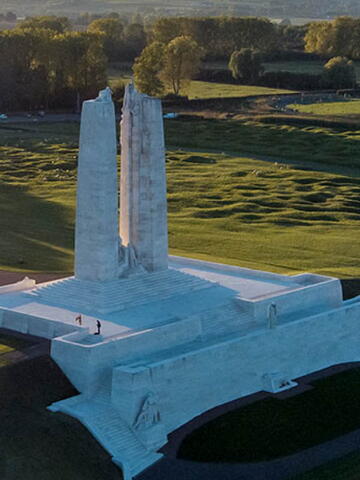
VIMY MEMORIAL Pas de Calais, France
Canada's most impressive tribute overseas to those Canadians who fought and gave their lives in the First World War is the majestic and inspiring Vimy Memorial, which overlooks the Douai Plain from the highest point of Vimy Ridge, about eight kilometres northeast of Arras on the N17 towards Lens. The Memorial is signposted from this road to the left, just before you enter the village of Vimy from the south. The memorial itself is someway inside the memorial park, but again it is well signposted. At the base of the memorial, these words appear in French and in English:
Inscribed on the ramparts of the Vimy Memorial are the names of over 11,000 Canadian soldiers who were posted as 'missing, presumed dead' in France.
A plaque at the entrance to the memorial states that the land for the battlefield park, 91.18 hectares in extent, was 'the free gift in perpetuity of the French nation to the people of Canada'. Construction of the massive work began in 1925, and 11 years later, on July 26, 1936, the monument was unveiled by King Edward VIII.
The park surrounding the Vimy Memorial was created by horticultural experts. Canadian trees and shrubs were planted in great masses to resemble the woods and forests of Canada. Wooded parklands surround the grassy slopes of the approaches around the Vimy Memorial. Trenches and tunnels have been restored and preserved and the visitor can picture the magnitude of the task that faced the Canadian Corps on that distant dawn when history was made.
On April 3, 2003, the Government of Canada designated April 9th of each year as a national day of remembrance of the Battle of Vimy Ridge.
For more information, visit Commonwealth War Graves Commission.
The Poppy Design is a trademark of The Royal Canadian Legion (Dominion Command) and is used with permission. Click here to learn more about the poppy.
Did we miss something?
Contribute information to this commemorative page
Do you have photographs, information or a correction relating to this individual’s virtual memorial? Learn more about the CVWM and the information we collect.