
Order of events
4 August 1914
First World War begins
22 April 1915
Canadians see first major action at Ypres
1 July 1916
Newfoundland Regiment suffers heavy losses at Beaumont-Hamel
9 April 1917
Canadians take Vimy Ridge
14 April 1917
Newfoundland Regiment holds off the enemy at Monchy-le-Preux
15-25 August 1917
Canadians take part in the Battle of Hill 70
November 1917
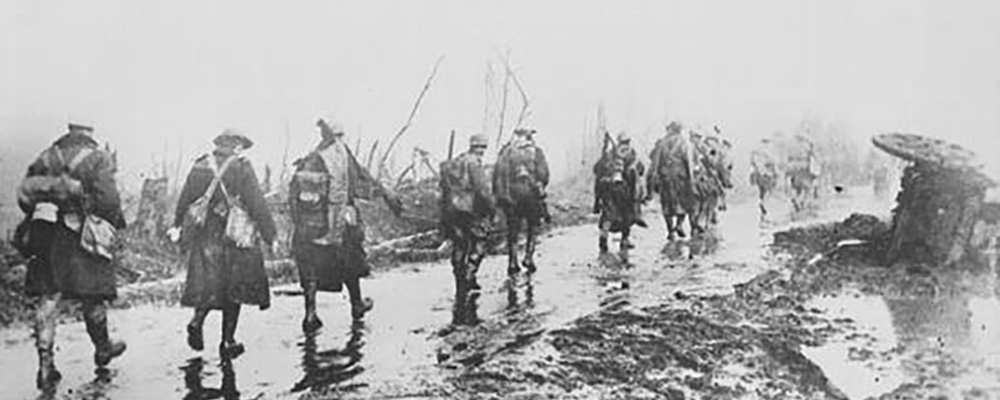
Canadians capture Passchendaele in muddy battle
17 December 1917
Some Canadian women first get to vote a in a federal election
8 August 1918
Battle of Amiens and “Canada's Hundred Days” begin
11 November 1918
Armistice signed ending the war
First World War
1914 – 1918
Read more about the First World War
How the war started
Rival alliances, clashing interests, and secret treaties divided pre-war Europe, and set the stage for a war that would quickly engulf most of the continent, and much of the world.
The immediate cause of the First World War was the assassination of Archduke Franz Ferdinand, the heir to the Austrian throne, in Sarajevo on 28 June 1914. The assassin, Gavrilo Princip, was a member of a Serbian nationalist movement that aimed to unite Serbia and other Slav states, which were then part of the Austro-Hungarian Empire.
Almost everyone expected a short, victorious war – one that would be “over by Christmas.” They were wrong. The war would grind on for more than four years.
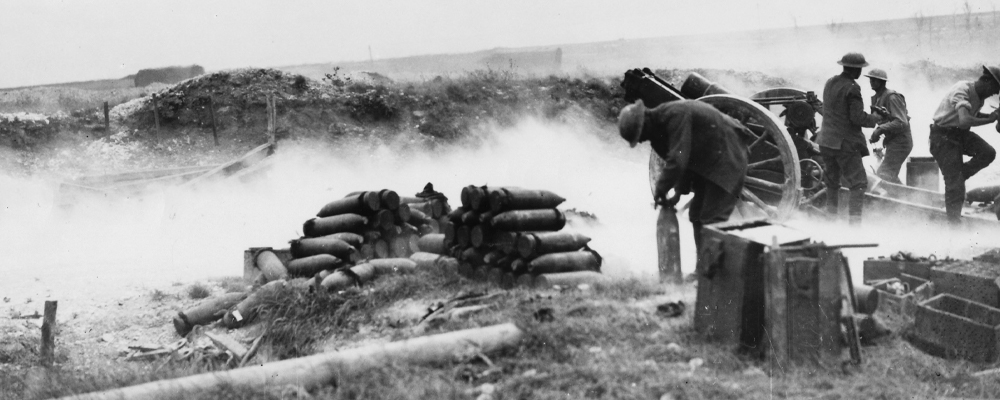
As many as ten million soldiers died in the fighting along with many millions of civilian casualties. Deadly new weapons of war such as high-explosive shells, tanks, powerful machine guns, and poison gas escalated the death toll.
Canada goes to war
Germany invaded Belgium on 4 August 1914. Britain, which had long pledged to defend Belgium’s sovereignty, issued an ultimatum demanding the immediate withdrawal of German troops. When the ultimatum expired at midnight, without a German retreat, Britain and Germany were at war. So too were the nations of Britain’s empire, including Canada and the colony of Newfoundland.
Even though Canada had been its own country since 1867, its external affairs were still governed by the United Kingdom. This meant that once Britain declared war, Canada automatically followed.
Patriotic enthusiasm
In an unprecedented burst of patriotic enthusiasm, Canadians enlisted from across the country. Because pre-war Canada had a very small military, citizen-soldiers would form most of the new Canadian Expeditionary Force.
Thousands showed up at their local recruiting stations eager to “do their bit,” many of them with strong emotional ties to Britain.
Trench warfare
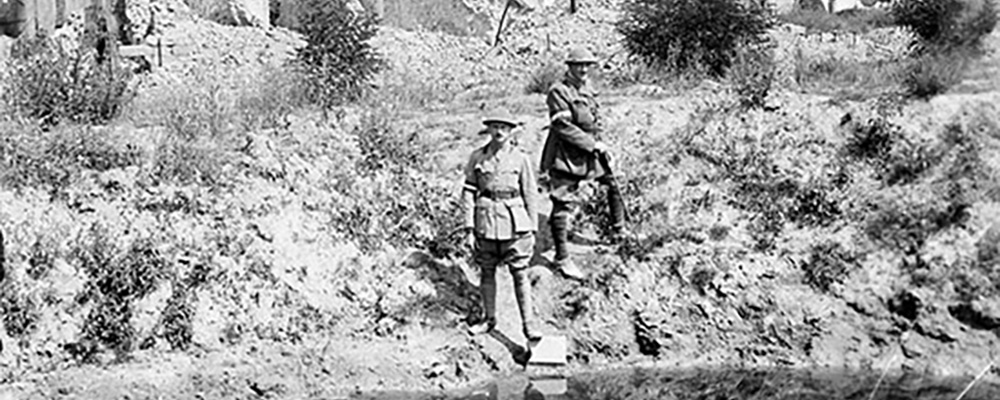
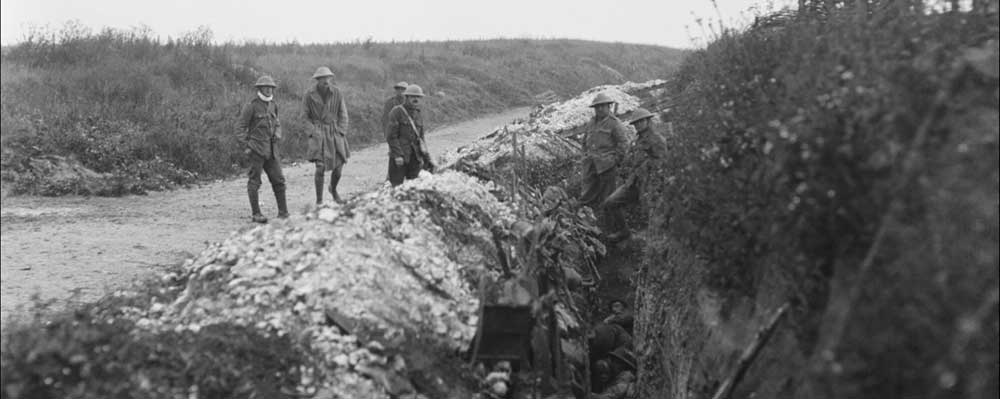
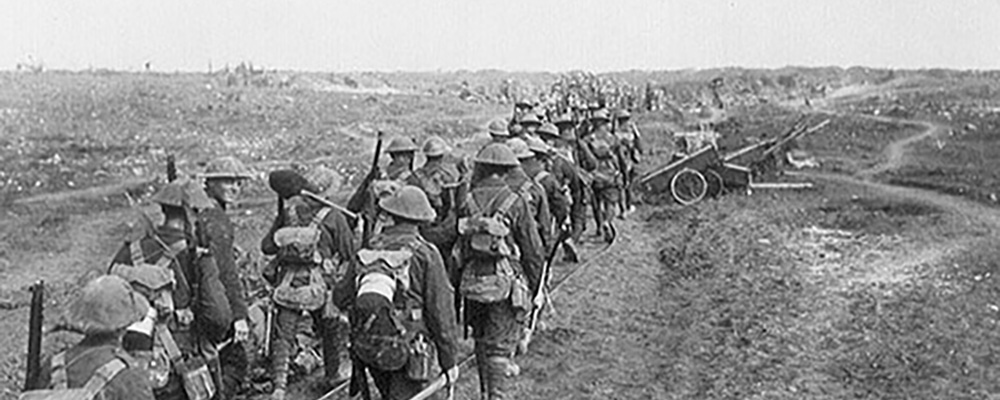
After the initial German advances, the battle on the Western Front quickly turned into a stalemate of trench warfare. The front line zigzagged for nearly 1,000 kilometres, from the coast of Belgium to the border of Switzerland.
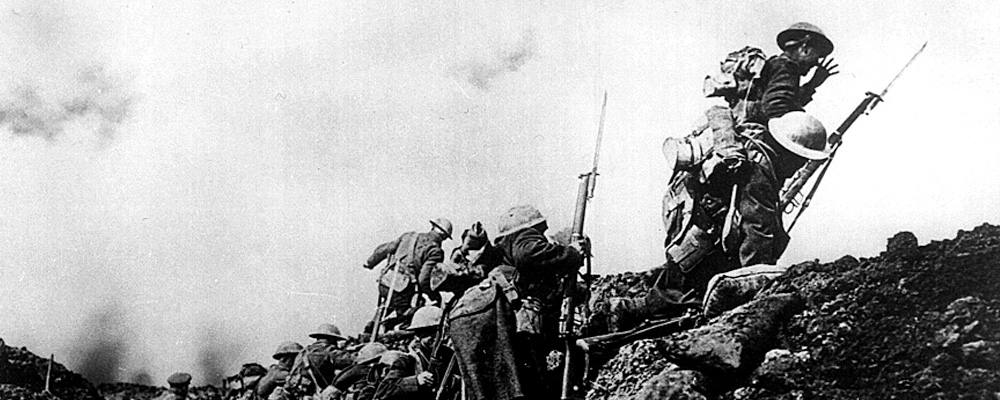
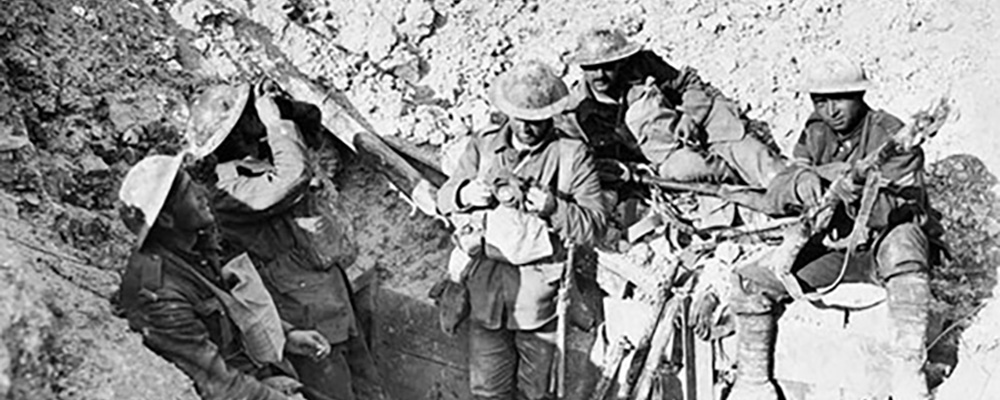
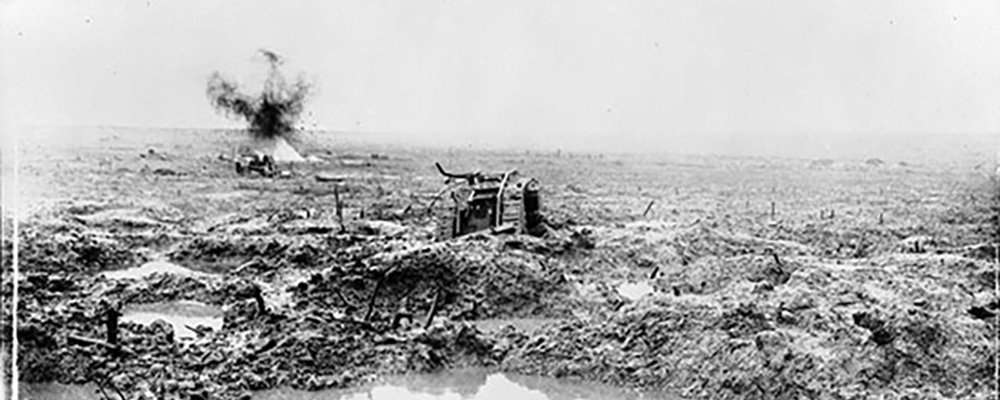
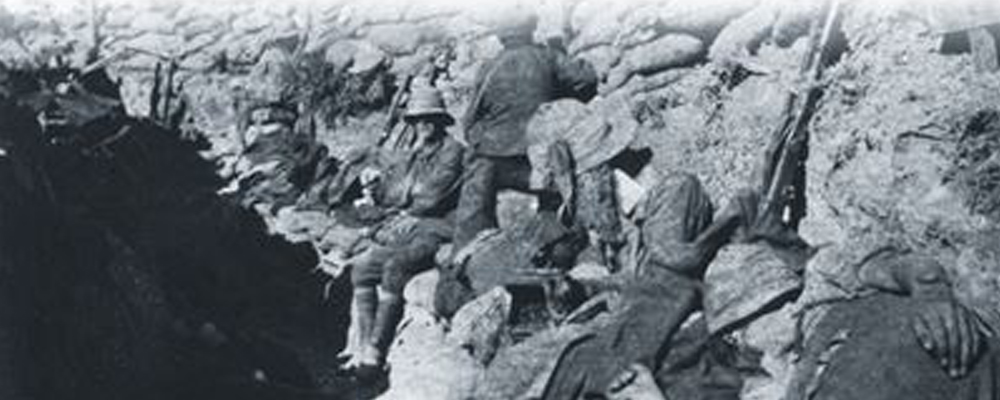
Life for soldiers in the trenches was miserable. They were often muddy and cold and had to live in the midst of pests like rats, lice and fleas. In this form of warfare, soldiers faced the enemy across a narrow strip of land between the opposing trenches. This was a harsh "No Man’s Land" of mud, barbed wire and shell craters, swept by machine gun fire, and menaced by artillery and snipers. This is what soldiers had to cross when they went "over the top" and launched an attack. The dead and injured who fell in No Man’s Land often could not be recovered.
Canada’s army
The Canadian Expeditionary Force (CEF) was the entire overseas force fielded by Canada during the First World War. Of the 650,000 Canadians who enlisted for military service, 424,000 went overseas as part of the CEF.
Canada’s first fighting division in Europe, comprised mainly of troops from the First Contingent who had sailed in autumn 1914, served as an individual division under British command.
In September 1915, the growing size and complexity of Canadian forces overseas led to the creation of the Canadian Corps, an operational and administrative grouping of most Canadian fighting units and their supporting services.
The Corps grew from an initial establishment of two divisions with approximately 35,000 troops to a powerful striking force of four divisions with 100,000 troops by early 1917.
A Canadian commander
At first, the CEF was commanded by British generals. Beginning in June 1917, the Canadians were led by Lieutenant-General Sir Arthur Currie, a Canadian militia officer who rose during the war from command of a brigade to command of the entire Corps.
Currie, who remained in command until 1919, is widely considered one of the war’s most capable generals.
The Corps’ effectiveness
The Canadian Corps was a unique national formation that fought together for most of the war.
The soldiers of the four divisions and their supporting troops learned to work together and could pool resources to improve combat effectiveness. This cohesion and stability, jealously guarded by most senior Canadian military and political figures, bred a sense of identity and pride in national accomplishment.
Legacy
Canada’s role in the war led to more autonomy and international recognition, but came at a great cost.
By the end of the First World War, Canada—at the time a country of fewer than 8 million citizens—would see 650,000 men and women serve; more than 66,000 Canadians and Newfoundlanders died, and another 170,000 were wounded.
Canada’s accomplishments earned it a newfound respect and a recognition—both at home and around the world—as an independent country. This earned Canada a separate signature on the Treaty of Versailles that formally ended the First World War.
Related People and Stories
Related Memorials
Related Medals
Related Lesson Plans
Photo Gallery
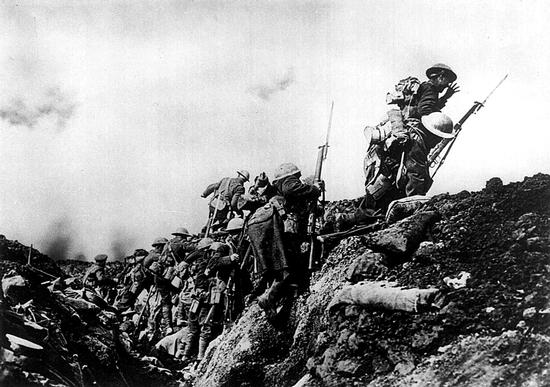
Battalion going over the top. Photo: Library and Archives Canada / PA-142
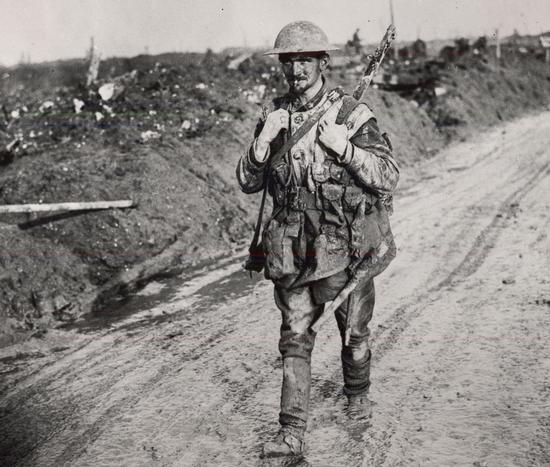
A Canadian covered with mud returning from front. Photo: Library and Archives Canada / PA-867
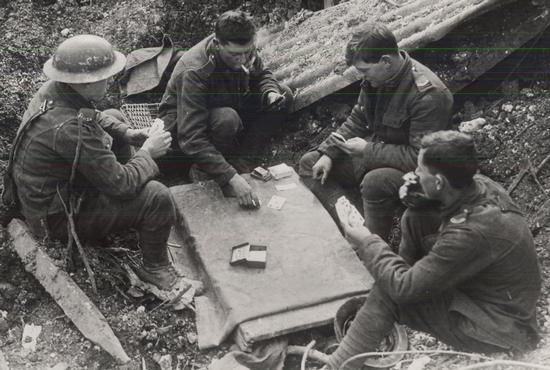
Canadians enjoying a game of cards in a shell hole. April, 1917. Photo: Library and Archives Canada/PA-001181
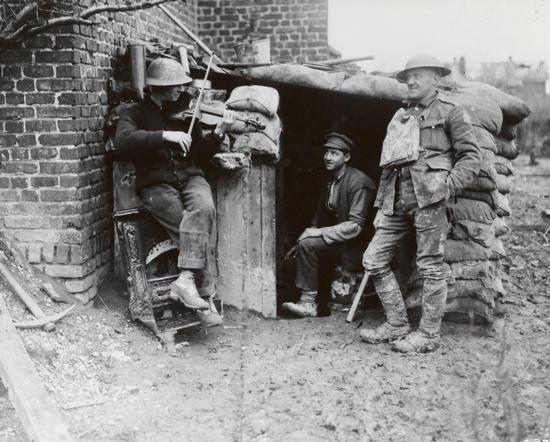
Entertainment. Photo: Library and Archives Canada / PA-2303
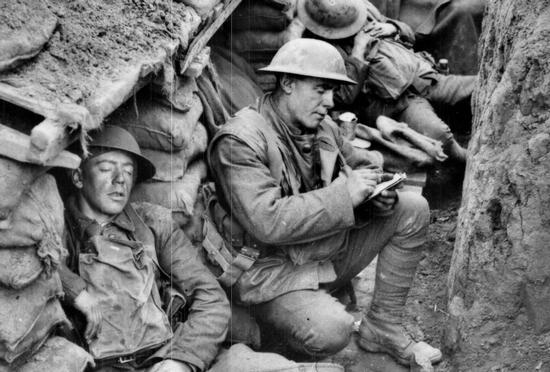
Canadians in a front line trench during the First World War, February 1918. Photo: Library and Archives Canada / PA-2468
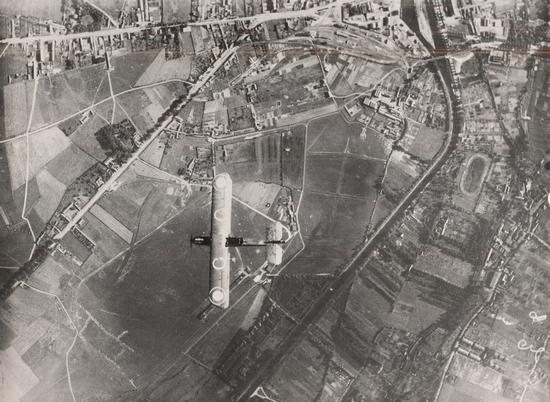
Canadian flier over Cambrai, October 13, 1918. Photo: Library and Archives Canada / C-28029
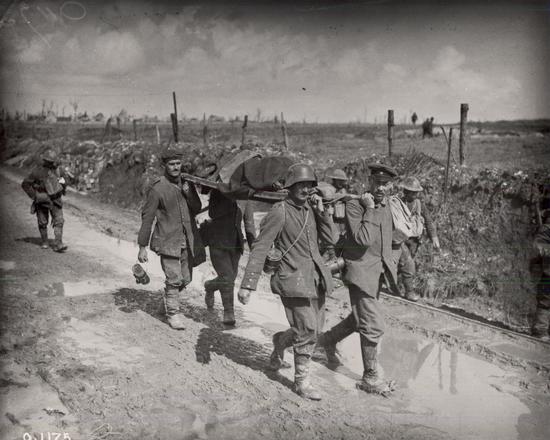
Wounded coming in. Vimy Ridge. April 1917. Photo: Library and Archives Canada
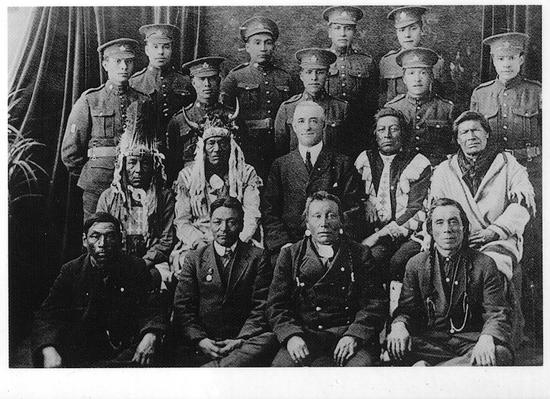
Recruits from Saskatchewan's File Hills community pose with elders, family members, and representative from the Department of Indian Affairs before departing for Great Britain. Photo: Library and Archives Canada / PA-66815
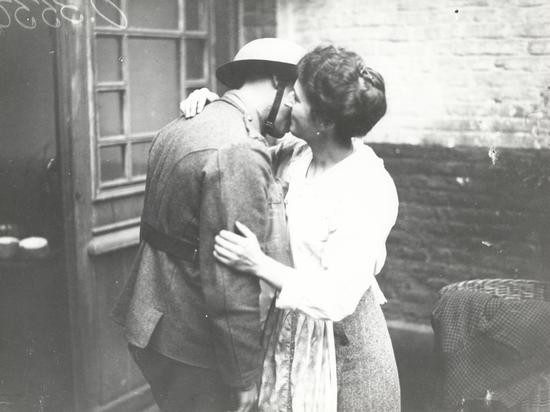
The Liberator. Photo: Library and Archives Canada / PA-3451
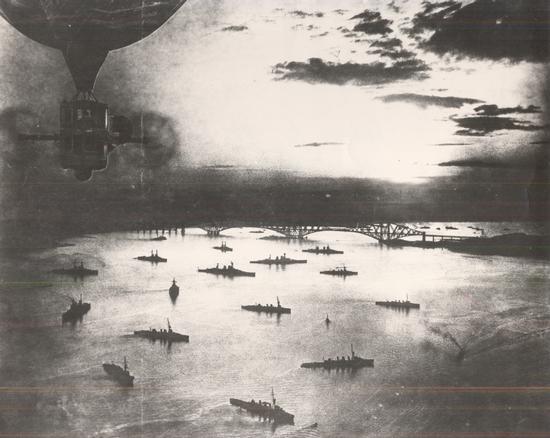
The War at Sea. Photo: Library and Archives Canada / PA-6347
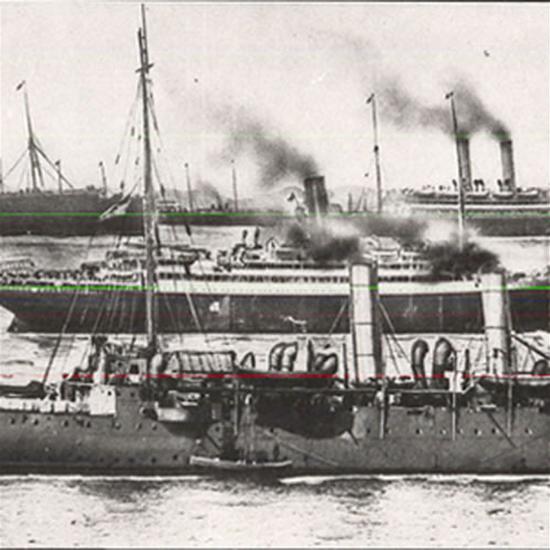
The sailing of the First Contingent. Photo: Library and Archives Canada / PA-6701
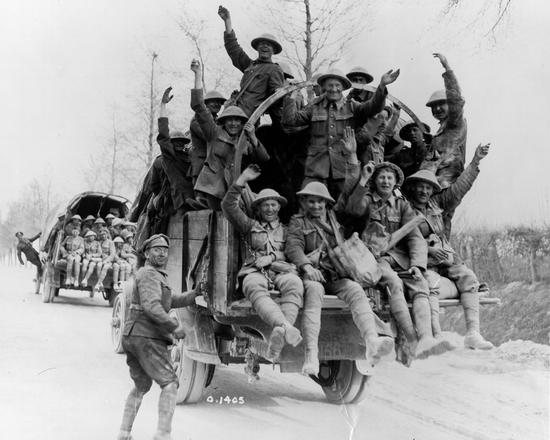
Victorious Canadian troops following the Battle of Vimy Ridge, April 1917. Photo: Library and Archives Canada / PA-001332
First World War
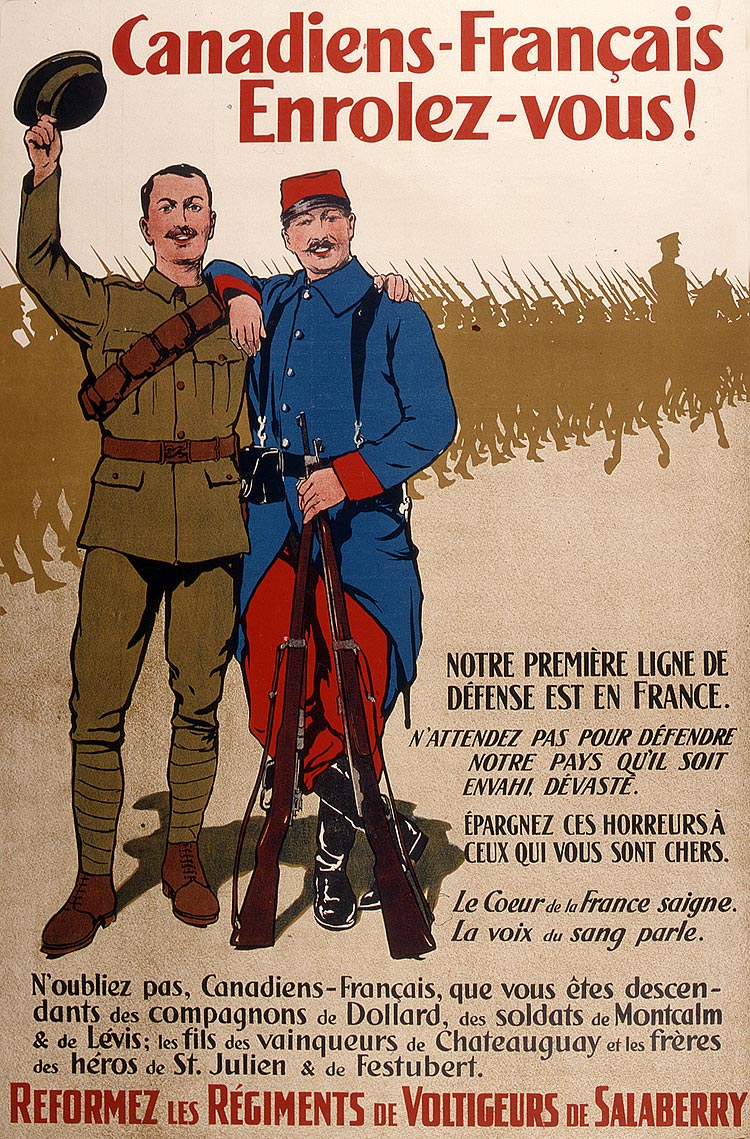
The primary purpose of most of the war posters produced in Canada was recruitment. Upon closer examination, it is evident that the messages were crafted to attract the interest of very specific groups of the population. (Canadiens-français, Enrôlez-vous!
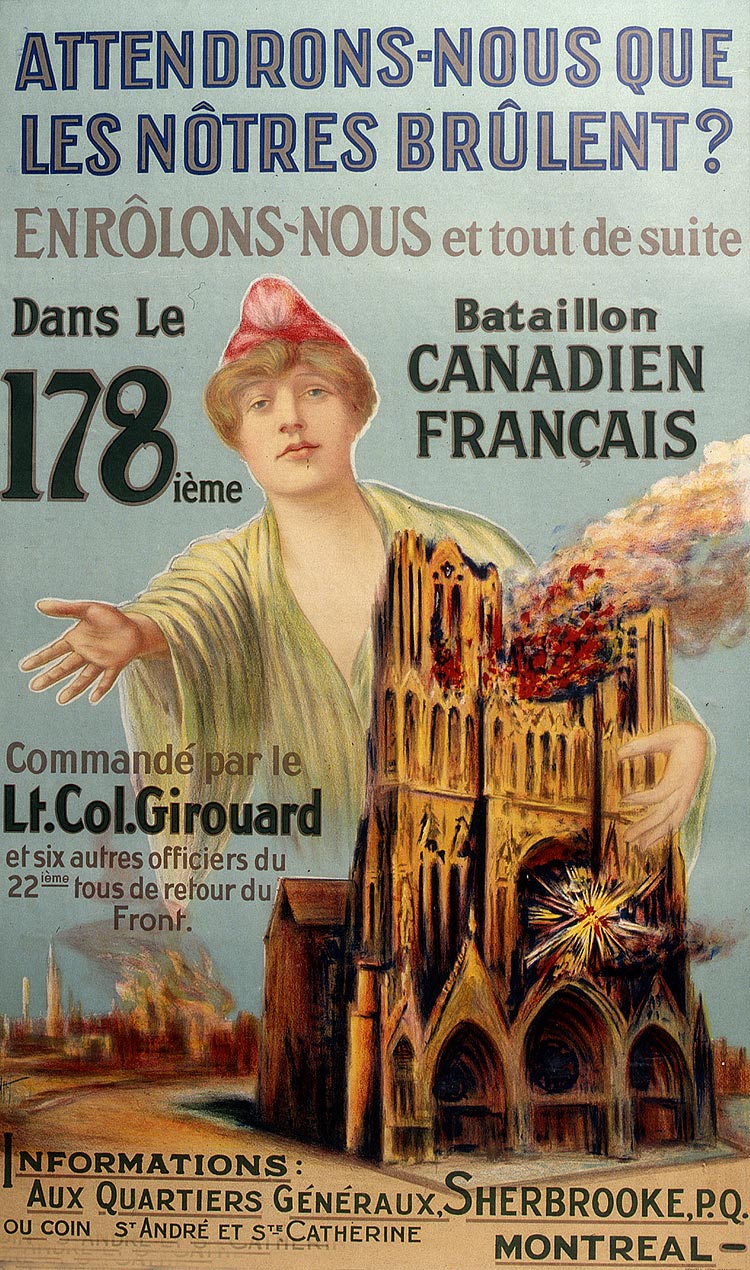
(Attendrons-nous que les nôtres brûlent? T.W.H. Howell. Canadian War Museum.)
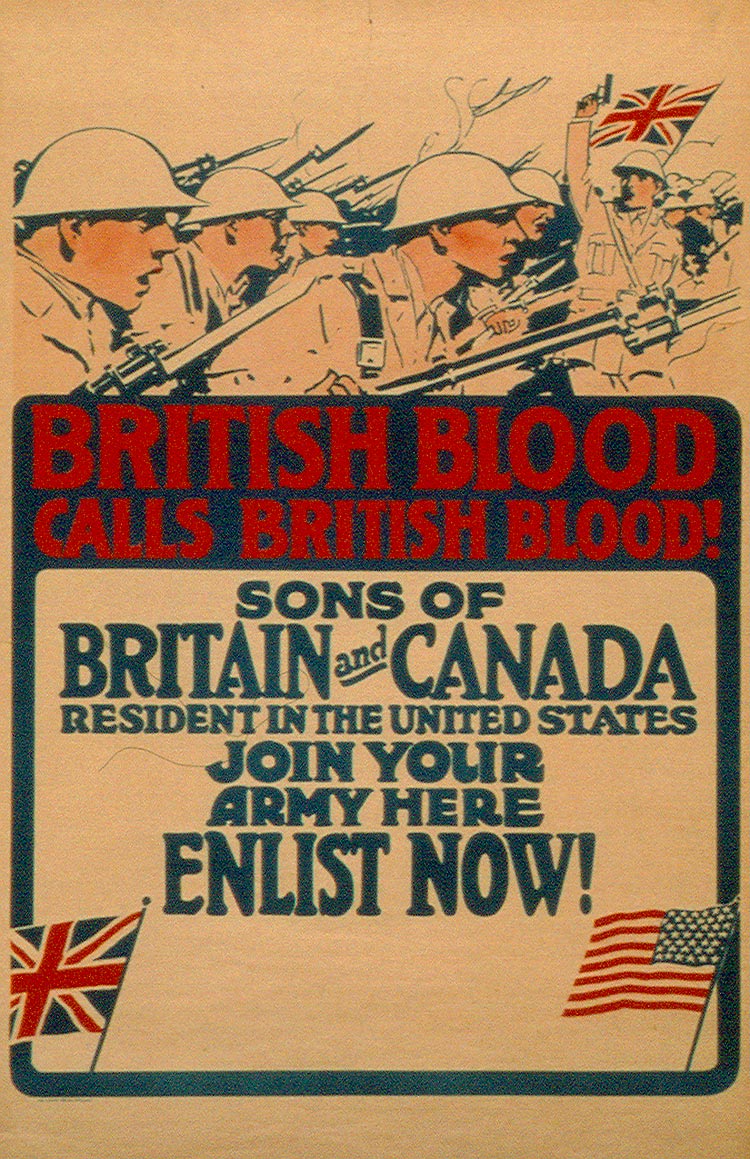
(British Blood Calls British Blood! Canadian War Museum.)
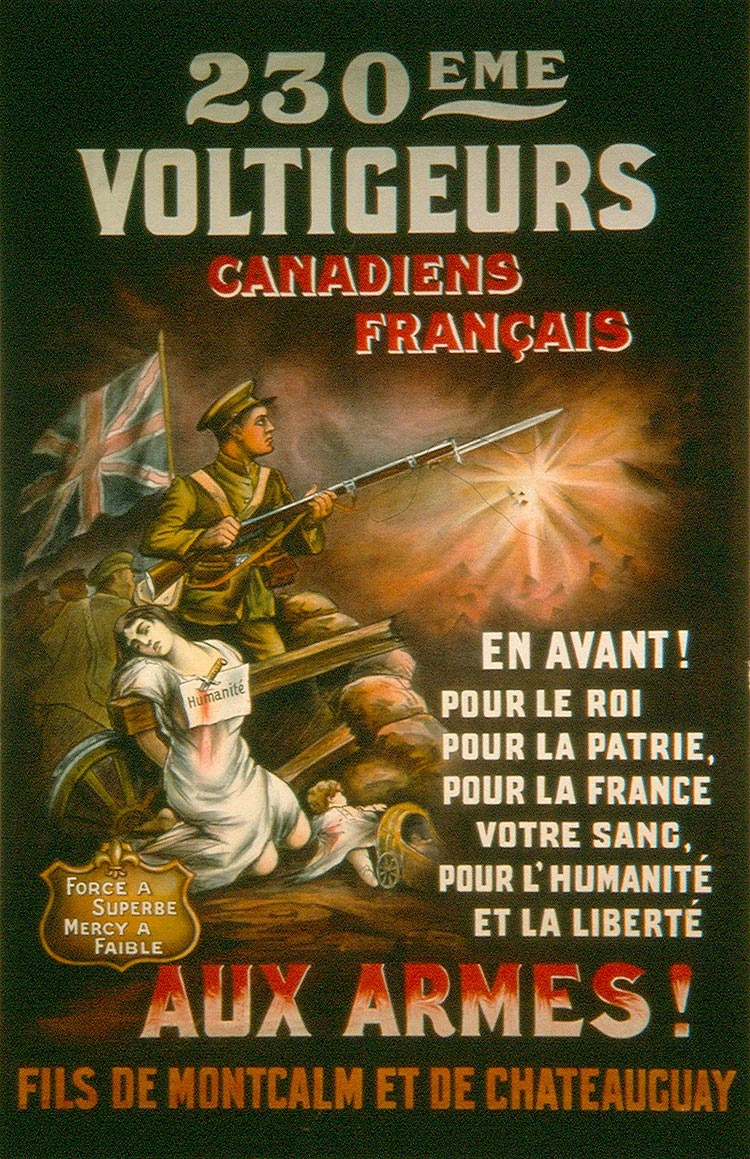
(230ième Voltigeurs, Canadiens-français, aux armes! Library and Archives Canada.)
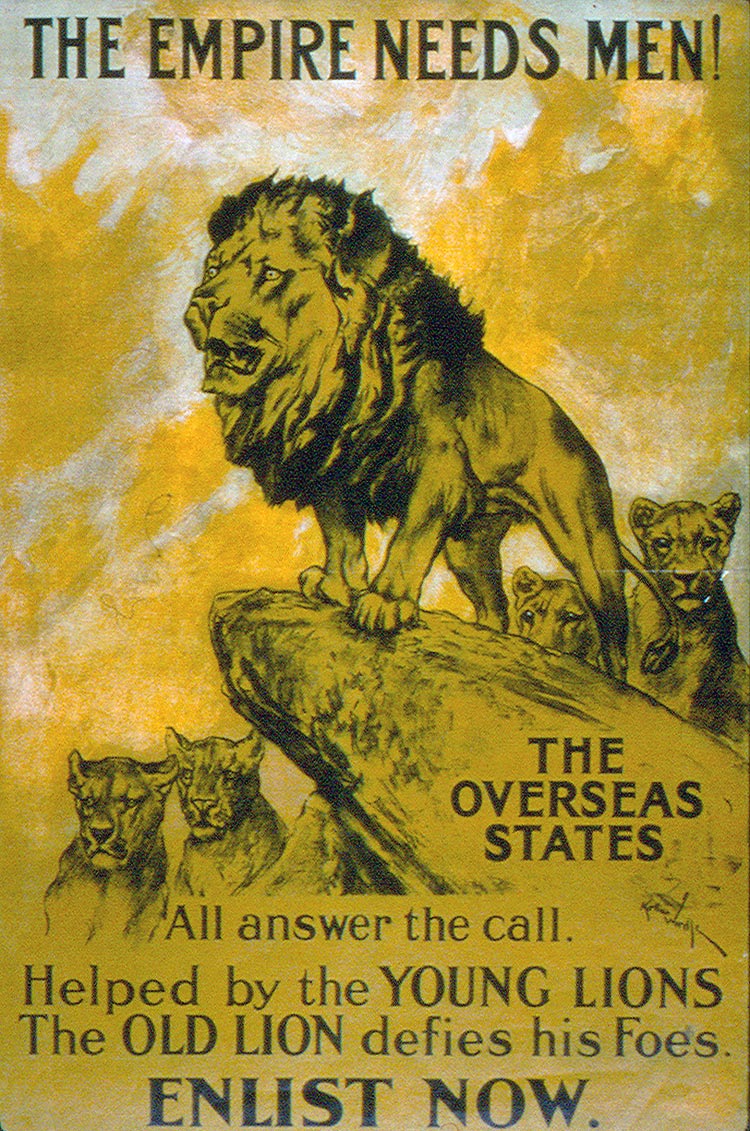
(The Empire Needs Men! Canadian War Museum.)
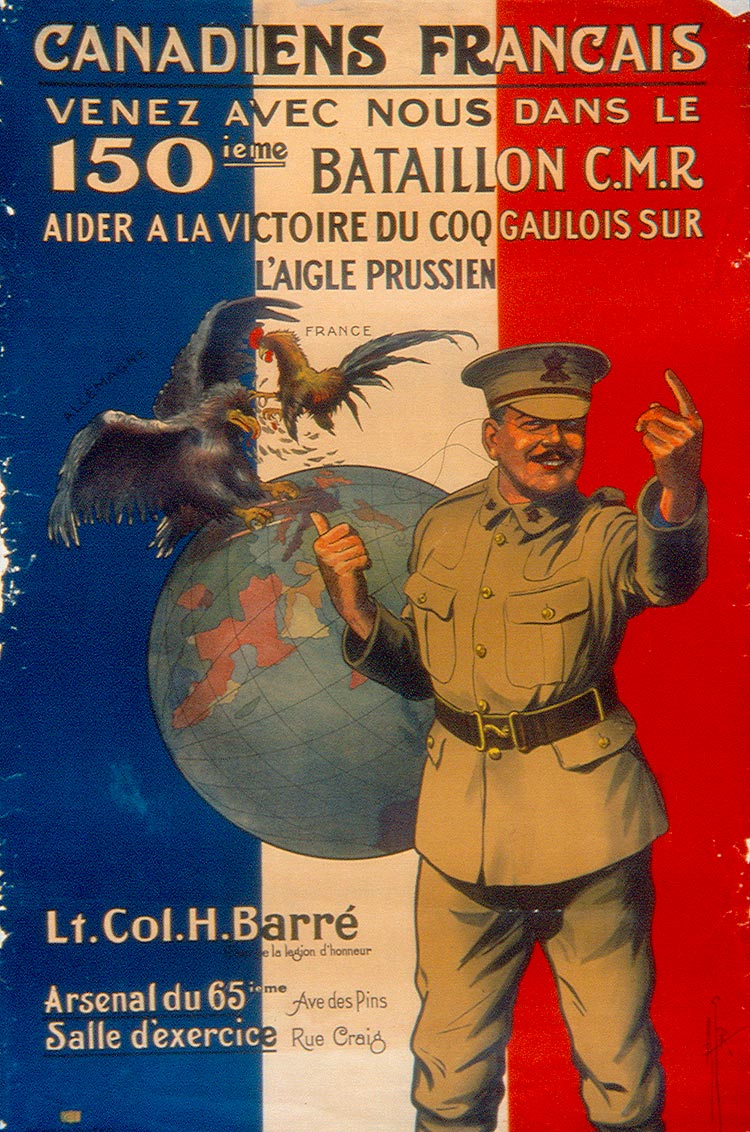
(Canadiens-français, venez avec nous dans le 150ième Bataillon CMR. Canadian War Museum.)
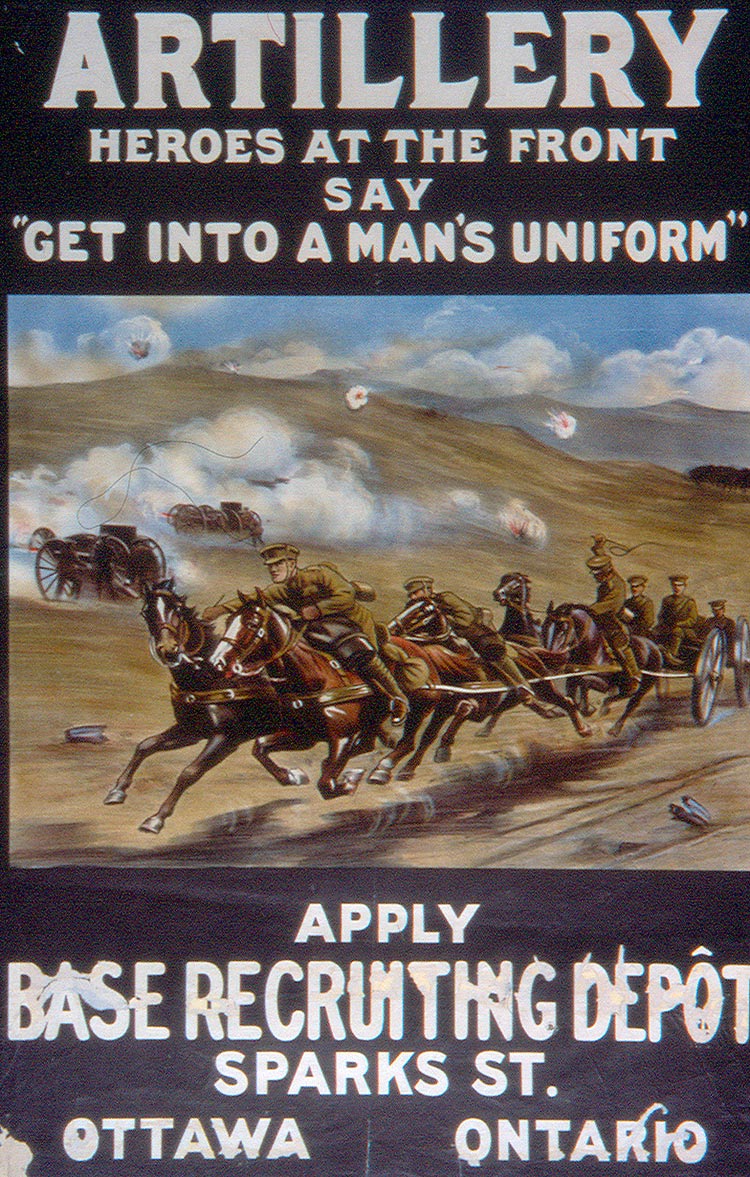
(Artillery Heroes at the Front Say
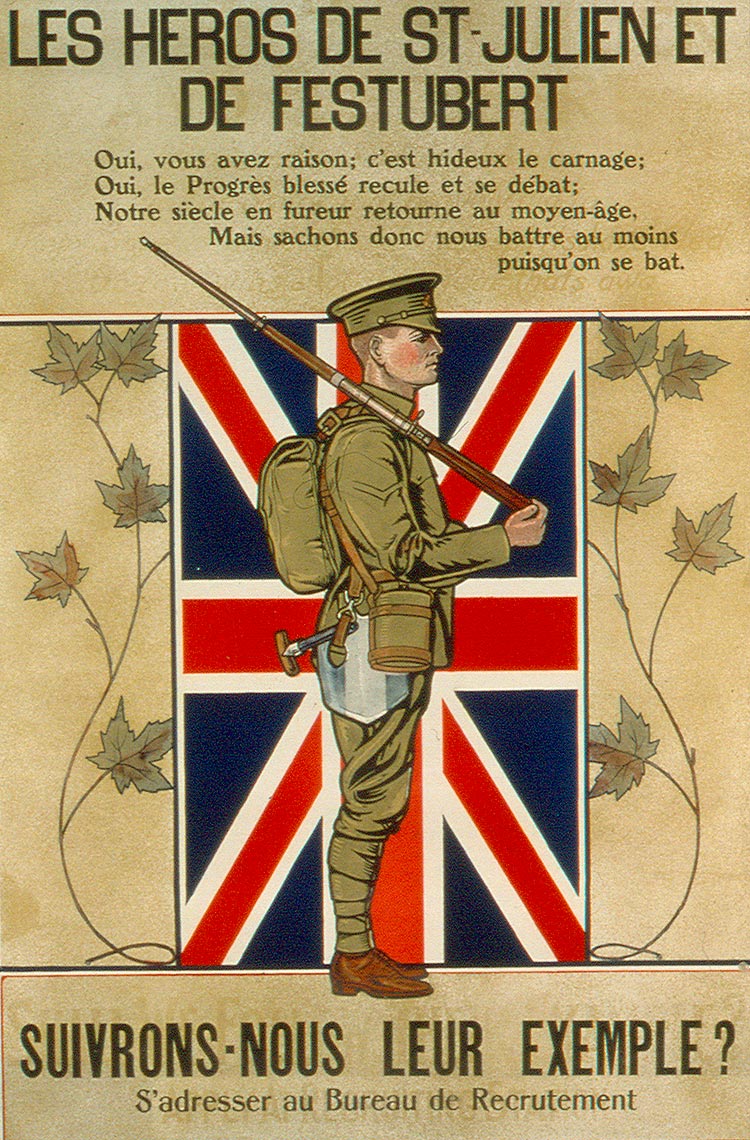
(Les héros de St-Julien et de Festubert. Canadian War Museum.)
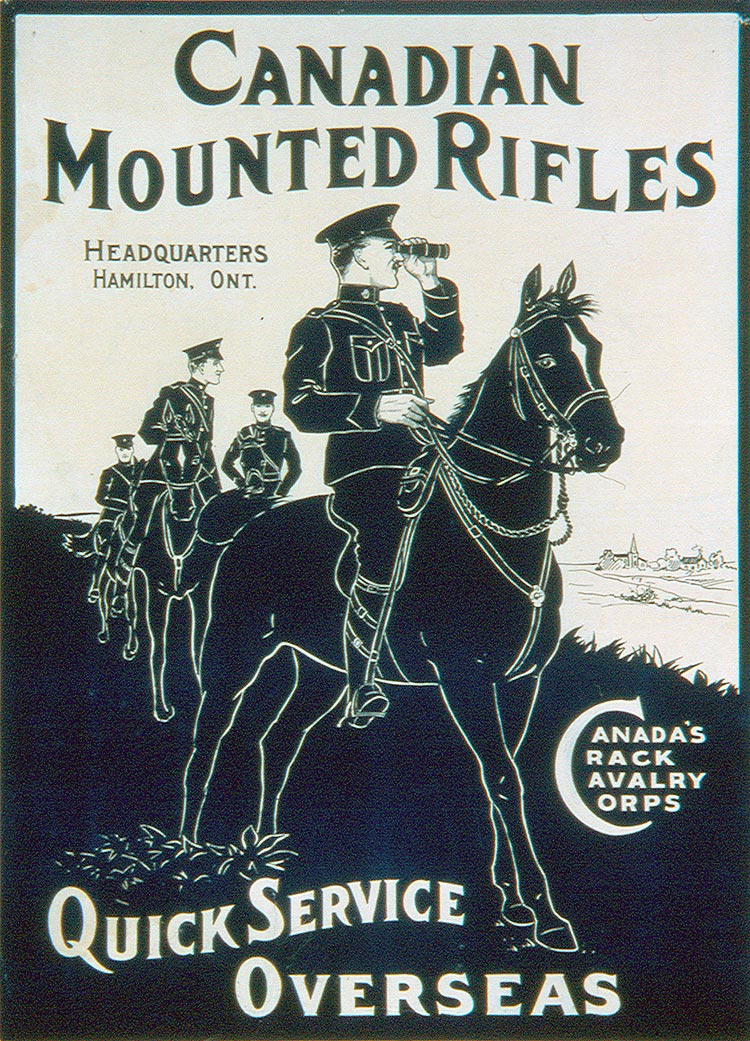
(Canadian Mounted Rifles – Quick Service Overseas. Library and Archives Canada.)
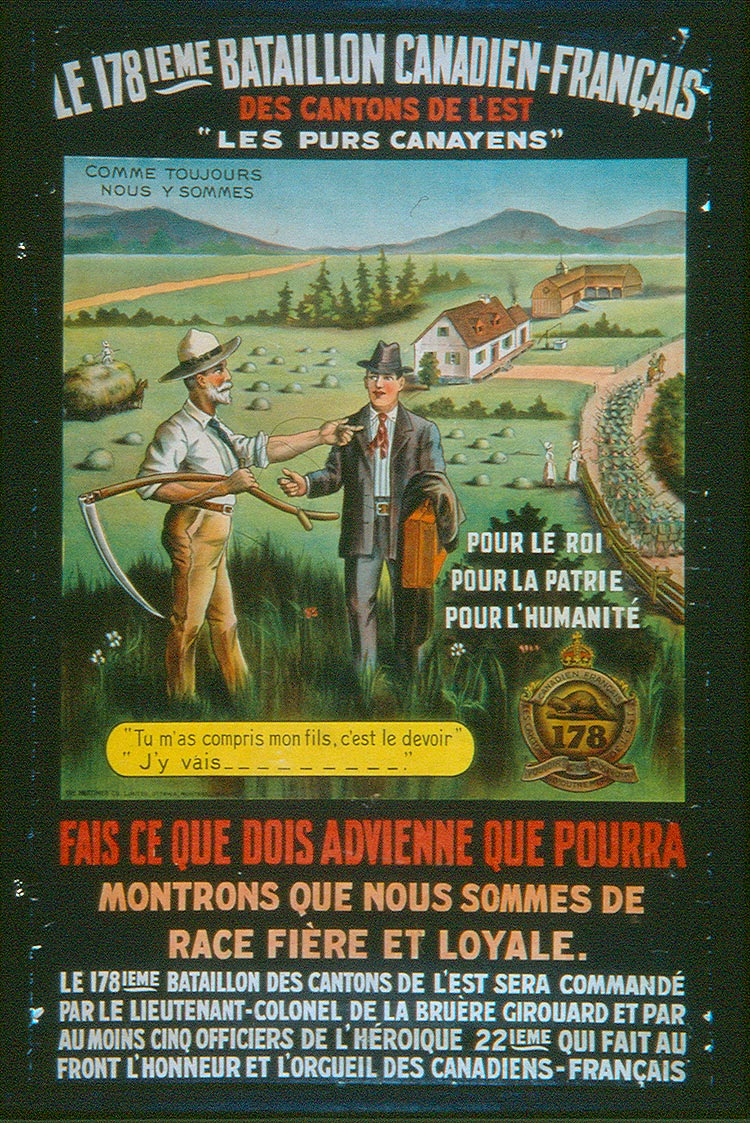
(Le 178ième Bataillon canadien-français des Cantons de l'Est. Library and Archives Canada.)
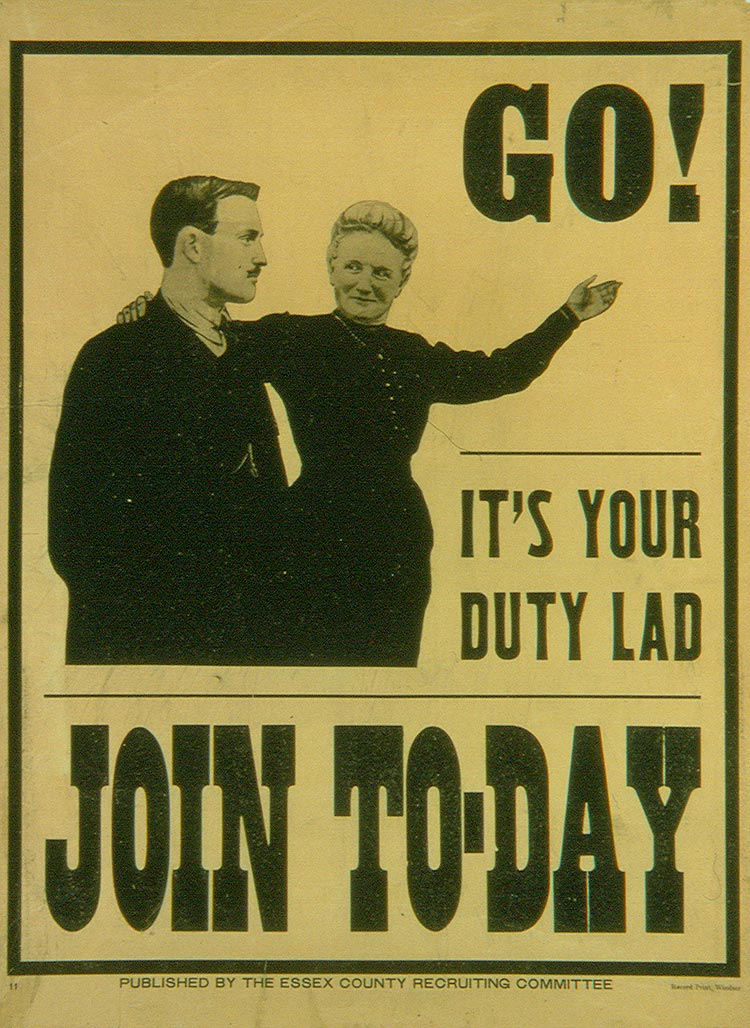
(Go! It's your duty lad. Join to-day. Library and Archives Canada.)
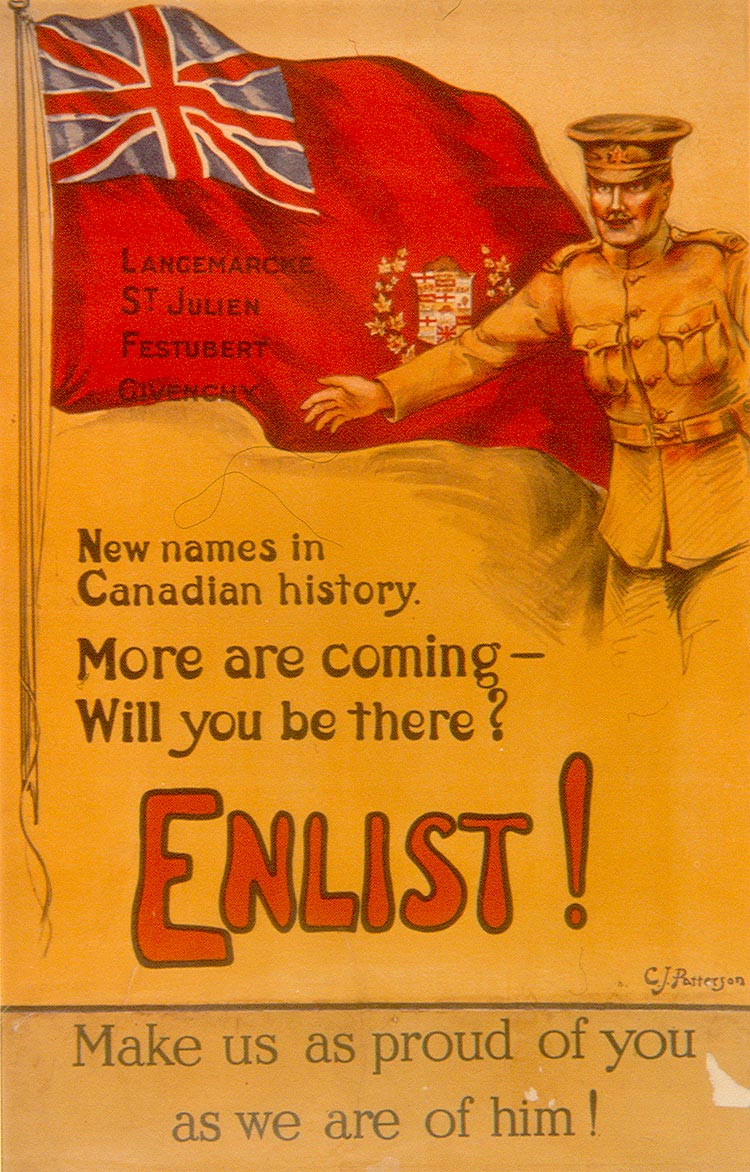
(Enlist! New names in Canadian history. More are coming. Will you be there? Library and Archives Canada.)
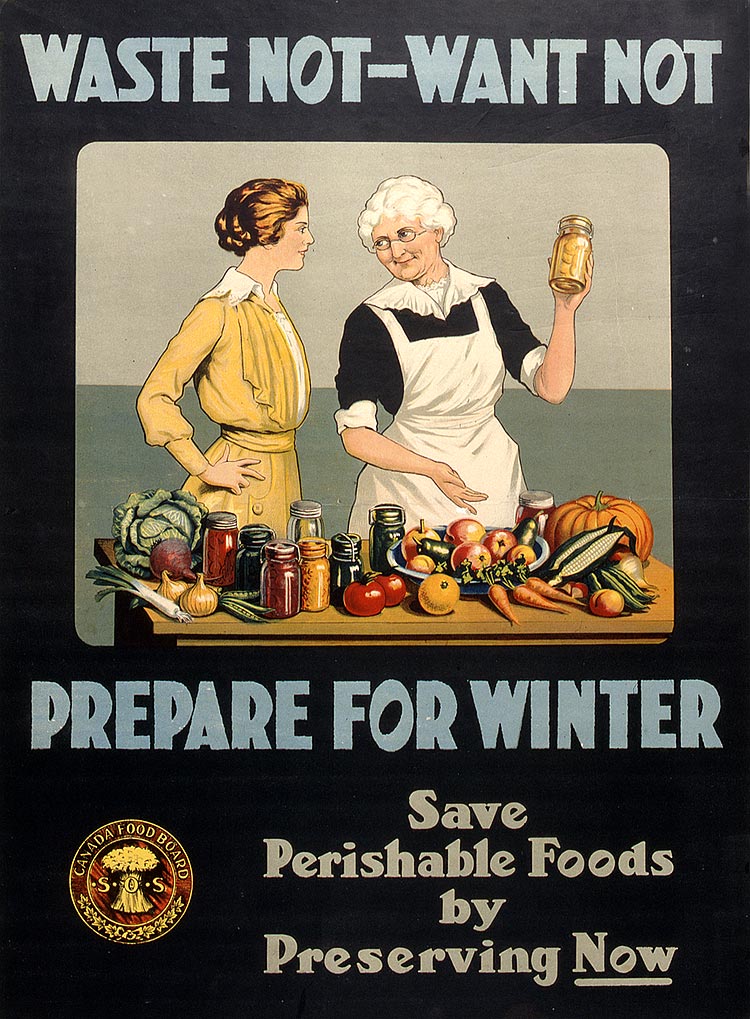
Some posters served the purpose of urging civilians to support the war effort by reducing waste at home and producing more goods for the men overseas. The next few posters were published by the Canada Food Board, an organization founded in 1918 with the g
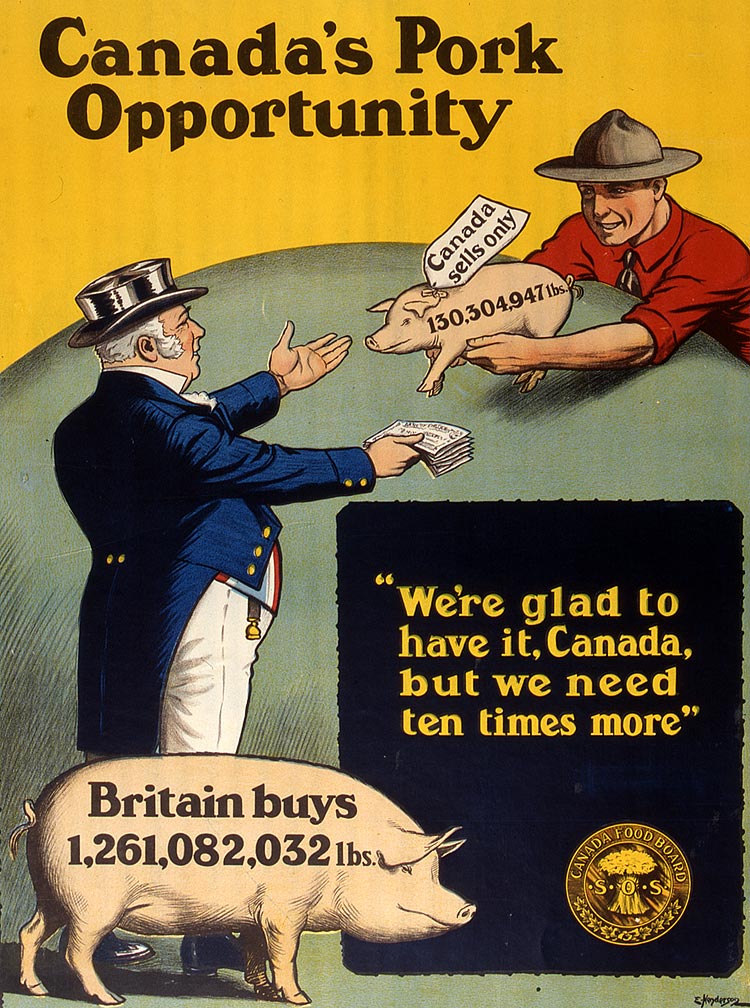
(Canada's Pork Opportunity. Canada Food Board.)
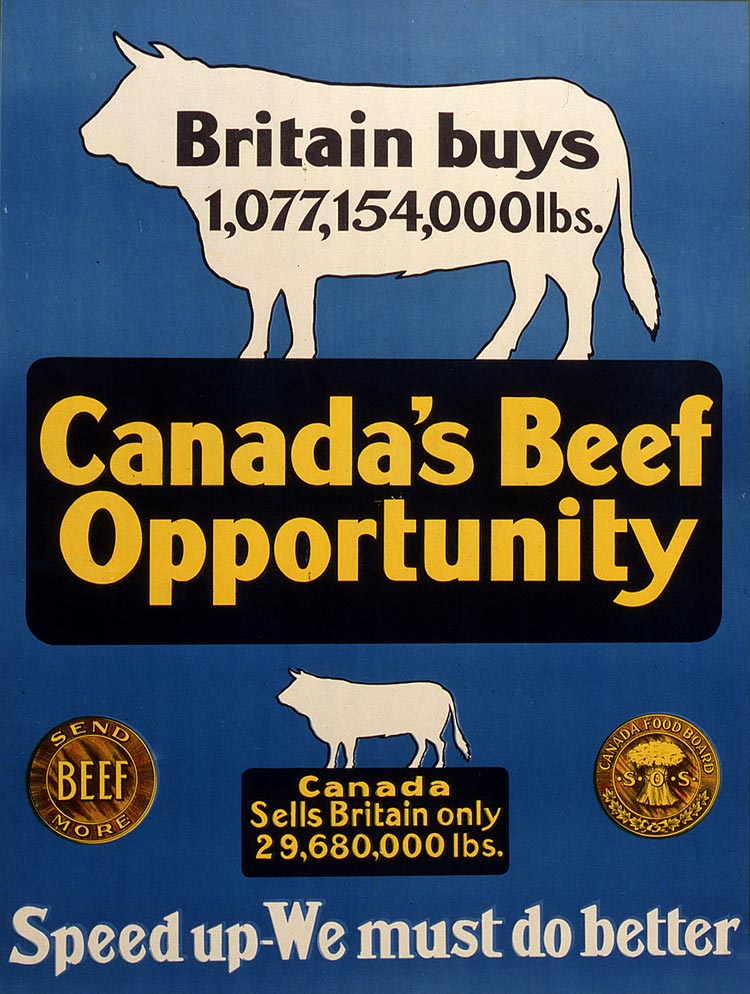
(Canada's Beef Opportunity. Canada Food Board.)
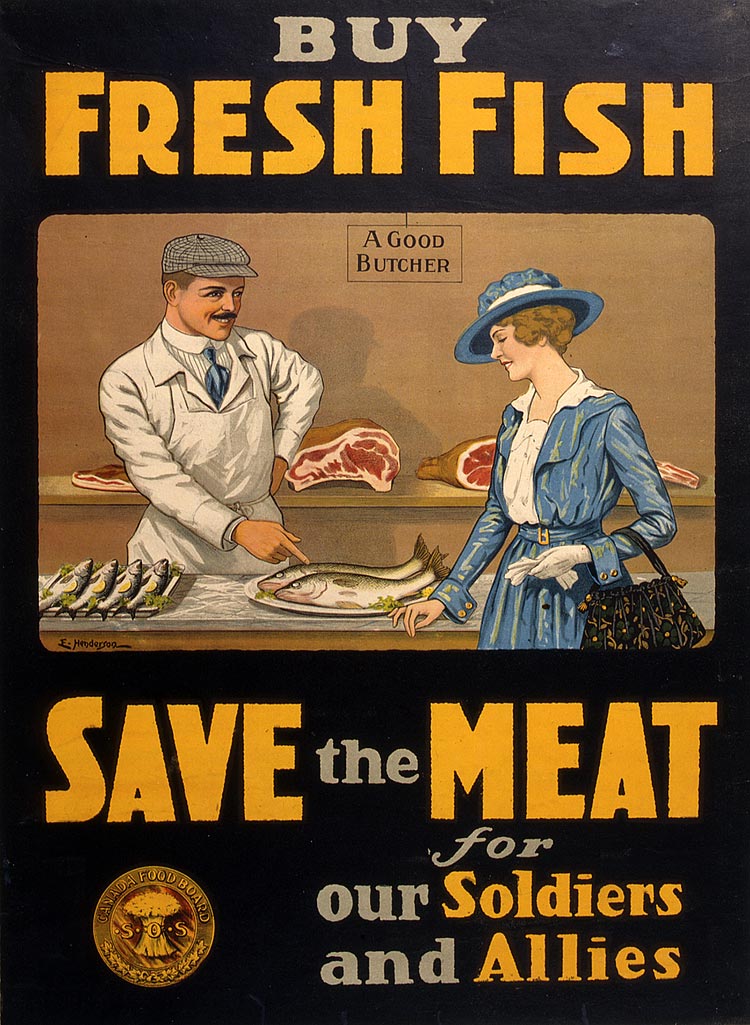
(Buy Fresh Fish – Save the Meat. Canada Food Board.)
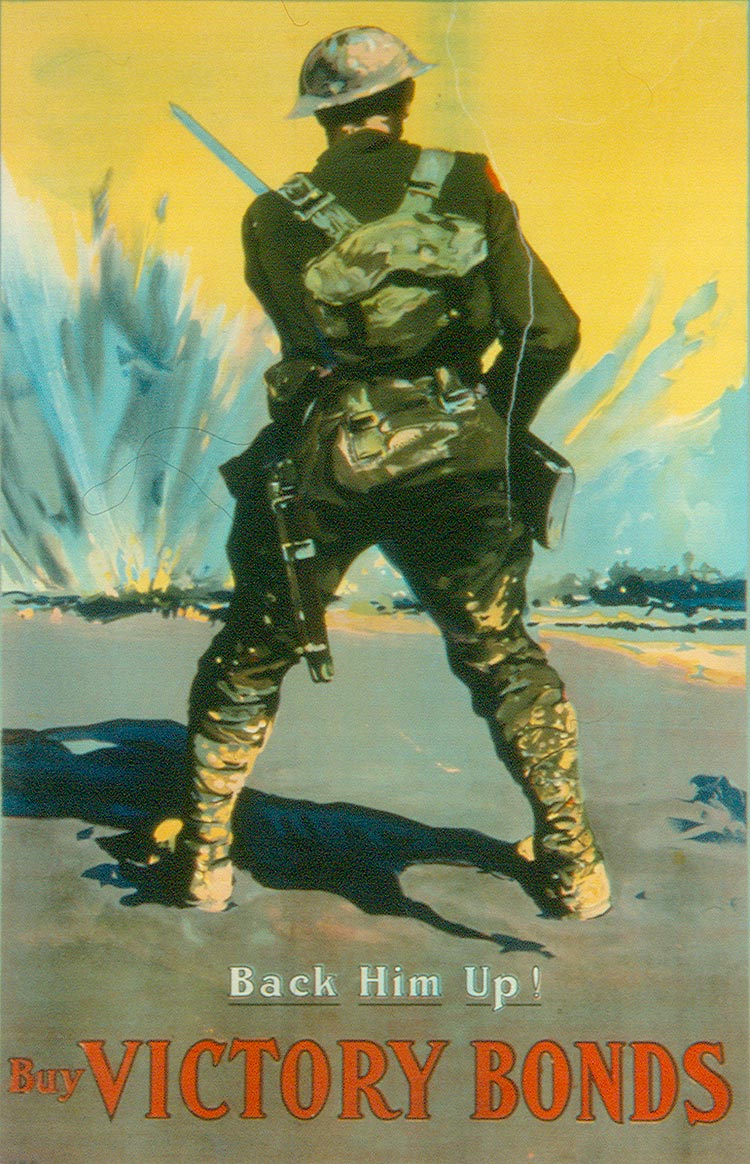
Another type of war poster existed for the sole purpose of bringing civilian money to the war effort by promoting the sale of Victory Bonds. These were similar in essence to what we now call Canada Savings Bonds except for the fact that all funds collecte
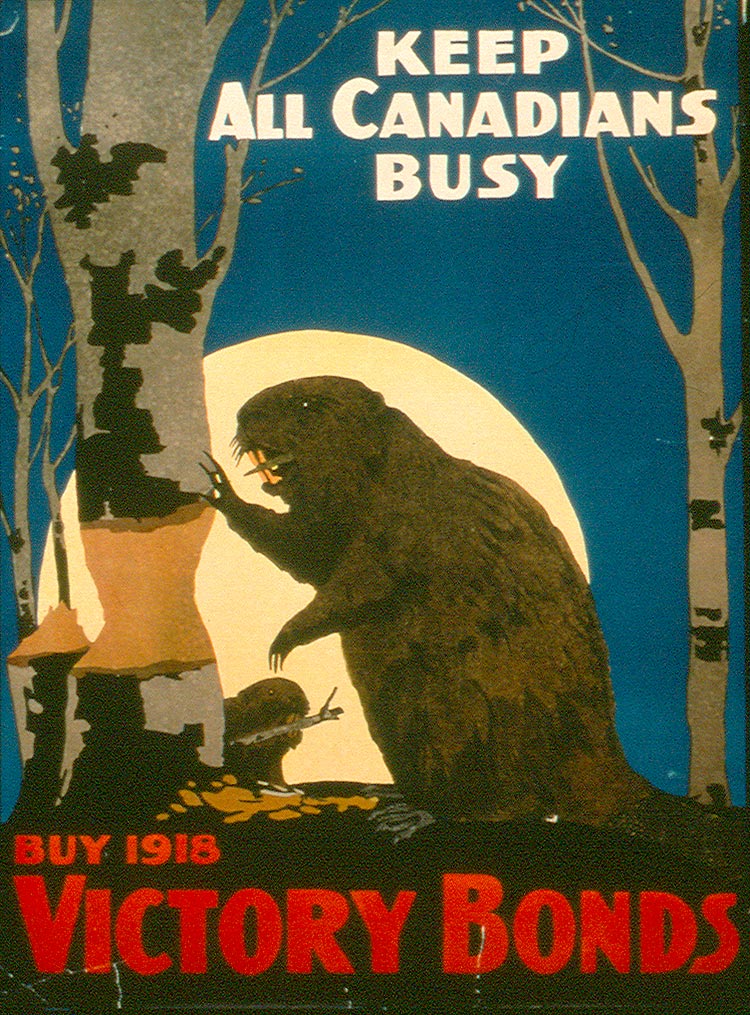
(Keep all Canadians Busy - Buy 1918 Victory Bonds. Canadian War Museum.)
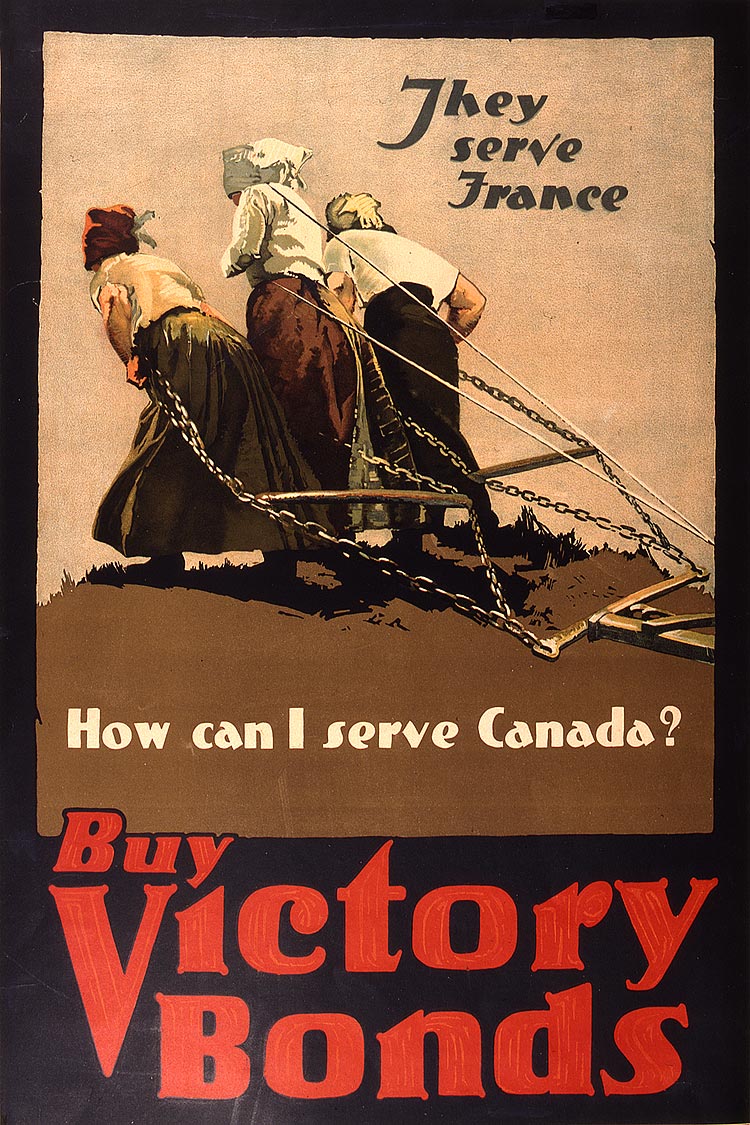
(Buy Victory Bonds. They serve France. How can I serve Canada? The Brown Brothers Ltd. Canadian War Museum.)
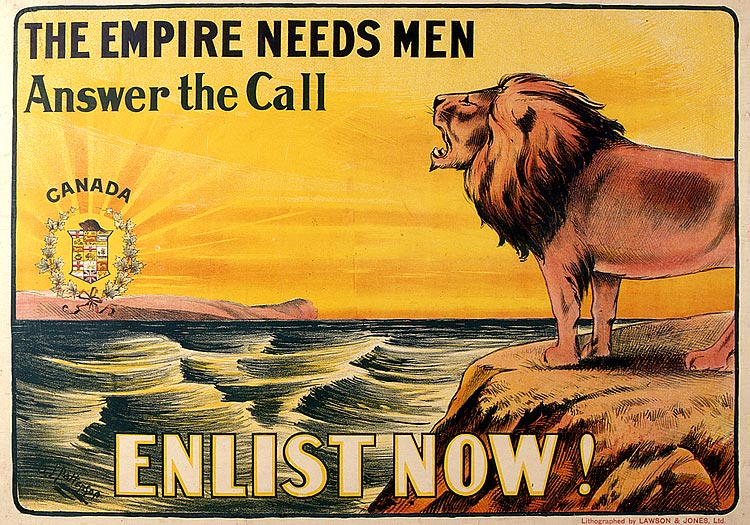
(The Empire Needs Men – Answer the Call. C.J. Patterson. Library and Archives Canada.)
Posters
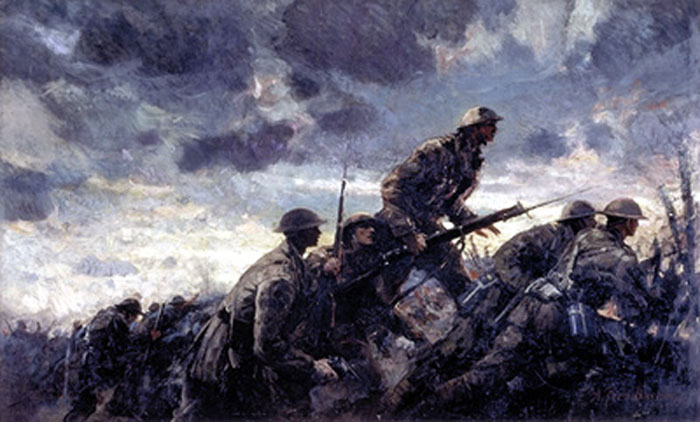
Over the Top, Neuville-Vitasse Painted in 1918 by Alfred Bastien
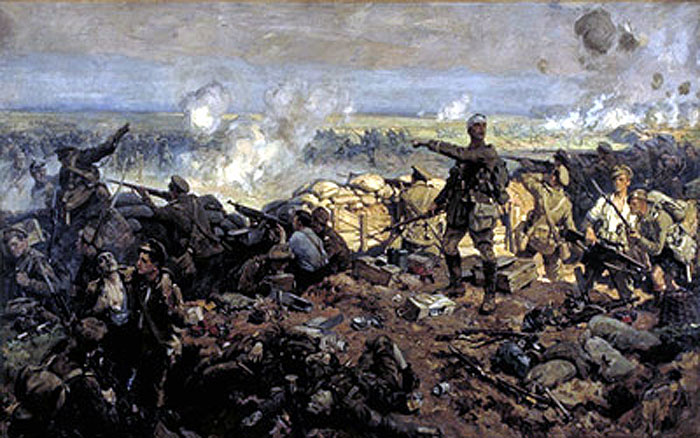
The Second Battle of Ypres, 22 April to 25 May 1915 Painted in 1917 by Richard Jack
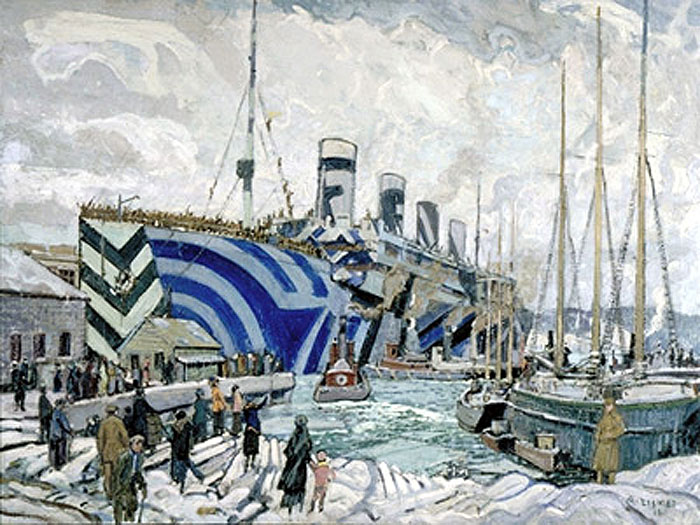
Olympic with Returned Soldiers Painted in 1919 by Arthur Lismer
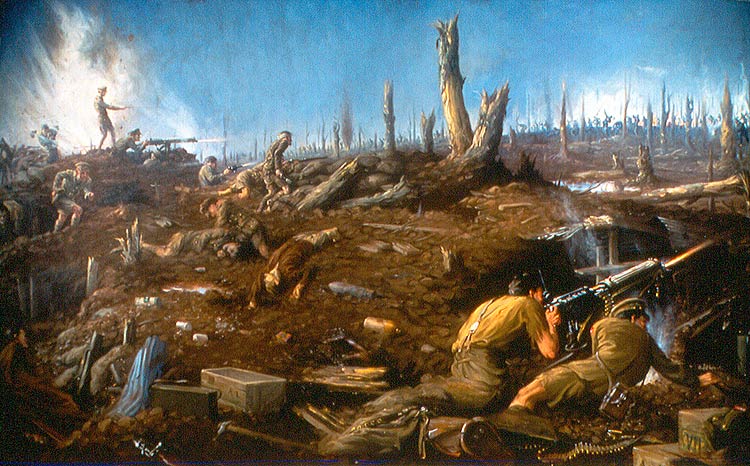
(The Defense of Sanctuary Wood. Kenneth Keith Forbes. Canadian War Museum.)
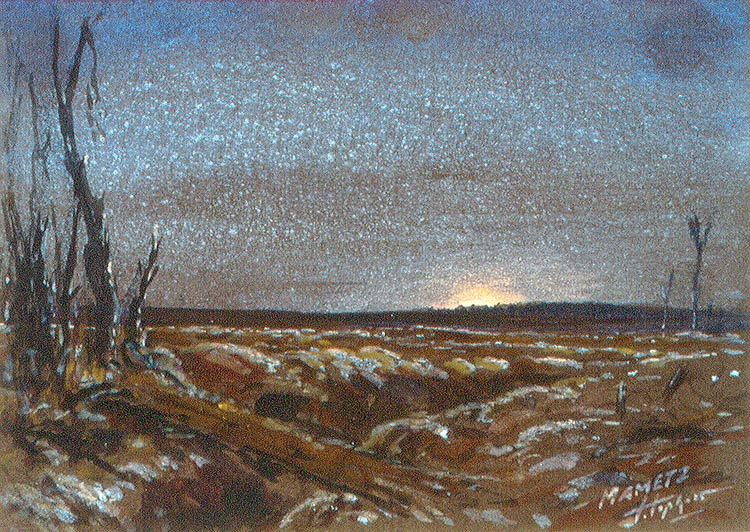
(Moonrise Over Mametz Wood. William Thurstan Topham. Canadian War Museum.)
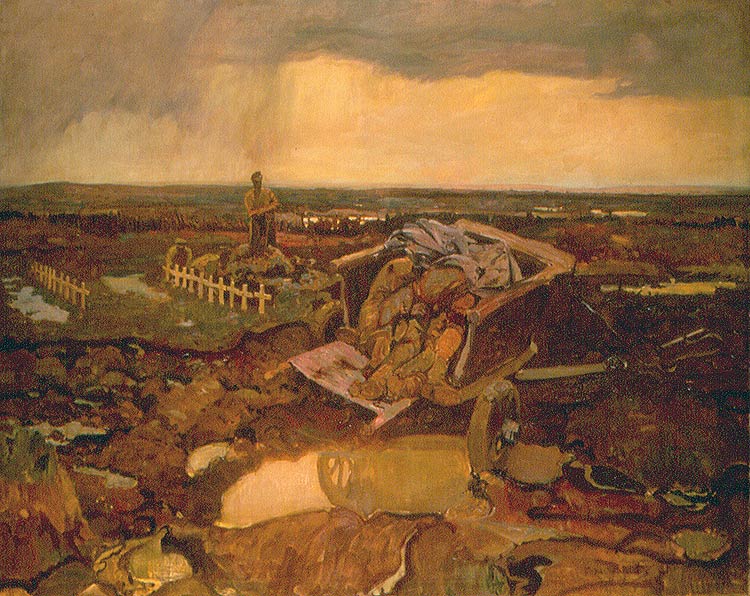
(For What? Frederick Horsman Varley. Canadian War Museum.)
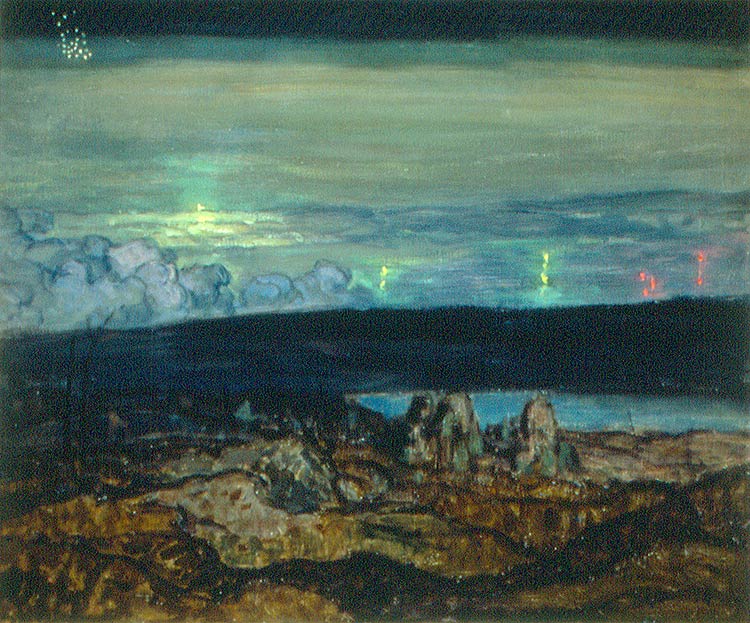
(Gas Attack, Liévin. A.Y. Jackson. Canadian War Museum.)
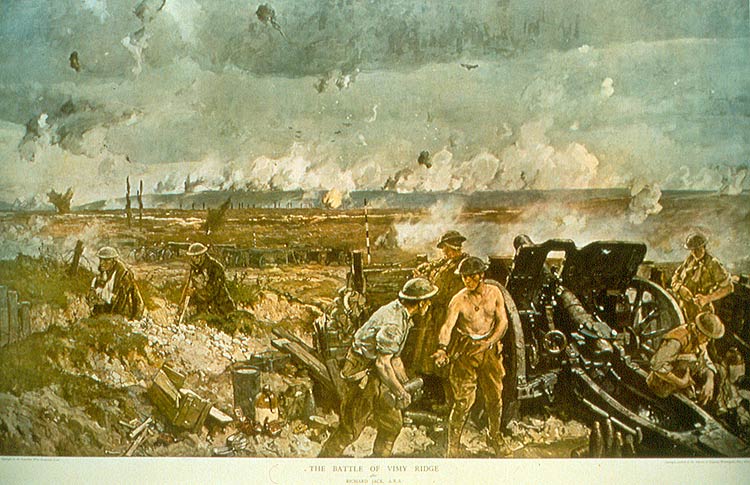
(The Taking of Vimy Ridge, Easter Monday, 1917. R. Jack. Canadian War Museum.)
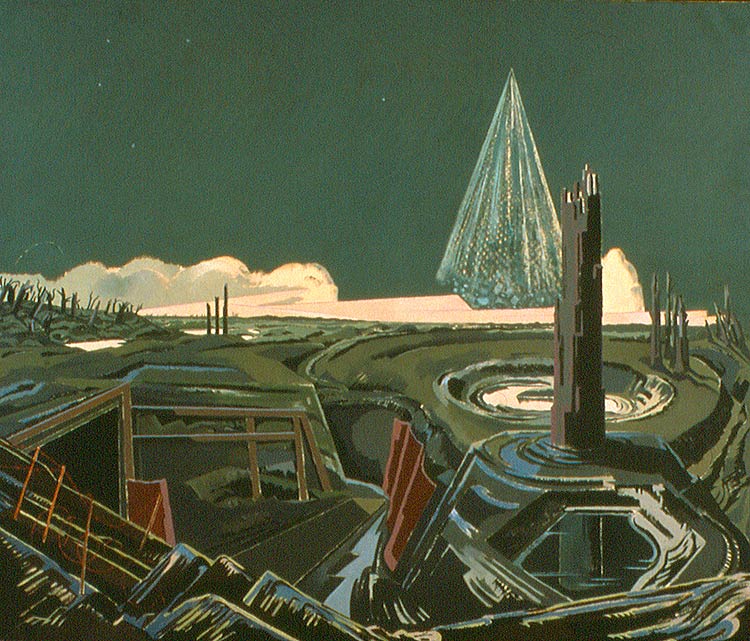
(Night Bombardment. Paul Nash. National Gallery of Canada.)
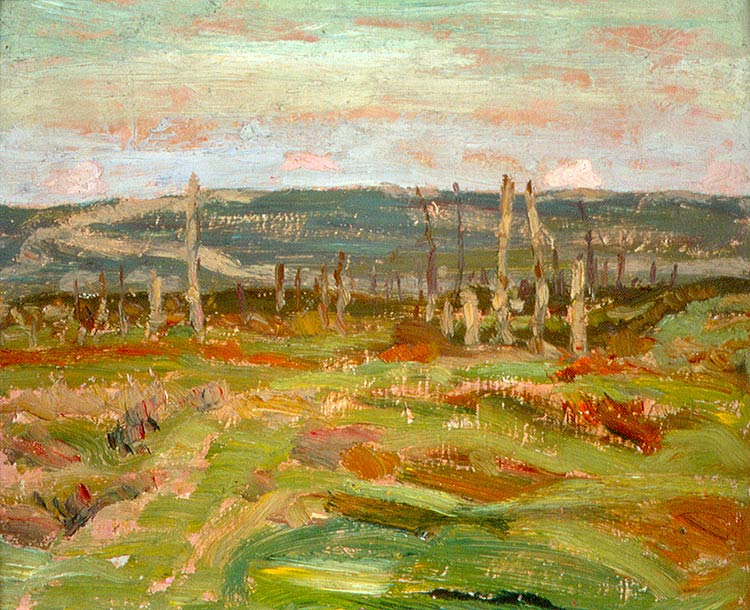
(Vimy Ridge from Souchez Valley – study. A.Y. Jackson. Canadian War Museum.)
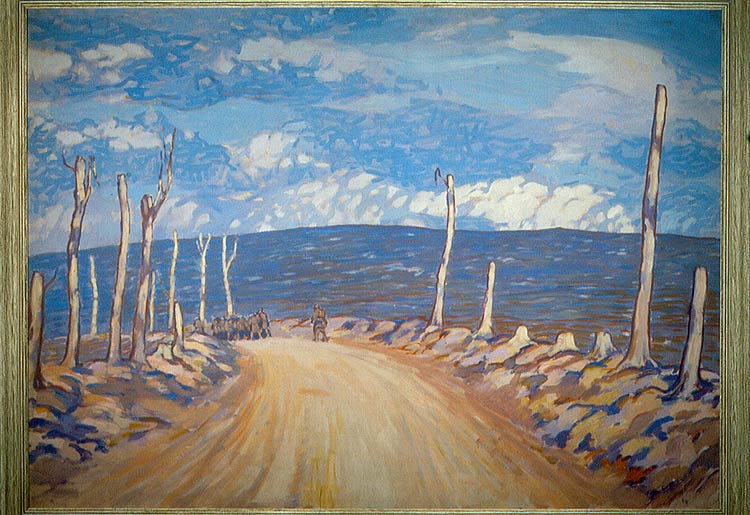
(Vimy Ridge from Souchez. Gyrth Russell. Canadian War Museum.)
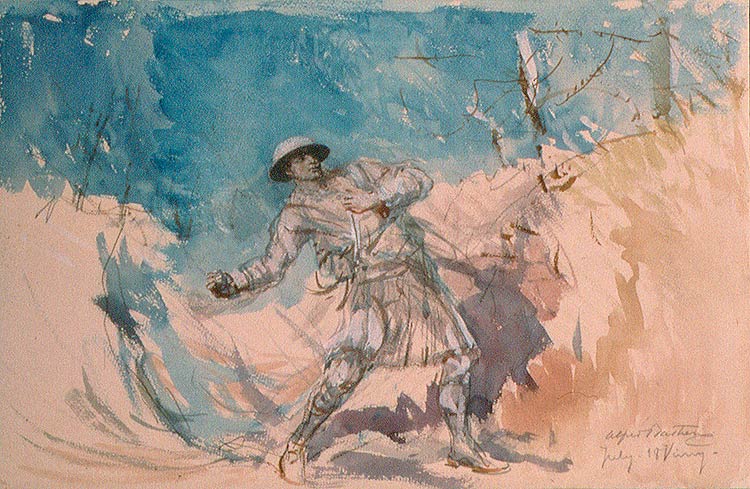
(Throwing Grenades. Canadian War Museum.)
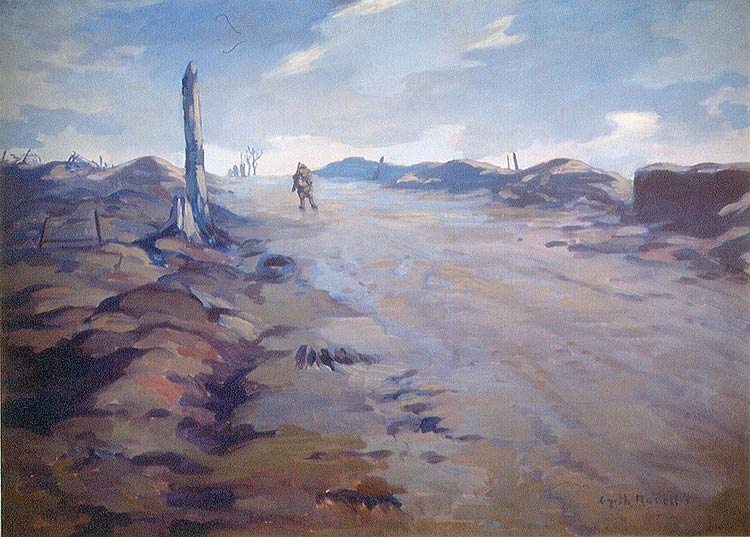
(The Crest of Vimy Ridge. Gyrth Russell. Canadian War Museum.)
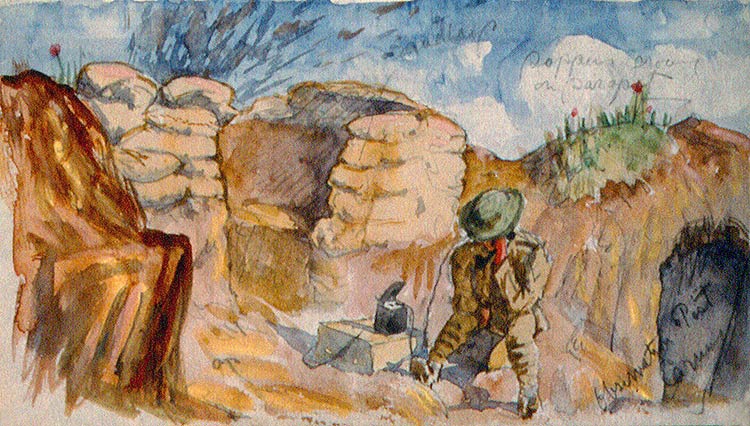
(Observation Post #1. W.T. Topham. Canadian War Museum.)
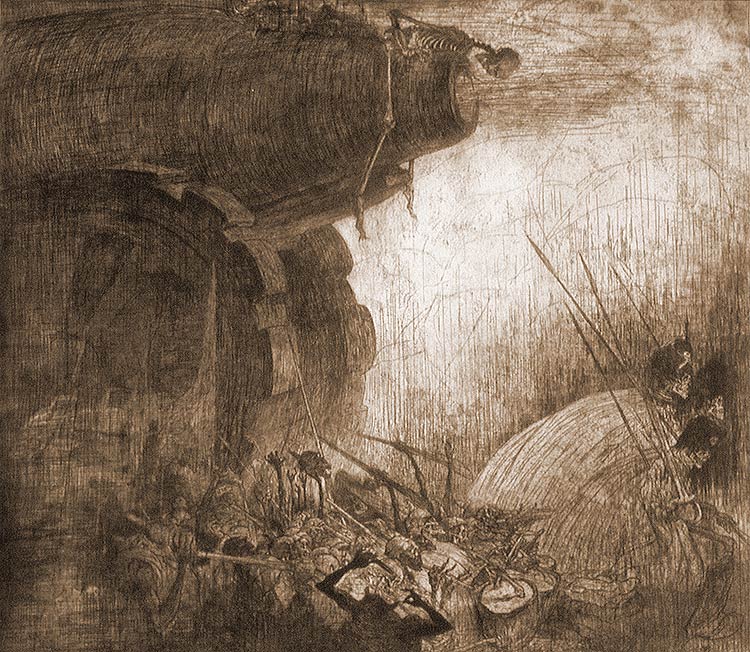
(Ku Itu. Jules de Bruycker. Canadian War Museum.)
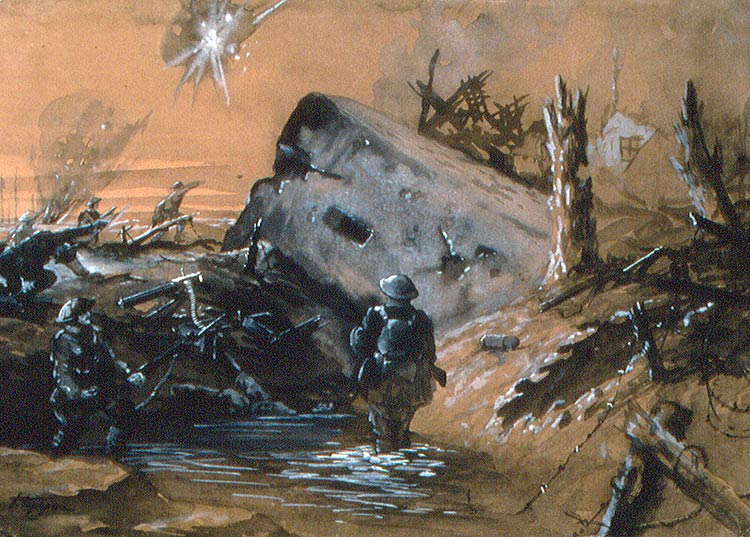
(A German Pill-Box After an Attack. W.T. Topham. Canadian War Museum.)
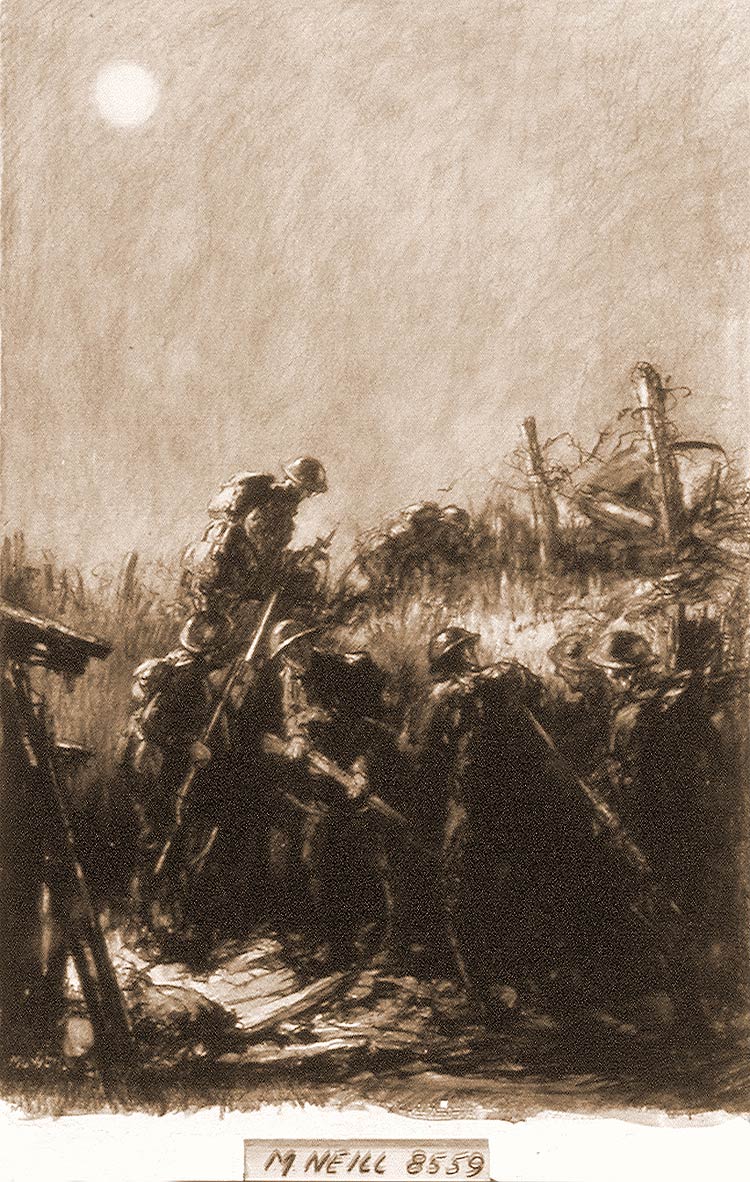
(A Night Raid. Harold James Mowat. Canadian War Museum.)
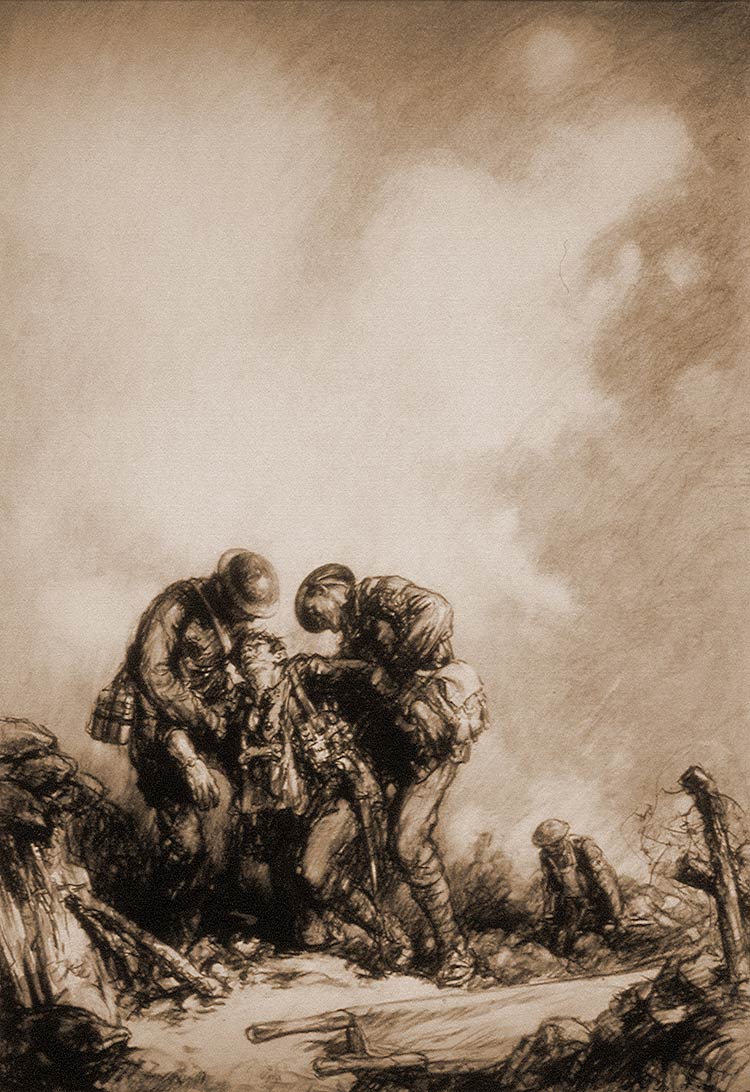
(Stretcher Bearers. H.J. Mowat. Canadian War Museum.)
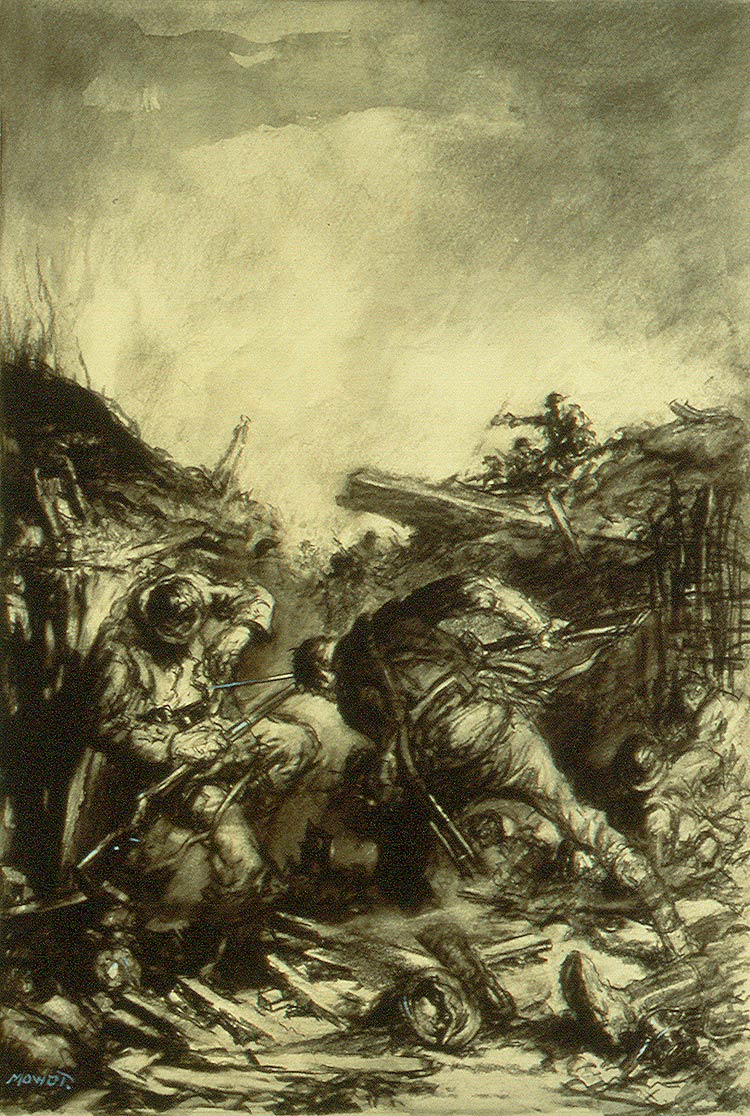
(Trench Fight. H.J. Mowat. Canadian War Museum.)
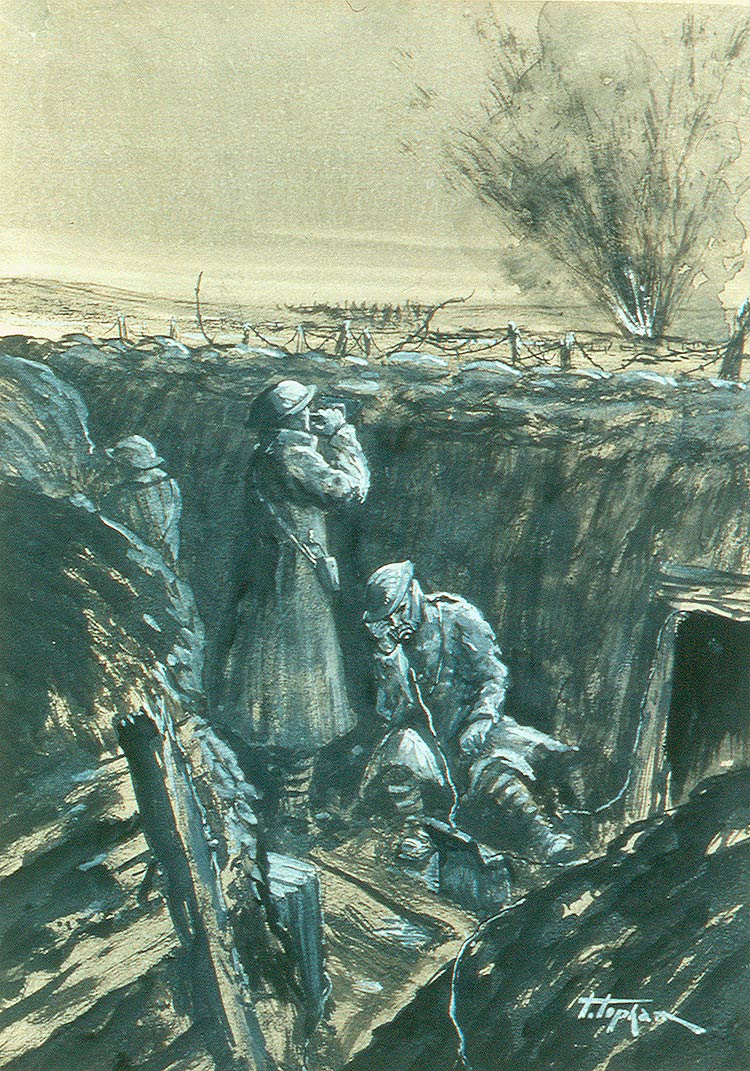
(Observation Post #2. W.T. Topham. Canadian War Museum.)
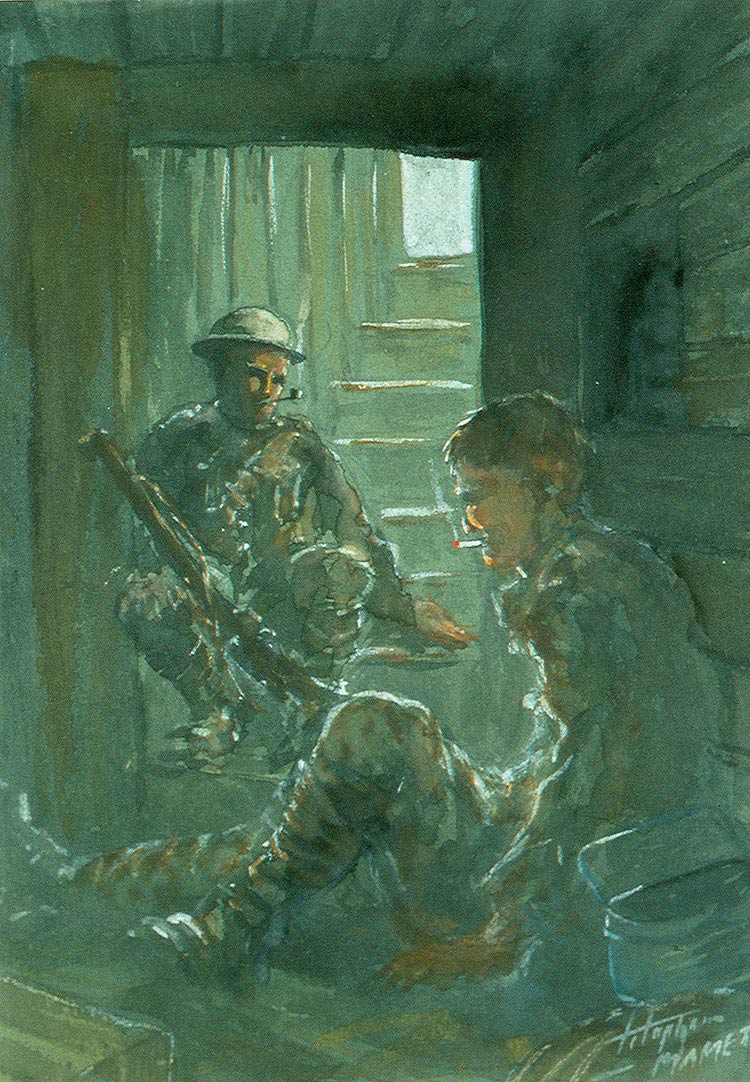
(Fed up, Entrance to a dug-out. Canadian War Museum.)
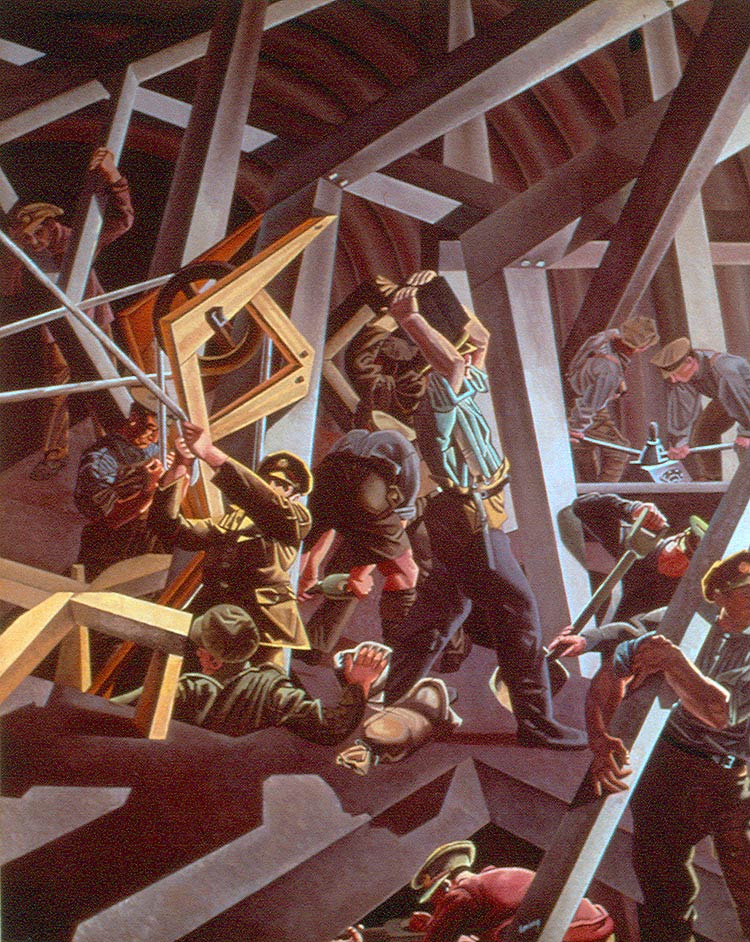
(Sappers at Work: A Canadian Tunnelling Company. David Bombers. National Gallery of Canada)
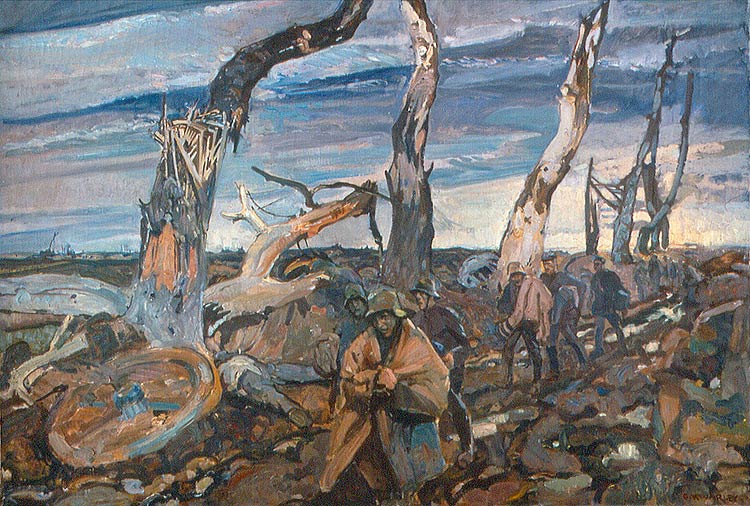
(German prisoners. Frederick Horsman Varley. Canadian War Museum.)
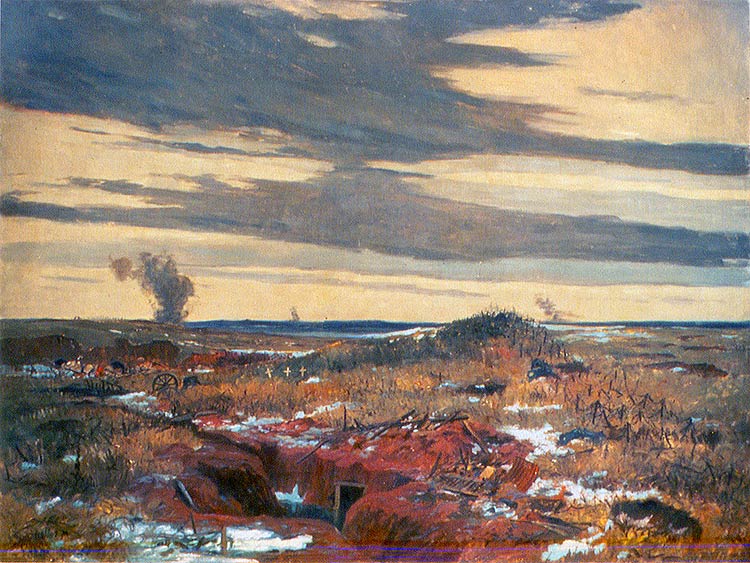
(No Man's Land. Maurice Galbraith Cullen. Canadian War Museum.)
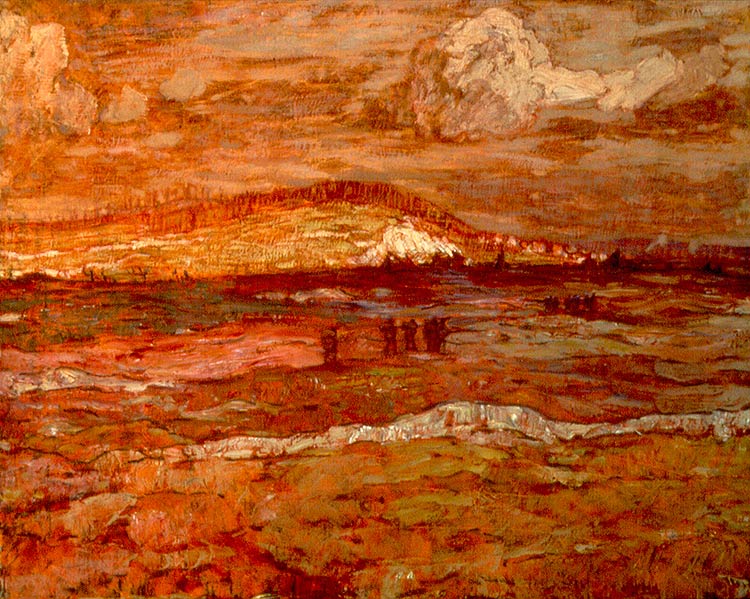
(Evening. A.Y. Jackson. Canadian War Museum.)
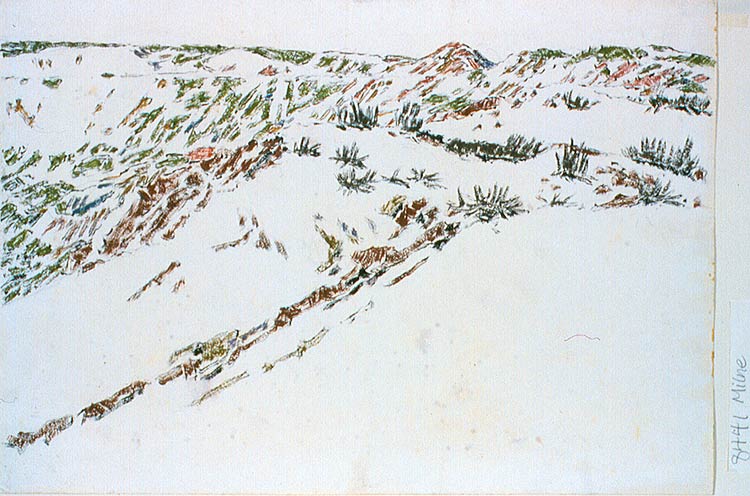
(David B. Milne National Gallery of Canada.)
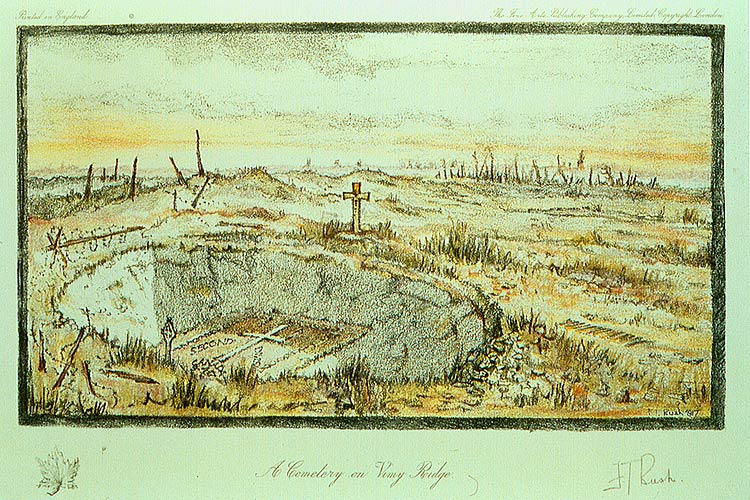
(A Cemetery on Vimy Ridge. F.T. Bush. Canadian War Museum.)
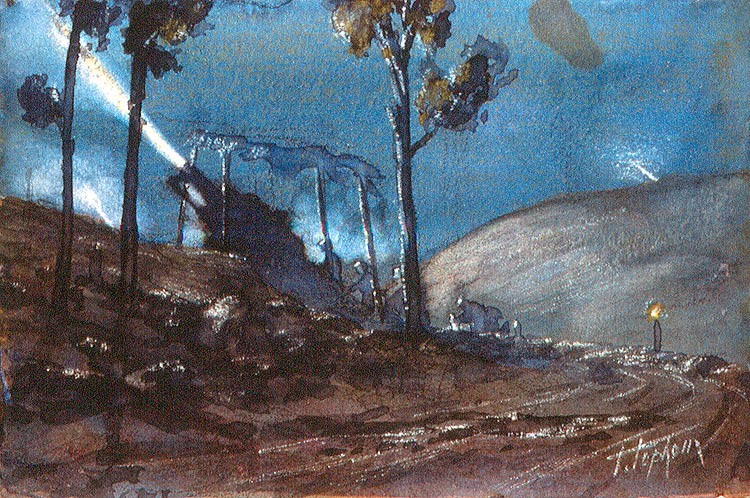
(A Night Shoot. W.T. Topham. Canadian War Museum.)
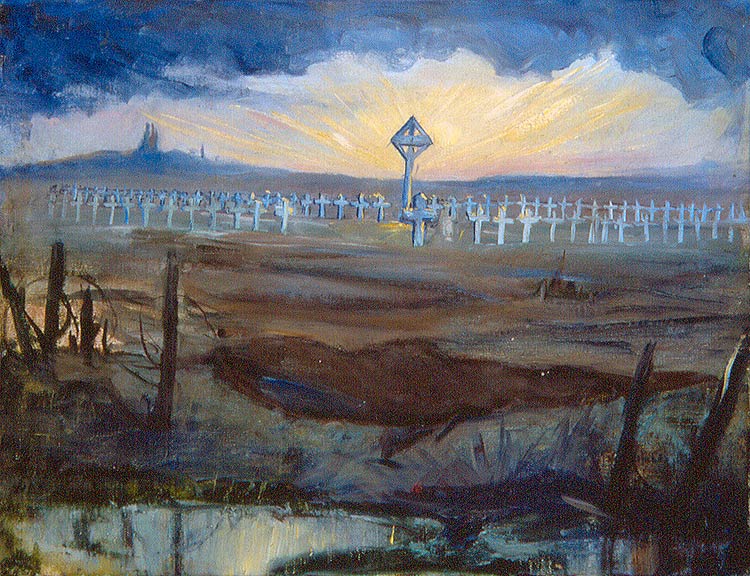
(British Columbia 7th batallion cemetery. Mary Riter Hamilton. Library and Archives Canada.)
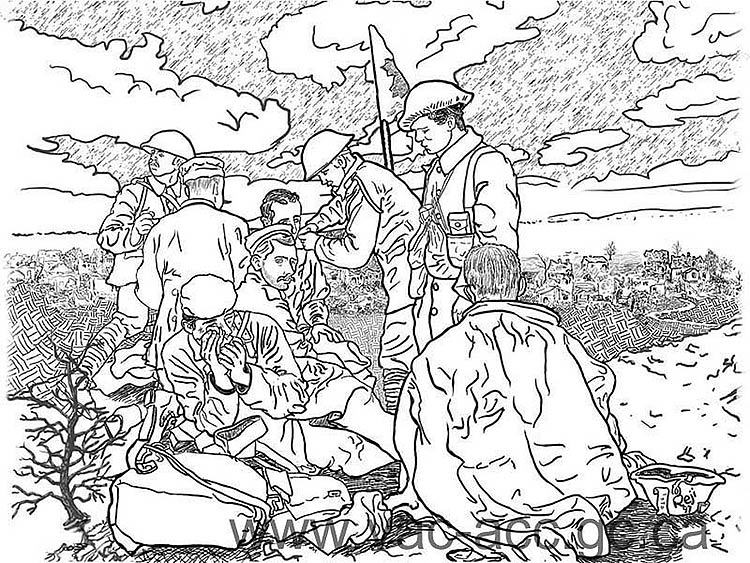
(Vimy Ridge. Reji Martin. Veterans Affairs Canada.)
War art