

Citation(s);
Military service
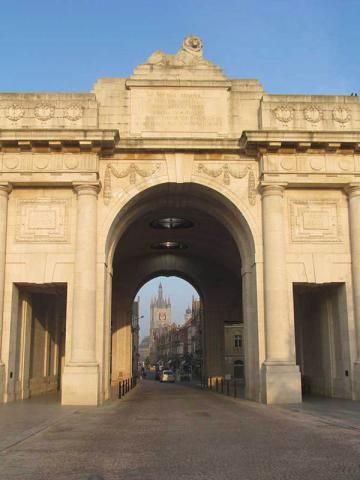
Burial/memorial information
He served under the name Joseph Harvey. Son of François-Nérée Harvey (deceased in 1915) and Clarisse Soucy (deceased in 1914), of Montréal, Québec. He stated being born on the 20th when he enlisted. He also stated his first name was Joseph but he is identified as Albert in the 1901 and 1911 censuses. After the passing of his father in November 1915, he named his younger sister Jeanne as next of kin and heiress.
He enlisted in Company D of the 41st Battalion of the Canadian Expeditionary Force. He sailed for Great Britain on October 16, 1915, and landed in Plymouth, England, on the 28th. From February 16 to March 22, 1916, he was seconded to the Canadian Engineer Corps. On the 23rd, he was incorporated into the 23rd Reserve Battalion. On May 1, 1916, he was transferred to the 22nd Battalion and, from Folkestone, crossed into France with the 23rd Reserve Battalion on the 2nd. He landed in Boulogne, Pas-de-Calais, that same day. On the 22nd, he joined his new unit on the front lines in the trenches of the St-Éloi sector in Belgium. Treated for trench fever from August 6 to 12, 1916, he was killed in action on August 18 in the Voormezeele-St-Éloi sector near Ypres, in West Flanders.
Digital gallery of Private Joseph Charles Albert Harvey
-
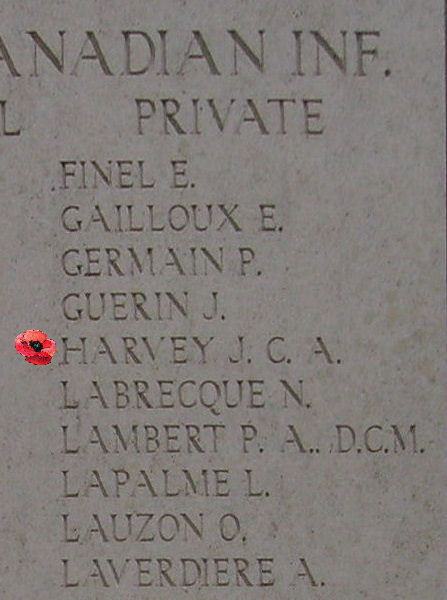
Memorial
Inscription on the Menin Gate … photo courtesy of Marg Liessens
Digital gallery of
Private Joseph Charles Albert Harvey
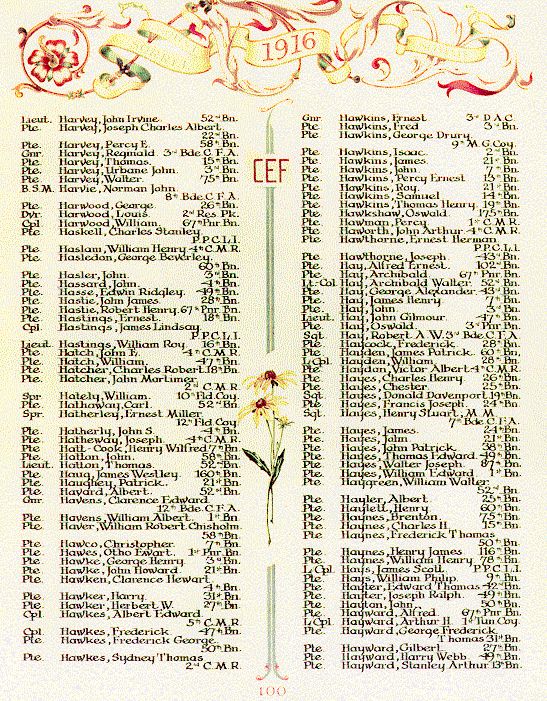
In the Books of Remembrance
Commemorated on:
Page 100 of the First World War Book of Remembrance.
Request this page
Download this page
The Poppy Design is a trademark of The Royal Canadian Legion (Dominion Command) and is used with permission. Click here to learn more about the poppy.
Did we miss something?
Contribute information to this commemorative page
Do you have photographs, information or a correction relating to this individual’s virtual memorial? Learn more about the CVWM and the information we collect.