


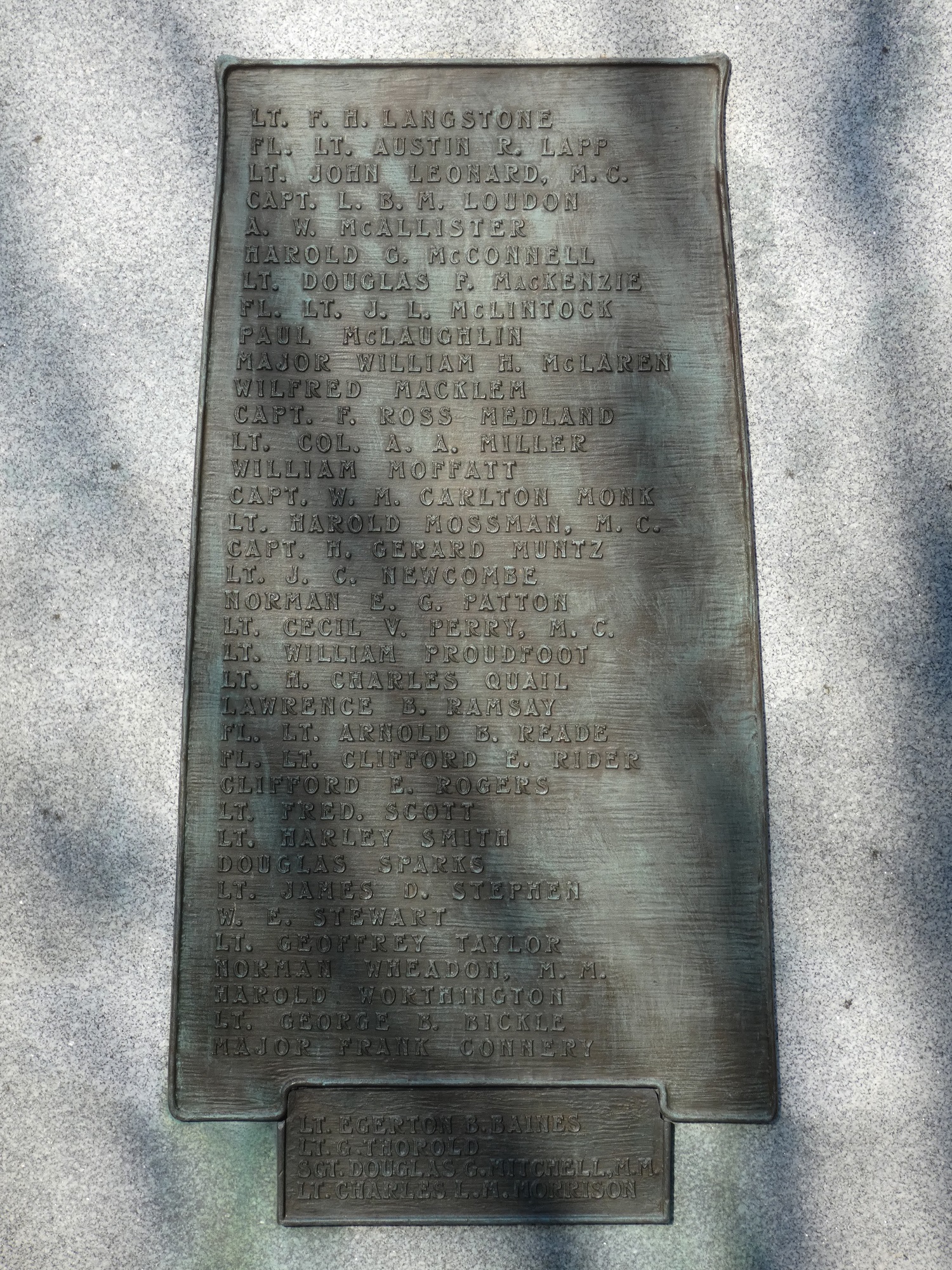


The Soldier, by sculptor George W. Hill, was dedicated in 1921 to honour the former pupils of Harbord Collegiate Institute who died for humanity in the Great War. The sculptor's name is etched into the base of the statue.
Edward William Hagarty was principal of Harbord Collegiate from 1906 to 1928. He served four years with the Queen’s Own Rifles while an undergraduate at the University of Toronto and was selected to raise the 201st Toronto Light Infantry in January 1916. Competing with several battalions, Hagarty struggled to fill the ranks of the 201st. He toured Toronto schools and cadet corps, emphasized morality and temperance, and promised to raise a liquorless battalion.
The colonel’s 21 year old son, Lieutenant Daniel Galer Hagarty, was expected to leave France in order to join his father as the battalion adjutant. Before he could return to Toronto, he died in action on 2 June 1916 while fighting with the Princess Patricia’s Canadian Light Infantry. Three months later, Hagarty announced his resignation for personal reasons and disbanded the 201st Toronto Light Infantry. One company went to the 170th (Mississaugas) and another went to the 198th (Canadian Buffs). One year after their son’s death, Hagarty and his wife erected a memorial tablet at Harbord Collegiate.
The memorial was rededicated in November 2005 by the son of Harbord student (Willard) Garfield Weston who had dropped out after three years at the high school to join his countrymen in the trenches of Europe where he was a sapper stringing communications wires across the Allied front.
In November 2014, three names of former Harbord students killed during the First World War were added to a plaque on the school’s memorial statue, known affectionately as “Our Soldier" - Lieutenant Myer Tutzer Cohen, Lieutenant-Colonel Thomas Craik Irving and Lieutenant Walter Howard Curry.
George William Hill was born in Shipton, Eastern Townships, in 1861. He learned to carve marble in his father’s company, after he graduated from college. Between 1889 and 1894, he left Quebec to study sculpting at the École nationale des beaux-arts and Académie Julian in Paris. When he returned to Montreal, he opened a studio and worked with architect Robert Findlay and brothers Edward and William S. Maxwell. Known for his public monuments and war memorials, he is now considered one of the most important Canadian sculptors of the early twentieth century.
Hill designed several monuments commemorating Canadians lost in the South African War, including the Strathcona and South African Soldiers' Memorial in Quebec and Boer War Soldiers Monument in Ontario. At the end of the First World War, Hill was awarded several contracts by towns and cities wishing to pay homage to citizens who had died on the battlefields. Between 1920 and 1930 he designed these monuments: Westmount Cenotaph, Magog Cenotaph, Argenteuil Cenotaph, Richmond Cenotaph, Sherbrooke War Memorial in Quebec; Pictou County War Memorial in Nova Scotia; Soldier's Monument, The Soldier and Nurses’ Memorial in Ontario; and the Soldier's Monument in Prince Edward Island.