

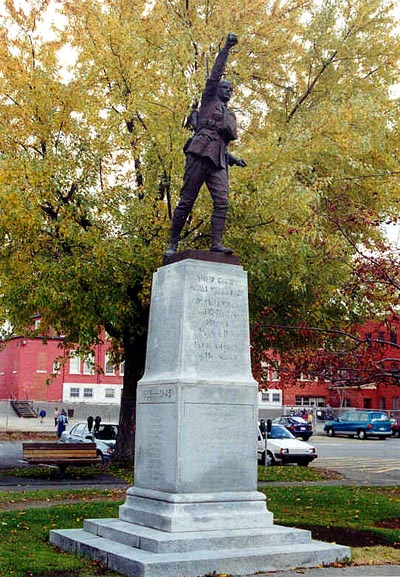
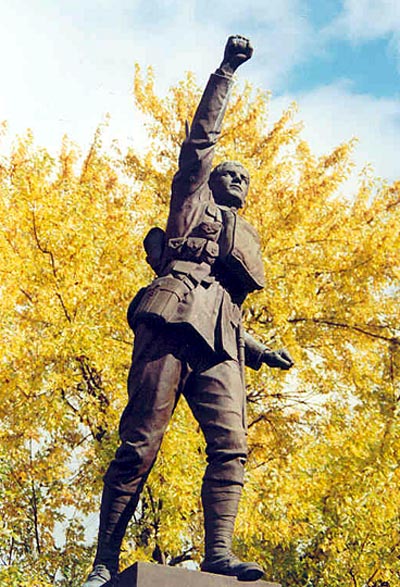
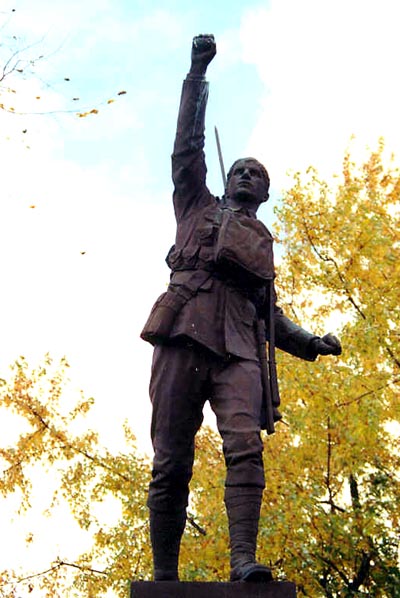

George Hill’s monument at Magog features a statue of a triumphant Canadian soldier who is bare-headed, the raised right hand clutches a Mills bomb, the left fist is clenched. The Canadian Tommy has triumphed, he has come though, he rejoices in the thrill of victory.
This memorial is dedicated to those who died and all who served during the two Great World Wars and the Korean War.
George William Hill was born in Shipton, Eastern Townships, in 1861. He learned to carve marble in his father’s company, after he graduated from college. Between 1889 and 1894, he left Quebec to study sculpting at the École nationale des beaux-arts and Académie Julian in Paris. When he returned to Montreal, he opened a studio and worked with architect Robert Findlay and brothers Edward and William S. Maxwell. Known for his public monuments and war memorials, he is now considered one of the most important Canadian sculptors of the early twentieth century.
Hill designed several monuments commemorating Canadians lost in the South African War, including the Strathcona and South African Soldiers' Memorial in Quebec and Boer War Soldiers Monument in Ontario. At the end of the First World War, Hill was awarded several contracts by towns and cities wishing to pay homage to citizens who had died on the battlefields. Between 1920 and 1930 he designed these monuments: Westmount Cenotaph, Magog Cenotaph, Argenteuil Cenotaph, Richmond Cenotaph, Sherbrooke War Memorial in Quebec; Pictou County War Memorial in Nova Scotia; Soldier's Monument, The Soldier and Nurses’ Memorial in Ontario; and the Soldier's Monument in Prince Edward Island.