
Battle of Passchendaele
July 31 – 10 November 1917
Introduction
Canadians have a proud history of bravely serving in the cause of peace and freedom over the years. A name from Canada's First World War military heritage that still stirs emotions is “Passchendaele.” On a muddy battlefield in northwest Belgium, Canadians overcame almost unimaginable hardships to win an impressive victory in the fall of 1917.
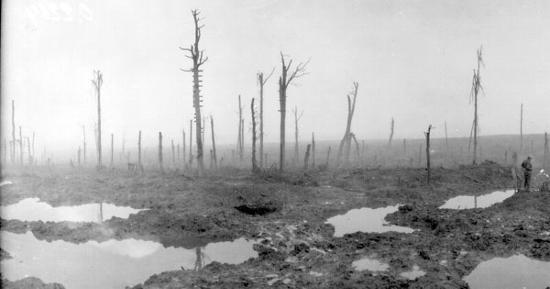
Passchendaele, now a field of mud. Photo: William Rider-Rider/Canada. Dept. of National Defence/Library and Archives Canada/PA-040140
Canada and the First World War
When Britain went to war in Europe in August 1914, Canada—as a member of the British Empire— automatically found itself at war as well. The First World War soon turned into a stalemate of trench fighting along the Western Front, with a heavily defended 1,000 kilometre-long network of trenches stretching across Belgium and northern France from the English Channel to the border of Switzerland. On one side were the forces of France and Britain (along with other allies such as Canada) and on the other were the Germans. From their opposing trenches they faced one another across a blasted “No Man's Land” of barbed wire, exploding artillery shells and deadly machine gun fire.
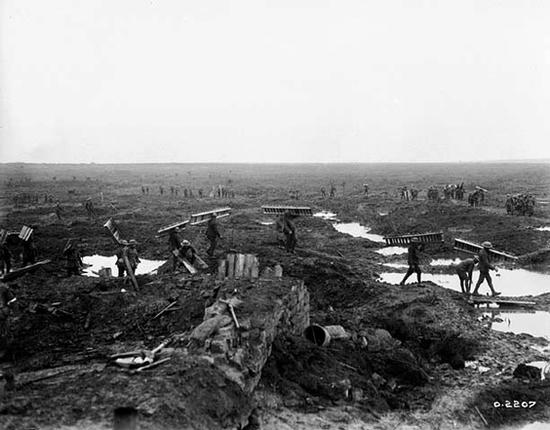
Canadian Pioneers carrying trench mats with wounded and prisoners in background during the Battle of Passchendaele. Photo: William Rider-Rider / Canada. Dept. of National Defence / Library and Archives Canada / PA-002084
In the fall of 1917, the Canadian Corps—after its great success at Vimy Ridge that April—was sent north to Belgium. It would be all-too-familiar ground for the Canadians who had seen heavy fighting there earlier in the war.
Ypres
The Ypres area of Belgium—where the village of Passchendaele is located—was the scene of several First World War battles, including the first use of poison gas when the Germans unleashed deadly chemical attacks there in April 1915. The Ypres salient was the last portion of Belgium that was not in enemy hands after the initial German advances of the war and, as a result, held great symbolic meaning to the Allies.
Muddy terrain
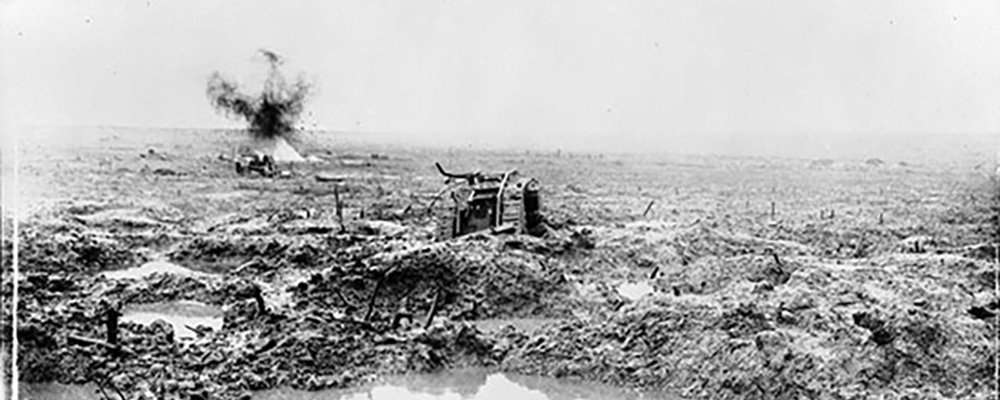
Ypres was a very difficult place to fight. It was a region largely made up of flat, low ground that was kept dry only with the help of an intricate series of dikes and ditches. Three years of heavy fighting there, however, had entirely destroyed these drainage systems. The ground, churned up by millions of artillery shells, turned to sticky mud when wet. In 1917, the autumn rains came early and turned the battlefield into a sea of muck, the likes of which still make the name Passchendaele synonymous with the horrific fighting conditions many people picture when thinking of the First World War.
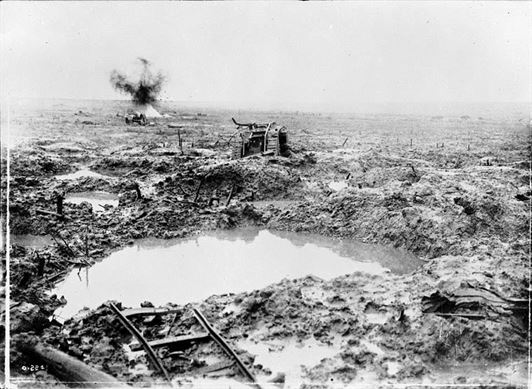
A damaged tank on the muddy Passchendaele battlefield. Photo: Library and Archives Canada PA-002195
The opening of the battle
The Third Battle of Ypres was undertaken by the British primarily to take the pressure off the French forces to the south. The British commander, Sir Douglas Haig, launched a drive in Belgium to wear down the German capacity to continue fighting the war while hopefully seizing strategic German railways in the occupied country and capturing the German submarine bases along the coast which were being used to menace Allied shipping.
A challenging battlefield
The campaign began at the end of July 1917. British, as well as Australian and New Zealand (ANZAC) forces, opened the attack with a pounding artillery barrage. Heavy rains came down the very night the ground assault was launched, however, and shell holes quickly filled with filthy water. The battlefield soon became peppered with countless flooded craters, all too often containing wounded and fallen soldiers. A heavy toll was taken on the attackers as they had to struggle through thick mud with little cover while German machine gunners in pill boxes (reinforced concrete machine gun positions) tore them to pieces. Despite these conditions, the Allied forces slowly gained much of the higher ground as the summer turned into fall. The main objectives of the offensive, however, remained out of reach.
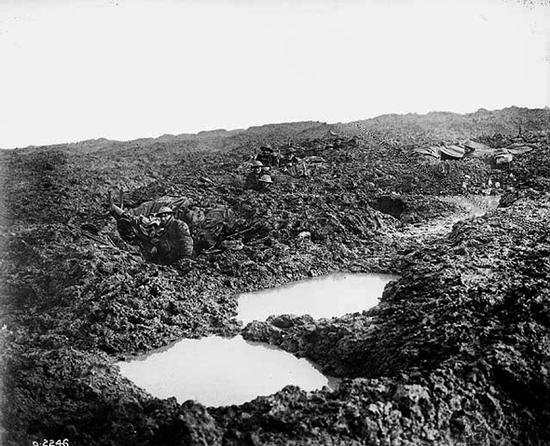
Personnel of the 16th Canadian Machine Gun Company holding the line in shell holes during the Battle of Passchendaele. Photo: William Rider-Rider / Library and Archives Canada / PA-002162
The Canadians at Passchendaele
Early in October 1917, the Canadians were sent to Belgium to relieve the battered ANZAC forces and take part in the final push to capture Passchendaele. Canadian Corps commander Lieutenant-General Arthur Currie inspected the terrain and was shocked at the conditions he saw. He tried to avoid having his men fight there but was overruled by his superiors. As at Vimy, the four divisions of the Canadian Corps would see action. However, the ubiquitous mud, flat terrain, and relative lack of preparation time and artillery support would make Passchendaele a far different battlefield than the one the Canadians had encountered at Vimy Ridge.
Canadians begin their offensive
Currie took as much time as he could to carefully prepare and on October 26, the Canadian offensive began. Advancing through the mud and enemy fire was slow and there were heavy losses but our soldiers clawed their way forward. On an exposed battlefield like that one, success was often only made possible due to acts of great individual heroism to get past spots of particularly stiff enemy resistance. Despite the adversity, the Canadians reached the outskirts of Passchendaele by the end of a second attack on October 30 during a driving rainstorm.
Capturing the village
On November 6, the Canadians and British launched the assault to capture the ruined village of Passchendaele itself. In heavy fighting, the attack went according to plan. The task of actually capturing the “infamous” village fell to the 27th (City of Winnipeg) Battalion and they took it that day. After weathering fierce enemy counterattacks, the last phase of the battle saw the Canadians attack on November 10 and clear the Germans from the eastern edge of Passchendaele Ridge before the campaign finally ground to a halt. Canadian soldiers had succeeded in the face of almost unbelievable challenges.

Wounded soldier being carried to an aid-post during the Battle of Passchendaele.
Photo: Library and Archives Canada PA-002107
Canadians earn the Victoria Cross
The fighting at Passchendaele took great bravery. Nine Canadians earned the Victoria Cross (the highest award for military valour that a Canadian could earn) there: Private Tommy Holmes, Captain Christopher O'Kelly, Sergeant George Mullin, Major George Pearkes, Private James Peter Robertson, Corporal Colin Barron, Private Cecil Kinross, Lieutenant Hugh McKenzie and Lieutenant Robert Shankland. Two of these men, McKenzie and Robertson, sadly lost their lives in the battle.
Heroic individuals
The efforts of all these men were truly remarkable, but it has been said that the Battle of Passchendaele could not have been won if it were not for the heroic actions of Major George Pearkes of the 5th Canadian Mounted Rifles. Despite a leg wound, he led a few dozen of his men through heavy enemy fire across open ground to capture a strategically located farm. They then fought off numerous counterattacks for more than a day, preventing the Germans from destroying the main advancing Canadian force from their vulnerable flank side.
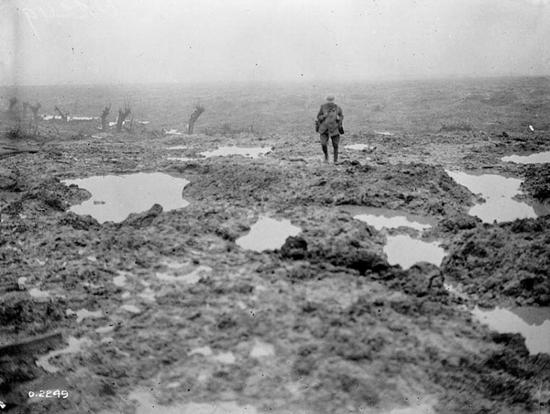
Mud and barbed wire through which the Canadians advanced during the Battle of Passchendaele Photo: William Rider-Rider / Canada. Dept. of National Defence / Library and Archives Canada / PA-002165
Sacrifice
Canada's great victory at Passchendaele came at a high price. More than 4,000 of our soldiers died in the fighting there and almost 12,000 were wounded. The some 100,000 members of the Canadian Corps who took part in the battle were among the over 650,000 men and women from our country who served in uniform during the First World War. Sadly, a total of more than 66,000 Canadians lost their lives in the conflict. The sacrifices and achievements of those who gave so much will never be forgotten.
Legacy
The Canadian victory at Passchendaele was truly impressive and added to our nation's growing reputation as having the best offensive fighting force on the Western Front. This status meant that our forces would be at the forefront of the series of advances that eventually won the war for the Allies a year later. Canada's great sacrifices and achievements on the battlefields of Europe indeed gained our country a new respect on the international stage. This esteem helped earn us a separate signature on the Treaty of Versailles that formally ended the First World War.
Photo Gallery
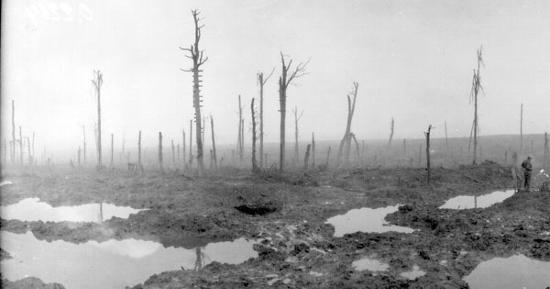
Passchendaele, now a field of mud. Photo: William Rider-Rider/Canada. Dept. of National Defence/Library and Archives Canada/PA-040140
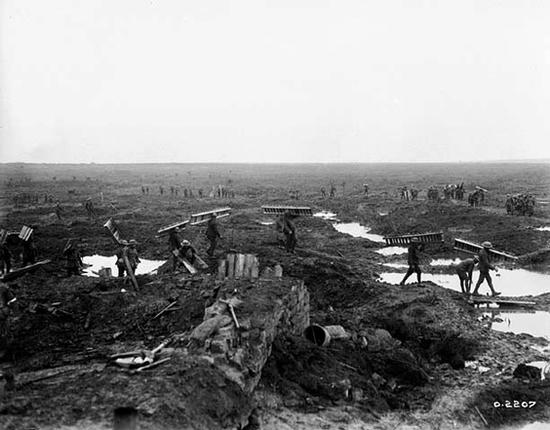
Canadian Pioneers carrying trench mats with wounded and prisoners in background during the Battle of Passchendaele. Photo: William Rider-Rider / Canada. Dept. of National Defence / Library and Archives Canada / PA-002084
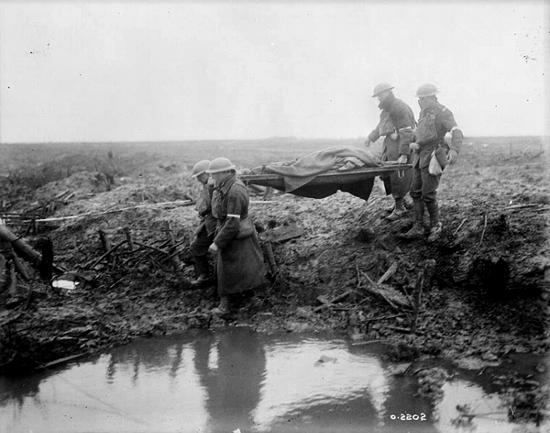
Wounded Canadians on way to aid-post. Photo: Canada. Dept. of National Defence / Library and Archives Canada / PA-002107
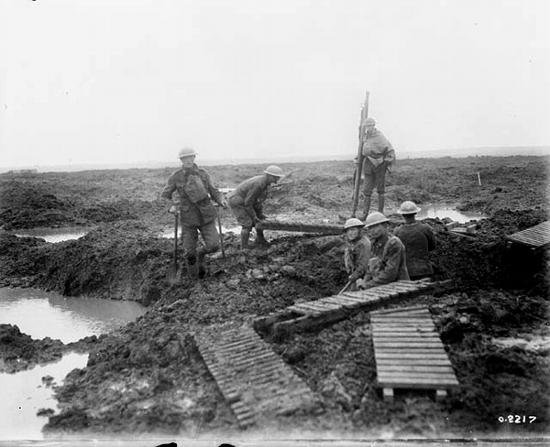
Canadian Pioneers laying trench mats over mud. Photo: William Rider-Rider / Canada. Dept. of National Defence / Library and Archives Canada / PA-002156

Personnel of the 16th Canadian Machine Gun Company holding the line in shell holes during the Battle of Passchendaele. Photo: William Rider-Rider / Library and Archives Canada / PA-002162
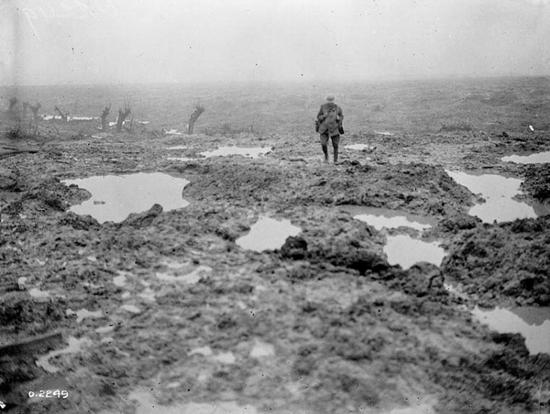
Mud and barbed wire through which the Canadians advanced during the Battle of Passchendaele. Photo: William Rider-Rider / Canada. Dept. of National Defence / Library and Archives Canada / PA-002165
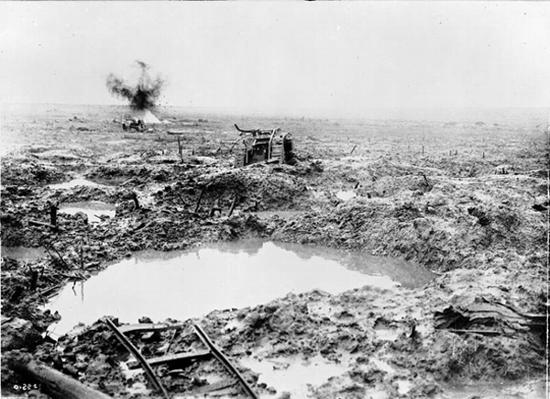
Tank in badly shelled mud area. Photo: Canada. Dept. of National Defence / Library and Archives Canada / PA-002195
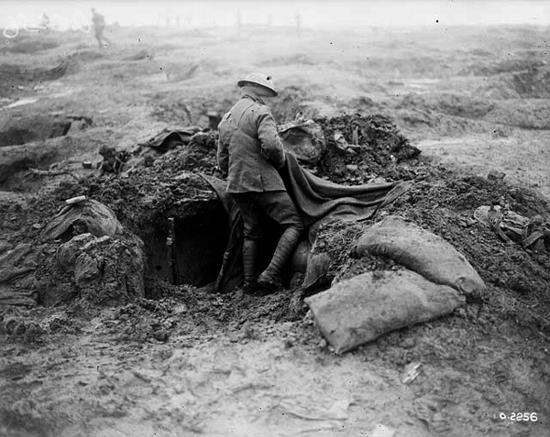
A Canadian finds that a Boche shell has disarranged his home. Battle of Passchendaele. Photo: Canada. Dept. of National Defence / Library and Archives Canada / PA-002217
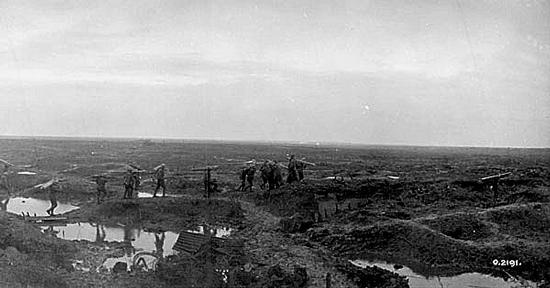
Canadians carrying trench mats. Photo: Canada. Dept. of National Defence / Library and Archives Canada / PA-040129
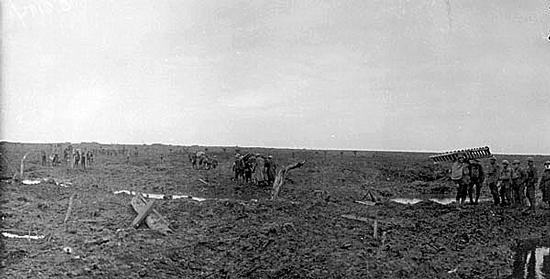
German prisoners and wounded Canadians. Photo: Canada. Dept. of National Defence / Library and Archives Canada / PA-040134