

Northwest Rebellion
In 1885, women serve for the first time in Canadian military history as nurses in the field to provide care to the Canadian troops serving in Saskatchewan. A total of 12 nursing sisters are awarded the North West Canada Medal for their service.
South African War
Four nursing sisters sailed with the first contingent of soldiers to South Africa in October 1899. A total of 12 Canadian Nursing Sisters served in the war, including Georgina Pope.
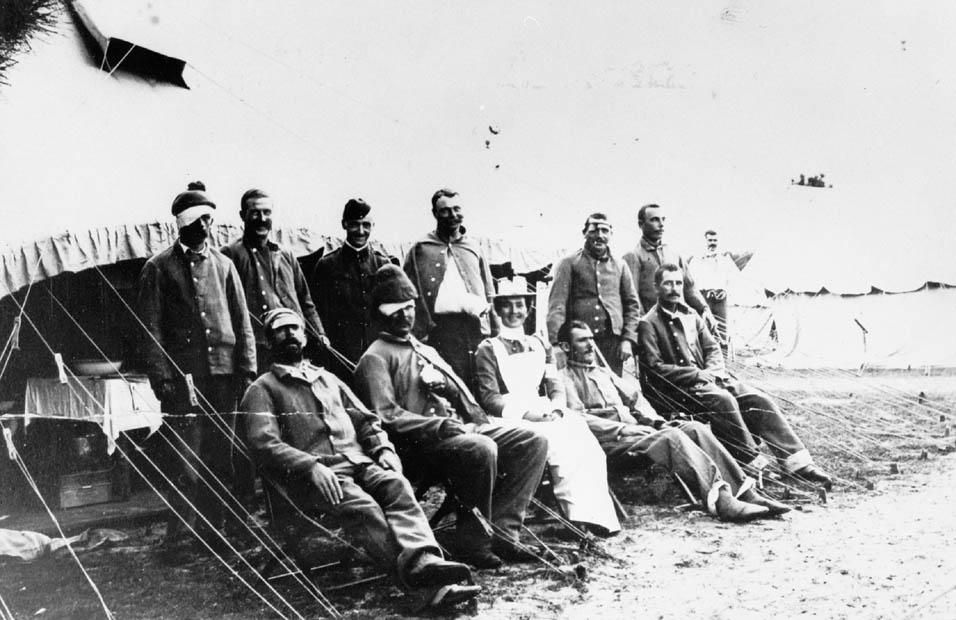
Georgina Pope
In 1908, Georgina Fane Pope would become the first matron-in-chief of the army’s Nursing Service when it was established as part of the Canadian Army Medical Corps. Pope managed military hospitals and the recruitment of nurses.
First World War
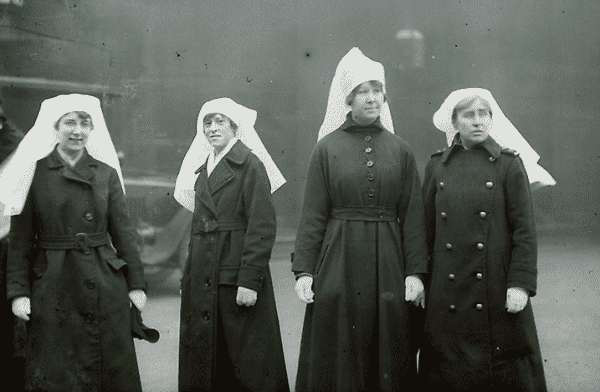
More than 2,800 women served with the Canadian Army Medical Corps, and roughly 2,500 went overseas where they served close to the front lines in hospitals, on board hospital ships, and in combat zones with field ambulance units. Over 40 lost their lives while in service.
1918
Katherine Macdonald was the first nurse killed by enemy action during the German bombing of Étaples, France, on 19 May 1918.
On 27 June 1918, the Canadian hospital ship Llandovery Castle was torpedoed by a German submarine. 234 people lost their lives, including all 14 of the Nursing Sisters onboard.
Nurses who served in the First World War were called Nursing Sisters, but because of their blue dresses and white veils, they were nicknamed the “bluebirds”.
Some Canadian nurses, including Edith Anderson, would join the United States Medical Corps, serving overseas caring for sick and wounded soldiers in American military hospitals in France.
The First World War also changed the role of women in the labour market. Over 30,000 women went to work in factories, offices and on farms due to the shortage of male workers.
1919
The Memorial Cross (also known as the Silver Cross) was created to recognize the mothers and widows of Canadian military personnel who died in service.
The right to vote
On 17 December 1917, Canadian women whose husbands, sons or brothers served in the war voted for the first time. Women were also allowed to vote if they met an exception for military personnel. Bluebirds were the first women to vote legally in a Canadian federal election. The federal right to vote would be extended to all Canadian women in 1918.
Second World War
More than four thousand Nursing Sisters served in the Second World War. Agnes W. Wilkie would be their first casualty of war. She died in October 1942 when the Newfoundland ferry Caribou was torpedoed and sunk in the Cabot Strait.
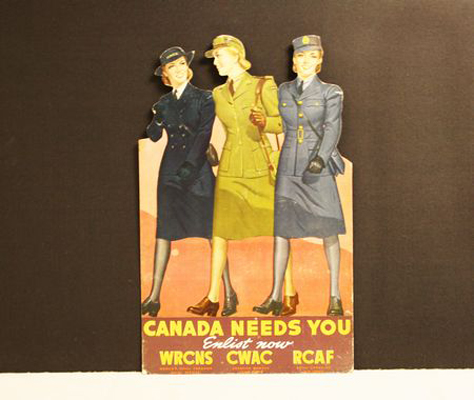
While women are not allowed to serve in combat, all three branches of the military are forever changed with the creation of Women’s Divisions:
- On 2 July 1941, the Royal Canadian Air Force established a Women’s Division (WD). During the war approximately 17,000 women served in the RCAF(WD).
- On 13 August 1941, the Canadian Army created the Canadian Women’s Army Corps, and approximately 21,000 women served as CWACs.
- On 21 July 1942, the Royal Canadian Navy created the WRENS (Women’s Royal Canadian Naval Service), where approximately 7,000 women served.
Women serving in these Divisions worked at various positions including as clerks, mechanics, parachute riggers, wireless operators and photographers.
In 1943, the initial pay rate for servicewomen was set at two-thirds the pay for men, but later in the year it was raised to 80%.
As in the First World War, the demands of a war economy and the labour shortage that resulted from men serving in the war meant that women were encouraged to “do their part” and enter the work force.
Hundreds of thousands stepped into jobs in wartime industry in jobs typically held by men in factories, in forestry, shipbuilding, scientific research and more.
Elsie MacGill became the first female aircraft designer in the world. And, in 1942, she took on the important job of supervising the Canadian production of the Hawker Hurricane fighter plane.
Jean Flatt Davey became the first Canadian woman doctor to enter the Canadian Armed Forces. From 1941–1945, she served in the Royal Canadian Air Force as squadron leader, forming a unit that provided medical care.
Korean War
Women are again recruited for military service, and more than 5,000 serve during the conflict. Canadian nurses often had to provide services in combat zones.
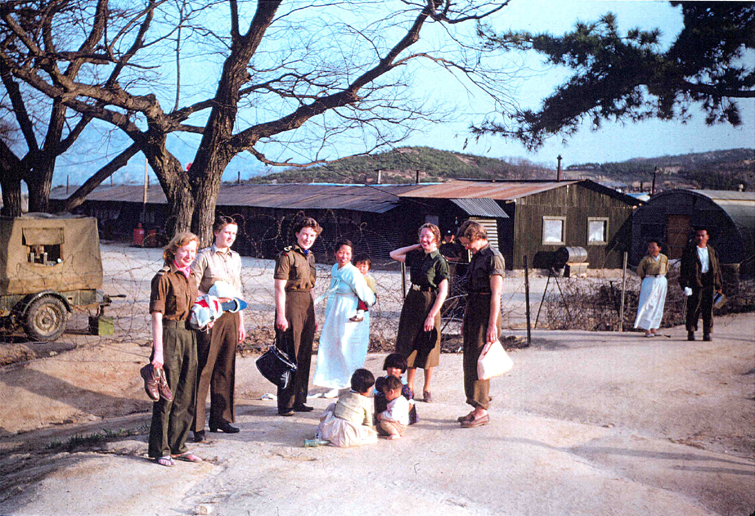
When the ceasefire came into effect in 1953, nursing sisters worked with the newly-released prisoners of war, helping to restore their physical health.
There are no female casualties during the conflict.
Canadian Armed Forces service: 1965 to present
1965
For the first time outside of war service, the government allows women to be employed in the Canadian military with a fixed ceiling of 1,500 (representing 1.5% of the total military at that time).
1972
The Honourable Flora MacDonald becomes the first woman to graduate from the National Defence College.
1974
Major Wendy Clay, a doctor, qualified for pilot’s wings six years before pilot classification is opened to all women.
1978
Corporal Gail Toupin becomes first female member of SkyHawks, the Army’s parachute demonstration team.
1979
- All Canadian military colleges are now open to female students.
- The CF opens 81 of 127 military trades to women.
1981
- Captain Dee Brasseur, Captain Leah Mosher, and Captain Nora Bottomley become the first three women to serve as RCAF pilots, following the opening of the pilot classification to women in 1979.
- Second Lieutenant Inge Plug becomes the first female helicopter pilot.
- Lieutenant Karen McCrimmon becomes the first female air navigator.
Signing of the Canadian Charter of Rights and Freedoms in 1982 changed the future of women in the workplace by prohibiting discrimination based on sex.
1987
- The Royal Canadian Air Force opens all positions to women.
- Colonel Sheila A. Hellstrom becomes the first woman serving as a Regular Force officer to be promoted to the rank of Brigadier-General.
1988
- First female gunners in the Regular Force graduate from qualification training.
- Private Shannon Wills wins the Queens Medal for Champion Shot of the Reserve Forces. Today, the Queen’s medal winner for top shot in the Rangers receives the Captain Shannon Willis Trophy in her honour.
The Canadian Human Rights Commission rules that women’s access to any military job be opened, with the exception of service aboard submarines and Catholic chaplains.
1989
- Private Heather Erxleben becomes the first female Regular Force infantry soldier.
- Laraine Francis Orthlieb becomes first woman appointed to the rank of Commodore.
- Major Dee Brasseur and Major Jane Foster become the first two female CF-18 Hornet fighter pilots.
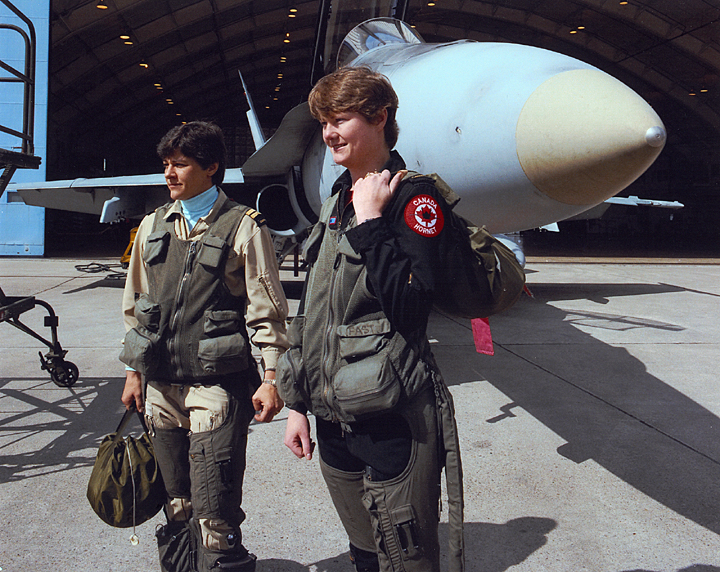
For more information on Dee Brasseur and many other groundbreaking women who have served in the Royal Canadian Air Force, read the article “Those damn women” (Legion Magazine).
1991
- The Gulf War is the first conflict in which Canadian women take part in combat.
- HMCS Nipigon becomes the first mixed gender warship to participate in NATO exercises.
- First female officers in combat arms graduate from artillery training.
1992
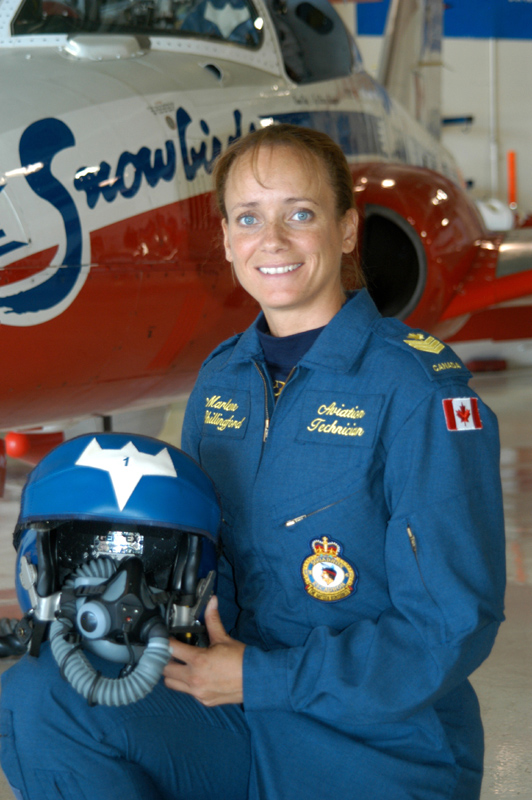
Corporal Marlene Shillingford becomes first woman to join Snowbirds team, serving as a technician. In 2006, now a Sergeant, she becomes the first female Crew Chief of the Canadian Forces’ Snowbirds.
1993
Lieutenant Leanne Crowe becomes first woman to qualify as clearance diving officer; subsequently first woman to become Officer Commanding of the Experimental Diving Unit.
1994
Wendy Clay becomes first woman promoted to Major General.
1995
Chief Warrant Officer Linda Smith becomes first woman named Wing Chief Warrant Officer at 17 Wing Winnipeg.
1997
- Colonel Marcia Quinn assumes command of 41 Canadian Brigade Group.
- Colonel Patricia Samson appointed Canadian Forces Provost Marshall in charge of the Canadian Forces military police.
1998
- Lieutenant Colonel Karen McCrimmon is appointed Commander of 429 Transport Squadron at CFB Trenton, becoming the first woman to command a Canadian Forces flying squadron.
- Chief Petty Officer 2nd Class Holly Kisbee becomes the first woman Combat Chief of a major warship.
2000
- Major Micky Colton becomes first female Hercules pilot to complete 10,000 flying hours.
- Lieutenant Ruth Ann Shamuhn becomes the first female combat diver.
The exception from the 1989 Canadian Human Rights Commission is removed, and women can now serve on submarines for the first time.
2002
Chief Warrant Officer Camille Tkacz becomes the first woman appointed Command Chief position as Assistant Deputy Minister (Human Resources – Military).
2003
- Major Anne Reiffenstein becomes the first female to command combat arms sub unit.
- Major Jennie Carignan becomes first female Deputy Commanding Officer of a combat arms unit.
- Leading Seaman Hayley John and Marketa Semik become first female non-commissioned clearance divers.
- Master Seaman Colleen Beattie becomes the first woman qualified as a submariner.
- First (and only) all-female Canadian Armed Forces team completes the Nijmegan March in Holland carrying same weight as male teams.
- Lieutenant Commander Marta Mulkins becomes the first woman to serve as a captain of a Canadian warship, HMCS Kingston.
2004
Chief Petty Officer 1st Class Jan Davis becomes first woman Coxswain of a major warship, HMCS Regina.
2006
- Brigadier General Christine Whitecross becomes first female Joint Task Force Commander.
- Captain Nichola Goddard, 1st Regiment Royal Canadian Horse Artillery, was killed in Afghanistan on 17 May 2006. She is the first female CAF member killed during combat duty.
2007
- Lieutenant Colonel Tammy Harris becomes the first woman to command an air force wing in Canada — 9 Wing in Newfoundland and Labrador.
- Commodore Jennifer Bennett becomes the first woman appointed Commander of the Naval Reserve; first female to command a Formation.
2009
Commander Josée Kurtz becomes the first woman to command a major warship, the HMCS Halifax.
2010
- Lieutenant Colonel Susan Wigg becomes the first female Director of Cadets at Royal Military College.
- Lieutenant Colonel Maryse Carmichael becomes the first female Commanding Officer of the Snowbirds in its 40 year history.
- Major Eleanor Taylor, the first female to lead an infantry company in a combat zone, is deployed to Afghanistan.
2011
- Brigadier General Chris Whitecross is one of two most senior ranked women in the Canadian Armed Forces; deployed to Afghanistan until end of June 2011.
- Jennifer Bennett is promoted to rear-admiral, becoming the first woman to achieve that rank in the Royal Canadian Navy.
Women now make up 15% of the Canadian military, with over 7,900 female personnel serving in the regular force and more than 4,800 women serving in the primary reserve. Out of that number, 225 women are part of the regular combat force and 925 are enlisted in the primary reserve combat force.
2012
Captain Ashley Collette receives the Medal of Military Valour for her actions in Afghanistan. She is the first female Canadian soldier to receive this honour.

2013
Colonel Jennie Carignan is the first female Commandant of the Royal Military College Saint-Jean in Quebec.

2015
Brigadier-General Lise Bourgon is commander of a Joint Task Force overseas mission (Operation Impact in Iraq). She is the first woman to hold this position.
2017
The Government of Canada announces the Elsie Initiative for Women in Peace Operations during a UN conference in Vancouver. Its goal is to help the participation of women in UN peace operations. It was named in honour of Elsie MacGill.
2020
Lieutenant-Colonel Riel “Guns” Erickson assumes command of No. 2 Canadian Forces Flying Training School in Moose Jaw, Saskatchewan.
2021
Rear Admiral Josee Kurtz becomes the first woman Commandant of the Royal Military College in Kingston, Ontario.
2022
Rear-Admiral (Retd) The Honourable Rebecca Patterson is the first woman Veteran appointed to the Senate of Canada.

2023
There are now 12 women who hold the rank of general or admiral within the Canadian Armed Forces.
2024
In July, General M.A.J. “Jennie” Carignan is the first woman appointed Chief of the Defense Staff.
In the face of distinct challenges, women have proven their commitment to Canada's freedom with their dedication and bravery. Learn more about women in service.