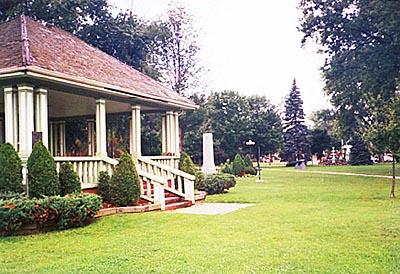
The area surrounding the St. Marys Cenotaph was officially named Memorial Park in June 2008 to commemorate the citizens of the community who served, or who will serve.
Memorial Park
needs further research/recherche incomplète
My VAC Account
My VAC Accountneeds further research/recherche incomplète
The area surrounding the St. Marys Cenotaph was officially named Memorial Park in June 2008 to commemorate the citizens of the community who served, or who will serve.
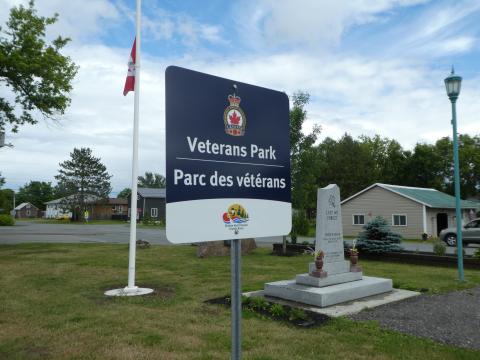
Veterans Park
Parc des vétérans
Veterans Park
The Algonquin Regiment evolved from the Northern Pioneers formed after the First World War from a number of northern Ontario military units. When The Algonquin Regiment was mobilized for active service on July 22, 1940, its purpose was to assist in the defeat of Adolph Hitler's Nazi Germany and its Allies. 130 men from the Parry Sound area flocked to join A Company of the Algonquins at local recruiting centers.
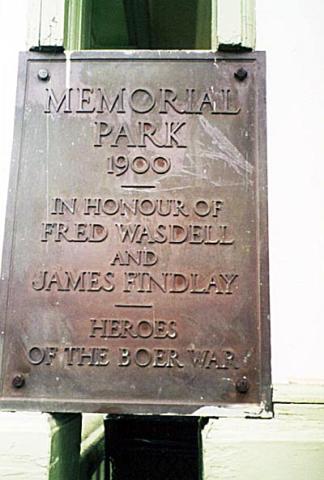
MEMORIAL
PARK
1900
IN HONOUR OF
FRED WASDELL
AND
JAMES FINDLAY
HEROES
OF THE BOER WAR
This memorial is in honour of Fred Wasdell and James Findlay, who were killed at the Battle of Paardeberg during the South African War. A plaque is located on the left side of the bandshell steps and was erected in 1900. The bandshell is not the original, nor at it's original location in the park.
Memorial Park also contains the Bracebridge Cenotaph and the Bracebridge Memorial Fountain.
Source: Redmond Thomas, Q.C., Bracebridge Gazette, July 23, 1970.
Memorial Park was dedicated after the Great War in 1921. In 1958, the park was moved to its current location.
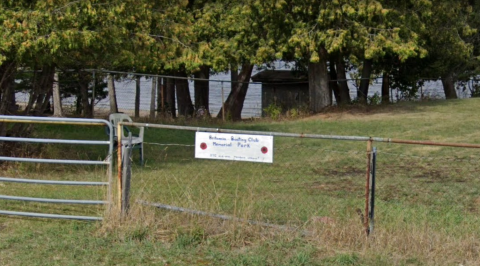
Brittania Boating Club
Memorial Park
In 1946, a group of Brittania Boating Club members got together, pooled their money, and bought the property at Baskins’ Beach for $700, which they named the Britannia Boating Club Memorial Park for; “the express purpose of acquiring and developing a parcel of land as an up-river park in memory of those members of the Club who have fallen in the Empire’s Wars”.
The Brittania Boating Club Memorial Park features a Memorial Cairn and a flagpole. It was dedicated in 1949 in honour of the Yacht Club (then called the Britannia Boating Club) members who were killed overseas during the First and Second World Wars.
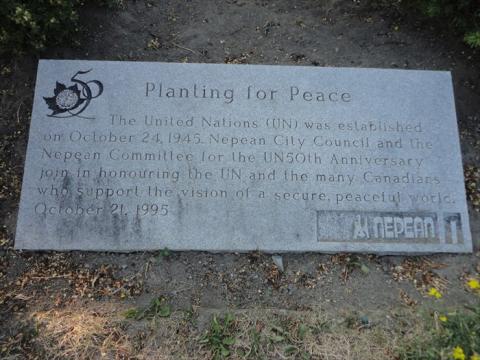
Planting For peace The United Nations (UN) was established on October 24 1945. Nepean City Council and the Nepean Committee for the UN 50th Anniversary join in honouring the UN and the many Canadians who support the vision of a secure, peaceful world. October 21, 1995
Centrepoint Park, was designated as Nepean's "Peace Park" as part of Canada's 125th Birthday in 1992.
"Peace Parks Across Canada" was conceived and organized by the International Institute for Peace through Tourism (IIPT) in collaboration with "CANADA 125" and the National Capital Commission. As Canada celebrated its 125th Birthday, some 400 cities and towns across Canada dedicated a Park to Peace – with most parks dedicated at Noon local time, October 8th, as the National Peacekeeping Monument was being unveiled in Ottawa. The members of the winning design team included Cornelia H. Oberlander, landscape architect. Supporters included the Federation of Canadian Mayors and Municipalities, Canada Parks and Recreation Association, the Tourism Industry Association of Canada, Heritage Canada, World Wildlife Fund Canada, Friends of the Earth, Canadian Society of Landscape Architects, and local Rotary Clubs all across Canada. Project sponsors included VIA Rail, Greyhound Lines Canada, Ltd., CP Hotels and Resorts, Ramada International Hotels and Resorts, Four Seasons Ltd., Meridien Hotels, Concept 3 Advertising and Programmed Communications, Ltd.
Peace Parks Across Canada" has served as the foundation in launching the "IIPT Global Peace Parks Program" on the 11th hour, of the 11th day, of the 11th month, 2000
At noon on October 9th, 2007 – one day after the precise 15th Anniversary of the original dedications, and as Canada continues to be a beacon of peace, Tolerance, and Understanding in a world of increasing violence and distrust, and a nation that celebrates diversity, a nation-wide re-dedication was co-ordinated.
Each of the original Peace Parks incorporated a ‘Bosco Sacro’ (Peace Grove) of 12 trees as a symbolic link with one another, and with nature - and as a symbol of hope for the future. The 12 trees were also symbolic of Canada’s 10 Provinces and two Territories. As there are now three Territories, a 13th tree was planted as part of the "Re-dedication Ceremony."
[front/devant]
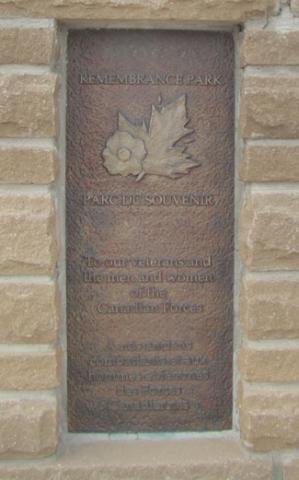
REMEMBRANCE PARK
PARC DU SOUVENIR
To our veterans and
the men and women
of the
Canadian Forces
À nos anciens
combattants et aux
hommes et femmes
des Forces
Canadiennes
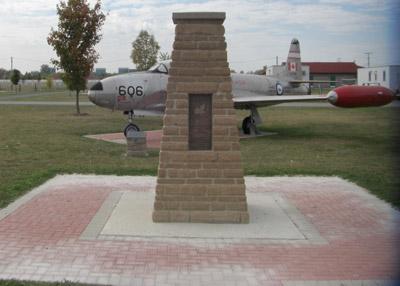
This memorial is dedicated to Veterans and the men and women of the Canadian Forces.
[plaque/plaque]
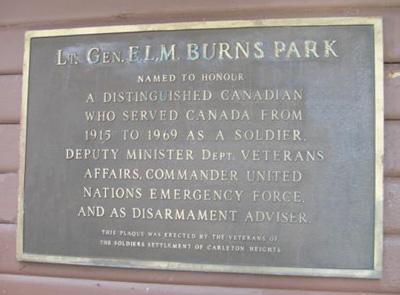
LT. GEN. E.L.M. BURNS PARK
NAMED TO HONOUR
A DISTINGUISHED CANADIAN
WHO SERVED CANADA FROM
1915 TO 1969 AS A SOLDIER.
DEPUTY MINISTER DEPT. VETERANS
AFFAIRS, COMMANDER UNITED
NATIONS EMERGENCY FORCE,
AND AS DISARMAMENT ADVISER.
THIS PLAQUE WAS ERECTED BY THE VETERANS OF
THE SOLDIERS SETTLEMENT OF CARLETON HEIGHTS.
[sign/enseigne]
[upper right corner/coin droit en haut]
Ottawa
[centre/centre]
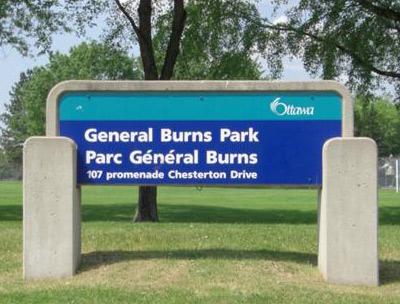
General Burns Park
Parc Général Burns
107 promenade Chesterton Drive
General Burns Park was erected by the Veterans of the Soldiers Settlement of Carleton Heights. This memorial is dedicated to Lieutenant-General E.L.M. "Tommy" Burns, CC, DSO, OBE, MC, CD (June 17, 1897 - September 13, 1985).
General Burns was born in Westmount, Québec, attended the Royal Military College of Canada (RMC), and was commissioned into the Royal Canadian Engineers in 1915. He went overseas in 1916 and fought on the Western Front from 1916 to 1918. In 1917, he became a staff officer with the 9th Brigade and returned to Canada in 1919.
After the war, he attended the School of Military Engineering in England, returning as an instructor to RMC. He served in Halifax and in the Survey Department in Ottawa. He attended the Staff College at Quetta, India and in 1939, as a Lieutenant-Colonel, he attended the Imperial Defence College in England.
During the Second World War, he served as Deputy Minister of Veterans Affairs. He also played a critical role in the Middle East peace process from 1954 to 1959 and was instrumental in developing the UN peacekeeping concept. He served as a Special Staff of the Truce Supervision Organization in Palestine (1954-56) with the Department of External Affairs. From November 1956 to December 1959, he led the UN Emergency Force and was Canada's principal disarmament negotiator from 1960-68.
[park sign/enseigne du parc]
Wing Office Willa Walker Park
305 Lysander Place
Parc de l'Officière-d'Escadre-Willa-Walker
305, place Lysander
Wilhelmina "Willa" Magee was born in Montreal on April 3, 1913, one of four children of Allan and Madeline Magee. After finishing school, Willa travelled to Paris to study French language and culture. Upon her return to Canada in 1933, she worked her way around the world as postmistress on Canadian Pacific’s famous Empress of Britain ocean liner.
Back in Montreal, Willa was employed by a news agency, accompanying the photographers who took pictures of local debutantes and celebrities. Hearing that Sir Herbert Marler had been appointed as Canadian minister to Washington, D.C., Willa offered herself as social secretary to his wife, Lady Beatrice Marler, and spent the next two years in Washington before returning to Canada.
In 1939, Willa attended a party at Rideau Hall in Ottawa, residence of the Canadian Governor-General, where she met a young Scottish captain in the British Black Watch 51st Highland Division, named David Walker. The young couple married on July 27, 1939, and only a few days after their honeymoon, in David’s native Scotland, war was declared and he rejoined his division.
When David went to war with his regiment in France in 1940, Willa stayed with David’s parents at their home in Cupar, Scotland. Shortly before the evacuation of Allied troops at Dunkirk in June 1940, David's entire division was captured at Saint-Valery, Normandy, and he spent the next five years in a prison camp. He managed to escape three times, but was always recaptured. Eventually, he was sent to the infamous Colditz Castle in Germany, a fortress for incorrigible inmates who had repeatedly escaped from other camps.
When Willa discovered she was pregnant she returned to Canada for the birth of her son Patrick in November 1940, but he died of crib death in February 1941 at the age of three months. In July 1941, Parliament passed an Order-in-Council allowing women to enlist, and the Royal Canadian Air Force formed a branch called the Women’s Division. With her husband in prison, Willa decided to join the war effort. In October 1941, she graduated with the first group of air force recruits, and achieved the highest marks in officer training. Three months later, in January 1942, she was placed in charge of the new female recruits in Canada, all of whom entered Number 7 Manning Depot in Rockcliffe, Ontario, for basic training. In February 1943, Willa was promoted to commanding officer of the Women's Division in Canada. Given the rank of wing officer, from then on Willa became known among the ranks as “The Wing.”
Willa was a natural-born leader. She was responsible for setting up training depots all over Canada as well as the overall discipline and efficiency of the Women’s Division. It was also her duty to urge more women to enlist, and no doubt her enthusiasm convinced many young women to follow in her footsteps. For the next couple of years, she crisscrossed the country by land and air, speaking to groups and organizations, even church congregations, in an effort to change the public perception of women in uniform.
It was still very much a man's world, but privately, Willa waged a war for women’s equality. For example, at all the training depots, the officers' mess, or dining hall, was reserved for men only, so Willa was not allowed to eat with the male officers. Frustrated by this regulation, one day Willa ordered her driver to park in front of the officers' mess. In sub-zero temperatures, she sat inside the vehicle during a snowstorm, eating her cold crackers, until the male officers were so ashamed that they invited her inside.
In November 1943, Willa accepted a solid gold cup on behalf of the Women’s Division, a gift from the British Women’s Auxiliary Air Force, presented by Her Royal Highness Princess Alice, Duchess of Gloucester. For her war work, Willa was made a Member of the Order of the British Empire in London, England, in January 1944, presented by Queen Elizabeth, wife of King George VI.
During the long years that David was in prison, Willa came up with a code for communicating important news in seemingly innocent letters to her husband, which passed undetected by both the Canadian and German censors. She managed to smuggle escape maps to David in the soles of a pair of shoes contained in a Red Cross package. This time, Canadian military officers intercepted the package and found the maps. The ingeniousness of the scheme appealed to them, so they repacked the shoes and sent off the package.
Unfortunately, nobody escaped from Colditz Castle, not even David. Willa resigned her post in October 1944 after three years of service, but it wasn’t until May 1945 that the war finally ended and they were reunited. Willa Walker blazed a trail for women in the Royal Canadian Air Force during the Second World War. The Wing Officer Willa Walker Park was dedicated in her honour on June 16, 2018.