Needs further research
Tofino Cenotaph
(needs further research/recherche incomplète)
My VAC Account
My VAC Account(needs further research/recherche incomplète)
Needs further research
[plaque]
THE PEACEKEEPES
WE WILL REMEMBER THEM
[plaque]
IN MEMORY OF
OUR FALLEN COMRADES
WORLD WAR I 1914 - 1918
WORLD WAR II 1939 - 1945
KOREAN WAR 1950 - 1953
WE WILL REMEMBER THEM
BRANCH 76
QUALICUM BEACH LEGION
NOVEMBER 11, 1993
[plaque]
LEST WE FORGET
The old Qualicum Beach Cenotaph was dedicated in May of 1949. By 1973, work had started on a new Legion Branch Clubhouse in the Royal Canadian Legion Community Park and it was decided that a new cenotaph should be located here.
Several designs were considered, the one chosen was by Terence Lyster, B. Arch of Vancouver. It is a unique design utilizing cedar logs that symbolize the radiating lines found in the maple leaf, Union Jack, fleur-de-lys, ship's wheel, gun carriage and other significant emblems. Branch members cut and assembled the huge yellow cedar logs.
The cenotaph was dedicated by Rev. B.A.J. Cowan and Rev. F. Golightly on October 6, 1973. It was unveiled by T. Lyster assisted by Branch Member W. Lyster.
[street sign]
MEMORIAL AVE
Memorial Avenue is dedicated to those who served and those who died in the First and Second World Wars. On November 11, 1995, plaques were placed in the sidewalk at the bases of 13 maple trees on Memorial Avenue. The dedication was made by Acting Mayor Orlan Rye and Wilma Stevens, President of Royal Canadian Legion Branch 76.
The 13 honoured are:
A.W. Field
G. Jones, DCM
F. Long
J. Osborne
W.J. Rankin
C.P. Davidson
A.R. Playfair
H.V.C. Hall
G. Lake
J. Middlemiss
W. Parker
A. Honeybun
I.C. MacLaine
In 1918, Canadians turned to the duty of commemorating the dead. Some promoted practical memorials like Roads of Remembrance. These linear tree-lined avenues had trees that were typically a single species, regularly spaced along each side of the avenue that would grow tall and stately. American elms were chosen for many of these avenues. A small plaque was used to assign a particular tree to a specific fallen soldier. In some cases, the next-of-kin was involved in purchasing the tree and/or plaque for the deceased soldier.
Roads of Remembrance were based on two symbol-laden images. The first was France’s tree-lined country avenues: “long straight roads, with large elms on either side, beautiful and useful, and loved by the Canadians overseas.” The second symbol was a living memorial: trees represented the victory of life over death. Memorial trees became living symbols of the sacrifices made overseas.
[front/devant]
LEST WE FORGET
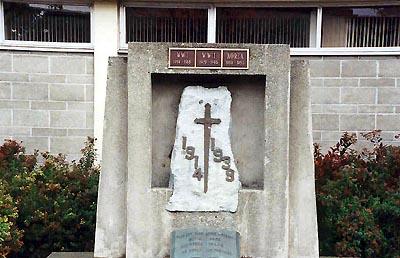
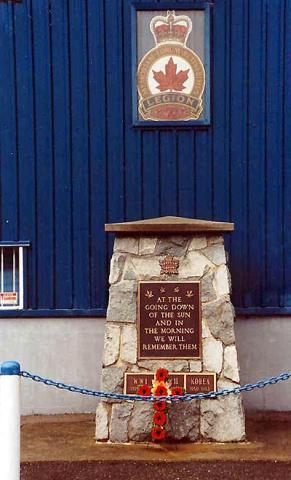
This memorial was designed and built in 1985 by Lorne Wilmer and volunteers for Royal Canadian Legion Branch No. 257. The Royal Canadian Legion Branch No. 257 donated a cheque to cover the cost of the materials. It was moved to the Legion with a truck loaned by the City of Nanaimo. It was first placed in front of the legion building. In 1992 it was moved again by the local lumber yard owner and legion volunteers. It was rededicated by the Reverend Les Clarke at a special meeting in 1992.
[upper plaque/plaque du haut]
LEST WE FORGET
[lower plaque/plaque du bas]
1914 - 1918
1939 - 1945
1950 - 1953
This memorial, erected by Royal Canadian Legion branch No. 211, is dedicated to the memory of the First and Second World Wars and the Korean War. The memorial was built in 1980 by Jim Simms and Rodger Strugnel.
[front top/devant, en haut]
ROLL OF HONOR
ALEXANDER SM
BADHAM FM
BOWLY RW
BREWIS T
BRIGNALL F
CALLARD ME
CHAPMAN H
DAVIS DSR
DUNN EC
FIELD AW
FORD EN
FOSTER L
FRASER AL
HALL HCV
HALL WC
HAMMIL N
HARDY C
HICKEY CRR DFC&BAR
JONES C
KILBY TW
LAWLER T
LIPSCOMBE HCP
LONG FW
MANISTY HS
MC ADOO L
MIDDLEMISS D
MOGG AB
MONKS AM
PARKER CW
PHILLIPS JW
PITTENDRIGH DM
PRICE RWF MC
RANKIN W
REID PW
REYNOLDS EW
RICHARDS P MC&BAR
RIDDELL AL
SCOTT CD
SIVELL AG
THOMAS HR
WARD GS
ERECTED IN MEMORY OF THE MEN OF THIS DISTRICT
WHO GAVE THEIR LIVES IN THE
GREAT WAR
1914 1918
[front bottom/devant, en bas]
1939-1945
H.J. BARNUM
R. CLARKE
D. COYSH
C.P. DAVIDSON
V. EVEREST
W. MC NEIL
E.K. OVERY
C.M. PEACE
A.R. PLAYFAIR
J.H.W. POPE
A.E. SHAW
E.S. STROUTS
R.F. TAYLOR
M. THOMPSON
E. CEDDES
C.W. HOLLINS
[right side/côté droit]
LEST WE FORGET
T. BREWIS
F. BRIGNALL
W. CHRISTIAN
C.C. CRUSE
A.L. FRASER
W.C. HALL
L. MC ADOO
J.W. OUIMET
R.W.F. PRICE M.B.
J.W. PHILLIPS
D.W. REID
A.S. SIVELL
GAVE THEIR LIVES IN THE GREAT WAR
1914-1918
[left side/côté gauche]
KOREA 1950-1953
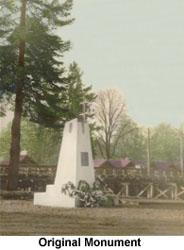
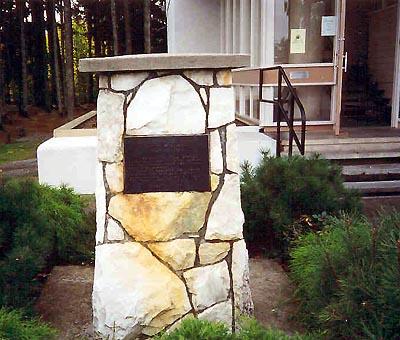
The Parksville Cenotaph is located at the Parksville Community Park, it was constructed in 1922-1923. It was built in memory of veterans from Parksville and area who served in the First and Second World Wars. The memorial was purchased from money raised by the Women’s Institute. The three tons of granite were brought from Nelson Island and carved by Bill Wheeler with the help of W. Bryce. The original site was on Memorial Avenue. The Women’s Institute also donated trees to border both sides of Memorial Avenue. However, due to traffic congestion it was decided to move the monument. The new location was a piece of land donated on Sutherland Drive. Memorial Park was created with grass and seed donated by Buckerfield and trees provided by B.C. Forest Service. The memorial was rededicated on 11 June 1967. It was during this move that it is believed the monument was separated from its original base. Due to traffic congestion the monument was moved again to the Parksville Community Park on 23 October 1976. The monument was moved once again to its current location, the plaza outside the Parksville Civic and Technology Centre complete with its original base, which was located by Don Levirs a local resident. It was rededicated on 11 November 2001.
[plaque/plaque]
Heritage Tree
Big Leaf Maple (Acer macrophyllum)
This tree was planted in 1923 in honour of Alfred W. Trattle who was killed in action near Vimy Ridge, France in 1917. Many more commemorative trees, some now lost, were planted throughout the community in honour of falled World War I soldiers from Langley. Dedicated by the Langley Heritage Society & the township of Langley.
The Trattle Memorial Maple Tree was planted as a memorial to a soldier, Alfred Trattle, at the intersection of 96th Avenue and Trattle Street in Fort Langley. In front of the matured Broad Leaf Maple tree is a bronze memorial marker that lists the name of a soldier being commemorated and a small tribute. Broad-leaf maple is the largest growing maple species native to British Columbia (reaching up to 36 meters), but they are the symbol of Canada and an early expression of Canada’s nationhood – the maple leaf was the first military insignia for Canada, and is appropriate to memorialize fallen Canadian soldiers with maple trees. Belonging to a well-known Langley family, Alfred Trattle was a former Canadian Pacific Railway worker and farmer when he joined the 360 men from Langley who went overseas to fight in the First World War. He died at Vimy Ridge in 1917 – one of about 36 who died in the line of duty.
Dr. Benjamin Marr and Archie Payne, Langley residents who were members of the Langley Volunteers division, wanted to honour their fallen comrades by having broad-leaf maple trees planted and named after the soldiers. They also arranged for the street names on which each Maple stood to be changed to the last name of the soldier being memorialized at that particular site. This tree is one of four First World War memorial maple trees that have survived in the Township and represented the residents’ pride in their community and their civic-mindedness in honouring those who fought and died in the First World War. The trees were planted in 1923.
[plaque/plaque]
Heritage Tree
Big Leaf Maple (Acer macrophyllum)
This tree was planted in 1923 in honour of Jesse Wright who was killed in action near Vimy Ridge, France in 1917. Many more commemorative trees, some now lost, were planted throughout the community in honour of falled World War I soldiers from Langley. Dedicated by the Langley Heritage Society & the township of Langley.
The Wright Memorial Maple Tree was planted as a memorial to a soldier, Jesse Wright, at the intersection of 96th Avenue and Wright Street in Fort Langley. In front of the matured Broad Leaf Maple tree is a bronze memorial marker that lists the name of a soldier being commemorated and a small tribute. Broad-leaf maple is the largest growing maple species native to British Columbia (reaching up to 36 meters), but they are the symbol of Canada and an early expression of Canada’s nationhood – the maple leaf was the first military insignia for Canada, and is appropriate to memorialize fallen Canadian soldiers with maple trees. Jesse Wright had only been in Canada since 1911 when he joined the 360 men from Langley who went overseas to fight in the First World War. He died at Vimy Ridge in 1917 – one of about 36 who died in the line of duty.
Dr. Benjamin Marr and Archie Payne, Langley residents who were members of the Langley Volunteers division, wanted to honour their fallen comrades by having broad-leaf maple trees planted and named after the soldiers. They also arranged for the street names on which each Maple stood to be changed to the last name of the soldier being memorialized at that particular site. This tree is one of four First World War memorial maple trees that have survived in the Township and represented the residents’ pride in their community and their civic-mindedness in honouring those who fought and died in the First World War. The trees were planted in 1923.
[plaque/plaque]
Heritage Tree
Big Leaf Maple (Acer macrophyllum)
This tree was planted in 1923 in honour of Arthur Johnston who was killed in action at Ypres in 1916. Many more commemorative trees, some now lost, were planted throughout the community in honour of falled World War I soldiers from Langley. Dedicated by the Langley Heritage Society & the township of Langley.
The Johnston Memorial Maple Tree was planted as a memorial to a soldier, Arthur Johnston, at the intersection of 216th Street and Glover Road in the Milner area of the Township of Langley. In front of the matured Broad Leaf Maple tree is a bronze memorial marker that lists the name of a soldier being commemorated and a small tribute. Broad-leaf maple is the largest growing maple species native to British Columbia (reaching up to 36 meters), but they are the symbol of Canada and an early expression of Canada’s nationhood – the maple leaf was the first military insignia for Canada, and is appropriate to memorialize fallen Canadian soldiers with maple trees. Arthur Johnston was a grocer and local leader when he joined the 360 men from Langley who went overseas to fight in the First World War. He died at Ypres in 1916 – one of about 36 who died in the line of duty.
Dr. Benjamin Marr and Archie Payne, Langley residents who were members of the Langley Volunteers division, wanted to honour their fallen comrades by having broad-leaf maple trees planted and named after the soldiers. They also arranged for the street names on which each Maple stood to be changed to the last name of the soldier being memorialized at that particular site. This tree is one of four First World War memorial maple trees that have survived in the Township and represented the residents’ pride in their community and their civic-mindedness in honouring those who fought and died in the First World War. The trees were planted in 1923.
ANAVETS Emblem
MATSQUI UNIT 315
LEST
WE
FORGET
This memorial is dedicated in memory of those who gave their lives in wars, erected in 1981 by the Members of Matsqui Unit #315 of the Army, Navy and Air Force Veterans of Canada.