British Columbia

Province Code
BC
City/Municipality
Esquimalt
Memorial Number
59005-091
Type
Address
Location
Canadian Forces Base Esquimalt, Maritime Forces Headquarters
in Canada
Yes
GPS Coordinates
48.4327, -123.43849
Province
!4v1679402017258!6m8!1m7!1sCuZ-JKdhtHwsYoCtU55-oQ!2m2!1d48.42847570388759!2d-123.4309928846376!3f301.17996636169283!4f-18.553854736061595!5f0.7820865974627469
Body Content

Bickford Tower was erected in 1901 as a signaling tower for naval visual communication. It was built at an estimated cost of $8,288, and designed by the Royal Navy’s Officer in Charge of Works, T. Woodgate. The tower bears the name of Admiral Andrew Kennedy Bickford, who commanded Britain’s Pacific base at Esquimalt. 

The tower was among the last of Britain’s Imperial defence works in Canada before they withdrew their naval units in 1905, making way for the Royal Canadian Navy, which assumed control in 1910. The tower is a four-story octagonal brick structure of 1184 square feet and is 50 feet tall. The first floor was the men’s mess room, an officer's room was on the second floor and up the stairs was a men’s room. The stairs continued on up to the signal room. On the platform were both a flagpole and a semaphore. 

Two years after its construction, the tower became obsolete due to the introduction of a military telephone system. The building was later used as a theodolite station for ship weapons alignment and a site for electronic instrumentation. 

City
Esquimalt
Country
Type Description
Building - signaling tower
Memorial CF Legacy ID
11560
City/Municipality
Esquimalt
Memorial Number
59005-090
Type
Address
1190 Colville Road
Location
Veterans Cemetery, God's Acre, Veterans Chapel
in Canada
Yes
GPS Coordinates
48.4379101, -123.4142781
Inscription

TO THE MEMORY
OF
CAPTAIN FREDERICK PERCIVAL TRENCH
OF
HER MAJESTY'S SHIP ROYAL ARTHUR
BORN 27 MARCH 1849
DIED 10 MAY 1895
AGED 46
BURIED AT SEA

Province
!4v1627405853058!6m8!1m7!1spy0nvdiajcS9VcxW8nUM-Q!2m2!1d48.43793623092444!2d-123.4143455546343!3f330.73322679621753!4f2.5750375762256396!5f0.7116711758875851
Body Content

This plaque was dedicated to the memory of Captain Frederick Percival Trench of the Royal Navy. He was the Captain of HMS Royal Arthur, the flagship of the Pacific Station in the late 1890s. While off the coast of Mexico in May of 1895, he died suddenly and was buried at sea. 

City
Esquimalt
Country
Type Description
Plaque
Memorial CF Legacy ID
11559
City/Municipality
Esquimalt
Memorial Number
59005-089
Type
Address
Location
Esquimalt Graving Dock property
in Canada
Yes
GPS Coordinates
48.4370955, -123.4192202
Inscription

MINE OWN WILL I BRING AGAIN
FROM THE DEEP OF THE SEA.
Ps 69.22.

TAKE YE HEED TO WATCHE AND PRAY
FOR YE KNOW NOT WHEN THE
TIME IS.
MARK 13.33.

Province
!4v1679337601517!6m8!1m7!1s-GKdY94gUyMwMQQbnm1uyw!2m2!1d48.4370954903081!2d-123.4192202307815!3f276.7955267151318!4f2.161299199332248!5f1.7016537505645846
Body Content

The Warspite Monument was erected sometime between July 26, 1891 and the end of 1894. The four meter high Celtic cross, made of granite that is not native to Canada, is believed to have been made in England and shipped to Esquimalt. It was erected by parents of the four midshipmen from HMS Warspite who were believed to have drowned in a canoe accident off Albert Head. Their names are inscribed on the monument in order of their academic ranking from HMS Britannia, a training establishment at Dartmouth which they all attended prior to receiving their first appointment to a Royal Navy ship.

On July 5, 1891, HMS Warspite arrived in Esquimalt for repairs from war action in Chile and on July 9, 1891 half the crew were given leave. The four midshipmen set off in two canoes purchased from the locals by Honourable A. Alberic De Montmorency. When they failed to return on Friday, a steam launch was sent for them. One of the canoes was found floating bottom upwards off Beacon Hill by a fisherman. The second was found abandoned at Albert Head with a tin cup and a paddle tied under the seat, mast up, and sail hanging in the water. 

The monument is not accessible to the public, due to a change in the configuration of fencing and property lines.

City
Esquimalt
Country
Type Description
Cross
Memorial CF Legacy ID
11558
City/Municipality
Esquimalt
Memorial Number
59005-088
Type
Address
Naden Way
Location
Canadian Forces Base Esquimalt
in Canada
Yes
GPS Coordinates
48.433149, -123.4180109
Inscription
  • THE FOUNDING OF THE CANADIAN
    NAVAL SERVICE
  •  
  • The Royal Canadian Navy, founded in
    1910 as the Canadian Naval Service, was
    the first national service of its kind. It
    played a key role in the Dominion’s
    contributions to the Allied effort during
    the First World War, notably in military
    recruitment and training, organization
    and operation of an Allied convoy
    service, coastal patrol, and provisioning
    British naval forces on the Atlantic coast.
    The establishment of the navy was an
    important expression of autonomy at a
    critical time in Canada’s development
    from colony to nation.
  •  
  • Historic Sites and
    Monuments Board of Canada
    and Parks Canada
  •  
  •  
  • LA CRÉATION DU SERVICE NAVAL
    DU CANADA
  •  
  • La Marine royale du Canada, premier
    service national du genre, fut fondée
    en 1910 sous le nom de Service naval du
    Canada. Elle joua un rôle clé dans l’effort
    de guerre du Dominion pendant la
    Première Guerre mondiale, notamment
    par le recrutement et la formation,
    l’organisation et les opérations d’un
    service de convois alliés, la surveillance
    côtière et l’approvisionnement des
    forces navales britanniques sur la côte
    atlantique. La création de la marine
    permit au Canada d’affirmer son
    autonomie à un moment crucial de sa
    transition de l’état de colonie à celui de
    nation.
  •  
  • Commission des lieux et
    monuments historiques du Canada
    et Parcs Canada
Image
Caption
Canadian Naval Service Monument
Province
!4v1679328593092!6m8!1m7!1spV0vGOK2x9IIw6aDLSG6Xg!2m2!1d48.43314904692863!2d-123.4180108860682!3f269.5340089588282!4f-6.828339698315688!5f0.7820865974627469
Body Content

A monument commemorating the founding of the Canadian Naval Service was unveiled on May 4, 1998, by Vice-Admiral (retired) Nigel Brodeur and Captain (Navy) Jason Boyd, Base Commander. Vice-Admiral Brodeur's grandfather was Canada’s first Naval Minister and instrumental to the establishment of the service. His father, Rear-Admiral Victor Brodeur, served in the Navy as the Commander Pacific Coast during the Second World War and was the first Francophone from Quebec to join the admirality.

To the left of the monument is a seven bladed propeller removed from HMCS Annapolis (DDH 265). This propeller was a revolutionary design at the time. The hull of the vessel is now an artificial reef. The propeller on the right was removed from one of the three HMC Submarines Ojibwa 72, Okanagan 74, and Onondaga 73. It is not likely that it is from Onondaga, as that sub is in Pointe au Pere, Rimouski, Quebec as a museum vessel. The subs were built at Chatham Dockyard in the United Kingdom and were identical to the Royal Navy Oberon Class conventionally powered submarines.

The Canadian Naval Service, now known as the Royal Canadian Navy, was established on May 4, 1910. A plaque identical to the one on this monument is located on the Wall of Valour at Canadian Forces Base Halifax. The founding of the Canadian Naval Service was designated a national historic event by the federal government on the recommendation of the Historic Sites and Monuments Board of Canada.

City
Esquimalt
Country
Type Description
Slab, plaque
Photo Credit
CFB Esquimalt Naval & Military Museum
Memorial CF Legacy ID
11557
City/Municipality
Esquimalt
Memorial Number
59005-087
Type
Address
Lyall and Head Streets
Location
Canadian Forces Base Esquimalt, Work Point
in Canada
Yes
GPS Coordinates
48.4261391, -123.3983846
Inscription

VENTURE CADET 1954-1966

"BY SEA AND AIR"
"PAR MER ET AIR"

PRESENTED BY THE VENTURE ASSOCIATION
SEPTEMBER 12 2004

Image
Photo Credit
Jack Bates
Caption
Venture Cadet
1 of 2 images
Image
Photo Credit
Jack Bates
Caption
inscription
1 of 2 images
Province
!4v1662740922696!6m8!1m7!1solRK-uj6_7N9xooLoqsWLQ!2m2!1d48.42613907806026!2d-123.3983846394522!3f160.72542640329033!4f-1.0202404284349456!5f1.2836551123170608
Body Content

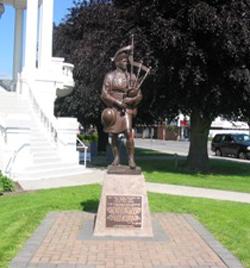
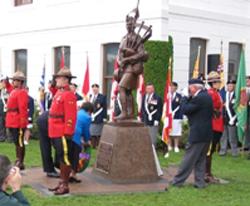
In the central plaza of the accommodation block at His Majesty's Canadian Ship Venture is a bronze statue of a Venture cadet circa 1954, which was commissioned and donated by the Venture Association on 12 September 2004.

Venture Plan was established in 1954 to address critical Royal Canadian Navy officers shortages that were not being addressed by existing intake plans. Venture was commissioned as the Royal Canadian Navy Junior Officer Training Establishment and located in the Esquimalt dockyard. Its role was to train junior naval officers of the executive, engineering, fleet air arm and naval supply branches during a two-year term of academic education. After that basic training, the various branches received different professional and educational training appropriate to their branch. 

In September 1963, Venture Plan was superseded and intake shifted to the Short Service Officer Plan for maritime officers. In 1968 with the adoption of integration, the Canadian Forces Officer Training Establishment was founded and Venture was phased out and returned to the Esquimalt dockyard.

With the army’s withdrawal of the 3rd Battalion, Princess Patricia’s Canadian Light Infantry from Work Point Barracks, Venture was relocated from the dockyard to several of the ex-PPCLI buildings at Work Point in the fall of 1994.

City
Esquimalt
Country
Type Description
Statue - bronze
Memorial CF Legacy ID
11174
City/Municipality
Esquimalt
Memorial Number
59005-086
Type
Address
1379 Esquimalt Road
Location
St. Peter and St. Paul's Anglican Church
in Canada
Yes
GPS Coordinates
48.4295686, -123.4224034
Image
Caption
St. Paul's Naval and Garrison Church sign
1 of 4 images
Image
1 of 4 images
Image
Caption
Inside St. Paul's Naval and Garrison Church
1 of 4 images
Image
Caption
St. Paul's Naval and Garrison Church
1 of 4 images
Province
!4v1670426977858!6m8!1m7!1sVk24dhJjp1jdQyBA3fPhlQ!2m2!1d48.42956858982394!2d-123.4224033780181!3f167.0265825201093!4f5.765810965700339!5f0.7820865974627469
Body Content

St. Paul’s Church was built in 1866 on the water’s edge at the foot of Signal Hill. Before that time, dating back to 1858, Anglican services were held in the little school building that once stood on that site. Also, previously, Anglican services were conducted by Royal Navy chaplains aboard their ships for naval personnel and the growing population around Victoria.

In 1904, the building was dismantled as required and relocated to its present site due to proposed firing of large caliber guns on Signal Hill combined with strong winter gales damaging the lead glassed windows, as well as the property was needed by the navy for expansion of its operations. In 1911, it was renamed St. Paul’s Naval and Garrison Church.

Colours were presented to Princess Patricia's Canadian Light Infantry (PPCLI) on 14 April 1934, by the Earl of Bessborough, Governor-General of Canada, at a parade in the Minto Street Armouries, Winnipeg, Manitoba. The Regimental Colour was emblazoned on it with ten Battle Honours awarded to the Regiment for its actions during the First World War and gazetted in 1919. On 15 Aug 1950, these Colours were designated the Colours of the First Battalion upon the formation of the Second Battalion for service in Korea.

The Colours were laid up on 25 Nov 1959 in St. Paul’s Naval and Garrison Church at the request of the Commanding Officer, Lieutenant-Colonel J.C. Allan, DSO, MBE, CD. Princess Patricia's Canadian Light Infantry is affiliated with the church, dating from 1920 when B Company was stationed at Work Point Barracks. The church has three plaques commemorating the service of Patricias who died while serving in Esquimalt. In army circles, the church is still known and fondly referred to as the "Garrison Church.”

When the Regiment was advised that the church was under threat of closure and possible demolition, resulting in the loss of access to the Colours, the Regiment reclaimed them in 1991 and placed them in the Museums of the Regiments in Calgary, Alberta, where they reside today. The church closure and demolition never materialized and only a small portrayal of the Colours remained in the church. Eventually, on 6 May, 2017, to celebrate the 150th anniversary of the church, the Victoria Branch of the PPCLI Association presented to St. Paul’s a framed replica and scroll dedicated to the original 1 PPCLI Colours, placed in 1959. The Colour Officer for the Regimental Colour when laid-up in 1959, Dick Macintosh, presented the plaque. Financial support for this event was provided by both the National PPCLI Association and Regimental Headquarters.

City
Esquimalt
Country
Type Description
Building - church
Photo Credit
St. Peter and St. Paul's Anglican Church
Memorial CF Legacy ID
11170
City/Municipality
Esquimalt
Memorial Number
59005-085
Type
Address
Lyall and Head Streets
Location
Canadian Forces Base Esquimalt, Work Point
in Canada
Yes
GPS Coordinates
48.4261391, -123.3983846
Inscription

BÂTIMENT
HAIDA
BUILDING

Image
Caption
Haida Building
1 of 3 images
Image
Caption
Haida Building
1 of 3 images
Image
Caption
Haida Building
1 of 3 images
War or Conflict Term
Province
!4v1662740922696!6m8!1m7!1solRK-uj6_7N9xooLoqsWLQ!2m2!1d48.42613907806026!2d-123.3983846394522!3f160.72542640329033!4f-1.0202404284349456!5f1.2836551123170608
Body Content

Building 1020 in Work Point Barracks was built in 1898 to for use as the base administration and headquarters. It housed the first headquarters of the Canadian Women’s Army Corps in 1941, later under the command of Lieutenant Colonel Joan Kennedy.

Formerly known as the Frezenberg Building, it was rededicated by the Naval Officer’s Training Centre (Venture) in 1998 in memory of His Majesty's Canadian Ship (HMCS) Haida, a Tribal class destroyer that served in the Second World War and Korean War. Haida helped sink 14 ships during the Second World War. After peacetime service from 1947 to 1950, it served from 1952 to 1954 in the Korean War where Haida protected aircraft carriers and blockaded supply lines. It also helped blow up communist supply trains as they sped along the coast in what was known as “train busting.”

Haida remained in service with the Royal Canadian Navy until 11 October 1963. After being moved to Ontario Place, Toronto, as a memorial, then to dry docks in St. Catharines for repairs, it moved to Hamilton, Ontario, where in June 2004 it opened as a National Historic Site. Haida is moored at Pier 9 in Hamilton Harbour and is the only surviving Tribal class destroyer.

City
Esquimalt
Country
Type Description
Building
Photo Credit
Jack Bates
Memorial CF Legacy ID
11169
City/Municipality
Esquimalt
Memorial Number
59005-084
Type
Address
Lyall and Head Streets
Location
Canadian Forces Base Esquimalt, Work Point
in Canada
Yes
GPS Coordinates
48.4261391, -123.3983846
Inscription

AMIENS
BUILDING

BATIMENT
AMIENS

Image
Photo Credit
Jack Bates
Caption
Amiens Building
War or Conflict Term
Province
!4v1662740922696!6m8!1m7!1solRK-uj6_7N9xooLoqsWLQ!2m2!1d48.42613907806026!2d-123.3983846394522!3f160.72542640329033!4f-1.0202404284349456!5f1.2836551123170608
Body Content

Building 1031 in Work Point Barracks was designated Amiens Building in 1977 by 3rd Battalion, Princess Patricia's Canadian Light Infantry in honour of the Princess Patricia's Canadian Light Infantry who fought in that battle and for which action they received a Battle Honour.

The Canadian Corps’ reputation in the First World War was such that the mere presence of Canadians on a section of the front would warn the enemy that an attack was coming. This meant that great secrecy would be involved in the movements of the Canadian Corps. A large offensive was planned in France in August 1918 and Canadian troops were shifted north to Ypres, Belgium. This made the Germans think a major attack was coming there before the Canadians secretly hurried back to the Amiens sector for the real attack.

On August 8, Canada led the way in an offensive that saw them advance 20 kilometres in three days. This offensive was launched without a long preliminary artillery bombardment as was usually done (which also warned the enemy that an attack was coming) and the Germans were taken totally by surprise. This breakthrough was a remarkable development and dashed enemy morale, with the German high commander calling it “the black day of the German Army.”

City
Esquimalt
Country
Type Description
Building
Memorial CF Legacy ID
11168
City/Municipality
Esquimalt
Memorial Number
59005-083
Type
Address
Lyall and Head Streets
Location
Canadian Forces Base Esquimalt, Work Point
in Canada
Yes
GPS Coordinates
48.4261391, -123.3983846
Inscription

ARLEUX
BUILDING

BÂTIMENT
ARLEUX

Image
Photo Credit
Jack Bates
Caption
Arleux Building
War or Conflict Term
Province
!4v1662740922696!6m8!1m7!1solRK-uj6_7N9xooLoqsWLQ!2m2!1d48.42613907806026!2d-123.3983846394522!3f160.72542640329033!4f-1.0202404284349456!5f1.2836551123170608
Body Content

Building 1070 in Work Point Barracks was built in 1902 as offices and general stores for the Royal Garrison Artillery. It was designated Arleux Building in 1977 by the 3rd Battalion, Princess Patricia's Canadian Light Infantry in honour of the Princess Patricia's Canadian Light Infantry who fought in that battle and for which action they received a Battle Honour.

Actions on 28 and 29 April 1917 resulted in the successful capture of the village of Arleux-en-Gohelle to the east of Vimy Ridge. Conducted mainly by the 1st Canadian Division (Major-General A.W. Currie) the Canadian attack was meant to capture a portion of the German “Arleux Loop” defensive position in front of the village. The Canadian portion of the attack was launched in the early morning of the 28th and had successfully gained its objectives by 6:00 am after which reinforcements moved forward in anticipation of German counterattacks. These counterattacks were mainly broken up by Canadian artillery fire. The Germans eventually fell back on to their Oppy-Méricourt Line defences in front of Fresnoy-en-Gohelle abandoning the Arleux salient. 

City
Esquimalt
Country
Type Description
Building
Memorial CF Legacy ID
11167
City/Municipality
Esquimalt
Memorial Number
59005-082
Type
Address
Lyall and Head Streets
Location
Canadian Forces Base Esquimalt, Work Point
in Canada
Yes
GPS Coordinates
48.4261391, -123.3983846
Inscription

HILL 70
BUILDING

BÂTIMENT
HILL 70

Image
Photo Credit
Jack Bates
Caption
Hill 70 Building
War or Conflict Term
Province
!4v1662740922696!6m8!1m7!1solRK-uj6_7N9xooLoqsWLQ!2m2!1d48.42613907806026!2d-123.3983846394522!3f160.72542640329033!4f-1.0202404284349456!5f1.2836551123170608
Body Content

Building 1068 in Work Point Barracks was built in 1904 by the Royal Engineers as the Detention Barracks for the Royal Garrison Artillery. It remained as such until 1957 when it was utilized for other barracks logistical requirements. It was designated Hill 70 Building in 1977 by the 3rd Battalion, Princess Patricia's Canadian Light Infantry in honour of the Princess Patricia's Canadian Light Infantry who fought in that battle and for which action they received a Battle Honour.

Hill 70 battle was planned and carried out almost entirely by Canadians—a rarity in the First World War where Canadians usually fought as part of a larger British effort. Lieutenant-General Arthur Currie felt that his artillery would have trouble smashing the well-camouflaged German defences at Lens and a direct attempt to send attacking troops into the town would result in terrible casualties. He persuaded his superiors to instead allow the Canadians to first capture the nearby high ground to the north (code-named Hill 70).

Poison gas was widely used, often forcing the men to gasp for air inside their restrictive respirators as they struggled to see the advancing enemy through their fogged-up goggles. Many soldiers had to engage in desperate hand-to-hand combat against the German attackers who managed to reach the Canadian defensive lines. The 100,000-strong Canadian Corps suffered some 9,200 casualties between August 15 and 25, 1917. 

City
Esquimalt
Country
Type Description
Building
Memorial CF Legacy ID
11166