
Erected by the firemen and citizens of Clair, this memorial is dedicated to the local veterans and war dead of the First and Second World Wars and the Korean War.
It was constructed in October of 1995.
Sign in to My VAC Account
Sign in to My VAC Account[front/devant]
A NOS GLORIEUX MORTS
TO OUR GLORIOUS DEAD
1914-1918
1939-1945
1950-1953
POUR HONORER NOS VETERANS
TO HONOUR OUR VETERANS
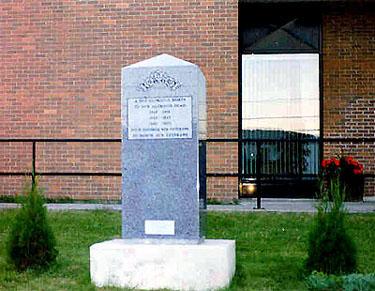
Erected by the firemen and citizens of Clair, this memorial is dedicated to the local veterans and war dead of the First and Second World Wars and the Korean War.
It was constructed in October of 1995.
[front/devant]
1914 — 1918
1939 — 1945
1950 — 1953
A NOS
GLORIEUX MORTS
TO OUR
GLORIOUS DEAD
GUERRE MONDIALE
1939-1945
WORLD WAR II
CHARLES EUGENE BEAULIEU
LLOYD BELLEFLEUR
ARTHUR BOUCHARD
LUCIEN BOUCHARD
J. MAURICE BOURQUE
ALPHONSE CHARETTE
JAMES CROOK
G.F. DAWSON
LOUIS-PHILIPPE DESJARDINS
LLOYD DESROCHES
ARMAND DUBE
HENRY E. DUBE
RICHARD A. DUNBAR
GILBERT L. FOURNIER
JEAN MARIE GAUTHIER
BOYD HORNHILL
FERNAND LEVESQUE
RONALD L'ITALIEN
ANFORD MAGOON
PAUL-EMILE MARTIN
LEWIS MCKINLEY
ARCHIE PHILLIP MCLEAN
HORMIDAS MICHAUD
RENE MORIN
GUY MORNEAULT
[right side/côté droit]
GUERRE MONDIALE
1914 — 1918
WORLD WAR I
G. CYR
D. DIONNE
P. DUMAIS
H. FOURNIER
J. LEBEL
P. MARQUIS
A. MARTIN
[back/arrière]
GUERRE DE COREE
1950 — 1953
KOREAN WAR
GILBERT BOSSE
ALBERT PELLETIER
AFGHANISTAN
2001 — 2014
CHARLES-PHILIPPE MICHAUD, CAPORAL-CHEF
[left side/côté gauche]
GUERRE MONDIALE
1939 — 1945
WORLD WAR II
LEON HUBERT PELLETIER
OSCAR PICARD
PAUL-EMILE PICARD
REGINALD PLOURDE
T.M. RICHARDS
DONALD ROSS
WALTER ROSS
ADRIEN ROUSSEL
JOHN RICHARD SCOTT
PHILLIP D. SCOTT
GEORGE SHERWOOD
RAOUL SOUCY
VINCENT WALLACE
JOHN JOSEPH WEATHERHEAD
The bottom and center sections of the Edmundston Cenotaph were erected in 1950 and the top section in 1994. The memorial honours the memory of the region’s war Veterans and the war dead of the First and Second World Wars and Korean War. Later, the war dead of Afghanistan was added to the memorial.
[front/devant]
EN HOMMAGE A NOS FRERES QUI ONT DONNE LEUR VIE POUR LA LIBERTE
GUERRE 1914-1918
CHARLES AKERLEY
LEE BIRD
ARCHILLE LEBEL
GUERRE 1939-1945 ET KOREE
GEORGE AKERLEY
AURELE CORMIER
CECIL COTE
RAYMOND COTE
JEAN DAMBOIRE
ARTHUR DARION
PIERRE GERVAIS
JAYEUX LANTEIGNE
ROGER SIROIS
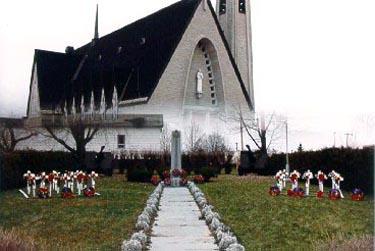
This memorial, measuring over nine feet in height and six feet wide, was unveiled by Royal Canadian Legion Branch No. 52 on 7 September 1959 as a memorial to the local war dead of the First and Second World Wars and the Korean War. It honours the veterans who died from the regions of St. Leonard, Ste-Anne, Siegas, N-Dame de Lourdes, and St. Leonard Parent.
Quispamsis Memorial Arena
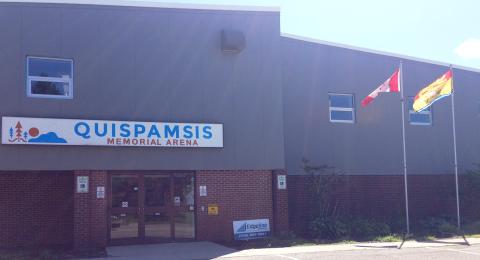
Quispamsis Memorial Arena was erected after the Second World War as a memorial to those lost during military service from the area.
[front/devant]
IN RECOGNITION OF
CAPT. JAMES WADE
RECIPIENT OF THE BRITISH EMPIRE MEDAL
PIONEER PILOT AND NAVIGATOR
ONE OF THE FIRST GRADUATES OF THE MONCTON FLYING CLUB
FIRST AREA RESIDENT TO OBTAIN A CIVILIAN PILOTS LICENSE
HE WAS INTERNATIONALLY HONOURED FOR HIS NUMEROUS DARING MERCY AND RESCUE MISSIONS
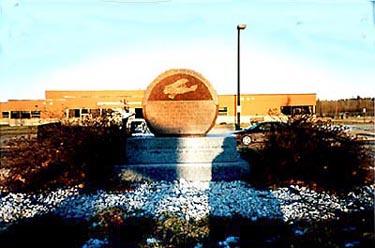
James Wade was born in 1909 in England and later attended the Village Elementary School and then graduated from Sussex High School in 1928.
He served in the Second World War flying military planes to Greenland and also flew K.C. Irving for several years as a personal pilot. He was known for his rescue missions and in three different cases he was able to land hi plane on “dime-sized” spot of open water, in the freezing cold to help rescue survivors. He also once spent 3 days in the Arctic wastes trying to find civilization after his plane went down on a rescue mission.
He received the British Empire Medal and the Distinguished Flying Medal, for actions few other would even attempt.
The monument at Sussex Corner School was unveiled on June 6, 1984 lead by Captain Wade’s widow, (the former Florence Lillian Mingo) of Charlottetown, PEI and his sister, Mrs. Ronald Bell of Peterborough, Ontario.
James Wade later passed away in January of 1974 at his home in Saint John.
[plaque/plaque]
IN MEMORY OF THE BOYS WHO LOST THEIR LIVES IN WORLD WAR I, WORLD WAR II AND KOREAN CONFLICT
needs further research/recherche incomplète
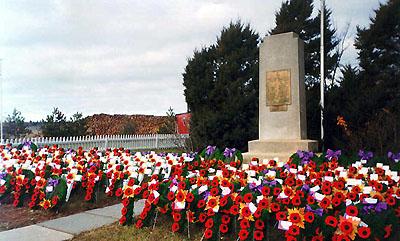
This memorial to the war dead of the First and Second World Wars and the Korean War was erected by Royal Canadian Legion Branch No. 74.
[front/devant]
[top plaque/plaque du haut]
IN MEMORY OF
THOSE WHO SERVED
IN THE NEW BRUNSWICK RANGERS
ERECTED BY
THE NEW BRUNSWICK RANGERS ASSOCIATION
1980
[front/devant]
[below plaque/plaque du bas]
BATTLE HONOURS 1914-1918
"MOUNT SORREL," "SOMME-1916,"
"ARRAS" 1917-1918," "HILL 70," "YPRES-1917"
"AMIONS," "HINDENBURG LINE," AND "PURSUIT TO MONS"
PRINCIPAL ACTIONS 1939-1945
FRANCE
HUBERT-FOLIE
ROCQUANCOURT
CINTHEAUX
HAUTMESNIL
HILL 195 (NEAR TRUN)
QUESNEY WOOD
TRUN (THE BATTLE OF THE GAP)
BELGIUM
GHENT CANAL
MOERKERKE
KERSELAER
CAMP DE BRASSHAET
ESSCHEN
HOLLAND
BERGEN-OP-ZOOM
STEENBERGEN
DINTELOORD
KAPELSCHE-VEER
GERMANY
HOCHWALD
VEEN
EMMERICH
TWENTHE CANAL (HOLLAND)
EMS CANAL
DORPEN
STEINBILD
KUSTEN CANAL
JEDDELOH
BAD ZWISCHENAHN
[front/devant]
[base/base]
1914-1918 1939-1945
[rear/arrière]
THE NEW BRUNSWICK RANGERS
1870-1946
INCORPORATING THE MILITIA COMPANIES OF
KINGS AND WESTMORLAND COUNTIES THE
REGIMENT WAS ORGANIZED IN 1870. AS THE 74TH
REGIMENT, CANADIAN MILITIA, IT PROVIDED
A COMPANY FOR THE CANADIAN NORTH WEST IN
1885, AND VOLUNTEERS FOR THE CANADIAN
CONTINGENTS DURING THE WAR IN SOUTH AFRICA
1899-1902 AND FOR THE 12TH, 55TH, 145TH AND
235TH BATTALIONS C.E.F., 1914-1918.
IN 1920 THE REGIMENT WAS RE-DESIGNATED
“THE NEW BRUNSWICK RANGERS“. ON 26 AUGUST
1939, THE RANGERS WERE PLACED ON ACTIVE
SERVICE AND CARRIED OUT COASTAL DEFENCE
DUTIES IN NEW BRUNSWICK, NOVA SCOTIA, AND
LABRADOR, 1939-1943. A SECOND BATTALION
(MILITIA) WAS RAISED AS PART OF THE RESERVE
ARMY.
THE 1ST BATTALION WENT OVERSEAS IN
SEPTEMBER 1943 AND SERVED AS THE SUPPORT
GROUP FOR THE 10TH INFANTRY BDE, 4TH CANADIAN
ARMOURED DIVISION IN NORTH-WEST EUROPE,
1944-1945. RETURNING TO CANADA, THE ACTIVE
UNIT WAS DISBANDED, 15 FEBRUARY 1946.
NUNQUAN NON PARATUS
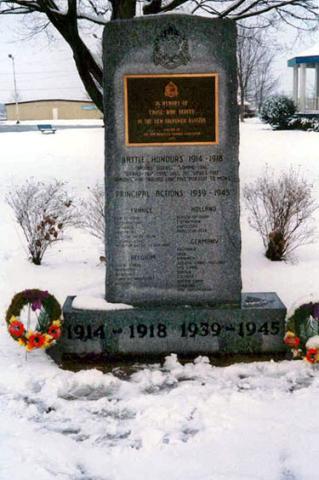
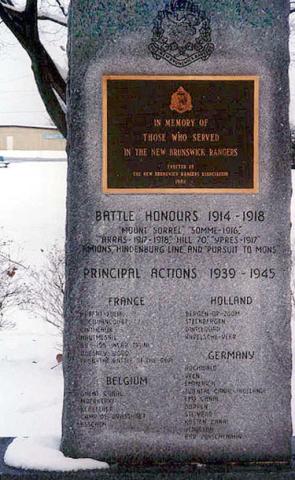
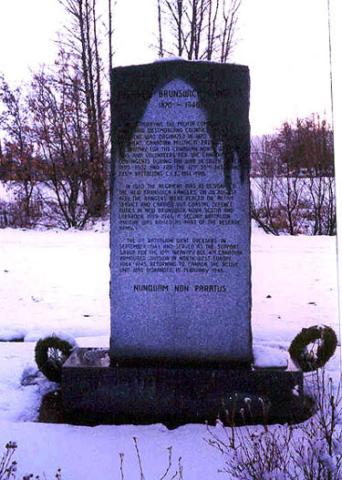
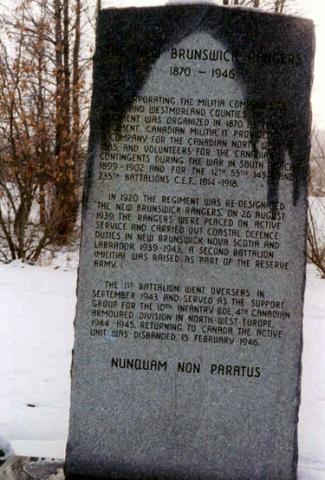
This memorial is dedicated to the New Brunswick Rangers. It was erected in 1980 by the New Brunswick Rangers Association.
needs further research/recherche incomplète
(front/de face)
JOHN ANDREWS
JOHN BLOOMFIELD
ALLEN DREMMER
LEONARD BUNNELL
GEORGE BUNNELL
HARRY CARR
GEORGE CAL--
FREDERICK W. CRAWFORD
ERECTED BY
SUSSEX WOMENS INSTITUTE
----
1914-1918
(left/gauche)
A.H. STOCKTON
R.E. SPRACUE
R.M. SPRACUE
J.B. WALLACE
W.A. WALLACE
K.E. WILSON
W.E. TRANTON
JOHN ROSS
ELMER SINNOTT
LEONARD SLIPP
EPHRAIM SMITH
DAVID WILSON
ALBERT EVELEIGH
ROY W. WALLACE
JOHN H. COOK
KOREA
1950-1953
(right/droit)
C.A. BECK
D.A.S. BLACK
A.J. CHESTNUT
F.J. DEVINE
H.M. LISSON
H.C. MANNINC
M.T. MAHONEY
GEORGE CHAPMAN
--- CHAPMAN
THOMAS DECOORSEY
JOHN DAWSON
CHARLES FR--
SEYMOUR GA---
HANFORD GELDART
DOANE HALLETT
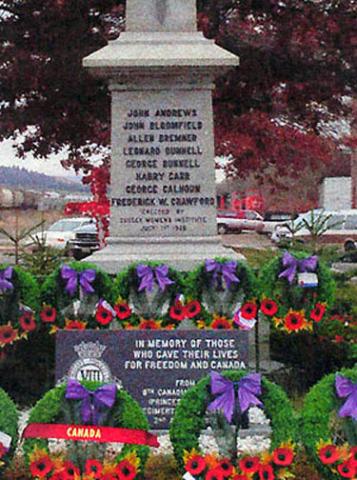
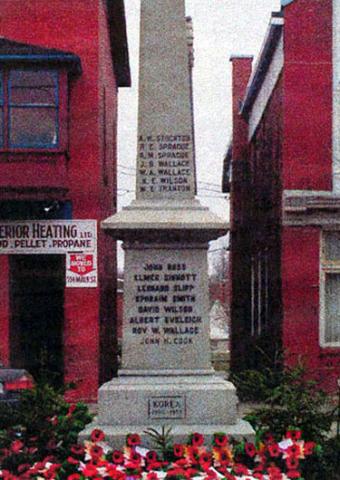
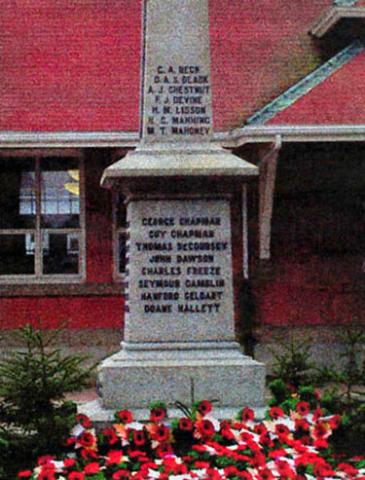
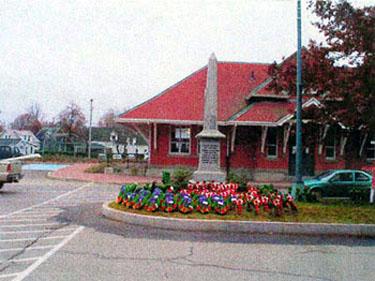
Erected by the Sussex Women's Institute and the 8th Canadian Hussars (Princess Louise's) Regiment, this memorial is dedicated to the Canadian war dead and veterans of the First and Second World Wars and the Korean War.
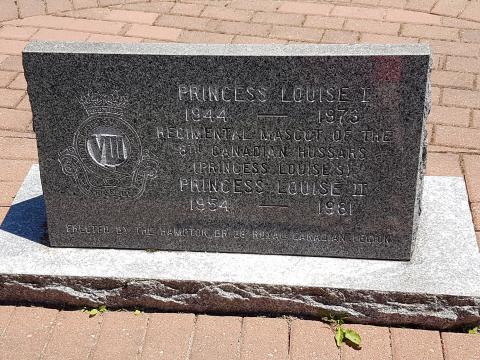
PRINCESS LOUISE I
1944 - 1973
REGIMENTAL MASCOT OF THE
8TH CANADIAN HUSSERS
(PRINCESS LOUISE'S)
PRINCESS LOUISE II
1954 - 1981
ERECTED BY THE HAMPTON BR. 28 ROYAL CANADIAN LEGION
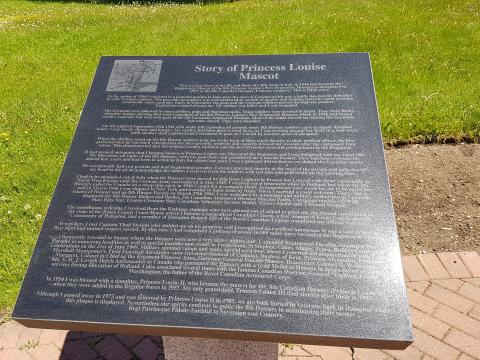
[plaque]
Story of Princess Louise Mascot
This is a true story of the life and times of a filly born in Italy in 1944 that became the Regimental Mascot of the 8th Princess. Louise's New Brunswick Hussars' re-designated in 1957 as the 8th Canadian Hussars (Princess Louise's). This is HER story.
In the spring of 1944 I was born in a peaceful pasture in Italy near the town of Coriano which was a battle line heavily defended by elite German soldiers. The peaceful atmosphere was soon shattered by sounds of gunfire and shelling from the south growing continually closer each day. Early in September the guns and the German soldiers passed through my pasture. Explosions erupted around me. My mother was killed and I was wounded.
The Germans were followed by more soldiers, guns and Sherman tanks. These soldiers were dressed in khaki. They wore flashy shoulder badges showing they were Canadians of the 8th Princess Louise's New Brunswick Hussars which in 1848 had been a cavalry regiment but were now part of the 5th Canadian Armoured Division. Most of the tanks moved on chasing the Germans but some stayed. They were disabled.
On the night of September 15th 1944 with shells still exploding all around, more 8th Hussar soldiers came to repair disabled tanks. I was lonely , thirsty and hungry. My mother had been dead several days. As I was trotting around her body in a well-worn path another shell exploded and I screamed in pain as I was hit by another piece of shrapnel.
When the shelling eased up the 8th Hussar soldiers took me in the back of their truck directly to their medical officer. He first protested that he wasn't a veterinarian but then speedily, tenderly and expertly dressed my wounds after the customary rum ration. This demonstrated that the original cavalry instincts and the love of horses were still predominant in the Regiment.
It just seemed automatic that I became known as Princess Louise, the Mascot of the regiment and I was delighted with my royal title. My liberators, all ranks of the 8th Hussars, were my guardians and considered me a moral booster. They had been overseas for almost four years and had been in action in Italy for almost one year. I was a pleasant distraction as we chased the Germans north.
We occasionally had rest periods and held Regimental parades. I always marched smartly at the head of the parade and gaily tossed my head in the air to acknowledge the salutes I received from the soldiers with red tabs and gold braid on the saluting base.
I had to be smuggled out of Italy when the Hussars were moved by ship from Leghorn to France but I stayed with them continually in North West Europe until the German Army surrendered in May 1945. I received royal treatment while in Holland but when the 8th Hussars sailed for Canada on a troop ship early in 1946 I could not accompany them. Arrangements were made for me to be cared for and in March 1946 I was shipped to New York and traveled to Saint John by train. There I received a royal welcome. There was a Guard of Honour and an 8th Hussar Parade on March 27th 1946. I was welcomed by municipal and military authorities as I proudly displayed my 8th Hussar Badges and flashes, 5th Canadian Armoured Division Maroon Pateh. Campaign medals (1939-45 star, Italy Star, France-Germany Star, Canadian Voluntary Service Medal. Victory Medal and 3 Wound Stripes).
The tumultuous welcome I received from the Rothesay students who were allowed out of school to greet me, the formal ceremony on the steps of the Kings County Court House where I became a naturalized Canadian Citizen, a free woman of Kings County and Community of Hampton, and a member of Hampton Branch #28 of the Royal Canadian Legion, completed my official welcome.
It was here I met Captain Thad Stevens who stabled me on his property and I recognized an excellent horseman. It was a case of love at first sight and mutual respect ensued. By this time I had completed a journey of about 16,000 miles since becoming the Regimental Mascot.
I frequently traveled to Sussex where the Hussars were not a very active militia unit. I attended Regimental Parades, Armistice Day Parades in numerous localities as well as special parades and events in Fredericton, St. Stephen, Calais, Maine, Truro, Halifax, Centennial celebrations on the 21st of June 1949 Military summer camps and many special occasions where I renewed old acquaintances with Field Marshall Montgomery, Field Marshal Alexander (now Governor General of Canada), Duchess of Kent, Princess Alexandra, Princess Margaret, Colonel in chief of the Regiment Princess Anne, Governor General Vincent Massey, Honourable Colonel R. W. Moncel, Mr. A. H. J. Lovink Dutch Ambassador to Canada who presented the Hussars with a Gold Medal of Honour in appreciation of their services during liberation of Holland. I also associated several times with the famous Canadian Warrior, General Fighting Frank Worthington, the father of the Royal Canadian Armoured Corps.
In 1954 I was blessed with a daughter, Princess Louise II, who became the mascot for the 8th Canadian Hussars (Princess Louise's) when they were added to the Regular Force in 1957. My only grandchild, Princess Louise III died shortly after birth in 1969.
Although I passed away in 1973 and was followed by Princess Louise II in 1981, we are both buried in Veterans Park in Hampton where this plaque is displayed. Nevertheless our spirits continue to guide the 8th Hussars in maintaining their motto: Regi Patriaeque Fidelis-Faithful to Sovereign and Country
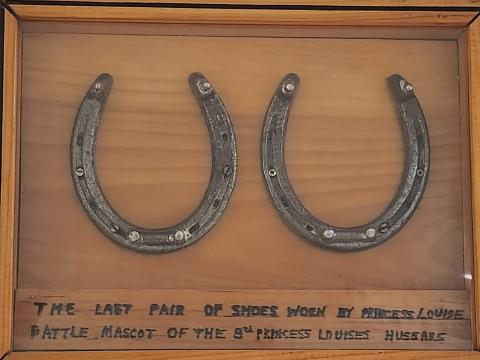
[framed horseshoes]
THE LAST PAIR OF SHOES WORN BY PRINCESS LOUISE
BATTLE MASCOT OF THE 8TH PRINCESS LOUISES HUSSARS
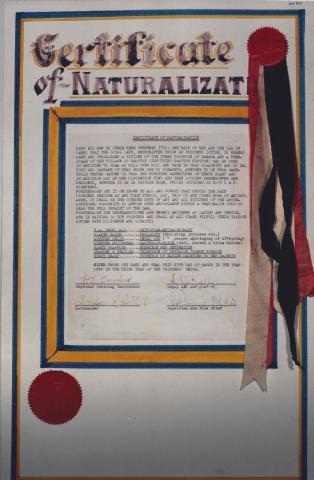
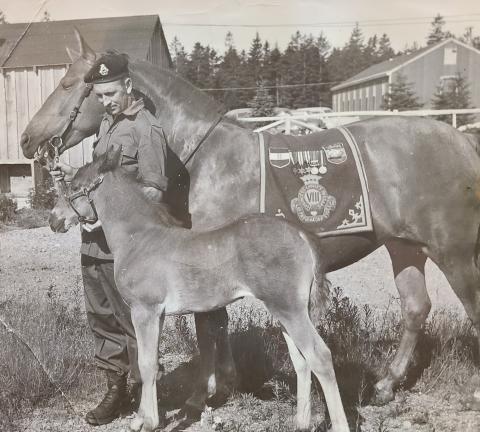
Princess Louise, a horse that served in the Second World War, was born in Coriano, Italy in 1944. That September, Princess Louise was injured and her mother killed. She was rescued from the battlefield on September 15 by soldiers of the 8th Princess Louise's New Brunswick Hussars and taken to their medical officer for treatment. The soldiers took turns changing her bandages to prevent infection and took an immediate liking to her. They named her after Queen Victoria’s daughter, whom their regiment was named after, and made her their mascot.
She reminded them of New Brunswick's rolling countryside and the things they cherished back home. Princess Louise continued with the regiment for the remainder of the war, gaining great popularity from her fellow soldiers. They concealed her in a stall they built in a truck and took her everywhere they went. The soldiers created the banner she wore on her back with the words Princess Louise on it.
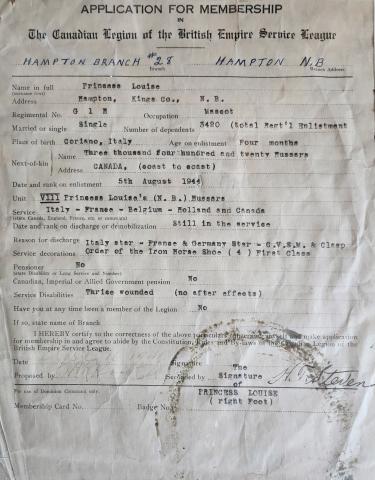
After the war, she was moved from France to Belgium to Holland, then shipped to New York where she was put on a train to Saint John, New Brunswick to be reunited with her regiment. On March 27, 1946, Princess Louise arrived to a large crowd where she was paraded showing off her service medals: 1939-1945 Star, Italy Star, France and Germany Star, Canadian Volunteer Service Medal and three Wound Stripes. She was proclaimed a Canadian Citizen and a free woman in the Village of Hampton. She was entitled to "roam at will in the community and devour as she pleased, whether from a garden or the warehouse of Henry Sharp and in addition find and take lodging where ever she desired, whether it be in a private home or public fired sheds." If the princess required any form of assistance, it was the duty of all citizens in the community to help within a reasonable time. She was also made a member of the Hampton Legion Branch with her hoof print marked on the membership form.
During the war, Princess Louise was a symbol of hope, beauty and love for her soldiers and lifted their morale during their darkest days. She lived the rest of her life participating in ceremonies, church events and parades. In 1973, at the age of 29, Princess Louise passed away. Her last pair of horseshoes are displayed at the legion.
Princess Louise had three foals, sons Prince and Hussar, and daughter Princess Louise II who became the new mascot for the regiment. Princess Louise II died at age 27 in 1981 and is buried with her mother in Veterans' Park outside the community center in Hampton.
The first Princess Louise I Memorial, built in October 1973, was demolished. Because it could not be refurbished, a new memorial was organized by Lieutenant General Lou Cuppens.
WORLD WAR I
1914-1918
WILLIAM A. HEGAN
GEORGE R. PERKINS
PERCY I. ROBINSON
WORLD WAR II
1939-1945
WALTER I. HOWARD
KOREAN WAR
1950-1953
“LEST WE FORGET”
TAKE TIME TO REMEMBER THOSE WHO GAVE
THEIR LIVES SO THAT WE WOULD HAVE OUR FREEDOM
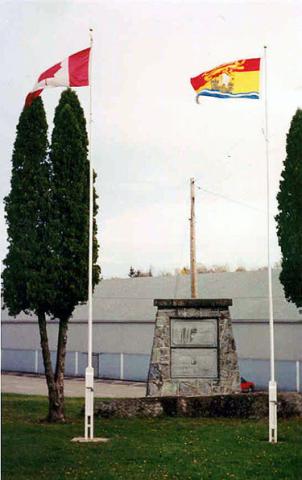
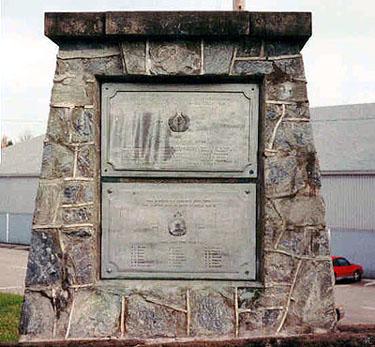
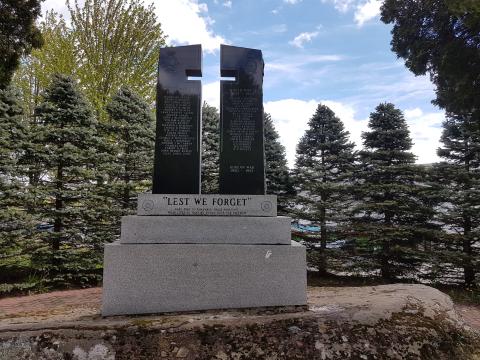
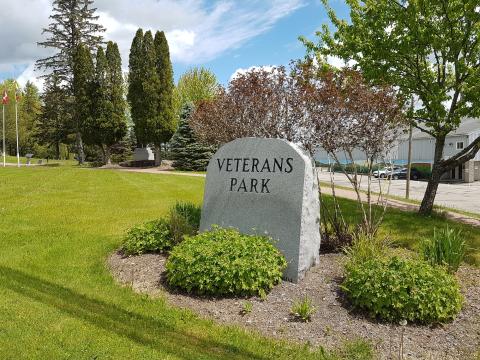
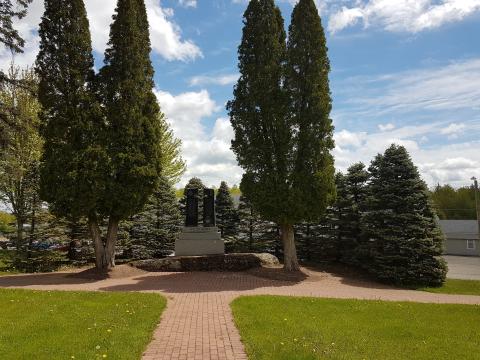
In early 2004, the Royal Canadian Legion Hampton Branch 28 began fundraising for a new Cenotaph. By mid-June 2004, the old cenotaph had been removed. Approximately $29,000 had been raised by mid-July and the new cenotaph was in place in September 2004. The official unveiling took place on October 20, 2004.