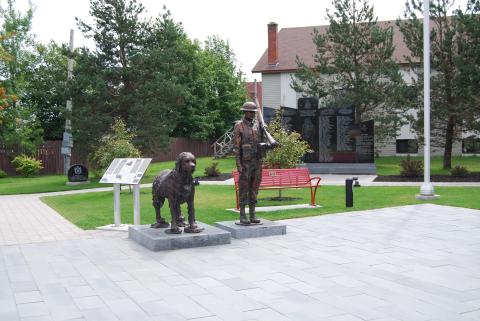
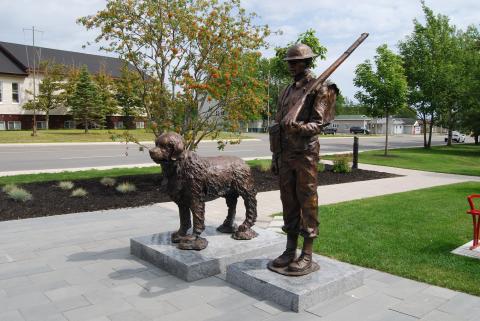
This memorial, unveiled on 1 July 1929, is dedicated to the local war dead of the First World War.
Port aux Basques First World War Memorial
(needs further research/recherche incomplète)
My VAC Account
My VAC Account(needs further research/recherche incomplète)
This memorial, unveiled on 1 July 1929, is dedicated to the local war dead of the First World War.
(needs further research/recherche incomplète)
This memorial, erected by the Railway Employees' Association, is dedicated to the memory of the 137 dead of the S.S. Caribou which was torpedoed and sunk on 14 October 1942. The ship had been serving as the ferry link between Nova Scotia and Newfoundland. The Royal Canadian Legion, Branch No. 11, Channel, Memorial Park, was dedicated on July 6th, 1986. The Memorial consists of a monument to the victims of the S.S. Caribou, and a monument each for the casualties of the two World Wars. On July 1st, 1929, Her Majesty's Ship (HMS) Capetown visited Port aux Basques for the official unveiling and dedication of the First World War monument, which was situated near the Court House in town. This monument contains all of the names of those from Port aux Basques who paid the supreme sacrifice in the First World War. The S.S. Caribou was the link between Nova Scotia and Newfoundland, and a very well-known ship. She was torpedoed on October 14, 1942, with a loss of 137 lives. This tragedy left 21 widows and 51 fatherless children. Three of the crew members were unmarried. Twenty-five of the crew members lived in Channel-Port aux Basques. The Railway Employees' Association decided to erect a monument in memory of the S.S. Caribou and this was done through a public subscription and the Railway Workers donating a full day's work towards the cost of this monument. On October 14 of each year, a memorial service was held at the Caribou monument. Over time, the site was found to be unsuitable for the annual memorial service so the monument was moved to the C.N. Marine premises and the original shape of the monument was changed to resemble an open book. Over the years it became evident that a new site would be needed for the First World War monument. When a new site was being chosen, there was a proposal to have a monument installed in the memory of those who gave their lives in the Second World War. It was then suggested that permission be sought to have the Caribou Monument included so that the three monuments would be on the same site. Permission was granted by the C.N. Marine and the old site was demolished. It was decided to have a whole new monument in memory of the S.S. Caribou. All that remains of the original monument are the four bronze plates which contain the names of the 137 people who lost their lives. The World War II monument is an exact replica of the First World War monument and all three now stand in Memorial Park, along with three flag poles and two anchors of former C.N. Marine ships, the S.S. Patrick Morris and the M/V William Carson, both of which are now gone. Memorial Park was officially dedicated on July 6th, 1986. November 11th is the day of remembrance, and the memorial service for the sinking of the Caribou has been combined with the usual November 11th memorial service.
(needs further research/recherche incomplète)
The bronze soldier and epitaph are dedicated to the memory of Grand Bank men who made the supreme sacrifice in the Frist World War. The names of the war victims are written on the bronze tablets, and those of the Second World war are on tablets in the Memorial Library.
[front/devant]
ERECTED BY ROYAL CANADIAN LEGION FORTUNE BRANCH NO. 25 TO THE MEMORY OF OUR COMRADES WHO PAID THE SUPREME SACRIFICE IN WORLD WAR II
AT THE GOING DOWN OF THE SUN AND IN THE MORNING
WE WILL REMEMBER THEM
1939 1945
This memorial was erected by Royal Canadian Legion Branch No. 25 in honour of the local war dead of the Second World War.
[front/devant]
KILLED IN ACTION
PTE. THOMAS GLUGDON
KILLED AT PASSCHENDALE
SEPT 29, 1918
PTE MUCH KEEPING
KILLED AT CAMBRAI
NOV. 17, 1917
PTE. GEORGE H. MOSHER
KILLED AT OUDEMARDE
OCT. 25, 1918
(needs further research/recherche incomplète)
Erected by the Great War Veterans' Association - the predecessor of the Royal Canadian Legion -, this memorial is dedicated to the local war dead of the First World War. This simple, yet noble, memorial takes the shape of a straight shaft of blue-grained marble, which is set in a rough granite base. The badge of the Royal Newfoundland Regiment, enclosed by Laurel wreath, is carved on the North side of shaft, while underneath is a list of engagements in which the Regiment fought. On the west side of the shaft is carved the following verses: "In Flanders Fields the poppies blow..." while on the east side is carved crossed rifles and an Ensign enclosed in a wreath of laurels, underneath which is a list of causalities, engagements, and dates. The memorial, which stands about 16 feet high, was erected by the well-known firm of J.D. Steel Monumental Works, North Sydney, Canada, and erected by the citizens of Fortune under the auspices of the Fortune Branch, G.W.V.A., in memory of their fallen heroes and comrades. The Fortune War Memorial was unveiled with deep solemnity on September 27 by Dr. MacDonald, J.P., in the presence of 800 people from Fortune and Grand Bank. A message from His Excellency the Governor was read by Capt. G.J. Whitty, M.C., expressing regret at his unavoidable absence. Addresses were also made by Rev. Mr. Howse, Dr. MacDonald, Ensign Carnick, T.E. Spencer and J.R. Dixon, secretary of the Fortune Branch. The Rev. Young pronounced the dedication prayer and the ceremony proceeded amidst great solemnity. The floral tributes were many. The firing party, under Lieut. W.C. Hawker, manager of the Bank of Nova Scotia, assisted by Bugler Cook, performed their duties with military precision. The memorial is a splendid tribute from the people of Fortune to the memory of her gallant lads who made the supreme sacrifice. The G.W.V.A. and people of Fortune are worthy of all praise in subscribing the entire cost of this memorial and thus perpetuating the memory of their fallen townsmen by handing down to posterity a monument that will stimulate, elevate and inspire youth for many generations to come as they recall the magnitude of the deeds performed and the sacrifice of Fortune's honoured dead.
[front/devant]
NEWFOUNDLAND
IN
LOVING MEMORY
OF
PT ANGUS
BRINSTON
OF ROYAL N.F.REG
WHO WAS KILLED IN
ACTION IN FRANCE
AUG. 16TH. 1917.
AGED 18 YEARS
THEIR NAME LIVETH
FOR EVERMORE
BRINSTON
[right side/côté droit]
NEWFOUNDLAND
IN
LOVING MEMORY
OF
L. CPL.
ALFRED
STACEY M. M.
OF ROYAL N.F. REG
WHO WAS KILLED IN
ACTION IN FRANCE
JAN. 20, 1918.
AGED 25 YEARS.
WHAT CAN I GIVE?
O, SOLDIER, TRUE AND
BRAVE,
LONG AS I LIVE
TO PAY THE LIFE YOU
GAVE.
ERECTED BY THE
PEOPLE OF
SOUND ISLAND
STACEY
The Brinston and Stacey Memorial was first erected at United Church on Sound Island, Placentia Bay. It was dedicated to Private Angus Brinston and Private Alfred Stacey, two local war dead of the First World War. In the mid 1950s, the memorial was relocated to Memorial United Church in Garden Cove.
The hardwood top was machined from laminated mahogany and after several decades had to be removed. In 2018, the memorial was refurbished through community fundraising, donated labour and funding from Veterans Affairs Canada.
Eastern
Health
PRIVATE
JOSIAH SQUIBB
MEMORIAL
PAVILION
The Private Josiah Squibb Memorial Pavilion honours a 19-year old local who was killed at Gallipoli in 1915. The Royal Canadian Legion Branch 23 suggested to name the building after Private Squibb. On December 11, 2017, the Provincial Government formally announced the previously unnamed facility would be called the Private Josiah Squibb Memorial Pavilion.
HE • DIED
FATIH HOPE & CHARITY.
THAT • OTHERS • MAY • LIVE.
IN•LOVING•MEMORY•OF
PRIVATE FRANK•MORRIS
WHO•FELL•AT•FRANCE•OCT.
9TH•1917•AGED•23•YRS. R.I.P.
The Private Frank Morris Window was erected in 1920.
HE DIED
GOD IS LOVE
THAT OTHERS MAY LIVE.
IN LOVING MEMORY OF
PRIVATE JAMES WOOLRIDGE
WHO FELL AT MONCHÉ,
APRIL 14TH,1917. AGED 18 YEARS.
R.I.P.
The Private James R. Woolridge Window was erected in 1920. He was a member of the Royal Newfoundland Regiment and was killed in action on April 14, 1917, at Monchy, France.
HE DIED
FOR GOD. KING & COUNTRY
THAT OTHERS MAY LIVE.
IN LOVING MEMORY OF
CHARLES ROWE, R.N.R.
WHO WENT DOWN WITH
H.M.S. VIKNORE,JAN.30TH.1915.
AGED 25 YEARS. R.I.P.
The Seaman Charles Rowe Window was ercted in 1920. He was a member of the Royal Newfoundland Naval Reserve and was killed on January 13, 1915, when his ship H.M.S. Viknor foundered off the coast of Ireland.