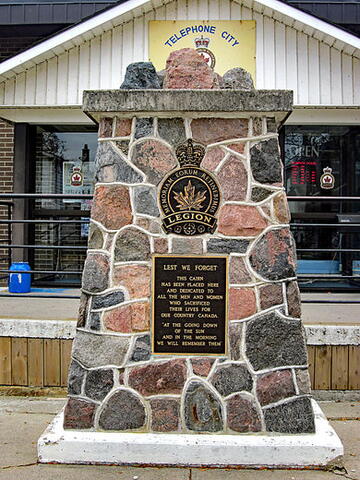
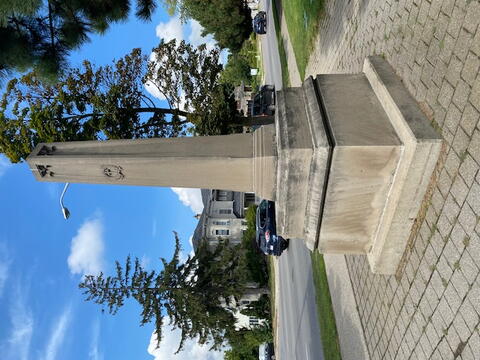
The cairn was erected by the Royal Canadian Legion Telephone City 90
Brantford Legion Cairn
Lest we forget
Sign in to My VAC Account
Sign in to My VAC AccountLest we forget
The cairn was erected by the Royal Canadian Legion Telephone City 90
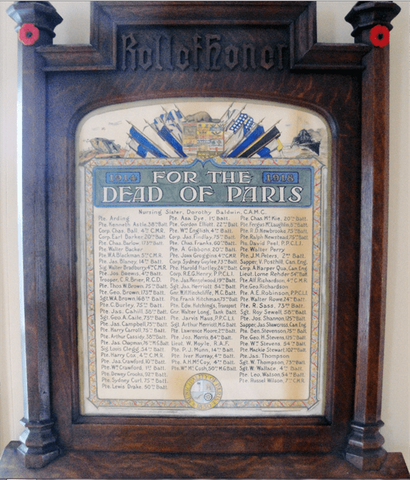
Roll of Honour
1914 1918
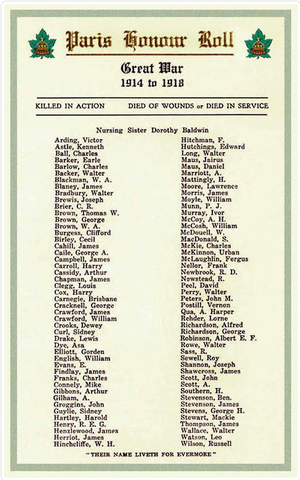
For the dead of Paris
Municipality of Paris
This roll of honor lists the war dead of the Municipality of Paris 1914-1918
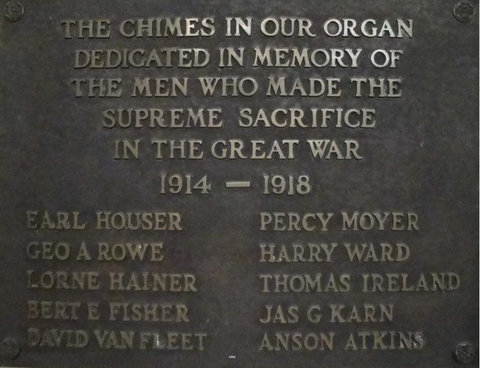
The chimes in our organ dedicated in memory of the men who made the supreme sacrifice in the Great War 1914-1918
Earl Houser, Percy Moyer
Geo A Rowe, Harrry Ward
Lorne Hainer, Thomas Ireland
Bert E Fisher, Jas G Karn
David Van Fleet, Anson Atkins
The organ chimes at the Colborne Street Methodist Church were dedicated in memory of the men who made the supreme sacrifice in the Great War 1914-1918
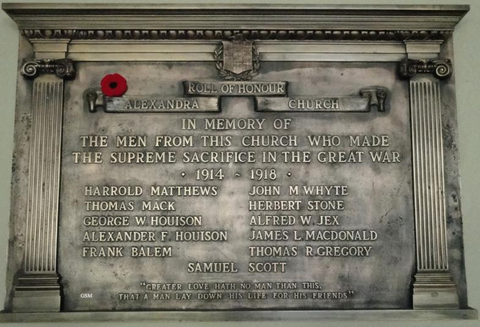
Roll of honour
Alexandra Church
In memory of the men from this church who made the supreme sacrifice in the Great War 1914-1918
Harrold Matthews, John M Whyte
Thomas Mack, Herbert Stone
George W Houison, James L MacdonaldFrank Balem, Thomas R Gregory
Samuel Scott
Greater love hath no man than this
that a man lay down his life for his friends
In memory of the men from the Alexandra Presbyterian Church who made the supreme sacrifice in the Great War 1914-1918
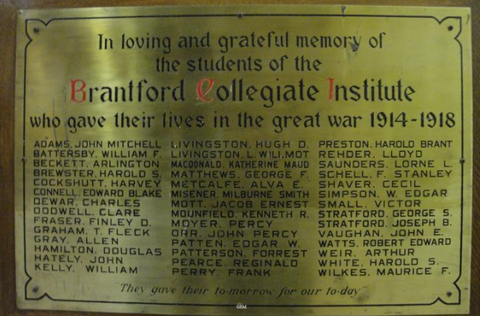
In loving and grateful memory of the students of Brantford Collegiate Institute who gave their lives in the great war 1914-1918
They gave their to-morrow for our to-day
The plaque was dedicated in 1925 in loving and grateful memory of the students of Brantford Collegiate Institute who gave their lives in the great war 1914-1918. They gave their to-morrow for our to-day
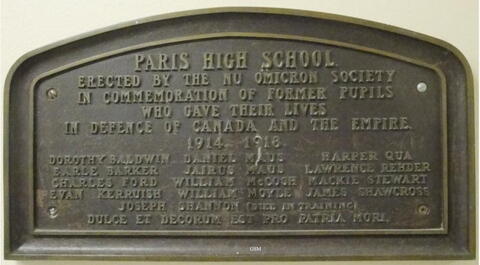
Paris High School
Erected by the NU Omicron society
In commemoration of former pupils
who gave their lives
in defence of Canada and the Empire
1914-1918
Dorothy Baldwin, Daniel Maus, Harper Qua
Earle Barker, Jairus Maus, Lawrence Rehder
Charles Ford, William McCogh, Mackie Stewart
Evan Kerruish, William Moyle, James Shawcross
Joseph Shannon (died in training)
Dulce et decorum ect pro patria mori
The Paris District High School First World War Memorial Plaque was erected by the NU Omicron society in commemoration of former pupils who gave their lives in defence of Canada and the Empire 1914-1918.
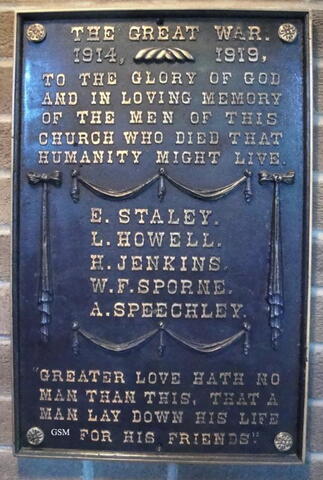
Great War
E. Staley
L. Howell
H. Jenkins
W.F. Sperne
A. Speechley
First World War memorial plaque.
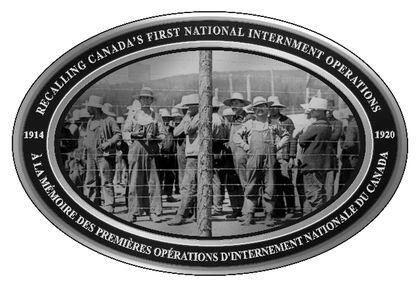
This memorial recalls a historic injustice Canadians should pause to remember, as we recall the First World War and the valour of all those Canadian men, and some women, who served. It is a tribute to mark the memory of the thousands of "enemy aliens" who had their civil rights stripped, and were subsequently imprisoned during Canada's first national internment operations of 1914-1920, following the implementation of the War Measures Act. 2014 marks the 100th anniversary of the War Measures Act - adopted on August 22, 1914 during the First World War. It was used to imprison Ukrainian-Canadians, and other ethnic groups, including German, Hungarian, Serbian, Croatian, and Armenian communities, into one of Canada's 24 internment camps.
Dr. Lubomyr Luciuk, a professor at the Royal Military College of Canada and former chair of the Ukrainian Canadian Civil Liberties Association (UCCLA), had taken it upon himself to lead the way and organize the memorial. In the CTO ("One Hundred") project, 100 aluminum plaques were simultaneously unveiled at 100 different locations across the country at 11:00am local time on August 22, 2014. The first plaque was unveiled in Amherst, Nova Scotia, followed by a wave of plaque unveilings moved west, from province to province, culminating in Nanaimo, British Columbia. The plaques, which cost $1,000 to make, were funded by the generosity of the Endowment Council of the Canadian First World War Interment Recognition Fund.
Each plaque features a photo of internment prisoners confined behind a wire fence at the Castle Mountain Internment Camp in Banff, Alberta. The Castle Camp, which was built in 1915 at the base of Castle Mountain, was a Canadian internment camp which held immigrant prisoners of Ukrainian, Austrian, Hungarian, and German descent.
[front/devant]
1914 1918
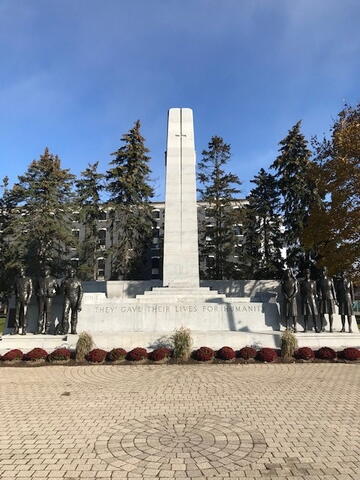
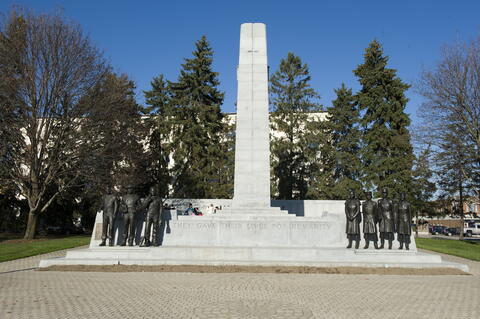
THEY GAVE THEIR LIVES FOR HUMANITY
[left side/côté gauche]
1914 † COUNTY OF BRANT HONOUR ROLL † 1918
(list of names)
[plaque]
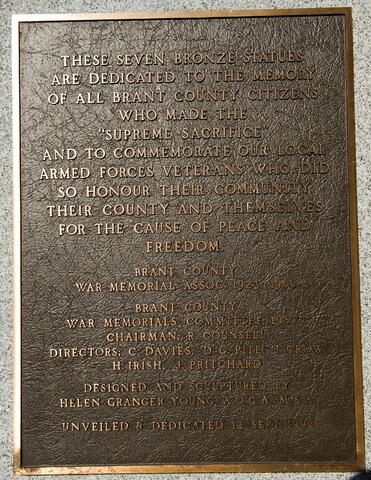
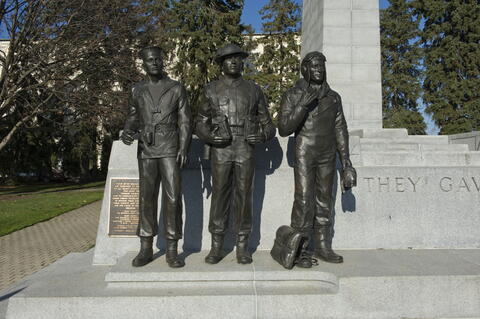
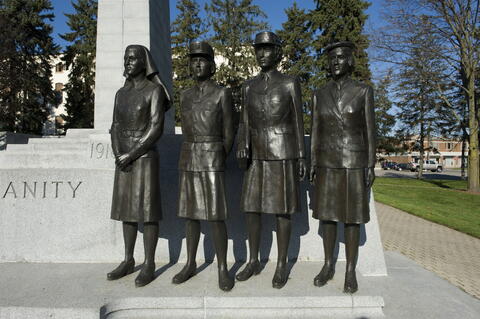
THESE SEVEN BRONZE STATUES
ARE DEDICATED TO THE MEMORY
OF ALL BRANT COUNTY CITIZENS
WHO MADE THE
"SUPREME SACRIFICE"
AND TO COMMEMORATE OUR LOCAL
ARMED FORCE VETERANS WHO DID
SO HONOUR THEIR COMMUNITY
THEIR COUNTY AND THEMSELVES
FOR THE CAUSE OF PEACE AND
FREEDOM.
BRANT COUNTY
WAR MEMORIAL ASSOC. 1923 - 1960
BRANT COUNTY
WAR MEMORIALS COMMITTEE 1987
CHAIRMAN; R. COUNSELL
DIRECTORS; D. DAVIES, D. G. PITE, J. CROW
H. IRISH, J. PRITCHARD
DESIGNED AND SCULPTERED BY
HELEN GRANGER YOUNG A.O.G.A. M.S.A.
UNVEILED & DEDICATED 12 SEPT. 1992
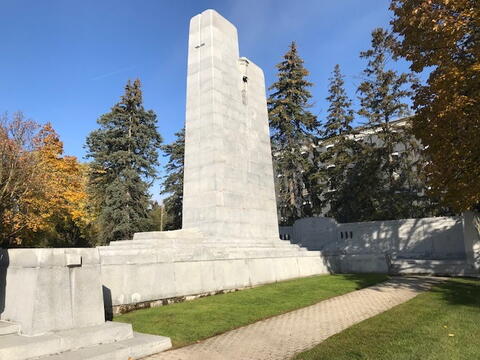
The Brant War Memorial was designed by Walter S. Allward and erected in 1933 in memory of the local war dead of the First World War. The pylons dominate, their great mass gives dignity, solemnity and a sense of guardianship over the stone of remembrance. The stone is a raised slab, ornamented with poppies. Above the remembrance stone is a cross, deeply cut in the main pylon. The park land on which the memorial sits was formerly used as a parade ground for those who left Brantford during the First World War.
Brant County, which included the City of Brantford and the Town of Paris had 5,571 enlist in the First World War. 701 died and 58 were reported missing or taken prisoner.
The memorial was later modified to incorporate the commemoration of the local war dead of the Second World War and the Korean War. In 1952, a Memorial Gallery was added and serves as a backdrop to the Brant War Memorial. On July 2, 1954, the memorial was rededicated.
The original design by Allward included a group of bronze sculptures to represent "Humanity", consisting of a wounded youth, a resolute mother and a figure praying. Financial obstacles prevented the completion of the monument according to the original design. The Brant County War Memorial Committee initiated the completion of seven bronze statutes which were designed and sculpted by Helen Granger Young. The figures represent men and women who made the supreme sacrifice and commemorate local Veterans and are depicted in the uniforms of a nursing sister, Navy, Army, Airforce, Women's Royal Canadian Naval Service, Canadian Women's Army Corps, and Royal Canadian Air Force Women's Division. The statutes were unveiled and dedicated on September 12, 1992.
Sculptor Walter S. Allward left school at fourteen and learned about sculpture through books and magazines at the local library and by studying replicas at a nearby museum. By twenty, he had won his first commission. One of Allward’s first projects was through Sir Edmund Walker, President of the Bank of Commerce. In 1918, Walker asked Allward for memorial ideas honouring bank employees who had served and Allward submitted two wax models sculptures. The first, The Service of Our Women—Healing the Scars of War, depicts a woman sowing seeds on rocky incline strewn with war debris, including a broken canon. The second, The Service of Our Men–Crushing the Power of the Sword, portrays a man standing over a recumbent figure with his sword cast aside, symbolizing the brute beast of willful war waged by a misguided nation. The sculptures were never used, but his proposals explored ideas that would be expressed in his future war memorials: Stratford, 1919–22; Peterborough, 1921–29; and Brantford, 1921–33.
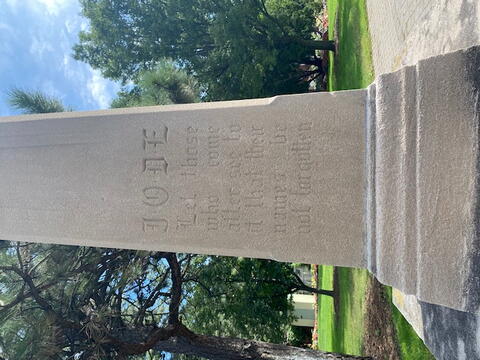
[front/devant]
IODE
Let those
who come
after see to
it that their
names be
not forgotten
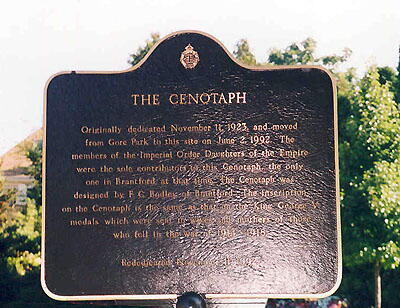
[plaque]
THE CENOTAPH
Originally dedicated November 11, 1923, and moved
from Gore Park to this site on June 2, 1992. The
members of the Imperial Order Daughters of the Empire
were the sole contributors to this cenotaph, the only
one in Brantford at that time. The cenotaph was
designed by F.C. Bordley of Brantford. The Inscription
on the Cenotaph is the same as that on the King George V
medals which were sent to wives and mothers of those
who fell in the war of 1914 - 1918.
Rededicated November 11, 1992
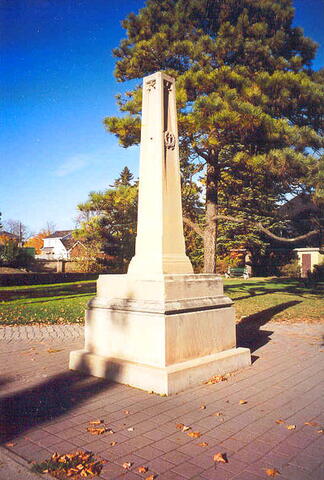
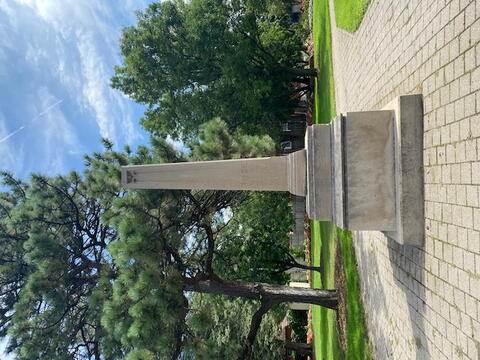
The IODE Cenotaph was provided to the city following the Great War by the local members of the Imperial Order of the Daughters of the Empire (IODE) and designed by architect F.C. Bodley. The limestone monument bears the inscription “Let those who come after see to it that their names be not forgotten”. These words were part of the message on a Memorial Scroll that was sent by King George V to parents or wives of the fallen soldiers during the First World War.
The memorial was originally located in Gore Park and was dedicated on 11 November 1923. On the armories gore were the Dufferin Rifles and band under Bandmaster Johnson, Brant Dragoons, Brantford Machine Gun Company, Great War Veterans Association, and pupils of Mohawk Institute. The eight standard bearers of the Brantford chapters of the IODE, Mrs. Cameron, Miss Gilkison, Mrs. Newman, Mrs. M. Paterson, Mrs. Popplewell, Miss Craddock, Mrs. Earl Smith, Miss Murray Thorburn, with their silken standards, stood by the side of their respective regents.
In front of the cenotaph was the guard of honor, which presented a very smart appearance under Captain Bolt, Captain Lloyd Colquhoun and Lieutenant Brooks. At 10.30 Captain (Reverend) W.G. Martin preluded the service with the invocation followed by the reading of a passage of scripture. He then asked Mrs. M.A. Colquhoun, as representing the mothers who had lost sons in the war, to unveil the cenotaph. The memorial was revealed and from standard rests at the sides floated two Union Jacks, while above was the symbolic torch, whose brightness shall serve to remind the passerby that the living flame which it typifies, burns in human hearts and that the supreme sacrifice of Canadian manhood was not made in vain.
On 2 June 1992, the memorial was moved to Tom Thumb Park and rededicated on 11 November 1992.