Ontario

Province Code
ON
City/Municipality
Bruce Mines
Memorial Number
35001-001
Type
Address
9179 Highway 17
Location
In front of the Bruce Mines Municipal Office
in Canada
Yes
GPS Coordinates
46.3002658, -83.7910887
Inscription

[front top/devant, en haut]
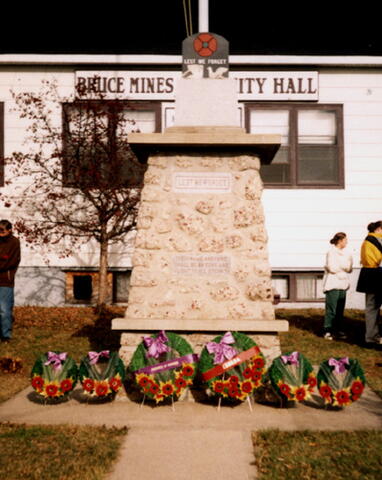
LEST WE FORGET

[front base/devant, sur la base]
LEST WE FORGET

THEIR NAME AND FAME
SHALL BE AN ECHO AND
A LIGHT TO ALL ETERNITY

[back/arrière]
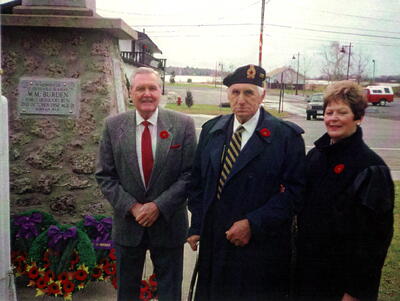
IN MEMORY OF
H. 17635 ABLE SEAMAN
W.M. BURDEN
HMCS IROQUOIS RCN
2ND OCTOBER 1952 AGE 21
KOREAN WAR

[side/côté]
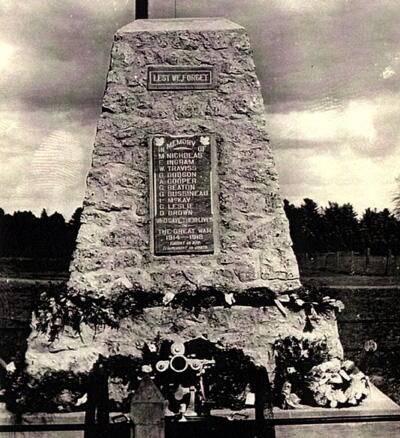
IN MEMORY OF THOSE WHO GAVE THEIR LIVES

THE GREAT WAR - 1914 - 1918

M. NICHOLAS
W. TRAVIS
G. DOBSON
A. COOPER
G. BEATON
G. BUSSINEAU
F. McKAY
G. LESLIE
D. BROWN

WORLD WAR II - 1939 - 1945

B. ALEXANDER
W. ANSLEY
R. BEILHARTZ
J. BLACK
H. CUTHBERTSON
J. PRATT
L. SHAULE
C. SMITH
J. STURGEON
B. TAYLOR
S. WILSON
A. WHITE

VALIANT IN LIFE...TRIUMPHANT IN DEATH
WE WILL REMEMBER THEM

Image
Photo Credit
Merritt Strum
Caption
original memorial
1 of 4 images
Image
Caption
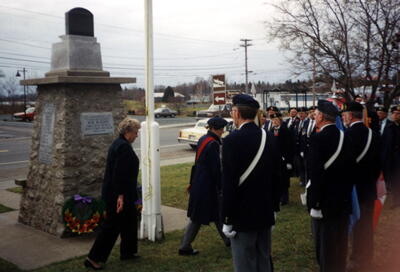
front view today
1 of 4 images
Image
Caption
rear and side view
1 of 4 images
Image
Caption
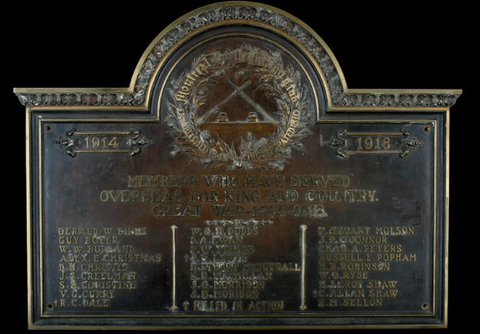
rear view
1 of 4 images
Province
!4v1623433976327!6m8!1m7!1s9c1jGp5YQ8K2QrMTl6aCbQ!2m2!1d46.30026583900253!2d-83.79108866355752!3f355.3147913494631!4f-1.9212502244960206!5f3.325193203789971"
Body Content

Excerpts from Bruce Mines Spectator, August 13, 1931 - 2000 People Attend Unveiling of Memorial, Regimental Band in Attendance

The service for the unveiling of Bruce Mines Soldiers' Memorial Sunday, August 9, drew large crowds from the town, surrounding communities and from Sault Ste. Marie, Thessalon and Blind River. The service was a very impressive one and will linger in the memories of those present. The Regimental Band directed by Bandmaster H.R. Pearce, A.L.O.M., F.C.C.M., W.O.I., were in attendance and generously contributed several selections and also accompanied in the hymns. Mr. Wm. White, War Veteran, who has worked untiringly for several years to have the Memorial erected, ably performed the duties of chairman. Revs. H. Peeling and R.K. Burnside read the Scripture selections and led in prayer. The Memorial was unveiled by Mr. Norman Beaton, of Ophir, father of one of the lads who passed on. The Last Post and Reveille were sounded by Bugler T. Swan, Sault. Beautiful wreaths were placed at the foot of the memorial by Mrs. Frazer Ingram, Miss Mary Wilson, members of the W.A. of the Anglican Church, the Patricia Women's Institute, Harmony Institute, Johnson Women's Institute, Mr. And Mrs. Wm. White, Mrs. Roach, Mrs. Newell, Allan Brown, Mr. And Mrs. Robt. Eakett, Mrs. Mannie Harmon, Mrs. John Harmon. Memorial addresses were delivered by Col. T.P. Rowland, Mayor Albert Grigg and Provincial Magistrate Peterson. The Memorial stands 10 feet high and is constructed of Jasper Conglomerate, the beautiful stone found only in Algoma. The monument is enclosed in a fenced off space beside the flag pole on the school grounds facing the Trans Canada Highway. Mr. Wm. White and Dr. V.S. Grigg who drafted the program and who with the other members of the Committee Miss H. Rickaby, Secretary, and Mr. W.L. Miller have worked for this cause are to be congratulated that the work has been brought to such a successful completion. The memorial underwent some changes in the 1990's and the result is what is seen today.

City
Bruce Mines
Country
Type Description
Cairn with doves
Memorial CF Legacy ID
6648
City/Municipality
Ottawa
Memorial Number
24075-089
Type
Address
1 Vimy Place
Location
Inside the Canadian War Museum
in Canada
Yes
GPS Coordinates
45.4164934, -75.7171634
Inscription

MONTREAL THISTLE CURLING CLUB
ESTABLISHED 1840
INCORPORATED 1870
1914-1918
MEMBERS WHO HAVE SERVED OVERSEAS FOR KING AND COUNTRY
GREAT WAR 1914-1918


Image
Photo Credit
Canadian War Museum, 20060033-001
Caption
Montreal Curling Club Great War Plaque
War or Conflict Term
Province
!4v1667228583129!6m8!1m7!1sETdQBXWVNvJN2fUye71z7Q!2m2!1d45.41649338207057!2d-75.71716343607842!3f359.0887716415551!4f4.598508948148293!5f1.016811202047807"
Body Content

This plaque by Mappin & Webb Ltd honours members of the Montreal Curling Club who served overseas during the Great War 1914-1918.

This plaque was erected for the Montreal Thistle Club, which was founded in 1840 and incorporated in 1870. The plaque is now in the collection of the Canadian War Museum.

Montreal Thistle Curling Club Fonds

Originating in Scotland, the game of curling became very popular in the 19th century in Montreal and other Canadian cities. Growing interest in the sport inspired the founding of the Montreal Thistle Curling Club on December 19, 1843, by a small group of Montrealers made up of Messrs. D. McTavish, Robert Speirs, John Bethune, Richard Harrison, John Auld, John and William Greenshields, J. B. Torry, Robert Muir, J. Simpson and John Armour, Jr.

Club members initially played outdoors on the frozen St. Lawrence River and then two years later created a rink in an old flour shed near the Lachine Canal. The Montreal Thistle Curling Club began competing against other sports teams from Quebec and Ontario in 1845. The Club was incorporated in 1870 and inaugurated its new rink on St. Monique Street on December 24 of the same year. However, in 1911, the Canadian National Railway Company expropriated the association's land and property for an expansion project. The following year, the Montreal Thistle Curling Club established its new site at 1490 Fort Street. The 1930s were key years in the association's history as it gained recognition at numerous competitions. In 1933, the Club won five major trophies: the Jubilee Trophy, the Governor General's Trophy, the Holt Renfrew Cup, the Quebec City Cup and the Heather Bonspiel.

Interest in curling started to fade in the late 1970s and the Montreal Thistle Curling Club lost a significant number of members, causing its revenues drop even as its tax burden rose. One hundred and fifty-six years after its founding, financial difficulties forced the association to close its physical doors in the fall of 1999.

City
Ottawa
Country
Type Description
Plaque
Memorial CF Legacy ID
9937
City/Municipality
Gatineau (Hull)
Memorial Number
24025-017
Type
Address
188 Alexander Tache J9AlL8
Location
Salaberry Armoury
in Canada
Yes
GPS Coordinates
45.42413, -75.7332
Inscription

Paix, Andre Gauthier

Image
Photo Credit
Victoria Edwards
Caption
Peace by Andre Gauthier
Province
Body Content

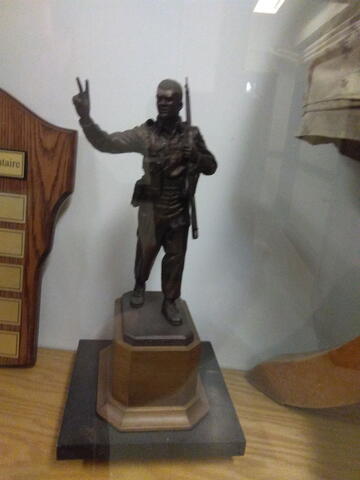
The maquette of a Canadian soldier making the peace sign was sculpted by Andre Gauthier, troop commander with the Regiment de Hull. It was dedicated to current and former members of the Regiment of Hull. It is located in a display case in the Salaberry Armoury.

City
Gatineau (Hull)
Country
Type Description
Sculpture
Memorial CF Legacy ID
9973
City/Municipality
Ottawa
Memorial Number
24025-015
Type
Location
In storage
in Canada
Yes
GPS Coordinates
0, 0
Inscription

Aboriginal Military Service in the First World War

Between 1914 and 1918, Aboriginal men from all regions of Canada and the Dominion of Newfoundland fought with the Canadian military in the First World War. These men volunteered to serve, even though for many this meant fighting for a government that considered them "wards" of the state and denied their right to vote. Serving side-by-side with other Canadian men, Aboriginal soldiers gained acceptance and respect at levels that contradicted their treatment and status back home, and challenged the racist sentiment that one could not be both Aboriginal and a responsible citizen. At war’s end, Aboriginal veterans and members of Aboriginal communities were inspired to improve the status of Aboriginal peoples in Canada. This was the active force behind the first pan-Canadian Aboriginal organization, the League of Indians of Canada, which gave a national voice to Aboriginal concerns and set the stage for future activism in the fight for Aboriginal rights.

When war broke out, Aboriginal men were among the first to enlist for the Canadian Expeditionary Force (CEF) and were part of the first contingent of Canadians to be sent overseas. During the war, the number of Aboriginal men that volunteered left some reserves nearly depleted of young men. Aboriginal women were also active participants, and raised money, formed committees, and sent comforts from home to the troops at the front. While many Aboriginal men were eager to enlist, not all shared this enthusiasm and some Aboriginal communities discouraged their young men from signing up.

Once overseas, Aboriginal men served throughout the army in the infantry, railway troops, forestry, pioneer, and labour battalions, the veterinary corps, and also the Royal Flying Corps. Some Aboriginal men were recognized for their skills as snipers and scouts, using abilities they had acquired through their civilian roles as hunters and trappers, and Aboriginal men won medals for bravery and honour throughout the CEF. More than 300 Aboriginal men were killed at war, and many others were wounded or died upon their return.

Many Aboriginal veterans felt that little distinction existed between Aboriginal and non-Aboriginal soldiers on the front. Upon their demobilization, however, veterans returned to the same discriminatory environment that had existed prior to the war, and many felt that their status in society did not reflect their wartime achievement and sacrifice. Military service had provided an opportunity for Aboriginal soldiers from different parts of the country to meet and exchange ideas, and this created a sense of shared experience. The League of Indians of Canada was founded in 1919 by a veteran of the war and attracted members from across Canada to lobby for Aboriginal rights until its demise in the 1920s.

Image
Photo Credit
Victoria Edwards
Caption
plaques
Province
Body Content

The Aboriginal Military Service First World War Plaque is currently in storage with Parks Canada. It will be installed eventually near Confederation Park, close to the National Aboriginal Veterans Monument. 

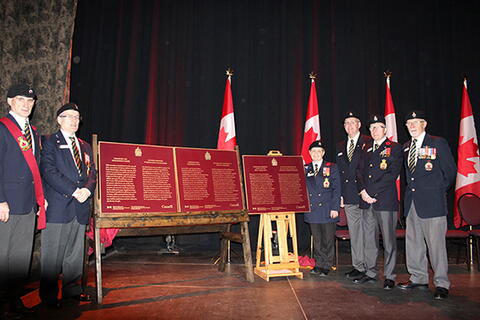
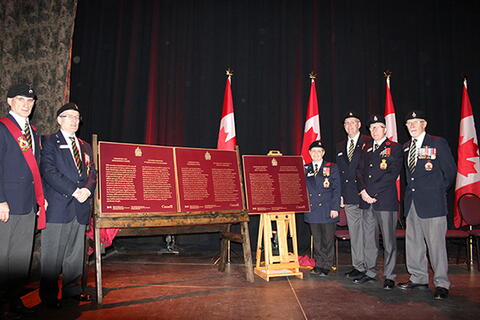
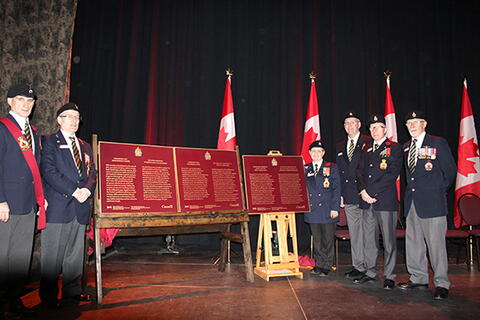
On March 2, 2017 personnel from Department of National Defence supported Parks Canada and the Historic Sites and Monuments Board of Canada at an event commemorating the national historic significance of Voluntary Aid Detachments. The event held in the Barney Danson theatre at the Canadian War Museum. Joining Master of Ceremonies Dr. Brian Always, Chair of the Historic Sites and Monuments Board of Canada, in the unveiling of the three plaques were the Honourable Catherine McKenna (Minister of the Environment and Climate Change and Minister responsible for Parks Canada), Councillor Ron Bernard of the Algonquins of Pikwakanagan First Nation, Dr. Laura Brandon (former Historian, Art and War at the Canadian War Museum), and Dave Mowat, member of the Alderville First Nation, of the Mississaugas.

City
Ottawa
Country
Type Description
Plaque
Memorial CF Legacy ID
9602
City/Municipality
Ottawa
Memorial Number
24025-014
Type
Address
1 Vimy Place
Location
Canadian War Museum
in Canada
Yes
GPS Coordinates
45.4165562, -75.7169158
Inscription

The Canadian War Memorials Fund

The Canadian War Memorials Fund (CWMF) was a charity initiated by Sir William Maxwell Aitken (subsequently Lord Beaverbrook) in November 1916. It was Canada’s first war art program and established the ongoing tradition of using artists to depict Canada at war.

The Fund was an outgrowth of the Canadian War Records Office (CWRO), an organ of the Canadian government founded in February 1916 and directed by Beaverbrook to document the conflict from a Canadian perspective in film, photography and print. The material he collected for the CWRO included official daily reports, maps, photographs and war diaries among other types of documents.

Beaverbrook’s new project of commissioning and collecting original works of war art was prompted in part by a lack of official war photographs, especially after the Second Battle of Ypres and the battles of Festubert, St. Eloi and Givenchy, which went largely unrecorded, at least visually. Post-battle paintings that reconstructed the events were criticized for lacking conviction. Worse, fake photographs and films purporting to depict elements of the battles began to be produced. Beaverbrook also believed that photographs had a maximum lifespan of 25 years. Only paintings, he believed, would survive long enough to convey a message about Canadian activity during the First World War for posterity.

Although Beaverbrook had formidable obstacles to overcome in trying to provide access to the front for artists and reporters, he eventually succeeded in moving artists into the theatre of war. These artists received military commissions and, as employees of the Canadian War Memorials Fund, compensation for materials, studio space and their completed works. In general, Beaverbrook and his partner the art critic P.G. Konody, commissioned oversized works in the tradition of historic battle paintings, with some smaller, more documentary works. Beaverbrook and Konody emphasized fieldwork and insisted that artists spend time on the battlefield making sketches that could later be transformed into canvases.

Nearly 1,000 paintings, photographs, drawings and films by over 100 artists, one-third of them Canadians, were commissioned. The Fund thus contributed to the artistic development of a number of important Canadian artists by providing them with salaries, commissions, supplies and media attention at a time when art production was little valued. The Fund paved the way for the growth of a young Canadian art scene by bringing together artists, curators, archivists, patrons and art institutions.

The hundreds of paintings, drawings, photographs and films produced for the Canadian War Memorials Fund were exhibited in London just after the war, as well as through the 1920s and 1930s, usually to warm public and critical acclaim. The collection was ultimately placed in the National Gallery of Canada. In 1971, most of the works were transferred to the Canadian War Museum, where they remain. The collection of the CWMF illustrates, commemorates and illuminates the Canadian experience of the First World War through the expression of Canadian artists.

Image
Photo Credit
Victoria Edwards
Caption
Canadian War Museum plaques
War or Conflict Term
Province
!4v1624467722215!6m8!1m7!1s7WEA4FaByVKwOu6VI7g5aA!2m2!1d45.41655621361518!2d-75.71691580193155!3f324.9564321006918!4f2.306413855340807!5f0.7820865974627469
Body Content

On March 2, 2017 personnel from Deparment of National Defence (DND) supported Parks Canada and the Historic Sites and Monuments Board of Canada (HSMBC) at an event commemorating the national historic significance of Voluntary Aid Detachments. They paraded the Colours at the event held in the Barney Danson theatre at the Canadian War Museum. Joining Master of Ceremonies Dr. Brian Always, Chair of the Historic Sites and Monuments Board of Canada, in the unveiling of the three plaques were the Honourable Catherine McKenna (Minister of the Environment and Climate Change and Minister responsible for Parks Canada), Councillor Ron Bernard of the Algonquins of Pikwakanagan First Nation, Dr. Laura Brandon (former Historian, Art and War at the Canadian War Museum), and Dave Mowat, member of the Alderville First Nation, of the Mississaugas.

City
Ottawa
Country
Type Description
Plaque
Memorial CF Legacy ID
9601
City/Municipality
Ottawa
Memorial Number
24025-013
Type
Address
321 Chapel Street
in Canada
Yes
GPS Coordinates
45.4268938, -75.6776163
Inscription
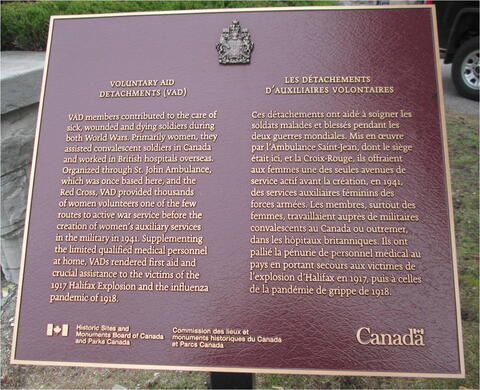
  • Voluntary Aid
    Detachments (VAD)
  • VAD members contributed to the care of
    sick, wounded and dying soldiers during
    both World Wars. Primarily women, they
    assisted convalescent soldiers in Canada
    and worked in British hospitals overseas.
    Organized through St. John Ambulance,
    which was once housed here, and the
    Red Cross, VAD provided thousands
    of women volunteers one of the few
    routes to active war service before the
    creation of women’s auxiliary services
    in the military in 1941. Supplementing
    the limited qualified medical personnel
    at home, VADs rendered first aid and
    crucial assistance to the victims of the
    1917 Halifax explosion and the influenza
    pandemic of 1918.
  • Historic Sites and
    Monuments Board of Canada
    and Parks Canada
  • Les Détachements
    d’Auxiliaires Volontaires
  • Ces détachements ont aidé à soigner les
    soldats malades et blessés pendants les
    deux guerres mondiales. Mis en oeuvre
    par l’Ambulance Saint-Jean, dont le siège
    était ici, et la Croix-Rouge, ils offraient
    aux femmes une des seules avenues de
    service actif avant la creation, en 1941,
    des services auxiliaires féminins des
    forces armées. Les members, surtout des
    femmes, travaillaient auprès des militaries
    convalescent au Canada ou outremer,
    dans les hôpitaux britanniques. Ils ont
    pallié la pénurie de personnel medical au
    pays en portant secours aux victimes de
    l’explosion d’Halifax en 1917, puis à celles
    de la pandémie de la grippe en 1918.
  • Commission des lieux
    et monuments historiques du Canada
    et Parcs Canada
Image
Photo Credit
Victoria Edwards
Caption
Voluntary Aid Detachments Plaque unveiling at the Canadian War Museum.
1 of 3 images
Image
Photo Credit
Richard Turcotte
Caption
Voluntary Aid Detachments Plaque
1 of 3 images
Image
Photo Credit
Richard Turcotte
Caption
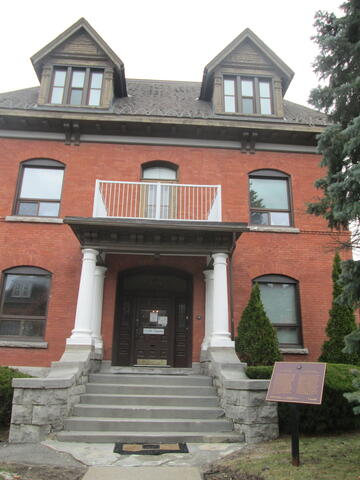
Voluntary Aid Detachments Plaque and former St. John Ambulance building.
1 of 3 images
Province
!4v1730990159954!6m8!1m7!1s4Et9wgqi8usbPLDlz_ilGg!2m2!1d45.42689384331576!2d-75.67761632071945!3f62.565243051198046!4f-4.218280620035387!5f0.7820865974627469
Body Content

On March 2, 2017, the Department of National Defence supported Parks Canada and the Historic Sites and Monuments Board of Canada at an event commemorating Indigenous Military Service in First World War, Canadian War Memorials Fund, and Voluntary Aid Detachments. The event was held in the Barney Danson theatre at the Canadian War Museum. Joining Master of Ceremonies Dr. Brian Always, Chair of the Historic Sites and Monuments Board of Canada, in the unveiling of the three plaques were the Honourable Catherine McKenna, Minister of the Environment and Climate Change and Minister responsible for Parks Canada; Councillor Ron Bernard of the Algonquins of Pikwakanagan First Nation; Dr. Laura Brandon, former Historian, Art and War at the Canadian War Museum; and Dave Mowat, member of the Alderville First Nation of the Mississaugas.

The plaque was subsequently installed at its current location in front of the building formerly housing the offices of the Saint John Ambulance.

Although unable to enlist, over 2,000 Canadian women volunteered and found a way to serve their country during the Great War and during two national emergencies at home -- the Halifax Explosion and the deadly Spanish Flu pandemic. Organized by the Canadian Red Cross and St. John Ambulance, Voluntary Aid Detachments worked as nurses’ aides, ambulance drivers, and clerical staff at convalescent hospitals in Canada and at some hospitals overseas. They assisted overworked medical and nursing staff in caring for thousands of injured and sick servicemen, some facing the same dangers and hardships as soldiers, nurses, and doctors working near the front lines.

Voluntary Aid Detachments first emerged in 1914 as Canada’s Militia Department made preparations at home, in anticipation of war in Europe. They were initially intended to create an emergency reserve of trained men and women who would support military medical services in case of invasion on Canadian soil. Later, following the outbreak of the First World War, the Voluntary Aid Detachments program developed into a female volunteer nursing corps, as male recruits were quickly drawn into the armed forces. Canadian Voluntary Aid Detachments units were modelled on a British system established in 1909, intended to supplement existing army nursing reserves. These reserves consisted of both professional nurses and civilian volunteers trained in first aid. While the British program utilized some 23,000 Voluntary Aid Detachments nurses during the Great War, the Canadian program was more modest. Still, the number of women who enrolled as Canadian Voluntary Aid Detachments members was considerable -- by the war’s end, some 2,000 had trained and qualified as Voluntary Aid Detachments nurses. While the majority were limited to working in military convalescent hospitals on the home front, an estimated 500 Canadian Voluntary Aid Detachments  members served in British military hospitals overseas.

The first Canadian Voluntary Aid Detachments were formed in Halifax, Québec City, and Saint John, because these ports were expected to be the first to receive wounded soldiers returning from overseas. These were later followed by units in Montreal, Ottawa, and Victoria. Initially, Voluntary Aid Detachments members engaged in non-nursing activities distributing comforts such as chocolate bars and cigarettes to departing troops and wishing them a safe return home. As the war progressed, however, they helped to prepare, open, and staff military convalescent hospitals. This role became particularly important as increasing numbers of sick and wounded soldiers returned to Canada in early 1915.

Many were anxious to go overseas where the need was greatest, but it was not until September 1916 that the first contingent of Canadian Voluntary Aid Detachments members left in response to a request from the British Red Cross. Although the Canadian Army Medical Corps refused to use voluntary nurses in its overseas hospitals, Voluntary Aid Detachments nurses were welcomed into British military hospitals. Overall, St. John Ambulance in Canada supplied more than 360 volunteers for overseas postings, while many other Canadian Voluntary Aid Detachments members financed their own passages to England and applied directly to British Voluntary Aid Detachments headquarters in London. Working in the British military medical establishment, Canadian Voluntary Aid Detachments nurses served as probationers (trainees) who were supervised by professional nurses. As was the case in Canadian convalescent hospitals at home, they assisted with various nursing tasks, such as making beds, preparing diets for invalids, and ensuring the overall comfort of soldiers. In some instances, Voluntary Aid Detachments work approached that of trained nurses, as volunteers changed surgical dressings and performed night duty in charge of wards. Like the military nurses under whom they served, Canadian Voluntary Aid Detachments members posted in France, and more distant battle zones were exposed to frontline dangers and hardships. A number of volunteers were recognized for their bravery during enemy attacks.

Both at home and in overseas operations, Voluntary Aid Detachments work varied greatly depending on the location and hospital type. Detachment members performed any number of tasks, working as nurses’ aides, ambulance drivers, clerical staff, and in any other auxiliary capacity required of them during the war. Voluntary Aid Detachments nurses also demonstrated their training and skill in the aftermath of the Halifax explosion in December 1917 and during the "Spanish" influenza pandemic of 1918. They provided crucial medical and nursing assistance during these two national crises. Canadian Voluntary Aid Detachments nurses served for the duration of the Great War and beyond, helping to care for convalescent soldiers well after the Armistice in 1918, and were officially demobilized in October 1920.

City
Ottawa
Country
Type Description
Plaque
Memorial CF Legacy ID
9600
City/Municipality
Trenton
Memorial Number
13006-021
Type
Address
220 RCAF Road
Location
National Air Force Museum of Canada, RCAF Memorial Airpark
in Canada
Yes
GPS Coordinates
44.1150572, -77.5510164
Image
Photo Credit
Paul Ozorak
Caption
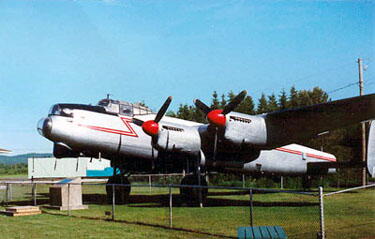
aircraft (left side)
War or Conflict Term
Province
!4v1620823833513!6m8!1m7!1sZ95aYdHoF2IdHL2qCDZx2g!2m2!1d44.11505721096301!2d-77.55101641210261!3f60.03099543377409!4f7.805396304625361!5f0.7820865974627469
Body Content

The Avro Lancaster KB882 was built in November 1944 by Victory Aircraft Ltd. in Malton, Ontario.  It was one of 430 Lancasters built in Canada.  In March of 1945, it was ferried to England and taken on strength by the 428 “Ghost” Squadron, 6 Bomber Group. The Lancaster flew 11 combat missions before the end of the Second World War. In June of 1945, it returned to Canada and became part of “Tiger Force”, Canada’s contribution to the air war in the Pacific. The war ended prior to deployment and the Lancaster was placed in storage at MacLeod, Alberta.

In 1956, the Lancaster was modified and delivered to 408 “Goose” Squadron at Royal Canadian Air Force Station in Rockcliffe, Ontario. The most notable modification to the aircraft included a 40-inch extension ahead of the cockpit to house the additional camera and RADAR installations. For the next 8 years, the Lancaster flew photo mapping, intelligence gathering, and photo reconnaissance missions including the surveillance of numerous Soviet ice stations. It was also used for photo and intelligence gathering during the Cuban Missile Crisis in October of 1962.

Struck off strength in 1964, the Lancaster was bought by the City of Edmundston, New Brunswick and placed on display at the local airport. The Lancaster KB882 was moved from Edmundston in October 2017, to the National Air Force Museum in Trenton, Ontario.

City
Trenton
Country
Type Description
Aircraft
Memorial CF Legacy ID
2661
City/Municipality
LaHave
Memorial Number
12009-074
Type
Address
100 Lahave Islands Road
Location
LaHave Islands Marine Museum
in Canada
Yes
GPS Coordinates
44.2329114, -64.3699864
Inscription

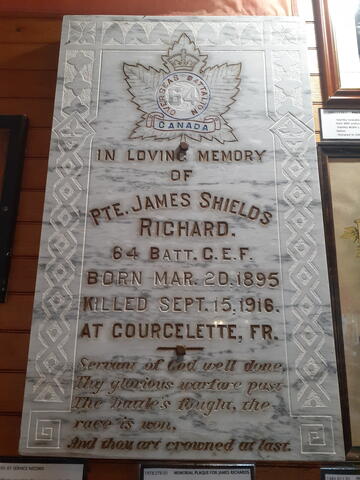
OVERSEAS BATTALION
CANADA

IN LOVING MEMORY
OF
PTE. JAMES SHIELDS
RICHARD.
64 BATT. C.E.F.
BORN MAR. 20, 1895
KILLED SEPT. 15, 1916.
AT COURCELETTE, FR.

Servant of God well done,
Thy glorious warfare past
The battle's fought, the
race is won,
And thou are crowned at last.

Image
Caption
Private James Shields Richard Plaque
Province
!4v1723042546924!6m8!1m7!1sV5i_7KrirL7XNZWVAgOf-Q!2m2!1d44.23291141161445!2d-64.36998635016388!3f233.78070626488253!4f-1.5214300631102589!5f0.7820865974627469
Body Content

The Private James Shields Richard Plaque was erected in the United/Methodist Church before the building was turned into a museum.

City
LaHave
Country
Type Description
Plaque
Photo Credit
Veterans Affairs Canada
Memorial CF Legacy ID
12663
City/Municipality
Halifax
Memorial Number
12004-196
Type
Address
165 Coronation Avenue
Location
Freemasons Hall
in Canada
Yes
GPS Coordinates
44.6519972, -63.6458364
Inscription

needs further research/recherche incomplète

Image
Caption
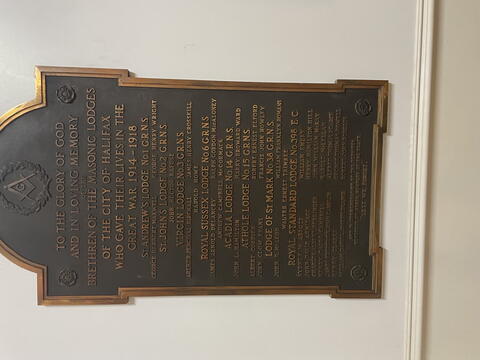
Masonic Lodges of Halifax Great War Plaque
War or Conflict Term
Province
!4v1726503980640!6m8!1m7!1sCq1sHjFRdlf2K8BQt8XUGA!2m2!1d44.65199719228825!2d-63.64583636332146!3f344.8000937787936!4f-10.624787150414704!5f1.0246095402924729
Body Content

The Great War Plaque was erected on June 10, 1930. It lists the names of those from each Masonic lodge in Halifax who died in the First World War.

City
Halifax
Country
Type Description
Plaque
Photo Credit
Grand Lodge of Nova Scotia
Memorial CF Legacy ID
12735
City/Municipality
Halifax
Memorial Number
12004-131
Type
Address
2729 Gottingen Street
Location
Naval Museum of Halifax
in Canada
Yes
GPS Coordinates
44.6589999, -63.5934688
Province
!4v1635871304343!6m8!1m7!1sGLQ-CpHP86xmG1v_oygQsA!2m2!1d44.65898520639836!2d-63.59345341852039!3f21.74180251721205!4f3.3451767271286883!5f0.7820865974627469"
Body Content

In 2012, a bust of Commander Adelaide Sinclair was unveiled at the Naval Museum of Halifax during the opening of an exhibit marking the 70th anniversary of the Women's Royal Canadian Naval Service. The bust was created by Christian Corbet, the Royal Canadian Navy sculptor-in-residence.

Adelaide Sinclair was born on 16 January 1900 in Toronto. She earned a degree in political science at the University of Toronto in 1922, followed by a master’s degree in economics in 1925. After the Second World War began, she took a position at the Central Volunteer Bureau and became chairman of the Women’s Salvage Committee. In 1942, she moved to Ottawa where she became an economist with the Wartime Prices and Trade Board.

In March 1943, she joined the Women’s Royal Canadian Naval Service. She was sent to England to train with the Women’s Royal Navy Service (WRNS) and was appointed director with the rank of commander of the Women’s Royal Canadian Naval Service on 18 September 1943. She was director until 1946, when the service was disbanded. She was not only the first Canadian director of the service, but also the first woman to earn the rank of captain in the Royal Canadian Navy.

Following the Second World War, Adelaide was the executive assistant to the Deputy Minister of National Health and Welfare (1946–57). In 1945, she became an Officer of the Order of the British Empire for her “untiring zeal and outstanding ability, tact and judgment in organizing the Women’s Royal Canadian Naval Service into a most efficient and well-disciplined unit.” In 1967, Sinclair was named an Officer of the Order of Canada for her contributions to Canada as director of the Women’s Royal Canadian Naval Service and her work with UNICEF.

Christian began working with the Royal Canadian Navy in 2010, which was Canada’s Naval Centennial. He offered to donate a sculpted bust of Admiral Sir Charles Kingsmill, known as the Father of the Royal Canadian Navy. The Royal Canadian Navy’s appreciation of this gift inspired Christian to donate a second bust in 2011. This one was of Chief Petty Officer Max Bernays, a Canadian navy hero from the Second World War

Other works by Christian Corbet include: Rear-Admiral Leonard Warren Murray Bust, Midshipman William A. Palmer Bust, Vice Admiral Ralph Lucien Hennessy Bust and Newfoundland Royal Naval Reserve Bust.

City
Halifax
Country
Type Description
Bust
Memorial CF Legacy ID
12450