Québec

Province Code
PQ
City/Municipality
Dorval
Memorial Number
24031-015
Type
Address
1335 Lakeshore Drive
Location
Peace Park Arboretum
in Canada
Yes
GPS Coordinates
45.4389483, -73.757705
Inscription

City of Dorval

Thursday Oct 8, 1992 at 15:00. His worship

Mayor Peter B Yeomans accompanied by Mr Claude

Dupras, Co-Chairman of Canada 125 Corporation,

representatives of the Horticultural Society, and citizens of

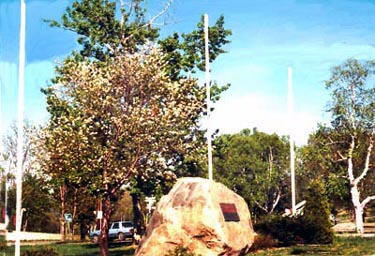
our community dedicated this Peace Park by the planting

of 12 trees representing the provinces and territories

as symbols of life creativity and hope for world peace

Image
Photo Credit
BruceS/Waymarking.com
Caption
Dorval Peace Park
Province
!4v1615386299010!6m8!1m7!1sSmYNxvaPyRK1teGU9GqHqA!2m2!1d45.43894832966608!2d-73.75770503065496!3f26.481635575389184!4f-1.1782992878982554!5f2.299968626952992"
Body Content

Dorval's "Peace Park" was designated as part of Canada's 125th Birthday in 1992.

"Peace Parks Across Canada" was conceived and organized by the International Institute for Peace through Tourism (IIPT) in collaboration with "CANADA 125" and the National Capital Commission. As Canada celebrated its 125th Birthday, some 400 cities and towns across Canada dedicated a Park to Peace – with most parks dedicated at Noon local time, October 8th, as the National Peacekeeping Monument was being unveiled in Ottawa. The members of the winning design team included Cornelia H. Oberlander, landscape architect. Supporters included the Federation of Canadian Mayors and Municipalities, Canada Parks and Recreation Association, the Tourism Industry Association of Canada, Heritage Canada, World Wildlife Fund Canada, Friends of the Earth, Canadian Society of Landscape Architects, and local Rotary Clubs all across Canada. Project sponsors included VIA Rail, Greyhound Lines Canada, Ltd., CP Hotels and Resorts, Ramada International Hotels and Resorts, Four Seasons Ltd., Meridien Hotels, Concept 3 Advertising and Programmed Communications, Ltd.

Peace Parks Across Canada" has served as the foundation in launching the "IIPT Global Peace Parks Program" on the 11th hour, of the 11th day, of the 11th month, 2000

At noon on October 9th, 2007 – one day after the precise 15th Anniversary of the original dedications, and as Canada continues to be a beacon of peace, Tolerance, and Understanding in a world of increasing violence and distrust, and a nation that celebrates diversity, a nation-wide re-dedication was co-ordinated.

Each of the original Peace Parks incorporated a ‘Bosco Sacro’ (Peace Grove) of 12 trees as a symbolic link with one another, and with nature - and as a symbol of hope for the future. The 12 trees were also symbolic of Canada’s 10 Provinces and two Territories. As there are now three Territories, a 13th tree was planted as part of the "Re-dedication Ceremony."

City
Dorval
Country
Type Description
Park
Photo Credit
Victoria Edwards
Memorial CF Legacy ID
10140
City/Municipality
Beaconsfield
Memorial Number
24031-014
Type
Address
269 Shore Road
Location
Heroes Park
in Canada
Yes
GPS Coordinates
45.4254328, -73.8629403
Inscription

[front/devant]

Capitaine Nichola Kathleen Sarah Goddard
17 mai 2006/ May 17, 2006
Kandahar, Afghanistan 

[left side/côté gauche]

En hommage
De ses frères et sœurs d’armes – artilleurs, tous les membres de la 2e Division du Canada et Forces opérationnelle interarmées (Est) et des femmes au service de la population au sein des services de police, d’incendie, paramédics et premier répondants.

Date et lieu de naissance : 2 mai 1980 Papouasie – Nouvelle-Guinée
Âge : 26
Unité : 1 Régiment – Royal Canadian Horse Artillery
Mention élogieuse : la Médaille du service méritoire, la Médaille du sacrifice (posthume)

La Capitaine Nichola Goddard, première femme militaire des Forces Armées canadiennes morte au combat occupant un rôle d’officier d’armes de combat. Nichola a écrit, de l’Afghanistan, le courriel suivant à ses parents quelques semaines seulement avant son décès.

Le 2 mai 2006
Chers Maman e Papa,

Les jours semblent passés comme bon leur semble. Certains jours filent à toute vitesse, d’autres sont très long. Nous sommes officiellement à mi-chemin maintenant, bien que j’aie de la difficulté à croire que cela fait trois mois que je suis ici. J’essaie de na pas oublier d’apprécier toutes les expériences – mêmes celles que je n’aime pas vraiment :)

J’ai beaucoup pensé au destin dernièrement. C’est tellement un hasard de naissance de nous retrouver à un endroit donné, à un moment donné, avec les choix que nous avons. Faire de ce monde un endroit meilleur, en particulier pour ceux qui sont nés dans des circonstances moins favorables que les nôtres, me parait une si grande responsabilité. C’est plus qu’une question de donner de l’argent aux organismes bien faisances; c’est agir et essayer d’améliorer les choses. Vous m’avez tous deux montré cela durant ma vie, mais ici, je le réalise encore plus que jamais auparavant.

Mon travail et mon rôle en Afghanistan ont un lien avec tout cela, mais ce sera aux organisations non gouvernementales qui viendront plus tard d’y voir. Ce sont elles qui influencent vraiment les choses. J’aime penser que, par ma présence, elles pourront venir bien plus vite et faire leur travail plus librement. Dès mon retour à Wainwright (Alberta), j’offrirai mes services pour essayer de faire des gestes significatifs. Je suis très touché d’être ici, de faire partie d »’une force bien plus grande que moi.

Avec tout mon amour,
Nichola

En mémoire de son sacrifice : un nouveau patrouilleur de la Garde Côtière canadienne sera nommé en l’honneur de Nichola Goddard. Il s’agit d’un groupe particulier de navires qui sont « dédiés à des héros ».

Autres navires nommés en l’honneur de :
Caporal Kaeble V.C. Royal 22e Régiment – 1918
Private Robertson V.C. 27th Battalion – 1917
Corporal Teather C.V. GRC/RCMP – 2004
Constable Carrière S.C. GRC/RCMP – 1997
G. Peddle S.C. Garde Côtière/Coast Guard – 1989
Corporal McLarem M.M.V. Royal Canadian Regiment – 2008
A. Leblanc, Agent de Pêches/Fisheries Officer – 1926
M. Charles S.C., M.B. Garde Côtière/Coast Guard – 1976
Captain Goddard M.S.M. Artillerie Royale Canadienne/Royal Canadian Artillery – 2006

[right side/côté droit]

In Honour
From her brothers and sisters in arms – gunners and all members of the 2nd Division and Joint Task Force (East) and all women serving the population in police, fire, paramedic services as well as first responders.

Date and place of birth: May 2, 1980 Papua New Guinea
Age: 26
Unit: 1st Regiment – Royal Canadian Horse Artillery
Citation: Meritorious Service Medal, Sacrifice Medal (posthumous)

Captain Nichola Goddard, first female of the Canadian Armed Forces killed during combat duty while occupying a combat arms officer role. Nichola wrote the following e-mail to her parents from Afghanistan just weeks before her death.

May 2, 2006
Dear Mum and Dad,

The days seem to move along at their own pace. Some days fly by, and others creep along. We are officially at the halfway point now, though I can’t believe I’ve been here for three months. I try to remind myself to appreciate every experience – even the ones I don’t really enjoy. :)

I have been thinking a lot about fate lately. It was such an accident of birth that we ended up where we did when we did, that we are where we are now, with the choices that we have available to us. It seems to me that we have such a burden of responsibility to make the world a better place for those who were born into far worse circumstances. It is more than donating money to charities; it is taking action and trying to make things better. You have both shown me that throughout my life, but here I realize it more than ever.

My current job and role in Afghanistan is part of that, but it is more the non-governmental organizations that come later. They are the ones that really make the difference. I like to think that my being here means they will be able to come that much sooner and operate more freely. I will be looking for more opportunities to volunteer in Wainwright (Alberta) and to really try to make a difference. It is humbling to be here, part of something so much bigger than myself.

Love always,
Nichola

In memory of her sacrifice: a new Canadian Coast Guard patrol vessel will be named after Nichola Goddard. This particular group of vessels are described as “Hero Class”.

Other ships named in honour of:
Caporal Kaeble V.C. Royal 22e Régiment – 1918
Private Robertson V.C. 27th Battalion – 1917
Corporal Teather C.V. GRC/RCMP – 2004
Constable Carrière S.C. GRC/RCMP – 1997
G. Peddle S.C. Garde Côtière/Coast Guard – 1989
Corporal McLarem M.M.V. Royal Canadian Regiment – 2008
A. Leblanc, Agent de Pêches/Fisheries Officer – 1926
M. Charles S.C., M.B. Garde Côtière/Coast Guard – 1976
Captain Goddard M.S.M. Artillerie Royale Canadienne/Royal Canadian Artillery – 2006

Image
Caption
plaque
1 of 2 images
Image
Caption
surroundings
1 of 2 images
War or Conflict Term
Province
!4v1649684369605!6m8!1m7!1sbhI-m99Rs9sZcKT3JK-gkQ!2m2!1d45.42543278158772!2d-73.86294033022338!3f324.9433997132289!4f-4.4162234744079285!5f1.6110638966479227"
Body Content

This memorial is dedicated to the memory of Captain Nichola Goodard, MSM. Captain Goddard was born in May 1980 to Canadian and British parents in Papua New Guinea, and lived in various locations across Canada. Captain Goddard was awarded the Meritorious Service Medal for her exemplary service in Afghanistan from January 2006 until her death on May 17, 2006 during the Battle of Bayanzi, a small village on the outskirts of Kandahar City.

Acting upon reports that the Taliban would be making a large-scale attack on Kandahar City itself, Canadian and Afghan National Army troops deployed to the Bayanzi area to counter fighters massing in the village. As the only Forward Observation Officer, Captain Goddard performed with distinction throughout that day, calling in artillery fire and support from the US Apache helicopters overhead. Shortly after sunset, the Canadian troops moved into Bayanzi. As the Canadian troops started to turn around in the narrow Bayanzi lanes, two rocket-propelled grenades (RPGs) struck Captain Goddard's LAV.

City
Beaconsfield
Country
Type Description
Panel
Memorial CF Legacy ID
8671
City/Municipality
Dorval
Memorial Number
24031-013
Type
Address
Albert-de-Niverville Boulevard
in Canada
Yes
GPS Coordinates
45.449698, -73.7518952
Inscription

[front'devant]

Boulevard
Albert-de-Niverville
Boulevard 

Image
War or Conflict Term
Province
!4v1615385963190!6m8!1m7!1sTCaTdsGGqwUjj2vw59o7MA!2m2!1d45.44969799413954!2d-73.75189518735648!3f313.41793075034195!4f1.6597142911537048!5f2.876859616440032"
Body Content

Albert-de-Niverville Boulevard was named in memory of Air Vice-Marshal Joseph Lionel Alphege Albert De Niverville, CB.

Albert De Niverville was born in August 1897 in Montreal. Educated in Ottawa, he joined the Royal Flying Corps in 1917 and flew until the end of the First World War. Following the war, he was gazette as a Pilot Officer in the Canadian air force Reserve, working with the Air Board until March 1924, at which time he was appointed to the newly-formed Permanent RCAF on April 1, 1924. He served as a Flying instructor at Camp Borden until September 1927 and was then transferred to AFHG as Staff Officer Training until April, 1931. De Niverville returned to instructing at Station Vancouver where he instructed on sea planes and flying boats, transferring to Station Rockcliffe in 1932. He completed RAF Staff College in 1933 and returned to AFHQ from January, 1934 to February, 1936, followed by an appointment as Air Staff Officer for Military District No. 4 (Montreal) until February, 1939. At the outbreak of the Second World War, he returned to AFHQ then became CO of No. 2 Service Flying Training School in August, 1941 before being appointed Air Officer Commanding No. 3 Training Command, from October, 1941, to November, 1943. He was later appointed Air Member for Training at Air Force Headquarters. Following the Second World War, he joined the Department of Transportation, retiring in November, 1964.

City
Dorval
Country
Type Description
Street - street sign
Memorial CF Legacy ID
8792
City/Municipality
Beaconsfield
Memorial Number
24031-012
Type
Address
269 Shore Road
Location
Heroes Park
in Canada
Yes
GPS Coordinates
45.4254328, -73.8629403
Inscription

[front/devant]

HMCS/NCSM Donnacona since 1943/ depuis 1943
The Royal Canadian Hussars (Montréal) since 1877/ depuis 1877
Le 2e Régiment d’artillerie de champagne, Artillerie royale canadienne depuis 1855/ The 2nd Field Regiment, Royal Canadian Artillery since 1855
34e Régiment du Génie de combat/ 34 Combat Engineer Regiment since 1920/ depuis 1920
4e Bataillon Royal 22e Régiment (Châteauguay) depusi 1869/ since 1869
6e Bataillon Royal 22e Régiment depuis 1871/ since 1871
Le Régiment de Maisonneuve depuis 1880/ since 1880
Les Fusiliers Mont=Royal depuis 1869
The Black Watch (Royal Highland Regiment) of Canada since 1862/ depuis 1862
The Canadian Grenadier Guards since 1764/ depuis 1764
The Royal Montreal Regiments since 1914/ depuis 1914
34e Battaillon des Services since 1972/ depuis 1972
34e Régiment des Transmissions/ 34 Signal Regiment since 1921/ depuis 1921
438e Escadron tactique d’helicoptères since 1943/ depuis 1943

[left side/côté gauche]

Honorer la Force de Réserve du Canada

Les forces de réserve du Canada représentent une tradition de service militaire remontant d’avant la Confédération. Strictement volontaire et composé de citoyens qui consacrent une partie de leur temps libre au service militaire, ils sont les représentants des Forces canadiennes auprès de la société canadiennes et appuient la Force régulière ici comme ailleurs dans le monde.

Elles étaient les unités du Canada sur les champs de bataille de la Première et de la Seconde Guerre mondiale bien avant que le Canada ait une armée professionnelle. De nombreuses unités de la région de Montréal ont été déployées sur tous les théâtres opérationnels et ont remporté de nombreux honneurs de bataille. Nous saluons le service et sacrifice de ces citoyens-soldats.

[right side/ côté driot]

Honouring the Reserve Force of Canada

Canada’s reserve forces represent a tradition of military service that goes back to before Confederation. Composed of citizens who voluntarily devote a portion of their spare time to military service and in doing so play a vital role in linking the Canadian Forces with Canadian society and supporting the regular Force at home and abroad.

They were the units of Canada on the battlefields of the First and Second World war well before Canada had a professional army. Reserve units from the Montreal area have deployed in every theater of operation and have won many battle honours. We salute the service and sacrifice of these citizen-soldiers.

Image
1 of 2 images
Image
1 of 2 images
Province
!4v1649684369605!6m8!1m7!1sbhI-m99Rs9sZcKT3JK-gkQ!2m2!1d45.42543278158772!2d-73.86294033022338!3f324.9433997132289!4f-4.4162234744079285!5f1.6110638966479227"
Body Content

This memorial is dedicated to the citizen-soldiers of the Reserve Force units of the Montreal area.

City
Beaconsfield
Country
Type Description
Panel
Memorial CF Legacy ID
8793
City/Municipality
Beaconsfield
Memorial Number
24031-011
Type
Address
269 Shore Road
Location
Heroes Park
in Canada
Yes
GPS Coordinates
45.4254328, -73.8629403
Inscription

[front/devant] *denotes a spelling error

John McCrea*
Poête et soldat
Poet and Soldier

En hommage

Un poème de la Grande Guerre, symbolisant le souvenir du sacrifice des Canadiens, intemporel et dépassant nos frontières.

LE COQUELICOT

Le coquelicot rouge, une plante indigène le long de la majeure partie du front occidental de la Première Guerre mondiale, est devenu un symbole éloquent du souvenir. C’est le principal emblème de la Légion royal canadienne, qui en distribue des millions chaque année aux Canadiens qui les portent le jour du Souvenir.

« Au champ d’honneur les coquelicots sont parsemés.. »

Le symbole familier du coquelicot doit une bonne part de sa célébrité au poète et soldat canadien John McCrae. Le poème le plus connu de McCrae, Au champ d’honneur, lui fut inspiré pas les coquelicots qui poussaient le long du front occidental et auxquels il fait allusion. Le poème débute ainsi « Au champ d’honneur les coquelicots/ Sont parsemé de lot en lot/ Près des croix.. »

AU CHAMP D’HONNEUR ET JOHN MCCRAE

On se souvient surtout de John McCrae comme l’auteur de Au champ d’honneur, le poème le plus connu de la Première Guerre mondiale.

L’HOMME

McCrae naquit à Guelph (Ontario) et servit comme artilleur pendant la guerre d’Afrique du Sud. Il fut plus tard professeur de médecine et médecin à l’Université McGill à Montréal. McCrae s’enrôla dès le Première Guerre mondiale, espérant une affectation d’artilleur, mais en raison de la pénurie de médecines, il accepta un poste de chirurgien de brigade dans une brigade d’artillerie.

LE POÉME

Au cours de la deuxième bataille d’Ypres, en 1915, McCrae soigna les blessés et pratiqua des chirurgies sur des soldats canadiens et alliés. Épuisé et attristé par la mort d’un ami cher, il composa Au champ d’honneur au cours d’une brève période de repos. Le poème fut publié le 8 décembre 1915 dans le Punch, où il connut un succès mondial presque immédiat. Il illustrait l’humeur belliqueuse des Alliés et affirmait la nécessité de rester fidèle à ceux qui étaient déjà mort.

LE LEGS

McCrae était devenu un poète de renommé mondiale, mais il continua de travailler comme chirurgien. Il servit dans plusieurs hôpitaux canadiens au cours de la guerre, ne ménageant ni son personnel ni sa propre personne. McCrae fut souvent malade mais se reposait peu et il succomba à une pneumonie le 28 janvier 1918. Il est inhumé au cimetière de Wimereux, en France. Des millions de personnes au Canada et à travers le monde lisent le poème de McCrae à chaque jour du Souvenir. Un musée historique situé dans le Halle aux draps, à Ypres (Belgique), a été baptisé en l’honneur de ce poème ; la salle des expositions spéciales du Musée canadien de la guerre, le musée nationale d’histoire militaire du Canada, porte le nom de McCrae.

In Honour

A poem of the Great War, symbolizing the memory of sacrifice of Canadians, timeless and exceeding our borders.

THE POPPY

The red poppy, a native plant along much of the Western Front during the First World War, has become a symbol of remembrance. It is the principal emblem of the Royal Canadian Legion, which distributes several million each year to be worn by Canadians on Remembrance Day.

“In Flanders Fields the Poppies Blow..”

The familiar symbol of the poppy owes much of its fame to Canadian poet and soldier John McCrae. In Flanders Fields, McCrae’s best-known poem, was inspired by and made reference to the poppies which grew along the Western Front. It opens, “In Flanders fields the poppies blow/ Between the crosses, row on row..”

IN FLANDERS FIELDS AND JOHN MCCRAE

John McCrae is best remembered as the author of In Flanders Fields, the most recognizable poem of the First World War.

THE MAN

McCrae was born in Guelph, Ontario and served as a gunner in the South African War. He was later a professor of medicine and physician at McGill University in Montreal. McCrae enlisted quickly at the outbreak of the First World War, hoping for a position as a gunner, but doctors were in short supply and he accepted an appointment as brigade-surgeon in an artillery brigade.

THE POEM

At the Battle of Second Ypres in April 1915, McCrae spent 17 days caring for the wounded and performing surgery on Canadian and Allied troops. Exhausted and saddened by the death of a close friend, he composed In Flanders Fields during a brief rest. The poem was published on 8 December 1915 in Punch magazine, where it achieved almost instant world-wide fame. It captured the Allies belligerent mood and the requirement to “keep faith” with those who had already died.

THE LEGACY

McCrae had become an internationally-recognized poet, but continued to work as a surgeon. He served in a number of Canadian hospitals during the war and pushed himself and his staff hard. McCrae was often sick but took little rest and succumbed to pneumonia on 28 January 1918. He is buried in Wimereux Cemetery, in France. McCrae’s poem is read by millions in Canada and around the world each Remembrance Day. A history museum in the Cloth Hall in Ypres, Belgium is named after his poem; the special exhibit gallery in the Canadian War Museum, Canada’s national museum of military history, is named for McCrae.

Image
1 of 2 images
Image
1 of 2 images
War or Conflict Term
Province
!4v1649684369605!6m8!1m7!1sbhI-m99Rs9sZcKT3JK-gkQ!2m2!1d45.42543278158772!2d-73.86294033022338!3f324.9433997132289!4f-4.4162234744079285!5f1.6110638966479227"
Body Content

This memorial is dedicated to the memory of Lieutenant Colonel John McCrae, best known as the author of the poem “In Flanders Fields”.

Lieutenant Colonel John Alexander McCrae (1872-1918) was born in Guelph where he became a member of the Guelph militia regiment. McCrae studied at the University of Toronto and joined The Queen’s Own Rifles of Canada. In 1893, he trained as an artilleryman at the Royal Military College in Kingston. He returned to U of T, completed his B.A. and went on to study medicine. McCrae served in the artillery during the Second Boer War and upon his returned taught at the University of Vermont and McGill University. Joining at the very start of the First World War, McCrae worked as a field surgeon and was in charge of a field hospital during the Second Battle of Ypres when McCrae’s friend Lt Alexis Helmer was killed in battle. His burial inspired the poem “In Flanders Fields” which was written on 3 May, 1915 and published later that year. In June 1915, McCrae was made responsible for No. 3 Canadian General Hospital (McGill) at Dannes-Cammiers near Boulogne-sur-Mer. On 28 January 1918, while still in command, McCrae died of pneumonia. He was buried in the Wimereux Cemetery with full military honours and in the presence of General Sir Arthur Currie.

City
Beaconsfield
Country
Type Description
Panel
Memorial CF Legacy ID
8795
City/Municipality
Beaconsfield
Memorial Number
24031-010
Type
Address
269 Shore Road
Location
Heroes Park
in Canada
Yes
GPS Coordinates
45.4254328, -73.8629403
Inscription

[front/devant]

Général le très honorable
General The Right Honourable
Georges Philias Vanier

[left side/côté gauche]

En homage
Gouverneur general: 1959 à 1967
Nommé le : 1er août 1959
Assermenté le : 15 septembre 1959 à Ottawa
Né le : 23 avril 1888 à Montréal (Québec)
Décédé le 5 mars 1967

Georges Philias Vanier naquit à Montréal le 23 avril 1888. Ayant grandi au sein d’une famille de la classe moyenne où l’on parlait surtout l’anglais, il a toutefois pu parfaire son français plus tard, dans le cadre de ses études. Après avoir obtenu un diplôme au Collège Loyola axé sur la dévotion confessionnelle, il songea un certain moment à se consacrer à la prêtrise. Ayant obtenu plus tard un diplôme en droit de l’université Laval, il fut appelé au Barreau du Québec en 1911. Toutefois, il se sentit interpellé lors du déclenchement de la Première Guerre mondiale et considéra qu’il était de son devoir de participer à l’effort de guerre. Il s’enrôla donc dans les Forces canadiennes dès 1915.

À l’âge de 26 ans, Georges Vanier entra dans les rangs du premier bataillon canadien-français, le Royal 22e Régiment, où il fut appelé à jouer un rôle organisationnel important. Le bataillon ayant été mobilisé sur le front dans les tranchées françaises, dès 1915, Georges Vanier participa à plusieurs affrontements historiques, notamment la bataille de la crête de Vimy et la bataille de Passchendaele. En 1918, à peine 74 jours avant la signature de l’armistice, il perdit sa jambe droite dans une attaque à la guerre lui a valu de nombreuses distinctions, notamment la Croix militaire (à deux reprises), la Croix de la Légion d’honneur décernée par le gouvernement français, l’Étoile de 1914 – 1915, la Médaille de guerre britannique, la Médaille de la victoire, ainsi que l’Ordre de Service distingué.

En 1919, de retour à Montréal après la guerre, il se consacrera d’abord au droit. En 1920, il sera nommé commandant au sien du Royal 22e Régiment où il sera finalement promu colonel.

Au cours des années qui menèrent à la Deuxième Guerre mondiale, George Vanier occupa plusieurs postes, notamment comme aide de camp du gouverneur général et comme conseiller pour le désarmement auprès de la Société des Nations, à Genève. De 1931 à 1938, il fut posté au sien du Haut-commissariat du Canada à Londres, avant d’être nommé ministre à l’Ambassade du Canada à Paris, dès 1939. Contraint de fuir Paris en raison des hostilités du début de la guerre, il organisa d’abord l’évacuation de citoyens canadiens et d’autres réfugiés. En 1944, Georges Vanier devint ambassadeur du Canada en France et participa à l’élaboration des ententes internationales pour encadrer les efforts d’après-guerre. Il délaissa finalement le monde diplomatique en 1954, mais demeura toutefois très engagé envers son pays. Enfin, le 15 septembre 1959, le major-général Vanier devint le tout premier gouverneur général du Canada né au Québec. Animé d’une volonté de démocratiser la fonction de gouverneur général aux yeux de la population canadienne (le poste était encore très associé à l’impérialisme britannique) et de rappeler aux Canadiens la richesse du patrimoine français de leur pays, il s’employa sans tarder à promouvoir une politique du bilinguisme dans le but d’améliorer les relations entre les deux principaux groupes linguistiques.

Pendants ses années à Rideau Hall, il a eu l’occasion de parcourir toutes les régions du Canada, où il a effectué 131 visites au cours des quelles il a pu s’arrêter dans des écoles, des hôpitaux, des centres de détention ainsi que d’autres établissements et lieux d’intérêt. Au cours de cette période, Georges Vanier a prononcé plus de 500 allocutions.

George Philias Vanier s’éteignit le 5 mars 1967 à l’âge de 78 ans, et fut inhumé plus tard à la Citadelle de Québec.

[right side/côté droit]

In honour
Governor General : 1959 – 1967
Appointed : August 1, 1959
Sworn in: September 15, 1959, Ottawa
Born: April 23, 1888, Montreal, Quebec
Died: March 5, 1967

Georges Philias Vanier was born in Montreal on April 23, 1888. He grew up in a middle-class, mostly English speaking household, only later perfecting his French through his studies. He earned a degree in church devotional fellowship at Loyola College and briefly considered entering the priesthood. He then earned a subsequent degree in law at Université Laval and was called to the Quebec Bar in 1911. However, with the start of the First World War, he felt it was his duty to participate in the war effort and enlisted in the Canadian Forces in 1915.

At the age of 26, he joined and played an important role in organizing the Royal 22nd Regiment, also known as the “Van Doos”, the first battalion raised by French Canadians. The battalion went to war in France’s tranches in 1915. Georges participated in many important battles including the Battle of Vimy Ridge, and the Battle of Passchandaele. In 1918, only 74 days before the armistice, he lost his right leg in an attack at Chérisy and stayed in Europe to recover. By the end of the war, he had earned many honours, including the Military Cross (on two occasions), the Cross of the Legion of Honour from the government of France, the 1914-1915 Star, the British War Medal, the Victory Medal, and a Distinguished Service Order.

Upon his returned to Montreal following the war in 1919, he practised law and, in 1920, was made commanding officer and subsequently colonel of the Royal 22nd Regiment.

In the years leading up to the Second World War, Georges held several position, including aide-de-camp to the Governor General and advisor to the League of Nations disarmament in Geneva. Between 1931 and 1938, he was posted to the Canadian High Commission in London and in 1939 he was named minister at the Canadian Embassy in Paris. With the hostilities of the impending war approaching, he arranged the evacuation of Canadian nationals and other refugees before leaving Paris himself. In 1944, Georges became Canada’s ambassador to France, working on international agreements focused on port-war efforts. He retired from diplomatic service in 1954, however he continued to be deeply committed to serving his country. Major-General Vanier became the first Quebec native to be appointed Governor General of Canada, on September 15, 1959. With the desire to make the position of Governor General (still affected by British Imperialism) more representative of the Canadian people, and to remind Canadians of their country’s rich French heritage, Georges immediately began promoting a policy of bilingualism, wanting to improve relations between both major linguistic groups.

During Georges’ tenure as Governor General, he travelled all across Canada, making a total of 131 tours, visiting schools, hospitals and jails, among other institutions and attractions. Georges also made more than 500 speeches.

Georges Philias Vanier died on March 5, 1967, at the age of 78 and was later buried at La Citadelle in Quebec City.

Image
1 of 2 images
Image
1 of 2 images
War or Conflict Term
Province
!4v1649683613652!6m8!1m7!1sbhI-m99Rs9sZcKT3JK-gkQ!2m2!1d45.42543278158772!2d-73.86294033022338!3f325.0192655530806!4f-2.1198910502704678!5f1.5353860272464637"
Body Content

This memorial is dedicated to the memory of Major-General Georges-Philéas Vanier PC, DSO, MC, CD.

Major-General Georges-Philéas Vanier was a Canadian soldier who served as Governor General of Canada. He was born and educated in Quebec. After obtaining a BA and a law degree, he served in the Canadian Army during the First World War on the European battlefields. On 1918, while leading an attack on the village of Chérisy, he was shot in the chest and both legs, eventually losing one leg to his wounds. Subsequently, Vanier returned to Canada and remained in the military until the early 1930s, when he was posted to diplomatic missions in Europe. With the outbreak of the Second World War, Vanier rejoined toe military, commanding troops on the home front. In 1942 he was promoted to the rank of major general, and made the Canadian Envoy Extraordinary and Minister Plenipotentiary to the governments of Belgium, Czechoslovakia, Greece, the Netherlands, Norway, Poland, and Yugoslavia, as well as the representative of the Canadian government to the Free French all of which were governments in exile. In 1959, he was appointed Governor General of Canada remaining in this post until his death in 1967. Vanier proved to be a popular governor general, with his war record earning respect from Canadians.

City
Beaconsfield
Country
Type Description
Panel on a pedestal
Memorial CF Legacy ID
8794
City/Municipality
Beaconsfield
Memorial Number
24031-009
Type
Address
269 Shore Road
Location
Heroes Park
in Canada
Yes
GPS Coordinates
45.4254096, -73.8629058
Image
Photo Credit
Neural Mass
Province
!4v1615383933734!6m8!1m7!1s18chg3VrE0q0uuC2PcNrRw!2m2!1d45.42540959616458!2d-73.8629058339333!3f316.98991494958307!4f2.7719868474521547!5f1.6787129176623816"
Body Content

The Path of Heroes stands to complement the Beaconsfield War Memorial (24031-007), erected by the Beaurepaire-Beaconsfield Historical Society in partnership with the Royal Canadian Legion and Beaconsfield High School. It recognizes police, firefighters and other first responders who have served and sacrificed in service to the community.

In 2010, The City of Beaconsfield and its citizens were honored when the city flag flew in the Canadian Headquarters of the 1st Battalion, Royal 22nd Regiment Battle Group in Kandahar, Afghanistan. Major R Gratton, a Beaconsfield resident and member of the Second Field Regiment (Reserve artillery Regiment in Montreal) was then deployed in Afghanistan made a promise to create a citizen committee to build a cenotaph to honour the service of the military but also those who are in harm’s way in the service to the population of Canada. The Path of Heroes is a part of this dedication, which also includes The Heroes Park Project and the Beaconsfield War Memorial.

City
Beaconsfield
Country
Type Description
Pathway
Memorial CF Legacy ID
8798
City/Municipality
Beaconsfield
Memorial Number
24031-008
Type
Address
269 Shore Road
Location
Heroes Park
in Canada
Yes
GPS Coordinates
45.4254018, -73.8629512
Inscription

[front/devant]

[left side/côté gauche]

Parc des Héros. En hommage à nos héros passés, présents, et futurs.

[right side/côté droit]

Heroes Park. In tribute to our heroes past, present, and future.

[back/arrière]

[left side/côté gauche]

Ce parc a été inauguré par son Excellence le Très Honorable David Johnson, C.C, C.M.M., C.O.M., C.D., Gouverneur Général et commandant en Chef du Canada, en présence de Son Honneur M. Georges Bourelle, Maire de Beaconsfield, du major Richard Gratton, C.D., A.R.C., Président du Comité des Héros et du soldat William Ross, The Queen’s Own Rifles of Canada, vétéran du débarquement du 6 juin 1944. Le 15 octobre 2014.

This par kwas dedicated by His Excellency the Right Honourable David Johnson, C.C, C.M.M., C.O.M., C.D., Governor General and Commander-in-Chief of Canada. In the presence of His Worship Georges Bourelle, Mayor of Beaconsfield, Major Richard Gratton, C.D., R.C.A., President of the Heores Committee, and Private William Ross, The Queen’s Own Rifles of Canada, veteran of the D-Day assault on 6 June 1944. October 15th 2014.

[right side/côté droit]

Comité des Héros
Heroes Committee

Major Richard Gratton, CD, Président-Chair. Artillerie Royale Canadienne
Mr. Dennis Pfeffer, Vice president, Vice chair
Lt-Col (Ret) T. Montague, CD, MD
Captain Mark Whittall Cadet Instructor Cadre, Trésorier-Treasurer
Sergeant Frank Jennings, Police de Montréal
M. Claude Lafond, Communications
Adjudant-Chef (Ret) Gilles Aubé, CD, MMM, Artillerie Royale Canadienne
Chef aux opérations Michel Robert, Service des incendies de Montréal
M. Kristopher Parent, Architecte
Mr. Wayne Belvedere, Liaison
Mr. Daniel Wolfe, Communications
Caporal (Ret) Christian Habel, Gendarmerie Royale du Canada
Caporal Camille Habel, Gendarmerie Royale du Canada
Paramedic Daniel Gauvin, Urgences-Santé
Officer John Carroll, Sécurité Publique, Ville de DDO
Captain (Ret) Dave Wakely, Cadet Instructor Cadre
Caporal Guillaume Plourde, Régiment de la Chaudière
Sergeant (Ret) Kevin McCready, Police de Montréal
Constable Jacques Monast, Police de Montréal

[monument/monument]

[front & rear/devant et arrière]

Honneur, Service, Sacrifice. Nous nous souviendrons d’eux.

[left & right/gauche et droite]

Honour, Service, Sacrifice. Lest we forget.

Image
Photo Credit
Richard Turcotte
Caption
“Gate front”
1 of 4 images
Image
Caption
“Gate rear”
1 of 4 images
Image
Caption
Monument
1 of 4 images
Image
Caption
Close up of monument
1 of 4 images
Province
!4v1618238851798!6m8!1m7!1sEDJh6PUlV_C8C857vVzgSg!2m2!1d45.42540184649223!2d-73.86295117692568!3f334.1224197589583!4f0.6543164706015716!5f1.9587109090973311"
Body Content

The Heroes Park Project commemorates the 100th anniversary of the First World War. The entrance to the park has a “gate”, consisting of low, curved walls with an inscribed front. The walls end in short columns, inscribed on the back, and a large, black stone monument is located in the middle of the park.

In 2010, The City of Beaconsfield and its citizens were honored when the city flag flew in the Canadian Headquarters of the 1st Battalion, Royal 22nd Regiment Battle Group in Kandahar, Afghanistan. Major R Gratton, a Beaconsfield resident and member of the Second Field Regiment (Reserve artillery Regiment in Montreal) was then deployed in Afghanistan made a promise to create a citizen committee to build a cenotaph to honour the service of the military but also those who are in harm’s way in the service to the population of Canada. Heroes Park is a part of this dedication, which also includes the Beaconsfield War Memorial and the Path of Heroes.

City
Beaconsfield
Country
Type Description
Park
Memorial CF Legacy ID
8796
City/Municipality
Beaconsfield
Memorial Number
24031-007
Type
Address
269 Shore Road
Location
Heroes Park
in Canada
Yes
GPS Coordinates
45.4260257, -73.8636142
Inscription

HONOUR

SERVICE

SACRIFICE

LEST WE FORGET

HONNEUR

SERVICE

SACRIFICE

NOUS NOUS SOUVIENDRONS D'EUX

Province
!4v1614355096761!6m8!1m7!1s2o2viuDNy-GNv3Q_Y5Bekw!2m2!1d45.42602565467826!2d-73.86361417561494!3f126.54227690730035!4f-0.5214637464176946!5f2.299968626952992"
Body Content

The Beaconsfield War Memorial is the central element of the Heroes Park project, erected by the Beaurepaire-Beaconsfield Historical Society in partnership with the Royal Canadian Legion and Beaconsfield High School. It is dedicated to the men and women who have served and sacrificed in all of Canada’s military operations.

In 2010, The City of Beaconsfield and its citizens were honored when the city flag flew in the Canadian Headquarters of the 1st Battalion, Royal 22nd Regiment Battle Group in Kandahar, Afghanistan. Major R Gratton, a Beaconsfield resident and member of the Second Field Regiment (Reserve artillery Regiment in Montreal) was then deployed in Afghanistan made a promise to create a citizen committee to build a cenotaph to honour the service of the military but also those who are in harm’s way in the service to the population of Canada. Beaconsfield War Memorial is a part of this dedication, which also includes Heroes Park and the Path of Heroes.

City
Beaconsfield
Country
Type Description
Shaft - black granite
Memorial CF Legacy ID
8797
City/Municipality
Sainte-Anne-de-Bellevue
Memorial Number
24031-006
Type
Address
Anciens-Combattants Boulevard
in Canada
Yes
GPS Coordinates
45.4083449, -73.9512712
Inscription

[front/devant]

Ste Anne de Bellevue

Boul des Anciens Combattants

Image
Province
!4v1620241323542!6m8!1m7!1sDBiyeobKIePJiY1FPMdzvQ!2m2!1d45.40834493964353!2d-73.95127117038435!3f233.24527474863623!4f8.973899152391937!5f3.325193203789971"
Body Content

This street is named and dedicated to all Veterans.

City
Sainte-Anne-de-Bellevue
Country
Type Description
Street
Memorial CF Legacy ID
8822