Other

City/Municipality
Calgary
Memorial Number
48002-089
Type
in Canada
Yes
GPS Coordinates
51.0231746, -114.1143009
Inscription

Garrison Woods

War or Conflict Term
Province
!4v1693329888880!6m8!1m7!1sR_QB1_Ibp_sL1emk6DZ8pQ!2m2!1d51.02317456102801!2d-114.1143008594806!3f185.0149226550817!4f-4.289779904628787!5f0.7820865974627469
Body Content

Garrison Woods, a residential area located between Crowchild Trail, 20th Street, 34th Avenue and 47th Avenue in South West Calgary, is the unique result of the redevelopment of Calgary’s former Canadian Forces Base by Canada Lands Company. The land of Garrison Woods was previously used as private married quarters for members of the military and their families. 

The theme of Garrison Woods was developed to honour the deep military roots of the land on which it's built and recognizes the First World War. This theme is reflected in a variety of ways, including street and park names. It was completed in 2004, and is home to 14 battle honour monuments.

City
Calgary
Country
Type Description
Neighbourhood
Memorial CF Legacy ID
11985
City/Municipality
Calgary
Memorial Number
48002-088
Type
Address
4520 Crowchild Trail South West
Location
The Military Museums
in Canada
Yes
GPS Coordinates
51.0137312, -114.1144458
Inscription

HORNBURG

Image
Photo Credit
Lord Strathcona’s Horse (Royal Canadians) Society
Caption
Hornburg Taurus Armoured Recovery Vehicle
Province
!4v1680202437289!6m8!1m7!1sp3NmosCQtEoODUJhegmQ4w!2m2!1d51.01373124002675!2d-114.1144457689118!3f268.03438089692503!4f-2.3053475118188373!5f1.7218578222464318
Body Content

A retired Taurus Armoured Recovery Vehicle (ARV) was dedicated as a living memorial to Corporal Nathan Hornburg on September 10, 2017. A plaque with Nathan Hornburg's likeness was unveiled during the ceremony as a permanent tribute to the Regular and Reserve soldiers who served in Afghanistan. On September 24, 2007, while serving on a NATO mission in Afghanistan, Corporal Hornburg was killed while helping to rescue a disabled tank in the Panjwai District, Kandahar. Hornburg’s tank commander noted that he was one of “those rare individuals that just had a very soft, big, caring heart, but who was also a warrior and a professional.”

The Taurus ARV was originally used to recover and tow armoured vehicles disabled by combat damage or mechanical failure during military operations. Acquired by The Military Museums in November 2016, it was previously deployed in Afghanistan used in support of operations with the Lord Strathcona’s Horse (Royal Canadians), B Squadron, who deployed there in October 2006.

City
Calgary
Country
Type Description
Vehicle - Taurus ARV (Armoured Recovery Vehicle)
Memorial CF Legacy ID
11635
City/Municipality
Calgary
Memorial Number
48002-087
Type
Address
950 6 Street NE
in Canada
Yes
GPS Coordinates
51.0596014, -114.0477316
Inscription
Image
Photo Credit
Princess Patricia’s Canadian Light Infantry
Caption
Stanley Jones School
War or Conflict Term
Province
!4v1672862526098!6m8!1m7!1sQPApxvnLHtMtVJQLKYdp8w!2m2!1d51.0596014267339!2d-114.0477315567984!3f359.9790053896689!4f16.464424118227114!5f0.7820865974627469
Body Content

Stanley Livingstone Jones was born in Wolfville, Nova Scotia, and educated at Acadia College before beginning his career as a school teacher in Manitoba. Around 1901, he re-located to Calgary, was admitted to the bar, and began practicing law. He married Alice B. Todd of Walkerton, Ontario in 1904. 

Stanley was an enthusiast of the war and a devout patriot of the British Empire. He left his law practice to participate, first in the Boer War and then in the Balkan conflict. In the latter conflict, he also served as an observer and correspondent to the Canadian Press. Stanley was a visible figure in Calgary, involved in many civic affairs, and is responsible for the African War Memorial statue, which stands in Central Memorial Park today. Stanley Jones was also one of the first (indeed, often rumoured to be the first) Canadians to enlist in the First World War.

He joined the Princess Patricia's Canadian Light Infantry on 10 August 1914 in Ottawa as a lieutenant. Stanley was wounded on 25 January 1915 and returned to duty. He subsequently became a major and was seriously wounded and captured at Sanctuary Wood on 2 June 1916. Major Stanley Jones died of his wounds on 8 June 1916 after being taken prisoner by German troops, eight days before what would have been his 39th birthday.

Bridgeland School was renamed Stanley Jones School on 5 September 1916.


City
Calgary
Country
Type Description
Building - school
Memorial CF Legacy ID
11250
City/Municipality
Calgary
Memorial Number
48002-086
Type
Address
801 11 Street SW
Location
Mewata Armoury
in Canada
Yes
GPS Coordinates
51.0461204, -114.0886502
Inscription

[plaque]
"ONWARD"
THE KING'S OWN CALGARY REGIMENT (RCAC)

THIS MONUMENT IS DEDICATED TO ALL REGIMENTAL OFFICERS, NON-COMMISSIONED OFFICERS, AND
SOLDIERS FOR THEIR DEVOTED SERVICE TO THE REGIMENT AND CANADA

UPON THIS BAILEY BRIDGE SITS A SHERMAN M4A2E8 TANK. THE SHERMAN WEIGHS 38 TONS
AND IS POWERED BY TWO GM DIESEL ENGINES. IT IS ARMED WITH A 76MM GUN AND TWO
30 MM MACHINE GUNS

THIS TANK STANDS IN REMEMBRANCE OF THOSE WHO MADE THE ULTIMATE SACRIFICE FOR
THEIR REGIMENT AND COUNTRY

DEDICATED
SAINT GEORGE'S DAY, 26 APRIL 2003

Image
Caption
plaque
1 of 4 images
Image
Caption
Sherman Tank Monument and Bailey Bridge - front
1 of 4 images
Image
Caption
Sherman Tank Monument and Bailey Bridge - side
1 of 4 images
Image
Caption
Sherman Tank Monument and Bailey Bridge - back
1 of 4 images
Province
!4v1646318468343!6m8!1m7!1s5llrlGpIZaEangu9wk115Q!2m2!1d51.04612041533439!2d-114.0886501514209!3f265.1573623039272!4f1.2981582074744722!5f1.830743460600568
Body Content

On April 26, 2003, the King's Own Calgary Regiment placed a Sherman tank on the Bailey Bridge. The memorial is dedicated to everyone that served in the regiment.

City
Calgary
Country
Type Description
Artillery - Sherman tank
Photo Credit
Egbert-Jan van Weelderen
Memorial CF Legacy ID
10796
City/Municipality
Calgary
Memorial Number
48002-085
Type
Address
Angle Street
Location
Garrison Green
in Canada
Yes
GPS Coordinates
51.0019286, -114.1235703
Inscription

[street sign/panneau de rue]
ANGLE ST

[plaque]
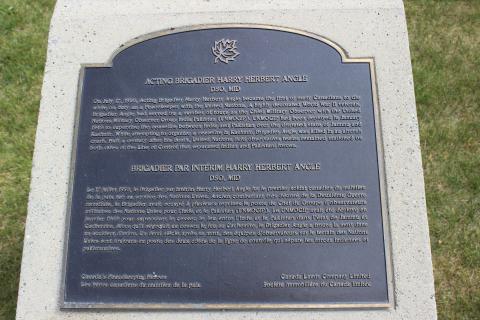
ACTING BRIGADIER HARRY HERBERT ANGLE
DSO, MID

On July 17, 1950, Acting Brigadier Harry Herbert Angle became the first of many Canadians to die
while on duty as a Peacekeeper with the United Nations. A highly decorated World War II veteran,
Brigadier Angle had served on a number of tours as the Chief Military Observers with the United
Nations Military Observer Group India Pakistan (UNMOGIP). UNMOGIP had been deployed in January
1949 to supervise the ceasefire between India and Pakistan over the disputed state of Jammu and
Kashmir. While attempting to organize a ceasefire in Kashmire, Brigadier Angle was killed in an aircraft
crash. Half a century after his death, United Nations field observation teams remained stationed on
both sides of the Line of Control that separated Indian and Pakistani forces.

BRIGADIER PAR INTÉRIM HARRY HERBERT ANGLE
DSO, MID

Le 17 juillet 1950, le Brigadier par intérim Harry Herbert Angle fut le premier soldat canadien du maintien
de la paiz tué au service des Nations Unies. Ancien combattant très décoré de la Deuxième Guerre
mondiale, le Bridgadier avait occupé à plusieurs reprises le poste de Chef du Groupe d'observateurs
militaires des Nations Unies pour l'Inde et le Pakistan (UNMOGIP). Le UNMOGIP avait été déployé en
janvier 1949 pour superviser le cessez le feu entre l'Inde et le Pakistan dan l'état de Jammu et
Cachemire. Alors qu'il négociait un cessez le feu au Cachemire, le Brigadier Angle a trouvé la mort dans
un accident d'avion. Un demi siècle après sa mort, des équipes d'observation sur le terrain des Nations
Unies sont toujours en poste des deux côtés de la ligne de contrôle qui sépare les forces indiennes et
pakistanaises.

Canada's Peacekeeping Heroes
Les héros candiens du maintien de la paix

Canada Lands Company Limited
Société immobilière du Canada limitée

Image
Caption
street sign
1 of 2 images
Image
Caption
plaque
1 of 2 images
War or Conflict Term
Province
!4v1631901214623!6m8!1m7!1s8ZaAVd8xwGvKJTYzu7z7lA!2m2!1d51.00192855982976!2d-114.1235703069635!3f122.54896769756492!4f3.032819732676572!5f3.325193203789971
Body Content

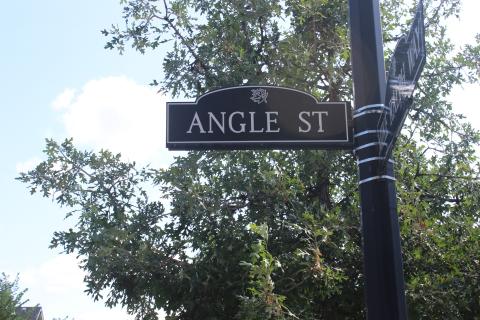
Angle Street was dedicated in 2004.

The streets in Garrison Green were initially named after the places where Canadian troops had served on peacekeeping missions and were to be renamed to reflect Lincoln Park’s history as an airfield during the Second World War. The Canadian Association of Veterans in United Nations Peacekeeping's (CAVUNP) national president at the time, Colonel Don Ethell, objected. The Calgary chapter of CAVUNP proposed 16 Canadian peacekeepers names, of which 13 were chosen. Each street is named after a Canadian Peacekeeper, of varying ranks and service time frames. A summary of the Peacekeepers’ experiences is provided with a plaque placed on each street. Together they provide a comprehensive overview of Canadian peacekeeping missions and experiences from the 1950’s to 2000.

City
Calgary
Country
Type Description
Street; plaque
Memorial CF Legacy ID
10600
City/Municipality
Calgary
Memorial Number
48002-084
Type
Address
Couture Crescent
Location
Garrison Green
in Canada
Yes
GPS Coordinates
51.0034317, -114.1273011
Inscription

[street sign/panneau de rue]
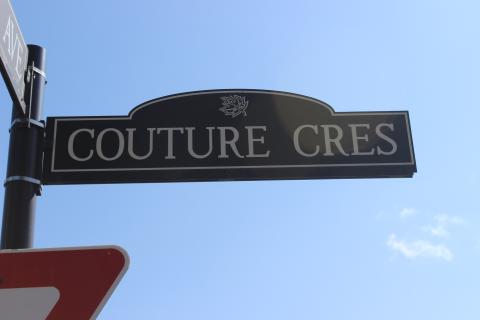
COUTURE CRES

[plaque]
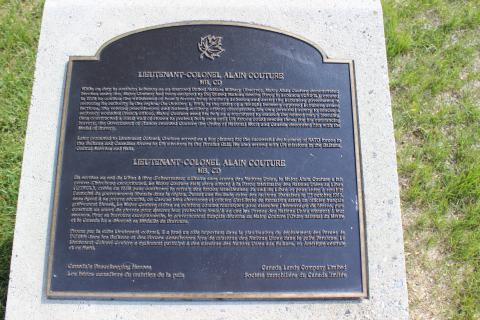
LIEUTENANT-COLONEL ALAIN COUTURE
MB, CD

While on duty in southern Lebanon as an unarmed United Nations Military Observer, Major Alain Couture demonstrated
heroism under fire. Major Couture had been assigned to the United Nations Interim Force in Lebanon (UNIFIL), created
in 1978 to confirm the withdrawal of Israeli forces from southern Lebanon and assist the Lebanese government in
restoring its authority in the region. On October 1, 1985, in the midst of a firefight between opposed Lebanese armed
factions, the veteran peacekeeper and trained artillery officer disregarded his own personal safety to rescue a
seriously wounded French officer. Major Couture used his belt as a tourniquet to staunch the injured man's bleeding
then constructed a small wall of stones to protect both men until UN forces could rescue them. For his outstanding
bravery, the Government of France awarded Couture the Order of National Merit and Canada decorated him with the
Medal of Bravery.

Later promoted to Lieutenant Colonel, Couture served as a key planner for the successful deployment of NATO forces to
the Balkans and Canadian forces to UN missions in the Persian Gulf. He also served with UN missions in the Balkans,
Central America and Haiti.

LIEUTENANT-COLONEL ALAIN COUTURE
MB, CD

En service au sud du Liban à titre d'observateur militaire sans armes des Nations Unies, le Major Alain Couture a fait
preuve d'héroïsme exceptionnel. Le Major Couture était alors affecté à la Force intérimaire des Nations Unies au Liban
(FINUL), créée en 1978 pour confirmer le retrait des forces israéliennes du sud du Liban et pour aider à rétablir
l'autorité du gouvernement libanais dans la région. Durant une fusillade entre des factions libanaises le 1er octobre 1985,
sans égarti à sa propre sécurité, ce Casque bleu chevronné et officier d'artillerie de formation sauva un officer français
grièvement blessé. Le Major Couture utilisa sa ceinture comme tourniquet pour étancher l'hémorragie du blessé, puis
construit un muret de pierres pour assurer leur protection jusqu'à ce que les Forces des Nations Unies viennent à leur
secours. Pour sa bravoure exceptionnelle, le gouvernement français décerné au Major Couture l'Ordre national du Mérite
et le Canada lui a décerné sa Médaille de Bravoure.

Prontu par la suite lieutenant colonel, il a joué un rôle important dans la planification du déploiement des forces de
l'OTAN dans les Balkans et des Forces canadiennes lors de missions des Nations Unies dans le golfe Persique. Le
Lieutenant Colonel Couture a également participé à des missions des Nations Unies aux Balkan en Amérique centrale
et en Haïti.

Canada's Peacekeeping Heroes
Les héros candiens du maintien de la paix

Canada Lands Company Limited
Société immobilière du Canada limitée
Image
Caption
street sign
1 of 2 images
Image
Caption
plaque
1 of 2 images
War or Conflict Term
Province
!4v1630604789011!6m8!1m7!1s19sSDcgCkt6uJMIVHBPv0w!2m2!1d51.0034316774502!2d-114.1273010846289!3f112.82201089084387!4f-0.24880294475549647!5f1.9587109090973311
Body Content

Couture Crescent was dedicated in 2004.

The streets in Garrison Green were initially named after the places where Canadian troops had served on peacekeeping missions and were to be renamed to reflect Lincoln Park’s history as an airfield during the Second World War. The Canadian Association of Veterans in United Nations Peacekeeping's (CAVUNP) national president at the time, Colonel Don Ethell, objected. The Calgary chapter of CAVUNP proposed 16 Canadian peacekeepers names, of which 13 were chosen. Each street is named after a Canadian Peacekeeper, of varying ranks and service time frames. A summary of the Peacekeepers’ experiences is provided with a plaque placed on each street. Together they provide a comprehensive overview of Canadian peacekeeping missions and experiences from the 1950’s to 2000.

City
Calgary
Country
Type Description
Street; plaque
Memorial CF Legacy ID
10589
City/Municipality
Calgary
Memorial Number
48002-083
Type
Address
Dallaire Avenue
Location
Garrison Green
in Canada
Yes
GPS Coordinates
51.0033763, -114.1272239
Inscription

[street sign/panneau de rue]
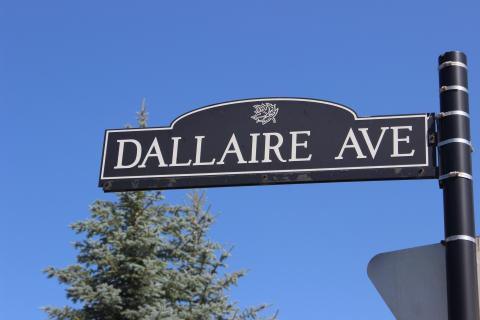
DALLAIRE AVE

[plaque]
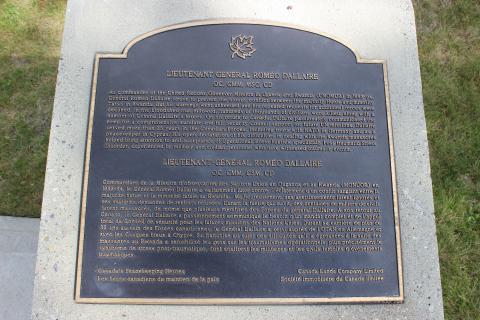
LIEUTENANT GENERAL ROMÉO DALLAIRE
OC, CMM, MSC, CD

As commander of the United Nations Observer Mission in Uganda and Rwanda (UNOMUR) in 1993-94,
General Roméo Dallaire strove to prevent the bloody conflict between the majority Hutus and minority
Tutsis in Rwanda. But his warnings went unheeded and his repeated requests for additional forces were
declined. In the bloodshed that followed, hundreds of thousands of civilians were killed, along with a
number of General Dallaire's forces. On his return to Canada, Dallaire passionately communicated the
need for a comprehensive mandate and full Security Council support to for future UN missions. Dallaire
served more than 35 years in the Canadian Forces, including tours with NATO in Germany and as a
peacekeeper in Cyprus. His open declaration of his difficulties in dealing with the Rwanda massacres
helped bring attention to the acceptance of Operational Stress Injuries, specifically Post-traumatic Stress
Disorder, experienced by military and civilian personnel who have witnessed traumatic events.

LIEUTENANT-GÉNÉRAL ROMÉO DALLAIRE
OC, CMM, CSM, CD

Commandant de la Mission d'observation des Nations Unies en Ouganda et au Rwanda (MONUOR) en
1993-94, le Général Roméo Dallaire a vaillamment lutté contre l'éclatement d'un conflit sanglant entre la
majorité hutue et la minorité tutsie au Rwanda. Malheureusement, ses avertissements furent ignorés et
ses multiples demandes de renforts refusées. Durant la tuerie qui suivit, des centaines de milliers de civils
furent massacrés, de même que plusieurs membres des forces du général Dallaire. À son retour au
Canada, le Général Dallaire a passionnément communiqué le besion d'un mandat comlet et de l'appui
total du Conseil de sécurité pour les futures missions des Nations Unies. Durant sa carrière de plus de
35 ans au sein des Forces canadiennes, le Général Dallaire a srvie auprès de l'OTAN en Allemagne et
avec les Casques bleu à Chypre. Sa franchise au sujet des difficultés qu'il a éprouvées à la suite des
massacres au Rwanda a sensibilisé les gens sur les traumatismes opérationnels, plus précisément le
syndrome de stress post-traumatique, dont souffrent les militaires et les civils témoins d'événements
traumatiques.

Canada's Peacekeeping Heroes
Les héros candiens du maintien de la paix

Canada Lands Company Limited
Société immobilière du Canada limitée
Image
Caption
street sign
1 of 2 images
Image
Caption
plaque
1 of 2 images
War or Conflict Term
Province
!4v1630602502010!6m8!1m7!1s45DoFoDiDRNlPOBqnoWrVw!2m2!1d51.00337628611146!2d-114.1272239276904!3f46.05684418697531!4f1.5830909851424622!5f1.9587109090973311
Body Content

Dallaire Avenue was dedicated in 2004.

The streets in Garrison Green were initially named after the places where Canadian troops had served on peacekeeping missions and were to be renamed to reflect Lincoln Park’s history as an airfield during the Second World War. The Canadian Association of Veterans in United Nations Peacekeeping's (CAVUNP) national president at the time, Colonel Don Ethell, objected. The Calgary chapter of CAVUNP proposed 16 Canadian peacekeepers names, of which 13 were chosen. Each street is named after a Canadian Peacekeeper, of varying ranks and service time frames. A summary of the Peacekeepers’ experiences is provided with a plaque placed on each street. Together they provide a comprehensive overview of Canadian peacekeeping missions and experiences from the 1950’s to 2000.

City
Calgary
Country
Type Description
Street; plaque
Memorial CF Legacy ID
10588
City/Municipality
Calgary
Memorial Number
48002-082
Type
Address
Don Ethell Boulevard
Location
Garrison Green
in Canada
Yes
GPS Coordinates
51.0047717, -114.1284324
Inscription

[plaque]

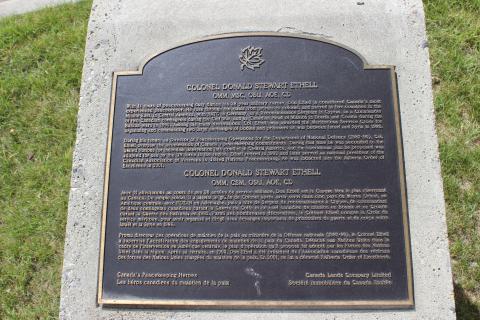
COLONEL DONALD STEWART ETHELL
OMM, MSC, OStJ, AOE, CD

With 14 tours of Peacekeeping duty during his 38 year military career, Don Ethell is considered Canada's most
experienced peacekeeper. He rose through the ranks from private to colonel, and served in five countries in the
Middle East, in Central America, with NATO in Germany, as a Reconnaissance Sergeant in Cyprus, as a Commander
of two Canadian contingents during the Gulf War, and as Canadian Head of Mission in Bosnia and Croatia
during the Balkans Wars in 1992. Among his many decorations, Col. Ethell the Meritorious Service Cross for
organizing and commanding two large exchange of bodies and prisoners of war Israel and Syria in 1986.

During his tenure as the Director of Peacekeeping Operations for the Department of National Defence (1987-90), Col.
Ethell oversaw the acceleration of Canada's peacekeeping commitments by Canada. During that time he was seconded to the
United Nations for individual intervention into conflict in Central America, and the operational plan he proposed was
adopted for use by the UN force in the region. Ethell retired in 1993 and later served as national president of the
Canadian Association of Veterans in the United Nations Peacekeeping. He was inducted into the Alberta Order of
Excellence in 2001.

COLONEL DONALD STEWART ETHELL
OMM, CSM, OStJ, AOE, CD

Avec 14 affectations au cours de ses 38 années de service militaire, Don Ethell est le Casque bleu le plus chevronné
au Canada. De simple soldat, il a atteint le grade Colonel après avoir servi dans cinq pays du Moyen Orient, en
Amérique centrale, avec l'OTAN en Allemagne, puis à titre de Sergent de reconnaissance à Chypre, de commandant
de deux contingents canadiens durant la Guerre du Golfe et de chef canadien de msision en Bosnie et en Croatie
durant la Guerre des Balkans, en 1992. Parmi ses nombreuses décorations, le Colonel Ethell compte la Croix du
service méritoire, pour avoir organisé et dirigé deuxs échanges importants de prisonniers de guerre et de corps entre
Israël et la Syrie en 1986.

Promu directeur des opérations de maintien de la paix au ministère de la Défense nationale (1987-90), le Colonel Ethell
a supervisé l'accélération des engagements de maintien de la paix du Canada. Détaché aux Nations Unies dans le
cadre de l'intervention en Amérique centrale, le plan d'opérationl qu'il proposa fut adopté par les Forces des Nations
Unies dans la région. Après sa retraite en 1993, Don Ethel a été président de l'Association canadienne des vétérans
des forces des Nations Unies chargées du maintain de la paix. En 2001. on lui a décerné l'Alberta Order of Excellence.

Canada's Peacekeeping Heroes
Les héros candiens du maintien de la paix

Canada Lands Company Limited
Société immobilière du Canada limitée
Image
Caption
street sign
1 of 2 images
Image
Caption
plaque
1 of 2 images
War or Conflict Term
Province
!4v1630602067443!6m8!1m7!1smP5taZfdSmJnouVZXYg0Rg!2m2!1d51.00477174890655!2d-114.1284323520987!3f0.9448170962138533!4f4.793994357430833!5f0.7820865974627469
Body Content

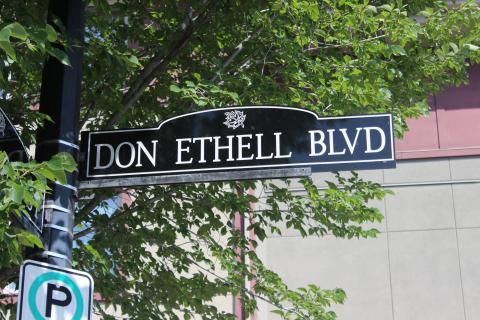
Don Ethell Boulevard was dedicated in 2004.

The streets in Garrison Green were initially named after the places where Canadian troops had served on peacekeeping missions and were to be renamed to reflect Lincoln Park’s history as an airfield during the Second World War. The Canadian Association of Veterans in United Nations Peacekeeping's (CAVUNP) national president at the time, Colonel Don Ethell, objected. The Calgary chapter of CAVUNP proposed 16 Canadian peacekeepers names, of which 13 were chosen. Each street is named after a Canadian Peacekeeper, of varying ranks and service time frames. A summary of the Peacekeepers’ experiences is provided with a plaque placed on each street. Together they provide a comprehensive overview of Canadian peacekeeping missions and experiences from the 1950’s to 2000.

City
Calgary
Country
Type Description
Street; plaque
Memorial CF Legacy ID
10587
City/Municipality
Calgary
Memorial Number
48002-081
Type
Address
Forand Street
Location
Garrison Green
in Canada
Yes
GPS Coordinates
51.0016838, -114.120949
Inscription

[street sign/panneau de rue]
FORAND ST

[plaque]
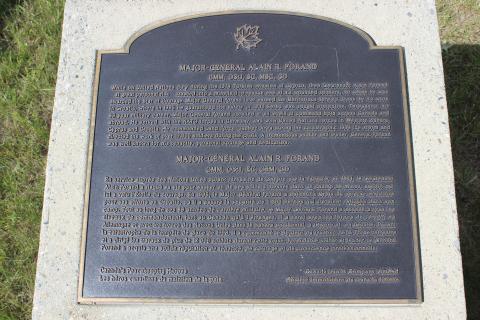
MAJOR-GENERAL ALAIN R. FORAND
CMM, OStJ, SC, MSC, CD

While on United Nations duty during the 1974 Turkish invasion of Cyprus, the Lieutenant Alain Forand
at great personal risk - crawled into a minefield under to rescue two of his wounded soldiers, for which he was
awarded the Star of Courage. Major General Forand later earned the Meritorious Service Cross for his work
in Croatia, where in 1995 he guaranteed the safety of 1200 Serbs who sought protection. Throughout his
33 year military career, Major General Forand excelled at all levels of command both across Canada and
abroad. He served with the NATO forces in Germany, and with United Nations forces in Western Sahara,
Cyprus and Croatia. He commanded Land Force Quebec Area during the catastrophic 1998 ice storm and
directed the work of over 12,000 soldiers during the crisis. A tremendous soldier and leader, General Forand
was well known for his tenacity, personal courage and dedication.

MAJOR-GÉNÉRAL ALAIN R. FORAND
CMM, OStJ, ÉC, CSM, CD

En service auprès des Nations Unies durant l'invasion de Chypre par la Turquie, en 1974, le Lieutenant
Alain Forand à risqué sa vie pour sauver un de ses soldats blessés dans un champ de mines, exploit qui
lui a valu l'Étoile du courage. En 1995, le Major Général Forand a obtenu la Croix du service méritoire
pour ses efforts en Croatie, où il a assuré la sécurité de 1 200 Serbes qui s'étaient réfugiés dans son
camp. Tout au long de ses années de carrière militaires, le Major Général Forand a excellé à tous les
niveaux de commandement, tant au Canada qu'à l'étranger. Il a servi avec les forces de l'OTAN en
Allemagne et avecs les forces des Nations Unies dans le Sahara occidental, à Chypre et en Croatie. Durant
la catastrophique de la tempête de glace de 1988, il a commandé le Secteur du Québec de la Force terrestre
et a dirigé les travaux de plus de 12 000 soldats durant cette crise. Formidable soldat et leader, le Général
Forand a acquis une solide réputation de ténacité, de courage et de conscience professionnelle.

Canada's Peacekeeping Heroes
Les héros candiens du maintien de la paix

Canada Lands Company Limited
Société immobilière du Canada limitée
Image
Caption
street sign
1 of 2 images
Image
Caption
plaque
1 of 2 images
War or Conflict Term
Province
!4v1630599130223!6m8!1m7!1sW25EwrNwSBIZQha6j2MrAw!2m2!1d51.00168379320883!2d-114.1209490054627!3f260.2504812586583!4f2.712506825659503!5f1.9587109090973311
Body Content

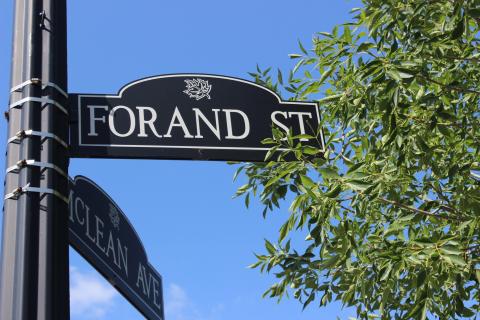
Forand Street was dedicated in 2004.

The streets in Garrison Green were initially named after the places where Canadian troops served on peacekeeping missions and were to be renamed to reflect Lincoln Park’s history as an airfield during the Second World War. The Canadian Association of Veterans in United Nations Peacekeeping's (CAVUNP) national president at the time, Colonel Don Ethell, objected. The Calgary chapter of CAVUNP proposed 16 Canadian peacekeepers names, of which 13 were chosen. Each street is named after a Canadian Peacekeeper, of varying ranks and service time frames. A summary of the Peacekeepers’ experiences is provided with a plaque placed on each street. Together they provide a comprehensive overview of Canadian peacekeeping missions and experiences from the 1950’s to 2000.

City
Calgary
Country
Type Description
Street, plaque
Memorial CF Legacy ID
10586
City/Municipality
Calgary
Memorial Number
48002-080
Type
Address
John Gardam Avenue
Location
Garrison Green
in Canada
Yes
GPS Coordinates
51.0030565, -114.1274689
Inscription

[street sign/panneau de rue]
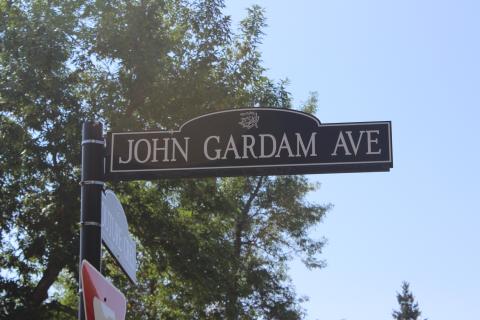
JOHN GARDAM AVE

[plaque]
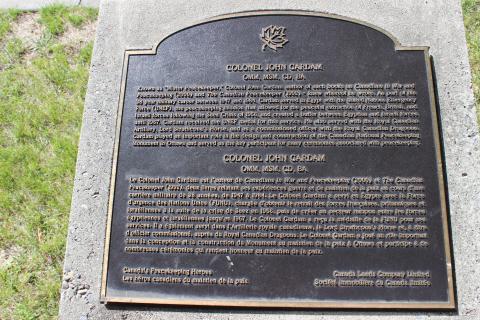
COLONEL JOHN GARDAM
OMM, MSM, CD, BA

Known as "Mister Peacekeeper," Colonel John Gardam author of such books as Canadians in War and
Peacekeeping (2000) and the Canadian Peacekeeper (1992) - knew whereof he wrote. As part of his
39 year military career between 1947 and 1984, Gardam served in Egypt with the United Nations Emergency
Force (UNEF), the peacekeeping mission that allowed for the peaceful extraction of French, British, and
Israeli forces following the Suez Crisis of 1956, and created a buffer between Egyptian and Israeli forces
until 1967. Gardam received the UNEF medal for this service. He also served with the Royal Canadian
Artillery, Lord Strathcona's Horse, and as a commissioned officer with the Royal Canadian Dragoons.
Gardam played an important role in the design and construction of the Canadian National Peacekeeping
Monument in Ottawa and served as the key participant for the many ceremonies associated with Peacekeeping.


COLONEL JEAN GARDAM
OMM, MSM, CD, BA

Le colonel John Gardam est l'auteur de Canadians in War and Peacekeeping (2000) et The Canadian
Peacekeeper (1992), deux livres relatant ses expériences guerre et de maintien de la paix au course d'une
carrière militaire de 38 années, de 1947 à 1984. Le Colonel Gardam a servi en Egypte avec la Force
d'urgence des Nations Unies (FUNU), chargée d'obtenir le retrait des forces françaises, britanniques et
israéliennes à la suite de la crise de Suez en 1956, puis de créer un secteur tampon entre les forces
égyptiennes et israéliennes jusqu'en 1967. Le Colonel Gardam a reçu la médaille de la FUNU pour ses
services. Il a également servi dans l'Artillerie royale canadianne, le Lord Strathcona's Horse et à titre
d'officier commissionné, auprès du Royal Canadian Dragoons. Le Colonel Gardam a joué un rôle important
dans la conception et la construction du Monument maintien de la paix à Ottawa et participe à de
nombreuses cérémonies qui rendent honneur au maintien de la paix.

Canada's Peacekeeping Heroes
Les héros candiens du maintien de la paix

Canada Lands Company Limited
Société immobilière du Canada limitée
Image
Caption
street sign
1 of 2 images
Image
Caption
plaque
1 of 2 images
Province
!4v1630593126201!6m8!1m7!1se-8RMN9DX0yUoaqY6pJNCQ!2m2!1d51.00305653120414!2d-114.127468949256!3f215.349907760681!4f3.6271251735239645!5f1.9587109090973311
Body Content

John Gardam Avenue was dedicated in 2004.

The streets in Garrison Green were initially named after the places where Canadian troops had served on peacekeeping missions and were to be renamed to reflect Lincoln Park’s history as an airfield during the Second World War. The Canadian Association of Veterans in United Nations Peacekeeping's (CAVUNP) national president at the time, Colonel Don Ethell, objected. The Calgary chapter of CAVUNP proposed 16 Canadian peacekeepers names, of which 13 were chosen. Each street is named after a Canadian Peacekeeper, of varying ranks and service time frames. A summary of the Peacekeepers’ experiences is provided with a plaque placed on each street. Together they provide a comprehensive overview of Canadian peacekeeping missions and experiences from the 1950’s to 2000.

City
Calgary
Country
Type Description
Street; plaque
Memorial CF Legacy ID
10585