Other

City/Municipality
Calgary
Memorial Number
48002-079
Type
Address
Joseph Marquis Crescent
Location
Garrison Green
in Canada
Yes
GPS Coordinates
51.0028365, -114.1221011
Inscription

[street sign/panneau de rue]
JOSEPH MARQUIS CRES

[plaque]
STAFF-SERGEANT JOSEPH PAUL MARQUIS, CD

Staff Sergeant Joseph Marquis was the first Canadian Peacekeeper to die serving on an armed United
Nations mission. Marquis served with the 57th Canadian Signals Unit as per of the United Nations
Operation in the Congo (ONUC), a 19,000-strong force created in 1960 to bring the law and order to the newly
independent African nation, and to halt Belgian intervention in its former colony. At the same time military
forces arrived, UN civilian experts were rushed in to help ensure the continues operations of essential
public services. ONUC's civilian aid component was the UN's largest single programme of assistance up
to that time.

Marquis was killed on January 20, 1962. He was one of 245 military personnel killed during ONUC's four-year
mission. In September 2001, Marquis' family was presented with the Canadian Memorial Cross, symbolic of
those soldiers who died while on duty for Canada.

SERGENT-CHEF JOSEPH PAUL MARQUIS, CD

Premier Casque bleu canadien tué lors d'une mission armée de maintien de la paix des Nations Unies,
le Sergent-chef Joseph Marquis a servi auprès du 57e Escaddron de communications (Royal Canadian
Signal Corps) de l'Opération des Nations Unies au Congo (ONUC), une force de 19 000 troupes formée en
1960 pour rétablir l'ordre dans cette nation africaine nouvellement indépendante et pour mettre fin à
l'intervention belge dans son ancienne colonie. A l'arrivée des forces militaires, des experts civils de
l'ONU ont été dépêchés sur les lieux pour veiller au fonctionnement continu des services publics
essentiels. L'importante composante d'aide civile de l'ONUC représentait la première tentative de l'ONU
de concilier un programme d'aide à sa mission.

Joseph Marquis a trouvé la mort le 20 janvier 1962. Il fait partie des 245 militaires tués durant les quatre
armées de mission de l'ONUC. En septembre 2001, on a remis à la famille du Sergent-chef Marquis la Croix
du Souvenir du Canada, symbole des soldats canadiens qui sont donné leur vie au service de Canada.

Canada's Peacekeeping Heroes
Les héros candiens du maintien de la paix

Canada Lands Company Limited
Société immobilière du Canada limitée

Image
Caption
street sign
1 of 2 images
Image
Caption
plaque
1 of 2 images
War or Conflict Term
Province
!4v1630520822427!6m8!1m7!1sceH2AsuHxnxKVcZu05oasg!2m2!1d51.00283648344863!2d-114.122101148343!3f136.4015215951403!4f-2.4149674747952474!5f1.9587109090973311
Body Content

Joseph Marquis Crescent was dedicated in 2004.

The streets in Garrison Green were initially named after the places where Canadian troops had served on peacekeeping missions and were to be renamed to reflect Lincoln Park’s history as an airfield during the Second World War. The Canadian Association of Veterans in United Nations Peacekeeping's (CAVUNP) national president at the time, Colonel Don Ethell, objected. The Calgary chapter of CAVUNP proposed 16 Canadian peacekeepers names, of which 13 were chosen. Each street is named after a Canadian Peacekeeper, of varying ranks and service time frames. A summary of the Peacekeepers’ experiences is provided with a plaque placed on each street. Together they provide a comprehensive overview of Canadian peacekeeping missions and experiences from the 1950’s to 2000.

City
Calgary
Country
Type Description
Street, plaque
Memorial CF Legacy ID
10581
City/Municipality
Calgary
Memorial Number
48002-078
Type
Address
Henwood Street
Location
Garrison Green
in Canada
Yes
GPS Coordinates
51.0031266, -114.1286535
Inscription

[street sign/panneau de rue]
HENWOOD ST

[plaque]
MAJOR ROBERT BRUCE HENWOOD, CD

On September 1995, while on duty as a United Nations Military Observer (UNMO) in war-torn Croatia,
Major Bruce Henwood suffered grievous injuries when his patrol vehicle struck an antitank mine. A graduate
of the Royal Military College, Henwood had enjoyed a promising career as an officer, including service with
the Lord Strathcona's Horse (Royal Canadians), the South Alberta Light Horse, the 8th Canadian Hussars
(Princess Louise's), and Royal Canadian Dragoons, with whom he served in Germany.

A British army officer saved Henwood's life when his vehicle exploded, but his injuries which - required
the amputation of both legs below the knees - ended Henwood's career. For his actions in Croatia, and in
recognition of his courage and perseverance during two years of gruelling rehabilitation, Henwood received
the Land Force Commander's Commendation. He became an inspiration for fellow peacekeepers,
particularly those who suffered physical and mental injuries.

MAJOR ROBERT BRUCE HENWOOD, CD

En mission d'observateur militaire des Nations Unies (UNMO) en Croatie, un pays déchiré par la guerre,
le major Bruce Henwood a été grièvement blessé en septembre 1995, lorsqu'une une mine antichar a fait sauter
son véhicule de patrouille Diplômé du Collège royal militaire du Canada, l'officer Henwood avait un avenir
prometteur au service des régiments Lord Strathcona's Horse (Royal Canadians), South Alberta Light
Horse, 8th Canadian Hussars (Princess Louise's) et Royal Canadian Dragoons, auprès duquel il a servi en
Allemagne.

Un officier de l'armée britannique a sauvé la vie du Major Henwood quand son véhicule fut touché, mais
ses blessures - qui nécessitèrent l'amputation des deux jambes sous les genoux - mirent fin à la carrière
de Major Henwood. Le Commandant de la Force terrestre a décerné unde citation au Major Henwood en
reconnaissance de ses actions en Croatie ainsi que son courage et de sa persévérance durant deux
longues et difficiles années de réadaptation. Le courage du Major Henwood est une source d'inspiration
pour les autres Casques bleus, particulièrement ceux et celles qui ont subi des blessures ou des
traumatismes.

Canada's Peacekeeping Heroes
Les héros candiens du maintien de la paix

Canada Lands Company Limited
Société immobilière du Canada limitée

Image
Caption
street sign
1 of 2 images
Image
Caption
plaque
1 of 2 images
War or Conflict Term
Province
!4v1630590471965!6m8!1m7!1sD_xNa2IjQ__JvexioH7hDw!2m2!1d51.00312656078144!2d-114.1286534933198!3f106.18967315479352!4f1.958990891225909!5f1.9587109090973311
Body Content

Henwood Street was dedicated in 2004.

The streets in Garrison Green were initially named after the places where Canadian troops had served on peacekeeping missions and were to be renamed to reflect Lincoln Park’s history as an airfield during the Second World War. The Canadian Association of Veterans in United Nations Peacekeeping's (CAVUNP) national president at the time, Colonel Don Ethell, objected. The Calgary chapter of CAVUNP proposed 16 Canadian peacekeepers names, of which 13 were chosen. Each street is named after a Canadian Peacekeeper, of varying ranks and service time frames. A summary of the Peacekeepers’ experiences is provided with a plaque placed on each street. Together they provide a comprehensive overview of Canadian peacekeeping missions and experiences from the 1950’s to 2000.

City
Calgary
Country
Type Description
Street; plaque
Memorial CF Legacy ID
10584
City/Municipality
Calgary
Memorial Number
48002-077
Type
Address
Lewis MacKenzie Place
Location
Garrison Green
in Canada
Yes
GPS Coordinates
51.0025137, -114.1271894
Inscription

[street sign/panneau de rue]
LEWIS MACKENZIE PL

[plaque]
MAJOR GENERAL LEWIS W. MACKENZIE
OStJ, OOnt, MSC (2), CD, LLD (Hon)

In the early 1990s, the eyes of the world were on the United Nations Protection Force in Yugoslavia
(UNPROFOR) and its Canadian chief of staff, Major General Lewis MacKenzie. Besieged in the midst of the
Bosnian civil war, General 'Lew' and the UN forces under his command kept open the Sarajevo airport for
delivery of humanitarian relief. In his 33 years of military service, MacKenzie accumulated more
peacekeeping experience, in more ranks and appointments, than any other Canadian. His military and
peacekeeping service ranged from Germany to Vietnam, and from Central America to Cyprus and the
Middle East. He is the only Canadian to have been awarded the Meritorious Service Cross twice. After
retiring in 1993, MacKenzie became a best selling author, lecturer and frequent media commentator. He is
regarded as one of the world's most experienced peacekeepers.

MAJOR-GÉNÉRAL LEWIS W. MACKENZIE
OStJ, OOnt, CSM (2), CD, LLD (Hon)

Au début des années 1990, le monde entier suivant les efforts de la Force de protection des Nations Unies en
Yougoslavie (FORPRONU) et de son chef d'état major canadien, le major-général Lewis MacKenzie. Au coeur
de la guerre civile en Bosnie, le Général «Lew» et les Forces de l'ONU sous son commandement ont protégé
l'aéroport de Sarajevo, permettant la livraison continue de secours humanitaires. En 33 années de service
militaire, le Major-général MacKenzie a accumulé une expérience du maintien de la paix dans le plus grand
nombres de grades et d'affectations, que tout autre Canadien. Lors de missions militaires ou de maintien de
la paix, il a servi en Allemagne, au Vietnam, en Amérique centrale, à Chypre et au Moyen Orient. Seul
Canadian décoré à deux reprises, de la Croix du service méritoire. Leiws MacKenzie a pris sa retraite en
1993 et est devenu auteur, conférencier et commentateur dans les médias. On le considéré comme l'un des
Casques bleus les plus chevronnés au monde.

Canada's Peacekeeping Heroes
Les héros candiens du maintien de la paix

Canada Lands Company Limited
Société immobilière du Canada limitée

Image
Caption
plaque
1 of 2 images
Image
Caption
street sign
1 of 2 images
War or Conflict Term
Province
!4v1630518410114!6m8!1m7!1shqKV9HiXZFhplHeKyDHOsQ!2m2!1d51.00251374684883!2d-114.12718944001!3f85.3986638108735!4f-1.1343390093294943!5f0.7820865974627469
Body Content

Lewis MacKenzie Place was dedicated in 2004.

The streets in Garrison Green were initially named after the places where Canadian troops had served on peacekeeping missions and were to be renamed to reflect Lincoln Park’s history as an airfield during the Second World War. The Canadian Association of Veterans in United Nations Peacekeeping's (CAVUNP) national president at the time, Colonel Don Ethell, objected. The Calgary chapter of CAVUNP proposed 16 Canadian peacekeepers names, of which 13 were chosen. Each street is named after a Canadian Peacekeeper, of varying ranks and service time frames. A summary of the Peacekeepers’ experiences is provided with a plaque placed on each street. Together they provide a comprehensive overview of Canadian peacekeeping missions and experiences from the 1950’s to 2000.

City
Calgary
Country
Type Description
Street; plaque
Memorial CF Legacy ID
10580
City/Municipality
calgary
Memorial Number
48002-076
Type
Address
Tom Hoppe Mews
Location
Garrison Green
in Canada
Yes
GPS Coordinates
51.0039284, -114.1286207
Inscription

[plaque]
SERGEANT THOMAS JOACHIM HOPPE
MSC, MB, CD

During an eighteen year career with the Canadian Forces Sergeant Tom Hoppe saw service with the Lord Strathcona's
Horse, the Royal Canadian Dragoons, 8th Canadian Hussars, and New Zealand's Queen Alexandra's Mounted Rifles.

While serving as the commander of an observation post between Muslim and Serb forces in Bosnia-Herzegovina
(UNPROFOR), Hoppe and his men came under attack on several occasions. In three separate incidents in 1994, Sgt.
Hoppe rescued colleagues and civilians - including a group of stranded children under direct small arms fire. In
recognition of his heroic actions in the Balkans, Hoppe was awarded the Medal of Bravery and Meritorious
Service Cross, becoming the first Canadian Peacekeeper cited for bravery twice in one tour. Following his
retirement from the Canadian Forces, Hoppe fought successfully for programs and benefits to assist veterans.
Officials in the Departments of National Defence and Veterans Affairs Canada have recognized and sought his advice
and leadership.

SERGENT THOMAS JOACHIM HOPPE
CSM, MB, CD

Durant 11 années de carrière au sein des Forces canadiennes, le Sergent Tom Hoppe a servi auprès des régiments
Lord Strathcona's Horse, Royal Canadian Dragoons et 8th Canadian Hussars, ainsi que des Queen Alexandra's
Mounted Rifles de Nouvelle Zélande.

Alors qu'il commandant un poste d'observation entre les musulmanes et les serbes en Bosnie Herzégovine
(FORPRONU), le Sergent Hoppe et ses hommes ont essuyé plusieurs attaques. A trois reprises en 1994, le Sergent
Hoppe a secouru des collègues et des civils, dont des enfants ciblés par des tirs d'armes de petit calibre. En
reconnaissance de son héroïsme dans les Balkans, on a décerné la Médaille de la bravoure et la Croix du service
méritoire au Sergent Hoppe, le premier Casque bleu canadien décoré à deux reprises pour bravoure durant la même
affectation. Retraité des Forces canadiennes, le Sergent Hoppe a insisté pour qu'on améliore les programmes et
avantages destinés aux anciens combattants. Des représentants des ministères de la Défense nationale et des
Anciens combattants ont reconnu le bien fondé des ses efforts et on fait appel à son leadership.

Canada's Peacekeeping Heroes
Les héros candiens du maintien de la paix

Canada Lands Company Limited
Société immobilière du Canada limitée

Image
Caption
plaque
War or Conflict Term
Province
!4v1630587503214!6m8!1m7!1sWf0Q_WTuKjcvgtad-BZ75w!2m2!1d51.00392839960318!2d-114.1286207338153!3f159.72739621967952!4f-1.083548301575945!5f1.9587109090973311
Body Content

Tom Hoppe Mews was dedicated in 2004.

The streets in Garrison Green were initially named after the places where Canadian troops had served on peacekeeping missions and were to be renamed to reflect Lincoln Park’s history as an airfield during the Second World War. The Canadian Association of Veterans in United Nations Peacekeeping's (CAVUNP) national president at the time, Colonel Don Ethell, objected. The Calgary chapter of CAVUNP proposed 16 Canadian peacekeepers names, of which 13 were chosen. Each street is named after a Canadian Peacekeeper, of varying ranks and service time frames. A summary of the Peacekeepers’ experiences is provided with a plaque placed on each street. Together they provide a comprehensive overview of Canadian peacekeeping missions and experiences from the 1950’s to 2000.

City
calgary
Country
Type Description
Street; plaque
Memorial CF Legacy ID
10583
City/Municipality
Calgary
Memorial Number
48002-075
Type
Address
McLean Avenue
Location
Garrison Green
in Canada
Yes
GPS Coordinates
51.0034965, 114.1220975
Inscription

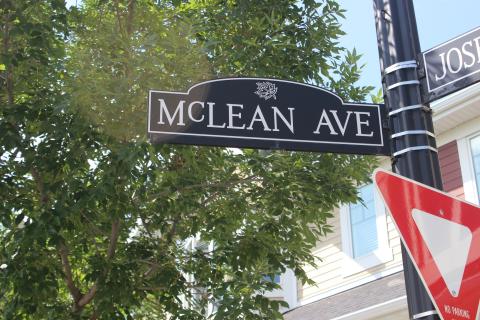
[street sign/panneau de rue]
MCLEAN AVE

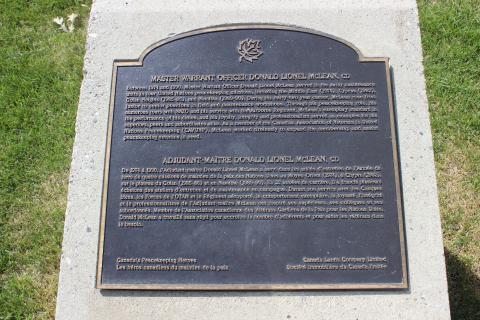
[plaque]
MASTER WARRANT OFFICER DONALD LIONEL MCLEAN, CD

Between 1974 and 1990, Master Warrant Officer Donald Lionel McLean served in the Army maintenance
units in four United Nations peacekeeping missions, including the Middle East (1974), Cyprus (1982),
Golan Heights (1985-86), and Namibia (1989-90). During his thirty-two year career, McLean rose from
junior to senior positions in field and maintenance workshops. Through his peacekeeping role, his
numerous tours with NATO and his service with the Airborne Regiment, McLean's exemplary standard in
the performance of his duties, and his loyalty, integrity and professionalism served as examples for his
superiors, peers and subordinates alike. As a member of the Canadian Association of Veterans in United
Nations Peacekeeping (CAVUNP), McLean worked tirelessly to expand the membership and assist
peacekeeping veterans in need.

ADJUDANT-MAÎTRE DONALD LIONEL MCLEAN, CD

De 1974 à 1990, l'adjudant-maître Donald Lionel McLean a servi dans les unités d'entretien de l'Armée de
terre de quatre missions de maintien de la paix des Nations Unies au Moyen-Orient (1974), à Chypre (1982),
sur le plateau du Golan (1985-86) et en Namibie (1989-90). En 32 années de carrière, il a franchi plusieurs
échelons des ateliers d'entretien et de maintenance en campagne. Durant son service avecd les Casques
bleus, les Forces de l'OTAN et le Régiment aéroporté, le comportement exemplaire, la loyauté, l'intégrité
et le professionnalisme de l'Adjudant-maître McLean ont inspiré ses supérierus, ses collègues, et ses
subordonnés. Membre de l'Association canadienne des Vétérans Gardiens de la Paix pour les Nations Unies,
Donald McLean a travaillé sans répit pour accroître le nombre d'adhérents et pour aider les vétérans dans
le besoin.

Canada's Peacekeeping Heroes
Les héros candiens du maintien de la paix

Canada Lands Company Limited
Société immobilière du Canada limitée

Image
Caption
street sign
1 of 2 images
Image
Caption
plaque
1 of 2 images
War or Conflict Term
Province
!4v1630514776559!6m8!1m7!1sAhcv8rVu5VtxIlW952MK9Q!2m2!1d51.00349645612052!2d-114.1220974928954!3f204.1851288596884!4f5.011212328695166!5f3.325193203789971
Body Content

McLean Avenue was dedicated in 2004.

The streets in Garrison Green were initially named after the places where Canadian troops had served on peacekeeping missions and were to be renamed to reflect Lincoln Park’s history as an airfield during the Second World War. The Canadian Association of Veterans in United Nations Peacekeeping's (CAVUNP) national president at the time, Colonel Don Ethell, objected. The Calgary chapter of CAVUNP proposed 16 Canadian peacekeepers names, of which 13 were chosen. Each street is named after a Canadian Peacekeeper, of varying ranks and service time frames. A summary of the Peacekeepers’ experiences is provided with a plaque placed on each street. Together they provide a comprehensive overview of Canadian peacekeeping missions and experiences from the 1950’s to 2000.

City
Calgary
Country
Type Description
Street; plaque
Memorial CF Legacy ID
10579
City/Municipality
Calgary
Memorial Number
48002-074
Type
Address
Johnson Place
Location
Garrison Green
in Canada
Yes
GPS Coordinates
51.0031267, -114.1257068
Inscription

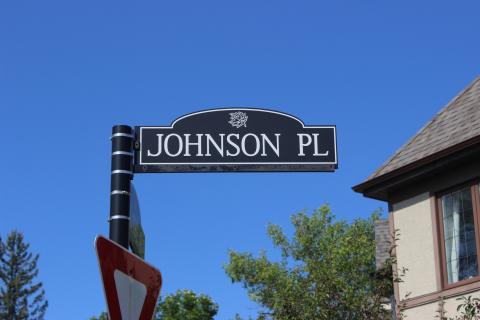
[street sign/panneau de rue]
JOHNSON PL

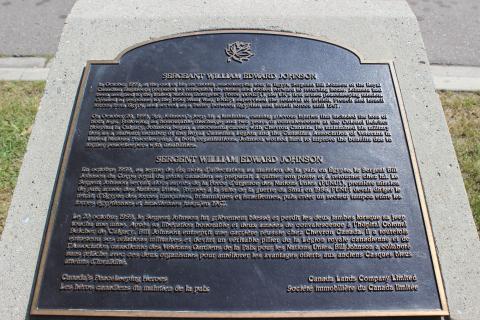
SERGEANT WILLIAM EDWARD JOHNSON

In October 1959, at the end of his six-month peacekeeping tour in Egypt, Sergeant Bill Johnson of the Royal
Canadian Engineers prepared to relinquish his duties and looked forward to returning home. Johnson had
been assigned to the United Nations Emergency Force (UNEF 1), the UN's first armed peacekeeping mission.
Created in response to the 1956 Sinai Wan, UNEF1 supervised the removal of British, French and Israeli
forces from Egypt, and served as a buffer between Egyptian and Israeli forces until 1967.

On October 20, 1959, Sgt Johnson’s jeep hit a landmine, causing grievous injuries that included the loss of
both legs. Following an honourable discharge and two years of convalescence at the Colonel Belcher
Hospital in Calgary, Johnson began a successful career with Chevron Canada. He maintained his military
ties as a stalwart member of the Royal Canadian Legion and the Canadian Association of Veterans in
United Nations Peacekeeping, in both organizations, Johnson worked hard to improve the benefits due to
former peacekeepers with disabilities.

SERGENT WILLIAM EDWARD JOHNSON

En octobre 1959, au terme de six mois d'affectation au mission de la paix en Égypte, le sergent Bill
Johnson du Corps royal du genie canadien se préparait à quitter son poste et à retourner chez lui. Le
Sergent Johnson servait alors auprès de la Force d'urgence des Nations Unies (FUNU1), première mission
de paix armée des Nations Unies. Formée à la suite de la guerre du Sinaï en 1956, FUNU1 devait diriger le
retrait d'Egypte des forces françaises, britanniques et israéliennes, puis créer un secteur tampon entre les
forces égyptiennes et israéliennes jusqu'en 1967.

Le 20 octobre 1959, le Sergent Johnson fut grièvement blessé et perdit les deux jambes lorsque sa jeep
toucha une mine. Après sa libération honorable et deux anées de convalescence à l'hôpital Colonel
Belcher de Calgary, Bill Johnson entreprit une carrière réussie chez Chevron Canada. Il a toutefois
entretenu ses relations militaires et devint un véritable pilier de la Légion royale canadienne et de
l'Association canadienne des Vétérans Gardiens de la Paix pour les Nations Unies. Bill Johnson a collaboré
sans relàche avec ces deux organismes pour améliorer les avantages offerts aux anciens Casques bleus
arreints d'invalidité.

Canada's Peacekeeping Heroes
Les héros candiens du maintien de la paix

Canada Lands Company Limited
Société immobilière du Canada limitée

Image
Caption
street sign
1 of 2 images
Image
Caption
plaque
1 of 2 images
Province
!4v1630585071165!6m8!1m7!1sykvjhN-BrWqWcuZnL_Ozgg!2m2!1d51.00312669325184!2d-114.1257068291134!3f274.88132518133534!4f2.723596875049296!5f1.9587109090973311
Body Content

Johnson Place was dedicated in 2004.

The streets in Garrison Green were initially named after the places where Canadian troops had served on peacekeeping missions and were to be renamed to reflect Lincoln Park’s history as an airfield during the Second World War. The Canadian Association of Veterans in United Nations Peacekeeping's (CAVUNP) national president at the time, Colonel Don Ethell, objected. The Calgary chapter of CAVUNP proposed 16 Canadian peacekeepers names, of which 13 were chosen. Each street is named after a Canadian Peacekeeper, of varying ranks and service time frames. A summary of the Peacekeepers’ experiences is provided with a plaque placed on each street. Together they provide a comprehensive overview of Canadian peacekeeping missions and experiences from the 1950’s to 2000.

City
Calgary
Country
Type Description
Street; plaque
Memorial CF Legacy ID
10582
City/Municipality
Calgary
Memorial Number
48002-073
Type
Address
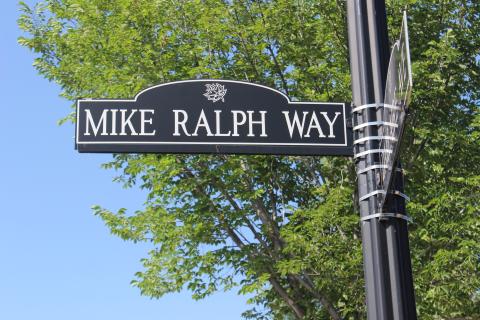
Mike Ralph Way
Location
Garrison Green
in Canada
Yes
GPS Coordinates
51.0029844, -114.1246247
Inscription

[street sign/panneau de rue]

MIKE RALPH WAY

[plaque]
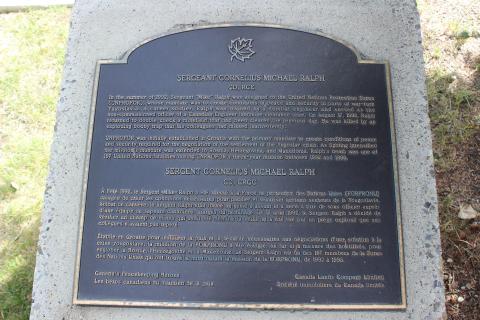
SERGEANT CORNELIUS MICHAEL RALPH
CD, RCE

In the summer of 1992, Sergeant "Mike" Ralph was assigned to the United Nations Protection Force
(UNPROFOR), whose mandate was to create conditions of peace and security in parts of war-torn
Yugoslavia. A career soldier, Ralph was trained as a combat engineer and served as the
non-commissioned officer of a Canadian Engineer landmine clearance team. On August 17, 1992, Ralph
returned to double-check a minefield that had been cleared the previous day. He was killed by an
exploding booby trap that his colleagues had missed inadvertently.

UNPROFOR was initially established in Croatia with the primary mandate to create conditions of peace
and security required for the negotiation of the settlement of Yugoslav crisis. As fighting intensified
the mission's mandate was extended to Bosnia, Herzegovina, and Macedonia. Ralph's death was one of
167 United Nations fatalities during UNPROFOR's three-year mission between 1992 and 1995.

SERGENT CORNELIUS MICHAEL RALPH
CD, CRGC

À l'été 1992, le sergent "Mike" Ralph a été affecté à la Force de protection des Nations Unies(FORPRONU)
chargée de créer les conditions nécessaires pour pacifier et sécuriser certains secteurs de la Yougoslavie.
Soldat de carrière, le Sergent Ralph était formé au génie d'assaut et a servi à titre de sous officier auprès
d'une équipe de sapeurs canadiens chargés du déminage. Le 17 août 1992, le Sergent Ralph a décidé de
vérifier un champ de mines qui avait été déminé la veille et été tué par un piège explosif que ses
collègues n'avaient pas repéré.

Établie en Croatie pour insaurer la paix et la sécurité nécessaires aux négociations d'une solution à la
crise yougoslave, la mission de la FORPRONU a été élargie, au fur et là mesure des hostilités, pour
englober la Bosnie, l'Herzégovine et la Macédoine. Le Sergent Ralph est un des 167 membres de la Force
des Nations Unies qui ont trouvé la mort durant la mission de la FORPRONU, de 1992 et à 1995.

Canada's Peacekeeping Heroes
Les héros candiens du maintien de la paix

Canada Lands Company Limited
Société immobilière du Canada limitée

Image
Caption
street sign
1 of 2 images
Image
Caption
plaque
1 of 2 images
Province
!4v1630511752825!6m8!1m7!1sGAO2-l_CM_oZs8Q7L7_9tQ!2m2!1d51.00298435014154!2d-114.124624668133!3f305.8115226568318!4f3.1645783958764895!5f1.9587109090973311
Body Content

Mike Ralph Way was dedicated in 2004.

The streets in Garrison Green were initially named after the places where Canadian troops had served on peacekeeping missions and were to be renamed to reflect Lincoln Park’s history as an airfield during the Second World War. The Canadian Association of Veterans in United Nations Peacekeeping's (CAVUNP) national president at the time, Colonel Don Ethell, objected. The Calgary chapter of CAVUNP proposed 16 Canadian peacekeepers names, of which 13 were chosen. Each street is named after a Canadian Peacekeeper, of varying ranks and service time frames. A summary of the Peacekeepers’ experiences is provided with a plaque placed on each street. Together they provide a comprehensive overview of Canadian peacekeeping missions and experiences from the 1950’s to 2000.

City
Calgary
Country
Type Description
Street; plaque
Memorial CF Legacy ID
10578
City/Municipality
Calgary
Memorial Number
48002-072
Type
Address
601 5th Street South West
Location
Calgary Courts Centre
in Canada
Yes
GPS Coordinates
51.047401529744, -114.07412137543
Inscription

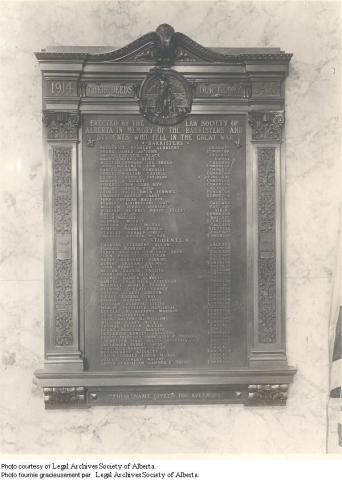
1914-1919

Their deeds our glory

Erected by the Law Socierty of Alberta in memory of the Barristers and Students who fell in the Great War

Barristers

Students

Their names liveth forevermore

Image
Photo Credit
Legal Archives Society of Alberta
Caption
Alberta Law Society Great War Plaque
Province
Body Content

The Law Socierty of Alberta erected a memorial plaque in memory of the Barristers and Students who fell in the Great War.
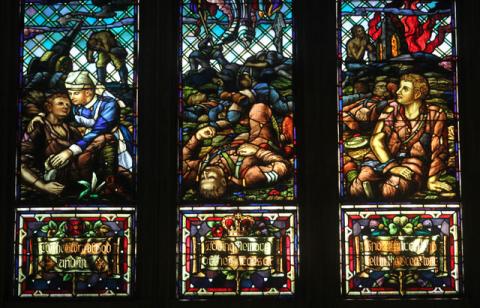
Imperial War Graves Commission member Rudyard Kipling recommended the inscription "Their names liveth for evermore" which has widely be inscribed on war memorials since the First World War. The phrase "Their names liveth for evermore" from the King James Version of the Bible, forms the second half of a line in Ecclesiasticus or Sirach, chapter 44, verse 14.

The Legal Archives Society of Alberta’s project titled “We Have Not Forgotten” involved a Bar Call ceremony on November 9, 2018 in the Ceremonial Court at the Calgary Court Center. Families of some of the fallen soldiers were in attendance and stood in for their respective Bar Calls. In memory and recognition of the sacrifice of Alberta students-at-law who enlisted in the Canadian Expeditionary Force, and who served therewith in the Great War of 1914-1918, and who lost their lives in service of our country in said War, the Law Society of Alberta waives all enrolment requirements and acknowledges they are entitled to be posthumously admitted to the Law Society of Alberta in 2018. Patrick Shea, QC, a partner at Gowling WLG in Toronto, has been working for several years to gather information about articling students across Canada who died in World War I. 

Lieutenant Thoburn Stephens Allan, MC ­Private Herbert Joseph Ball Private Francis Benedict Barnes Private Percy Douglas Sinclair Broad
Private Bernal Benjamin Brown Major John Francis Costigan Private Henry Humphreys Dinning Lieutenant Albert Graham Eakins
Lieutenant John Norris Eaton Lance Corporal Nelson Rankin English Captain John Ogilvie Fairlie Lieutenant Thomas Harold Fennell
Second Lieutenant Samuel Cranswick Ferguson Trooper Maxwell Donald Fraser Corporal Desmond St. Clair George Private Joseph Albert Gordon
Lieutenant Pierre-Eugene Guay, MC Private George Mason Lavell Private William Alfred Lipsett Lieutenant William Roberts Lister, MC
Corporal John William Gow Logan Driver John MacPherson Sergeant John Dalton MacWilliams Lieutenant Warine Frederick Martindale
Lieutenant William Carey McKee Lance Corporal Thomas Gordon McLean Second Lieutenant Douglas Rutherford Morison Lance Corporal Frank Procter Oldroyd
Lieutenant Frederick Arnott Perraton Captain Ernest Frederick John Vernon Pinkham Second Lieutenant Llewellyn Isaac Hilton Roberts Corporal Alexander Everett Ross
Private Harold Alexander Skene Second Lieutenant Roy Clarke Steckley Lance Corporal Edwin Donald Forgie Wilson Major Joshua Stanley Wright
Major James Christian Lawrence Young
City
Calgary
Country
Type Description
Plaque
Memorial CF Legacy ID
10256
City/Municipality
Calgary
Memorial Number
48002-071
Type
Address
1221 2nd Street SW
Location
Central Memorial Park
in Canada
Yes
GPS Coordinates
51.04112, -114.06909
Inscription

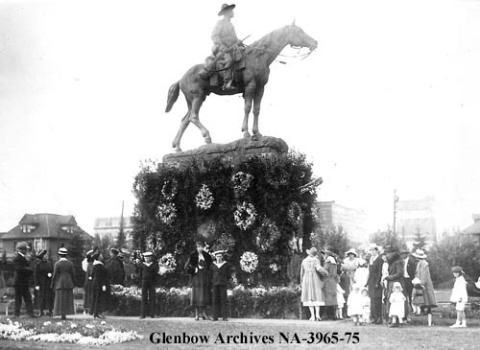
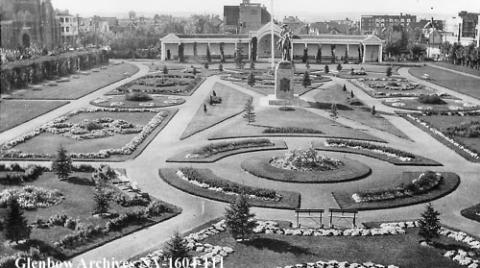
The Horseman of the Plains, South African War monument, by Louis Philippe Hebert, erected by The City of Calgary in 1914

Image
Photo Credit
calgary.ca
Caption
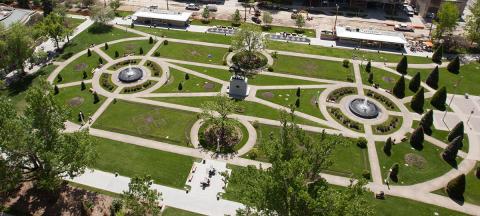
Central Memorial Park showing the Equestrian statue
1 of 4 images
Image
Photo Credit
Glenbow archives NA3965-75
Caption
South African War Memorial Glenbow archives NA3965 75
1 of 4 images
Image
Photo Credit
Glenbow archives NA 1604-111
Caption
Central Memorial Park Calgary 1914 1919 Glenbow archives NA 1604 111
1 of 4 images
Image
Photo Credit
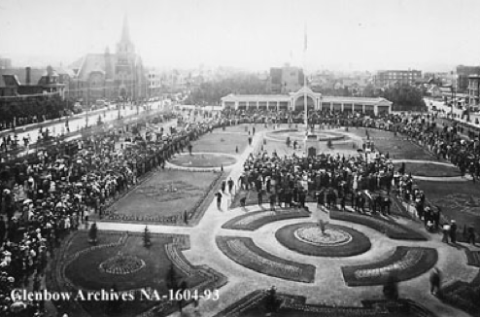
Glenbow archives NA 1604-93
Caption
Unveiling the South African War Monument Central Park Calgary 20 June 1914 Glenbow archives NA 2354 9
1 of 4 images
Province
!4v1614782776006!6m8!1m7!1sCAoSLEFGMVFpcE5yVUJmMkdQUVd2TWRLTmhtNXdLQklnT1dtajZfV085YnpoVDNh!2m2!1d51.04108840918973!2d-114.0700969908119!3f334.1542413993948!4f13.701951665702893!5f1.3944214919651336"
Body Content

A magnificent bronze equestrian statue, the South African War Monument was unveiled in Central [Memorial] Park in Calgary on 20 June 1914. The Horseman of the Plains, commemorating the South African War, located in the centre of the Central Memorial park’s oval. The Horseman of the Plains is the earliest commissioned work, since it was erected by the City of Calgary in 1914. The equestrian statue was erected as a tribute to all Albertans who fought in the Boer War. The French-Canadian sculptor Louis Philippe Hébert suggested that the memorial be placed in Calgary’s Central Park.

Remembrance Day ceremonies are held here annually on November 11.

After the Calgary Canadian Club and the South African War veterans were denied city funds, they asked the public to help raise the $25,000 necessary to construct the statue. The Imperial Order of the Daughters of the Empire was among the first to respond and enlisted Boy Scouts and Cadets to help them raise the sum by through fundraisers and donations. The Daughters of the Empire was a women’s patriotic association that focused on educating young Canadians about the South African War and the heroic sacrifices of Canadian veterans while instilling British patriotic values.

City
Calgary
Country
Type Description
Sculpture
Memorial CF Legacy ID
10237
City/Municipality
Calgary
Memorial Number
48002-070
Type
Location
Commercial Banking Center
in Canada
Yes
GPS Coordinates
0, 0
Inscription

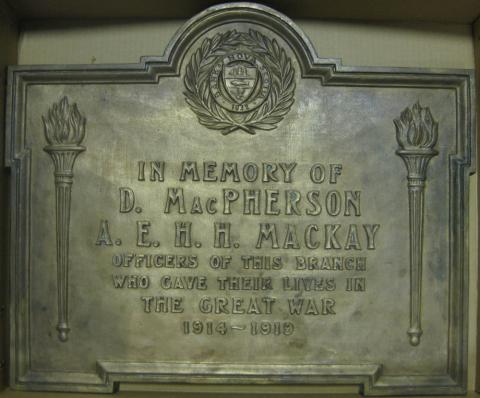
IN MEMORY OF
D. MACPHERSON
A.E.H.H. MACKAY
OFFICERS OF THIS BRANCH
WHO GAVE THEIR LIVES IN
THE GREAT WAR
1914∼1919

Image
Photo Credit
Scotiabank Archives
Caption
Bank of Nova Scotia Main Branch, Calgary, Alberta, Great War Plaque
Province
Body Content

As a memorial to staff who gave their lives in the Great War, the Bank of Nova Scotia commissioned about 60 bronze tablets, between July 1920 and February 1921, to be placed on the wall of the branch where each known staff member was employed when they joined the military forces. These plaques listed the names of staff killed on the field, as well as those who died from their wounds after they returned home from the war.

This plaque honours Duncan MacPherson and Andrew Edward Hector Hugh MacKay former officers of the Bank of Nova Scotia Main Branch in Calgary, Alberta, who were was killed in service during the Great War.

City
Calgary
Country
Type Description
Plaque
Memorial CF Legacy ID
10158