Other

City/Municipality
Saskatoon
Memorial Number
47012-018
Type
Address
816 Spadina Crescent
Location
St. John's Cathedral
in Canada
Yes
GPS Coordinates
52.1298123, -106.655605
Inscription

[top/haut]

IN MEMORIAM

Image
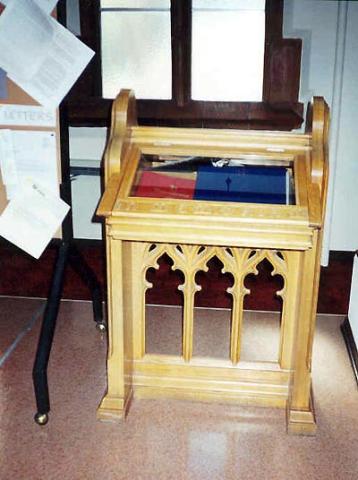
Photo Credit
Susan Harmer & Keith Inches
Caption
cabinet (top and front)
Province
!4v1621440615626!6m8!1m7!1sr1fraMTYJ65ChaTGlATIjA!2m2!1d52.12938904617017!2d-106.6550288749623!3f342.7363109269711!4f21.147265071417067!5f0.7820865974627469"
Body Content

Constructed as a book holder, this memorial is dedicated to war dead and veterans.

City
Saskatoon
Country
Type Description
Wooden and glass cabinet
Memorial CF Legacy ID
2205
City/Municipality
Saskatoon
Memorial Number
47012-017
Type
Address
816 Spadina Crescent
Location
St. John's Cathedral
in Canada
Yes
GPS Coordinates
52.1294437, -106.6549318
Inscription

[certificate/certificat]

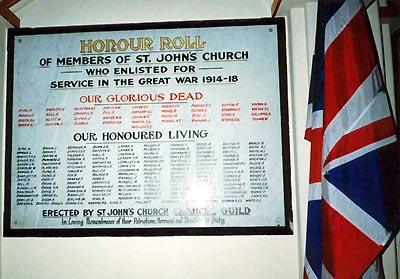
HONOUR ROLL
OF MEMBERS OF ST. JOHN'S CHURCH
WHO ENLISTED FOR
SERVICE IN THE GREAT WAR 1914-18

OUR GLORIOUS DEAD

AIRD, D.
ARNOLD E.
BAKER, H.G.
BAKER, S.
BARTLETT, E.
BELL, R.
BLOTT, W.
BURSTON, F.
CLAYTON, H.C.
CAMPBELL, R.
CLEMER, J.
CLARE, L.
DAVIS, R.W.
FOX, C.
HAMER, W.W.
HARRIS, G.W.
LAVER, S.V.
LEATHERBY, C.J.
LEWIN, W.F.
MARTIN, S.H.
MCDOUGALL, F.
MIZZLE, F.T.
MOORE, R.
MOORE, M.
MORRIS, A.T.
MORRIS, W.P.
OLIVER, E.
PYNE, J.
RAYMOND, J.
SUTTON, C.
STEBBING, C.
STIRK, H.
STERNS, S.S.
WILSON, G.
WHETEN T.G.
WILLIAMS E.
YOUNG, W.

OUR HONOURED LIVING

AIRD, H.
ARNOLD, L.
ARSCOTT, S.H.
BAKER, J.C.
BARCLAY, W.
BARGUS, P.
BARTLETT, H.
BATE, A.
BELL, A.
BIDWELL, L.M.
BOULTON, R.
BRANDWIRTH, W.
BRALEY, D.
BREWER, S.
BROWN, J.
BROWN, T.
CEATES, W.
CHAMBERS, S.
CHEETHAM, H.
CLARK, W.G.
COCKS, A.
COCKS, G.
COPP, P.
CRONE, G.
DAVIS, H.
DAVIS, A.L.
DIXON, H.
DOWN, A.E.
EDMONDS, A.
EVANS, V.D.S.
FALKNER, N.
FERGUSON, B.
FINBOW, G.
FITZJOHN, F.
FOWLER, N.
FOX, G.
FRANKS, T.
FROST, F.
GARDNER, A.
GARRISON, B.
GIBAUT, J.T.
GIRLING DR.
GOULD, G.
GOWAN, H.N.
GUNN, J.D.
GRIFFITH, W.
HALL, S.
HARRIS, J.
HARTNEY, H.E.; HEMMING, J.H.; HILL, C.R.; HOLMES, A.; HOWE, G.; JARRATT, E.; KARAGIANIS, E.; KEARNEY, A.G.; KEEFLER, J.K.; KING, A.; KERANS, R.O.; KING, E.; LAMBE, C.; LAMBE, D.; LAWSON, D.; LEADER, F.M.; LEVALLEY, L.N.; LEWIN, E.H.; LOVEGROVE, W.; MACKLEM, J.; MAXWELL, C.; MANSELL, M.; MACFARLANE, G.; MCPHERSON, F.; MCLORG, F.; MEUBURN, W.H.; MILLET, T.; MILSOM, R.; MILSOM, H.; MOORE, H.; MORLAND, J.; MORRISS, G.G.; MORGAN, R.; MOSLEY, D.; MOXON, J.; NEIL, R.; NUTT, G.J.; O'BRIEN, T.; OTTON, F.; PARKER, H.; PARKER, C.; PARKER, T.; PEARSON, G.; PEARSON, R.; PINCHBECK, V.; POWLEY, R.S.; PORTCONS, J.; PROBERT, A.; QUINN, S.; REANEY, J.E.; REEVES, P.; REES, H.; RICHARDSON, J.L.; ROBINSON, G.; ROSS, W.; ROSS, P.; SCOTT, C.; SHEPHERD, F.; SIMPSON, A.F.; SINCLAIR, W.; SLOUGH, P.; SMITH, A.; SMITH, Z.; SMITH, E.; SMITH, P.; STEVEN, E.G.; STREMES, F.; SUMMERS, R.E.; SUMMER, A.J.E.; SUTTON, F.; SUTTON, R.; SWIFT, L.; THORNE, H.; THING, H.; TOWNSEND, R.J.; TURNER, A.R.; TURNER, E.; TURNER, E.; VAN EQMOND, G.; VINCENT, S.; WAITE, G.J.; WATTERMAN, O.E.; WARREN, J.H.; WHALE, G.; WHITE, A.J.; WHITE, W.A.; WHETON, E.; WILDIG, B.; WRIGHT, W.; WRIGHT, C.; WYATT, J.A.; YATES, G.G.; YOUNG, C.; ZAPFE, A.K.

ERECTED BY ST. JOHN'S CHURCH CHANCEL GUILD

In Loving Remembrances of their Patriotism, Heroism and Devotion to Duty

Image
Photo Credit
Susan Harmer
Caption
certificate (front)
1 of 3 images
Image
Caption
certificate (surroundings)
1 of 3 images
Image
Caption
certificate (front)
1 of 3 images
Province
!4v1621440476214!6m8!1m7!1sWWLkVoSIHz49BPVYbVFWGw!2m2!1d52.12944368783945!2d-106.6549318295201!3f326.9637409407876!4f22.065958098859355!5f0.7820865974627469"
Body Content

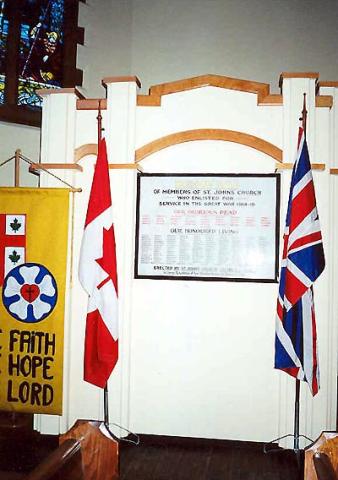
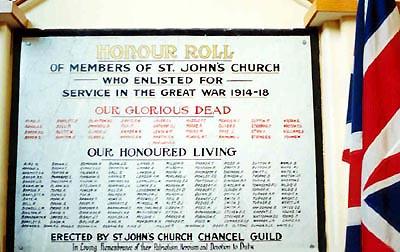
Erected by the Chancel Guild of St. John's Cathedral, this memorial is dedicated to the members of the congregation who were veterans or war dead of the First World War.

City
Saskatoon
Country
Type Description
Paper certificate
Memorial CF Legacy ID
2204
City/Municipality
Saskatoon
Memorial Number
47012-016
Type
Address
1502-2nd Avenue North
Location
Woodlawn Cemetery
in Canada
Yes
GPS Coordinates
52.150744194599, -106.65490467339
Inscription

[plaque/plaque]

TO OUR DEAD

Image
Photo Credit
Susan Harmer & Keith Inches
Caption
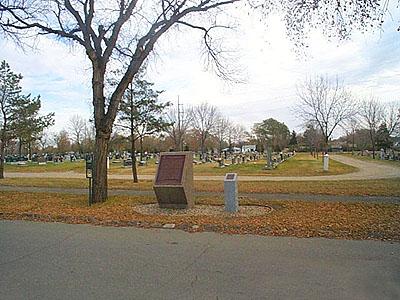
front view
1 of 2 images
Image
Caption
surroundings
1 of 2 images
Province
!4v1621440160798!6m8!1m7!1sBD0A5-w78TyLmJoLc79aXQ!2m2!1d52.1445063038644!2d-106.6582520702367!3f15.261453656394291!4f6.812009716359782!5f0.7820865974627469"
Body Content

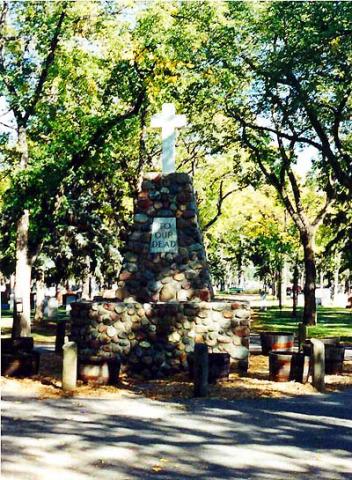
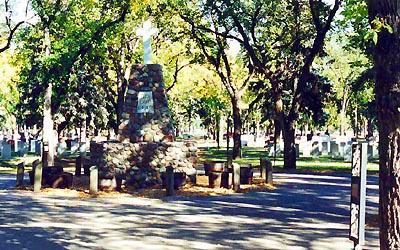
This memorial is dedicated "to our dead".

City
Saskatoon
Country
Type Description
Stone cairn and base and cement cross
Memorial CF Legacy ID
2202
City/Municipality
Saskatoon
Memorial Number
47012-015
Type
Address
Needs further research
Location
Woodlawn Cemetery
in Canada
Yes
GPS Coordinates
52.151112141128, -106.65544882627
Inscription

[plaque/plaque]

KOREA 1950-53
DONATED BY
KOREA VETERANS ASSOCIATION # 46
SASKATOON 1991

Image
Caption
benches (bench)
Province
!4v1621436046470!6m8!1m7!1sBD0A5-w78TyLmJoLc79aXQ!2m2!1d52.1445063038644!2d-106.6582520702367!3f7.161972091759338!4f3.2744077216286485!5f0.7820865974627469"
Body Content

These benches were donated in 1991 by Korea Veterans Association Unit # 46 in honour of the Korean War.

City
Saskatoon
Country
Type Description
Wooden benches
Memorial CF Legacy ID
2243
City/Municipality
Saskatoon
Memorial Number
47012-014
Type
Address
Between Broadway Bridge and University Bridge (25th Street Bridge)
Location
Kiwanis Memorial Park Grounds
in Canada
Yes
GPS Coordinates
52.1247449, -106.6597936
Image
Caption
front view
Province
!4v1621434831664!6m8!1m7!1sYu9aW5FcVIOFLC-cSw6Jsw!2m2!1d52.12474492797167!2d-106.6597936231022!3f131.84762723356266!4f2.283990629003384!5f0.7820865974627469"
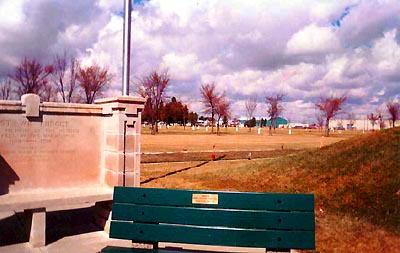
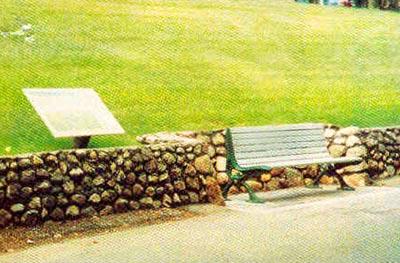
Body Content

This memorial plaque and bench, located between the Bessborough Hotel and the 25th Street Bridge, was erected by the Meewasin Valley Authority in memory of the Korean War. On 25 June 1950, North Korean troops crossed the 38th parallel into the Republic of Korea. Canada agreed to raise an Infantry Brigade Group to assist the South Koreans, British, and Americans defend the country. Over 10,000 men formed an all-volunteer force and by February 1951, the 2nd Battalion Princess Patricia’s Canadian Light Infantry was in action. Although peace negotiations began that summer, the fighting continued until an armistice was signed on 27 July 1953. Approximately 27,000 Canadians served in Korea. Of our 1,558 casualties, 516 were fatalities.

City
Saskatoon
Country
Type Description
Plaque and bench
Memorial CF Legacy ID
2242
City/Municipality
Saskatoon
Memorial Number
47012-013
Type
Address
222 3rd Avenue
Location
Saskatoon City Hall
in Canada
Yes
GPS Coordinates
52.129811, -106.6603894
Inscription

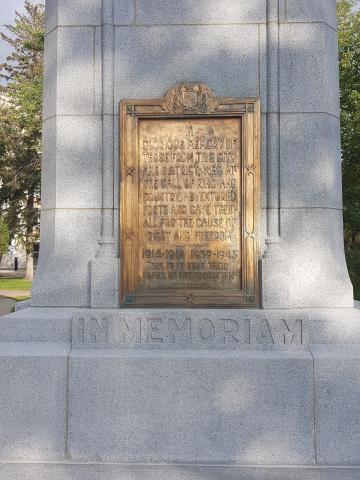
[front/devant]
IN GLORIOUS MEMORY OF
THOSE FROM THIS CITY
AND DISTRICT WHO AT
THE CALL OF KING AND
COUNTRY, ADVENTURED
FORTH AND GAVE THEIR LIVES
ALL FOR THE CAUSE OF
RIGHT AND FREEDOM

1914-1918 1939-1945
SEE TO IT THAT THEIR
NAMES NOT BE FORGOTTEN

IN MEMORIAM

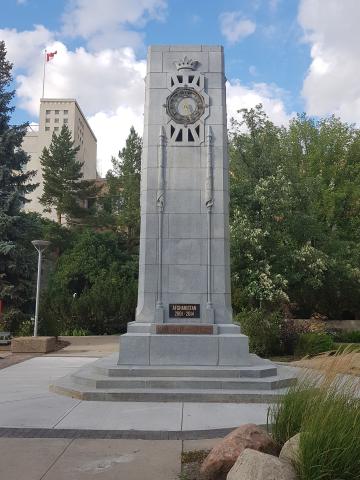
[right side/côté droit]
AFGHANISTAN
2001 - 2014

1914-1918    1939-1945

[back/arrière]
KOREA
1950 - 1953

IN MEMORIAM

 [left side/côté gauche]
PEACEKEEPING
SERVICE DE LA PAIX


1914-1918    1939-1945

Image
Caption
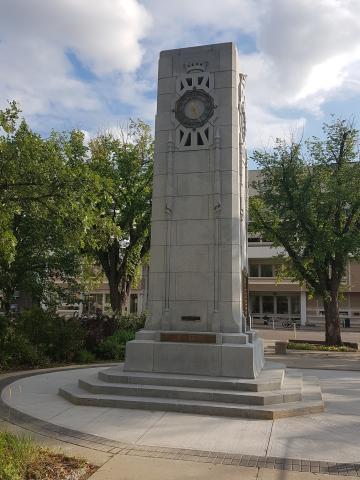
Saskatoon Cenotaph
1 of 6 images
Image
Caption
back
1 of 6 images
Image
Caption
left side
1 of 6 images
Image
Caption
front plaque
1 of 6 images
Image
Caption
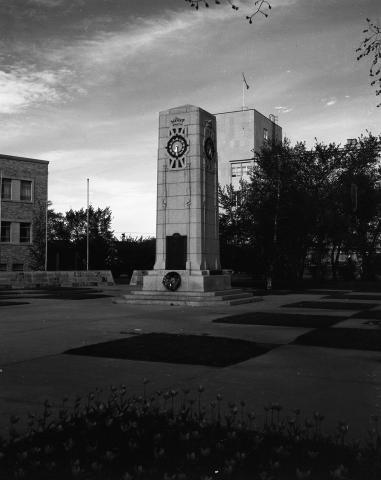
Saskatoon Cenotaph in 1964.
1 of 6 images
Image
Caption
right side
1 of 6 images
Province
!4v1621434296272!6m8!1m7!1sXuirIx_SgC_p4g8BHNSQWg!2m2!1d52.12981101772458!2d-106.6603894201199!3f18.580519502808265!4f2.45080073726632!5f3.2082761994319027
Body Content

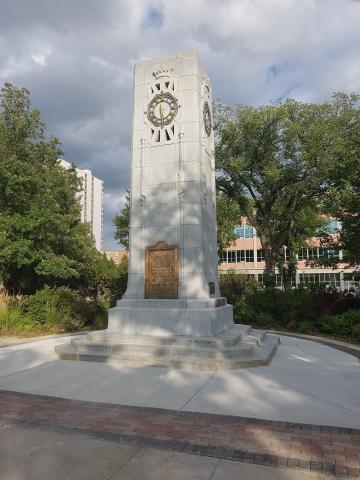
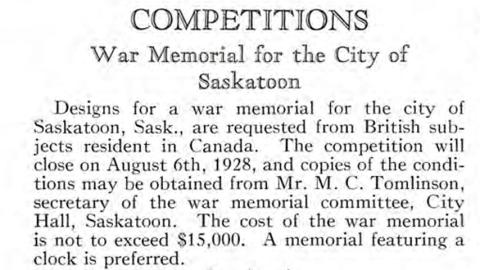
Plans for a war memorial were undertaken at the initiative of the Canadian Legion (Saskatchewan Command, Saskatoon Branch) and formally passed by a resolution of City Council on March 12, 1928. The cost would be jointly funded by the city and the Legion. By the end of April, City Council had appointed a Cenotaph Committee to work in coordination with the Legion’s committee. The Cenotaph Committee announced a contest with a $250 prize for the best design. City Council asked that the cenotaph have a chiming clock because it would serve a more useful and practical purpose than merely a memorial of stone with a plaque. On 8 August, F.H. Portnall, a Regina architect and Great War Veteran, was selected as the winner out of fifteen applicants. 

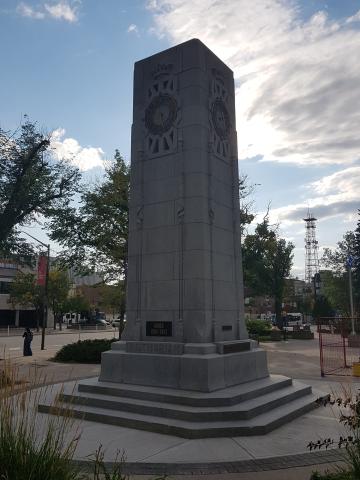
The almost 28 feet high, four-sided monument was constructed of Vancouver grey granite obtained by the Western Granite and Marble Co. The shaft is affixed to a base of reinforced concrete, built as a seven foot square, tapering to six square feet at the top and finished with a pyramidal cap. The main upper feature is a four-sided, bronze, electric clock, each face measuring thirty-six inches, specially ordered from Wm. Potts and Sons Ltd. in England. Surrounding each dial are fretted panels which allow the sound to pass, forming an outline of a Union Jack. Above the clock dial, a crown represented the war effort of the British Empire. The clock was illuminated at night and had four chiming bells to sound the time, ranging in weight from 400 pounds to 90 pounds.

A granite Coat of Arms of the city is above the bronze dedication plaque. On either side of the plaque are draped flags carved in granite, the tops of which reach to the fretwork on either side of the clock face. A bronze door on one side of the clock accesses the interior of the cenotaph, particularly to the clock works for maintenance and repair.

There were delays in the shipping the clock, and it was not shipped until October 17. Further delays had the clock arrive only one day before the unveiling. Despite work virtually around the clock by Henry Birks and Sons on Sunday, November 10, there were still finishing touches remaining. The clock, although assembled, was not fully operational for the dedication ceremonies the following day.

The cenotaph was constructed by Saskatoon general contractor, James Priel. David Webster, a local architect, supervised the work locally on Portnall’s behalf. Built at a total cost of $18,769, the cenotaph was unveiled at a dedication ceremony on November 11, 1929, at its original location on 21st Street near 2nd Avenue. Nearly 3,000 attended, among them, many ex-servicemen and those representing all branches of active military service.

On the night of August 15, 1957, it was dismantled and moved by Smith Brothers and Wilson Co., and reassembled at its current location. At that time, a new clock mechanism was installed, synchronous clockworks purchased again from the English company, Wm. Potts and Sons Ltd., and the faces and hands regilted. It was rededicated on October 15, 1957, during a convention of the Canadian Legion (Saskatchewan Command), which brought together over two hundred Legionnaires. In total, approximately 1,500 Saskatoon citizens were on site for the rededication.

A ceremony for the Second World War plaque took place on November 11, 1947. The Korean War plaque was added sometime in the mid to late 1950s. A ceremony for the peacekeepers plaque took place on August 9, 2006. The Afghanistan plaque ceremony was held in May of 2018. 

City
Saskatoon
Country
Type Description
Shaft - granite, 4 clocks, brass plaques
Photo Credit
City of Saskatoon
Memorial CF Legacy ID
3333
City/Municipality
Saskatoon
Memorial Number
47012-012
Type
Address
24th Street E and 5th Avenue N
Location
Star-Phoenix
in Canada
Yes
GPS Coordinates
52.1307792, -106.6573239
Inscription

1920
The Star-Phoenix 

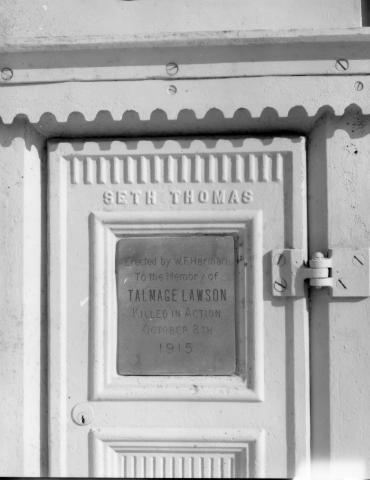
Erected by W.F. Herman
To the Memory of
TALMAGE LAWSON
KILLED IN ACTION
October 8th
1915

Image
Photo Credit
Keith Inches and Susan Harmer.
Caption
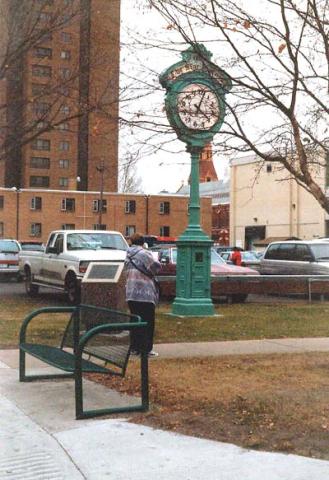
The Star-Phoenix Clock
1 of 5 images
Image
Caption
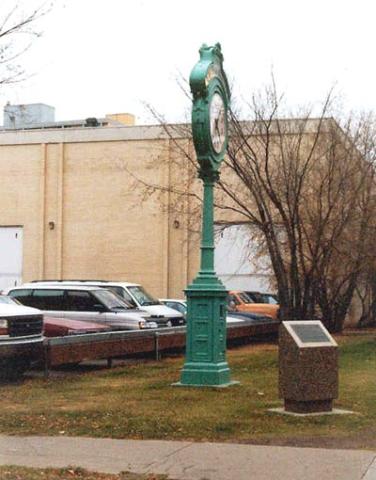
side view
1 of 5 images
Image
Caption
Newspaper article for memorial competition.
1 of 5 images
Image
Photo Credit
City of Saskatoon
Caption
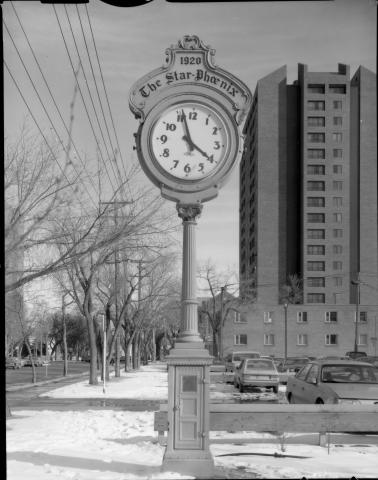
The Star-Phoenix Clock, 1988.
1 of 5 images
Image
Photo Credit
City of Saskatoon
Caption
plaque
1 of 5 images
War or Conflict Term
Province
!4v1621434163624!6m8!1m7!1sQ-hYFN7HlzkasTy3xojQGA!2m2!1d52.13077873034198!2d-106.6573249382979!3f80.56967412358213!4f3.459249156814124!5f3.0298445359500215
Body Content

The Star-Phoenix Clock was erected on October 6, 1920, in memory of Talmage Lawson who perished in the First World War. In 1912, Talmage and his partner Bill Herman bought the Capital, one of Saskatoon's daily newspapers, and renamed it the Saskatoon Daily Star. In 1928, the Star amalgamated with the Phoenix and formed the Star-Phoenix which still serves the city today. The Star-Phoenix Clock is a protected heritage property established by Bill in memory of his partner. Bill hired the Seth Thomas Clock Company to create a timepiece and erected it outside the newspaper office at 20th Street East. Seth Thomas was the first to succeed in designing and making tower clocks in different countries.

The two-sided clock stands 15 feet high with a square pedestal and column of cast-iron. The clock was originally powered by a heavy counterweight and cranked every Monday morning. It now operates electrically via a cable running to the Star-Phoenix press room. Two heaters are turned on to keep it going in the winter. The clock had a large thermometer bolted onto it for the first several decades. There are two holes on the street-facing side where it was attached.

The old interior clockworks have been removed and new faces were put on in 1978. When the old clockworks and counterweights were removed, they were sent to Regina for scrap. Hugh McNaughton, a Star-Phoenix technician and Bert Buckle, a well-known local watch maker, went to Regina to retrieve them.

When the Star-Phoenix moved to 5th Avenue in 1967, the clock moved too. When it was moved the base was sandblasted to remove layers of paint. The original paint was black or brown. The clock was moved to its current location in 1979. 

Private Talmage Lawson was born in Prince Edward Island in 1879. Lawson spent his pre-war years trading and selling horses. Lawson’s mother, Alice, died unexpectedly in 1910 after a weeklong illness. He travelled the world extensively and when he got into Africa, took the railroad as far as it would go then journeyed deep into the continent on foot. After only a few days of hiking and sleeping on the ground, Lawson came down with a fever. He returned to the train, but his fever worsened. For nine days aboard the train, Lawson became delirious. He returned to Saskatoon and enlisted as a private in October of 1914. Private Thomas Lawson died at age 35 near the Belgian village of Kemmel.

City
Saskatoon
Country
Type Description
Clock tower, plaque
Memorial CF Legacy ID
3334
City/Municipality
Saskatoon
Memorial Number
47012-011
Type
Address
Corner of 25th and Spadina Streets
Location
945 Spadina Crescent E
in Canada
Yes
GPS Coordinates
52.1318897, -106.6516397
Inscription

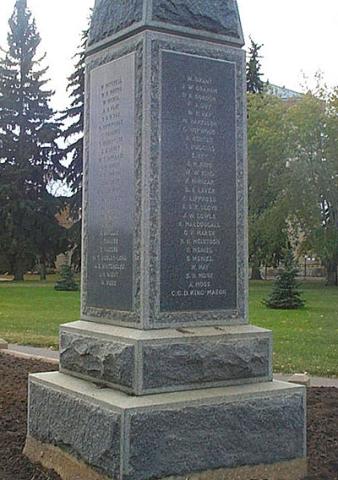
[base]

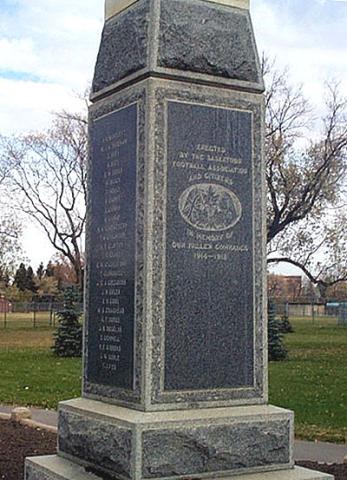
ERECTED BY THE SASKATOON FOOTBALL ASSOCIATION AND CITIZENS
IN MEMORY OF OUR FALLEN COMRADES
1914 - 1918

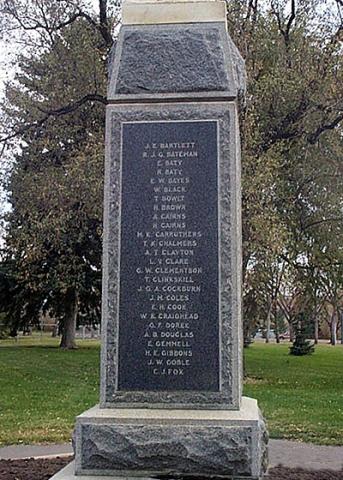
J.E. BARTLETT
R.J.G. BATEMAN
E. BATY
R. BATY
E.W. BAYES
W. BLACK
T. BOWLT
A. CAIRNS
H. CAIRNS
M.K. CARRUTHERS
T.K. CHALMERS
A.T. CLAYTON
L.N. CLARE
G.W. CLEMENTSON
T. CLINKSKILL
J.G.A. COCKBURN
J.M. COLES
E.H. COOK
W.K. CRAIGHEAD
G.F. DOREE
A.B. DOUGLAS
E. GEMMELL
H.E. GIBBONS
J.W. GOBLE
C.J. FOX
W. GRANT
J.W. GRAHAM
D.K. GORDON
F.J. GUY
W.P. HAY
W. HARRISON
G. HOPWOOD
A. HUNTER
T. HUGGINS
E. KEY
S.M. KING
P. KINNEAR
S.M. LAVER
F. LIPPROSS
A.S.K. LLOYD
J.W. LOWES
A. MACDOUGALL
G.H. MARSH
N.M. MCINTOSH
R. MCNEIL
S. MCNEIL
W. MAY
S.H. MONK
A. MOSS
C.G.D. KING-MASON
W. MITCHELL
W.K. MUNRO
W. NICHOL
A.H. PEAT
V.D.B. RAE
G. RIPPENGALE
C. ROBBINS
T. ROBERTSON
J.J. SCOTT
W.T. SINCLAIR
D.F. SMART
C.B. SMILLIE
T.H. SMITH
A.G. STARKINGS
C.A. STEBBING
A. STEELE
W. SPENCE
G. SWIFT
R. SMYLLIE
J. TINKESS
T. WATERS
W.T. WESLEY-LONG
A.E. WHITEHOUSE
J.H. WRIGHT
W. WOOD

Image
Photo Credit
City of Saskatoon/Ville de Saskatoon
Caption
front view
1 of 5 images
Image
Caption
front and left side details
1 of 5 images
Image
Caption
back details
1 of 5 images
Image
Caption
back details
1 of 5 images
Image
1 of 5 images
Province
!4v1621433667223!6m8!1m7!1s9jb1_OyzzfdGaJTlcfKsDw!2m2!1d52.13188971927509!2d-106.6516396566081!3f328.35015159298877!4f2.054887521889114!5f3.325193203789971"
Body Content

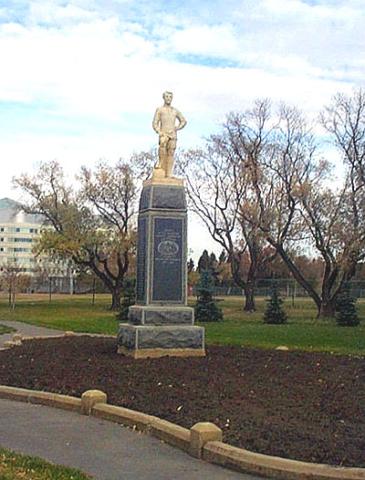
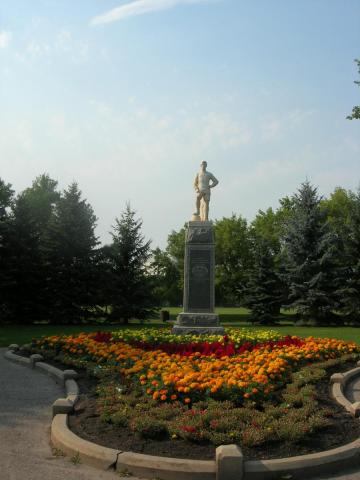
The Hugh Cairns Memorial, also known as the Footballer’s Memorial, features an 18 foot high marble statue of a footballer. Underneath the statue, Hugh Cairns' name is engraved, and on the statue’s base is the inscription of seventy-five Saskatoon football players’ names that lost their lives in World War I. The monument is located in Kinsmen Park near the South Saskatchewan River and the University Bridge.

The Hugh Cairns Memorial is a symbol of the lives that were lost during World War I, including that of Hugh Cairns who was born in 1896 in England but was raised in Saskatoon. Cairns was an apprentice plumber, and a member of the Christ Church football team and choir. He began his military service at the age of 19 in 1915 when he joined the 65th Battalion.  He later transferred to The 46th Battalion, Saskatchewan Regiment, where he attained the rank of sergeant.

In the summer of 1917, Cairns was awarded the Distinguished Conduct Medal for his bravery, during the Battle of Vimy Ridge.  He had led his machine gun crew against a German position, captured enemy gun emplacements and then stayed behind to cover the retreat of his men.  He incurred thirteen pieces of shrapnel in the encounter but recovered. Sergeant Hugh Cairns led three skirmishes during the advance at Valenciennes in Northern France; he was wounded on a fourth skirmish and died the next day, November 2, 1918. He was awarded the Victoria Cross posthumously in 1919 for his extraordinary efforts, an honour which has only been bestowed on six Saskatchewan Soldiers. The official statement which accompanied the award stated: "Throughout the operations he showed the highest degree of valour.  His leadership greatly contributed to the success of the attack."

To commemorate the sacrifice of Cairns and other fallen soldiers of World War I, the Hugh Cairns Memorial was unveiled on June 8, 1921. The monument has a polished granite base, and a marble statue resembling a footballer - Hugh Cairns. On the front of the granite base the following inscription is found "Erected by the Saskatoon Football Association and citizens In memory of Our Fallen Comrades 1914 – 1918." On the statue’s base is the inscription of seventy-five Saskatoon football players’ names that lost their lives in World War I (including the names of Hugh Cairns and his brother Albert).

Source: City of Saskatoon Built Heritage Database

City
Saskatoon
Country
Type Description
Granite statue and shaft
Memorial CF Legacy ID
3197
City/Municipality
Saskatoon
Memorial Number
47012-010
Type
Address
2108 Memorial Avenue
Location
Woodlawn Cemetery
in Canada
Yes
GPS Coordinates
52.1441713, -106.6582499
Inscription

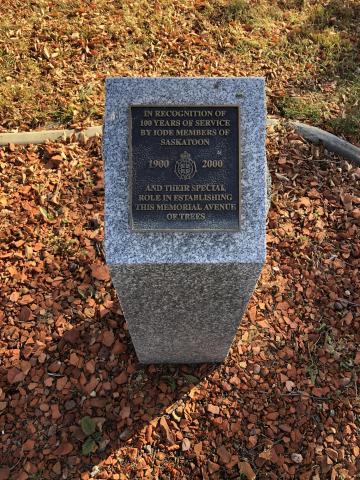
[plaque on shaft/plaque sur socle]
IN RECOGNITION OF
100 YEARS OF SERVICE
BY IODE MEMBERS OF
SASKATOON

1900 - 2000

AND THEIR SPECIAL
ROLE IN ESTABLISHING
THIS MEMORIAL AVENUE
OF TREES

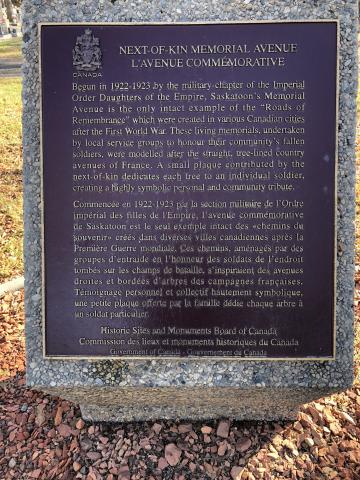
[plaque on shaft/plaque sur socle]
NEXT-OF-KIN MEMORIAL AVENUE
L'AVENUE COMMÉMORATIVE

Begun in 1922-1923 by the military chapter of the Imperial
Order Daughters of the Empire, Saskatoon's Memorial
Avenue is the only intact example of the "Roads of
Remembrance" which were created in various Canadian cities
after the First World War. These living memorials, undertaken
by local service groups to honour their community's fallen
soldiers, were modelled after the straight tree-lined country
avenues of France. A small plaque contributed by the
next-of-kin dedicates each tree to an individual soldier,
creating a highly symbolic personal and community tribute.

Commencée en 1922-1923 par la section militaire de l'Ordre
impérial des filles de l'Empire, l'avenue commémorative
de Saskatoon est le seul exemple intact des «chemins du
souvenir» créés dans diverses villes canadiennes après la
Première Guerre mondiale. Ces chemins, aménagés par des
groupes d'entraide en l'honneur des soldats de l'endroit
tombés sur les champs de bataille, s'inspiraient des avenues
droites et bordées d'arbres des campagnes françaises.
Témoignage personnel et collectif hautement symbolique,
une petite plaque offerte par la famille dédie chaque arbre à
un soldat particulier.


Historic Sites and Monuments Board of Canada
Commission des lieux et monuments historiques du Canada
Government of Canada - Gouvernement du Canada

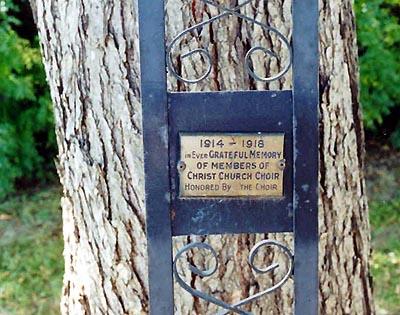
[tree plaque/plaque sur arbre]
1914 - 1918
IN EVER GRATEFUL MEMORY
OF MEMBERS OF
CHRIST CHURCH CHOIR
HONORED BY THE CHOIR

[plaque on tree/plaque sur arbre]
1914 - 1918
LIEUT. IVAN W. TINKESS
PTE. JAS. G. GALLAGHER
PTE. E.H. KING
HONORED BY NO. 777 R.B.P.

[gates at entrance near 33rd Street]

(left pillar plaque)

NEXT-OF-KIN
MEMORIAL
AVENUE

(right pillar plaque)

“TO THE
SACRED MEMORY OF
THOSE WHO SERVED
IN THE ARMED FORCES
AND
“REST FROM THEIR LABORS”
THIS NEXT-OF-KIN
MEMORIAL AVENUE IS
DEDICATED”.

Image
Photo Credit
City of Saskatoon
Caption
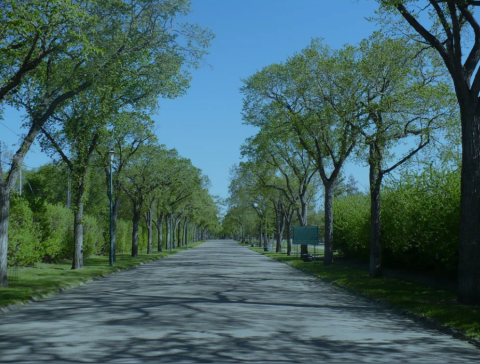
South Entrance looking north down Next-of-Kin Memorial Avenue, May 2008.
1 of 6 images
Image
Caption
plaques
1 of 6 images
Image
Caption
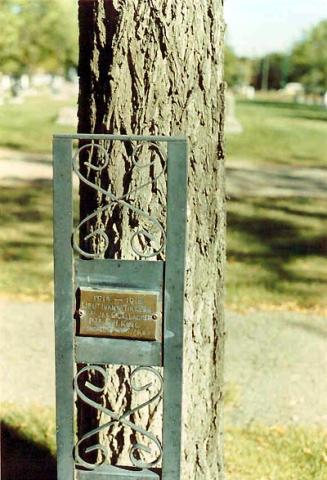
tree plaque
1 of 6 images
Image
Caption
tree plaque
1 of 6 images
Image
Photo Credit
City of Saskatoon
Caption
plaque on shaft
1 of 6 images
Image
Photo Credit
City of Saskatoon
Caption
plaque on shaft
1 of 6 images
Province
!4v1633457172794!6m8!1m7!1sW1hxz2hnc7ig9pglSDknHg!2m2!1d52.14417128499773!2d-106.6582498690229!3f354.7104960423604!4f8.999198092921375!5f0.7820865974627469
Body Content

The idea for a memorial avenue originated with the Education Committee of the local Military Chapter of the Imperial Order of the daughters of the Empire. Mrs. Jean Jarvis and Mrs. A. H. Hanson, key members of the committee, presented the concept to the City of Saskatoon in May 1922. The following month, the council endorsed a committee consisting of Parks Board staff and Imperial Order of the daughters of the Empire members. 

From the Saskatoon Imperial Order Daughters of the Empire branch: "A tree is a living memorial often more enduring than marble or bronze; a tree is a thing of beauty and of inspiration — a living token of the wonder and glory of nature — a symbol of service — for the life of a tree is a life of service, even the end of life is not the end of a tree's service; to the contrary, the end of a life opens new fields of service which add immeasurably to our civilization, our culture, and our happiness; therefore, is not a tree a fitting symbol for those valiant men who gave their lives for the service of their country and who died that humanity might continue to live in civilization, in culture, and in happiness?"

On June 17, 1923 the first trees were dedicated at a formal ceremony with Brigadier-General Alexander Ross, military units and representatives of every organization in Saskatoon in attendance. A crowd of 8,000 attended the event as 265 trees and plaques were dedicated. Each tree was purchased by the next-of-kin of a deceased soldier and dedicated to that specific individual with a brass plaque. For twenty years, Albert Meek skillfully engraved the plaques.

The 1923 ceremony was the first annual memorial service. Originally a private drive, Next-of-Kin Memorial Avenue was officially dedicated as a street on February 15, 1937. The yearly event and scope of the avenue has been expanded to memorialize those who died in both World Wars, the Korean War and all subsequent military engagements. Since that first dedication of 265 trees in 1923, more than 1,200 trees have been planted on various “branches” or avenues stemming from Next-of-Kin Memorial Avenue and running throughout the cemetery. The branches of the Avenue are names after distinguished soldiers, major battles, or ships.

The City of Saskatoon website maintains a listing of each memorial tree including the individual’s name, rank during service, place of death, age and the sponsor. The Imperial Order of the daughters of the Empire was responsible for the management of this program until February 10, 1986 when the City of Saskatoon assumed the administration of the program.

Two sets of gates are located within the initial Next-of-Kin Memorial Avenue. The first is the original entrance to Woodlawn Cemetery located on the north end of the Avenue. The original entrance is marked by two stone pillars and predates Next-of-Kin Memorial Avenue. The second gate is currently used as the entrance near 33rd Street. Two pillars of stone and brick were erected in the early 1950s. The Imperial Order of the daughters of the Empire contributed financially to the construction. A plaque is affixed to each pillar. 

In 1991 Jim Hall, an Executive Committee member of the Royal Canadian Legion, contacted the Historic Sites and Monuments Board of Canada with the proposal that Memorial Avenue be declared a National Historic Site. Gordon Fulton, along with Fern Graham, both of the Parks Service Architectural History Branch, had researched "Roads of Remembrance" in Canada and prepared a report.

In 1992, the Next-of-Kin Memorial Avenue was designated a national historic site of Canada because: it is an excellent example of the “Roads of Remembrance” and it is the only such boulevard in Canada to have retained its integrity. Official recognition refers to the roadway known as Memorial Avenue, beginning at the north edge of Warman Road and ending at the stone cairn located between cemetery lots J and K and includes the road, the stone cairn and a measured boundary extending 14.2 meters from the center-point of Memorial Avenue. On August 28, 1994, a plaque was unveiled during the annual Decoration Day Memorial Service at the Soldiers' Cairn in Woodlawn Cemetery.

The Next-of-Kin Memorial Avenue National Historic Site of Canada is a picturesque 0.7 kilometer-long Road of Remembrance. The avenue begins at a pair of stone pedestals, flanked by a wrought-iron fence and runs northwards following the western boundary of the cemetery. It ends in a paved circle surrounding a stone memorial cairn. The asphalt-paved roadway is flanked on either side by a single row of 112 stately, mature elm trees, accompanied by bronze plaques on wrought-iron stands that dedicate each tree to a deceased soldier.

Each tree has a plaque and plaque stand associated with it. Each plaque, or brass plate, contains the individual’s name, rank and date of service. Initially serving as protection for the tree, the guards are now used solely as stands for the plaque. Some of the original guards have grown into some trees. In the past, plaques and stands have been replaced as required (due to damage). Three different styles of plaque stands have been used over the years and can be found on the avenue. The original style was replaced with a two-spiked plaque stand (date uncertain). In 1984, the Director of Woodlawn Cemetery chose a one-rod stand instead of two to facilitate lawn maintenance. Since 2002, replacement stands are replicas of the original style and are constructed of black wrought iron. They are distinguishable from the originals because they are slightly taller. Of the 1,360 memorial tree plaques, 99% are in honor of a Veteran.

In November 1918, Canadians turned to the duty of commemorating the dead. Some promoted practical memorials like Roads of Remembrance. These linear tree-lined avenues had trees that were typically a single species, regularly spaced along each side of the avenue that would grow tall and stately. American elms were chosen for many of these avenues. A small plaque was used to assign a particular tree to a specific fallen soldier. In some cases, the next-of-kin was involved in purchasing the tree and/or plaque for the deceased soldier.

Roads of Remembrance were based on two symbol-laden images. The first was France’s tree-lined country avenues: “long straight roads, with large elms on either side, beautiful and useful, and loved by the Canadians overseas.” The second symbol was a living memorial: trees represented the victory of life over death. Memorial trees became living symbols of the sacrifices made in France and Belgium.

City
Saskatoon
Country
Type Description
Street, trees and plaques
Memorial CF Legacy ID
6788
City/Municipality
Hepburn
Memorial Number
47012-009
Type
Address
3rd Ave S
Location
Hepburn M.B. Cemetery
in Canada
Yes
GPS Coordinates
52.5212, -106.73116
Inscription

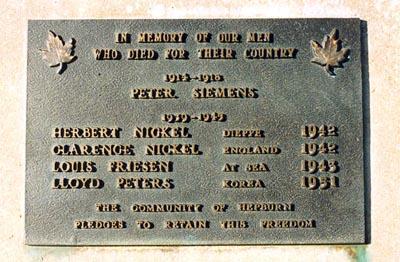
IN MEMORY OF OUR MEN
WHO DIED FOR THEIR COUNTRY
1914-1918
PETER SIEMENS
1939-1945
HERBERT NICKEL, DIEPPE, 1942
CLARENCE NICKEL, ENGLAND, 1942
LOUIS FRIESEN, AT SEA, 1943
LLOYD PETERS, KOREA, 1951
THE COMMUNITY OF HEPBURN
PLEDGES TO RETAIN THIS FREEDOM

Image
Photo Credit
Reuben Andres
Caption
detail of plaque
Province
!4v1621432660369!6m8!1m7!1se3Fsx0azZ7dNaDsvLQHbvQ!2m2!1d52.52063062799239!2d-106.7304228181074!3f336.0894569486431!4f2.955696171293397!5f0.7820865974627469"
Body Content

Needs further research

City
Hepburn
Country
Type Description
Bronze plaque
Memorial CF Legacy ID
3246